Best Marine Batteries: The 5 We'd Wire In for 2026
The best marine batteries for a 25 to 40 ft coastal cruiser come down to chemistry and use-case fit. This roundup covers five: the Optima D34M BlueTop dual-purpose AGM (the highest review count on Amazon), the LiTime Group 31 LiFePO4 lithium, the budget WEIZE Group 24 AGM, the thin-plate pure-lead Odyssey ODX-AGM31 for high-cycle owners, and the Battle Born BB10012 lithium kept with a safety caveat. We read the manufacturer specs, then cross-referenced Cruisers Forum, Trawler Forum, The Hull Truth, Marine How To, Panbo, and Will Prowse teardowns. Two honesty points organize the guide. The lithium-vs-AGM answer depends on your charging system, cycle frequency, and budget; the drop-in-replacement line is optimistic on the boat. And the Battle Born BB10012 has an actively documented 2026 positive-terminal overheating issue (plastic melt point around 250 degrees Fahrenheit, some warranty claims denied), so it stays as a Specialty pick with that finding placed up front, not buried.
- 01 Optima D34M BlueTop , the AGM dual-purpose with the highest Amazon review count in the guide, 1,459 reviews, $340
- 02 LiTime 12V 100Ah Group 31 , the lithium runner-up, 4.7 stars across 550 reviews with Bluetooth BMS, $310
- 03 WEIZE Dual Purpose Group 24M , the budget pick, compact Group 24 AGM for pontoon and small-boat owners, $200
- 04 Odyssey ODX-AGM31 Extreme Series , the thin-plate pure-lead AGM for liveaboards (needs a 40A recommended charger; 10A absolute minimum), $524
- 05 Battle Born BB10012 100Ah , the cruiser brand-of-record LiFePO4 with an active 2025 to 2026 terminal-overheating safety finding, $770
Not sure what size you need? Our Sailboat Battery Bank & Solar Calculator sizes your house bank, solar array, and charge controller from your onboard loads. →
Free toolRunning new wire for it? Our Marine DC Wire-Gauge Calculator sizes the gauge for your load and run, checking both voltage drop and ampacity the ABYC way. →
How they compare.
| Rank | Product | Best for | Price | Our score |
|---|---|---|---|---|
| 01 | Optima D34M BlueTop (AGM Dual Purpose)
Top Pick
| Single-battery 25 to 40 ft cruiser, start + house | $340
Buy → | 9.0/10 |
| 02 | LiTime 12V 100Ah Group 31 (LiFePO4) | Lithium-curious without the Battle Born safety story | $310
Buy → | 8.8/10 |
| 03 | WEIZE Dual Purpose Group 24M (AGM) | Pontoon or small-boat Group 24 budget | $200
Buy → | 8.0/10 |
| 04 | Odyssey ODX-AGM31 Extreme Series (TPPL AGM) | Liveaboard high-cycle AGM, 40A recommended charger | $524
Buy → | 8.4/10 |
| 05 | Battle Born BB10012 100Ah (LiFePO4) | Battle Born brand loyalty, read the safety section first | ~$770
Buy → | 7.5/10 |
Prices are current Amazon prices at time of publication and can change. Scores reflect our editorial evaluation, not vendor input.
Our #1 pick: Optima D34M BlueTop, Group 34M (AGM dual purpose, 55 Ah, 750 CCA, the spiral-wound dual-purpose volume seller).
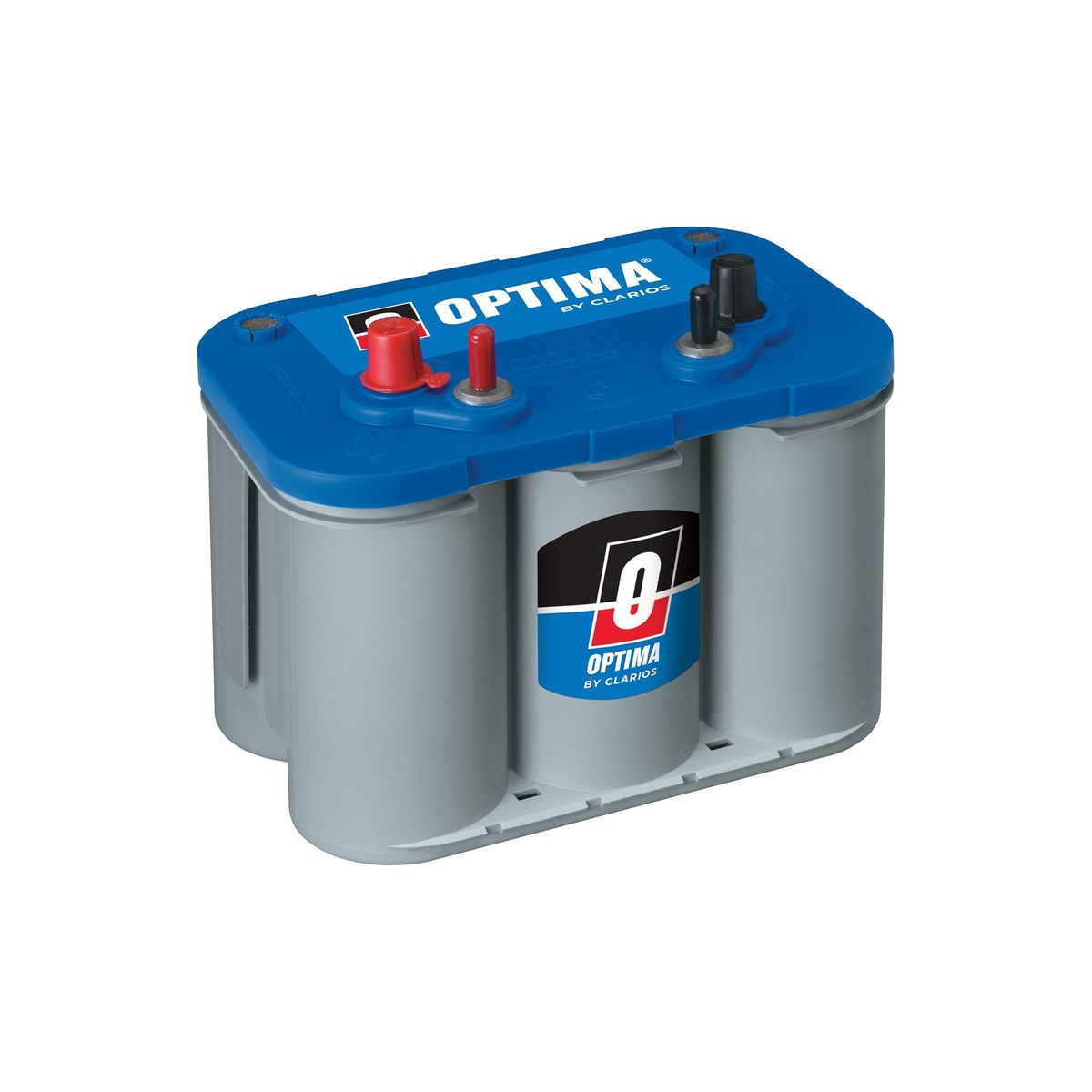
Optima D34M BlueTop, Group 34M (AGM dual purpose, 55 Ah, 750 CCA, the spiral-wound dual-purpose volume seller)
The Optima D34M BlueTop is the AGM dual-purpose battery we'd buy first for a single-battery 25 to 40 ft coastal cruiser, and the Top Pick on review-count signal: 1,459 Amazon owner reviews at 4.3 stars, by a wide margin the strongest social proof of any marine battery on Amazon. This is the battery that starts the motor, runs the lights and the fishfinder and the stereo at anchor, and accepts whatever your existing alternator and shore-power charger were already configured to put back in, no charging-system rework required. The spiral-wound AGM cell construction tolerates vibration the way no flat-plate battery (AGM or flooded) does, which is why the BlueTop is the default on go-fast center consoles and offshore boats where flat-plate cells crack under sustained pounding. Two honesty points on the BlueTop: first, the 55 Ah capacity is sized for dual-purpose use (start plus moderate house load) and is undersized for any boat that runs a refrigerator plus electronics plus stereo at anchor for 12 hours without recharge; owners doing that load profile need a separate true deep-cycle house bank, and the BlueTop becomes the start-only side of a two-bank setup. Second, Optima quality control declined after Johnson Controls acquired the brand in 2000 and moved production from Colorado to Mexico starting July 2007 (Johnson Controls spun the battery division off as Clarios LLC in 2019); BobIsTheOilGuy and Cruisers Forum threads from 2008 forward document Mexican-production units failing inside 18 months at a rate the Colorado-built BlueTops never approached. The 1,459 reviews still earn the Top Pick on signal volume, but expect to use the 24-month free-replacement warranty if you draw an early-failure unit. For the single-battery boat that wants the dual-purpose AGM with the strongest review signal and no charging-system upgrades required, this is the BlueTop we'd buy.
- + 4.3 stars across 1,459 Amazon owner reviews, by a wide margin the highest review count for any marine battery on Amazon, roughly 1.8 times Battle Born's 809 and 2.7 times LiTime's 550, the social-proof signal the persona this guide serves actually responds to
- + Dual-purpose construction means the BlueTop handles starting amps (750 CCA at zero degrees Fahrenheit) and the deep cycle service of running lights, fishfinder, livewell pump, and stereo at anchor on the same battery, the right answer for the single-battery boat that does not have a separate house bank
- + Spiral-wound AGM cell construction (Optima's distinctive cylindrical six-pack design) tolerates the vibration of bouncing across a chop better than flat-plate AGM and most flooded designs, the durability advantage that earns the BlueTop its place on go-fast boats and offshore center consoles where flat-plate AGM cells crack under sustained pounding
- + Sealed, spill-proof, and vibration-resistant means the BlueTop installs at any angle (including on its side under a console) and ventilates as a sealed system, no hydrogen off-gassing and no monthly water-level check, the maintenance advantage flooded lead-acid does not have
- × 55 Ah usable capacity is small for any house-bank-only role on a boat that anchors overnight regularly; the BlueTop is engineered as a dual-purpose battery (start plus moderate house load) and an owner running a refrigerator, navigation, and stereo for 12 hours at anchor will discharge it past the AGM-safe 50 percent depth-of-discharge window and shorten battery life. Boats with separate house and start banks need a true deep-cycle battery (Battle Born, LiTime, or Odyssey ODX-AGM31) for the house side, not a BlueTop
- × Optima quality control declined after Johnson Controls acquired the brand in 2000 and moved production from Colorado to Mexico beginning July 2007 (Johnson Controls spun the battery division off as Clarios LLC in 2019, which has manufactured Optima since); BobIsTheOilGuy, Trawler Forum, and Cruisers Forum threads from 2008 onward consistently document Mexican-production units failing inside 18 months at a rate the original Colorado-built BlueTops never approached, and a 2024 Trustpilot review documented an 18-month failure on a sister-line RedTop calling it 'junk that doesn't cost like junk.' The 1,459 reviews still earn the Top Pick on signal volume, but the practical expectation is that current-production BlueTops are not the bulletproof battery they were before the 2007 Mexico move, and the 24-month free-replacement warranty (barely longer than the documented failure window) is the practical fallback
- × The terminal posts (SAE automotive plus 5/16 inch stud) require a hybrid cable setup if your boat uses marine ring terminals exclusively; not a deal-breaker but plan the cable order before installation rather than after
Runner-up: LiTime 12V 100Ah Group 31 LiFePO4 (the lithium runner-up with Bluetooth BMS and no documented safety issues at the SKU).
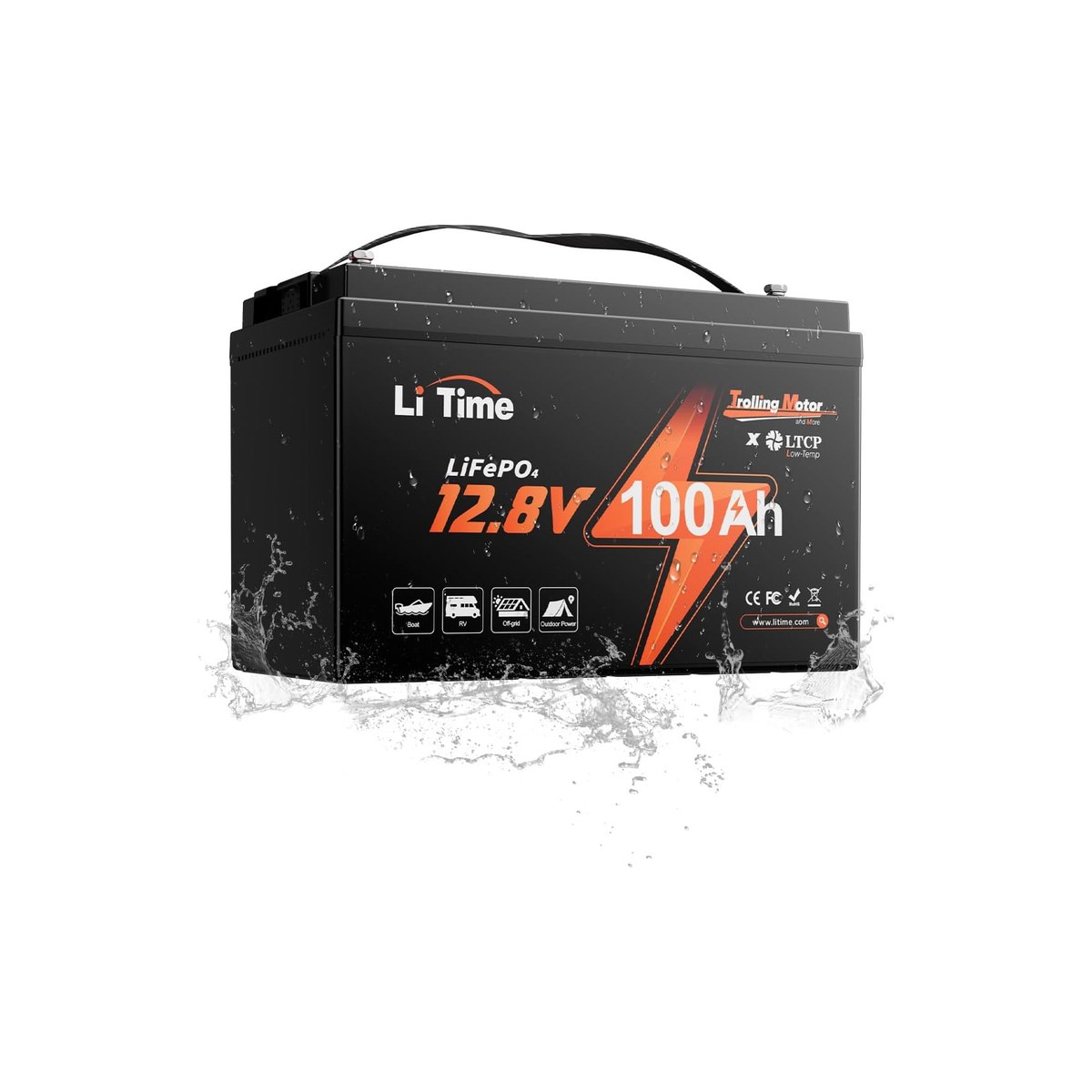
LiTime 12V 100Ah Group 31 LiFePO4 (the lithium runner-up with Bluetooth BMS and no documented safety issues at the SKU)
The LiTime 12V 100Ah Group 31 is the LiFePO4 marine battery we'd buy first in 2026, and the Runner-up rather than the Top Pick because the AGM tier is still the right answer for the majority of single-battery boats that have not upgraded their charging systems. The LiTime has 550 Amazon owner reviews at 4.7 stars (a higher star rating than Battle Born's 4.5, though on roughly two-thirds the review base) and '100+ bought past month' velocity. The Bluetooth-enabled BMS is the diagnostic feature most lithium competitors omit and the cleanest way to catch BMS misbehavior before a single bad cell ends the battery's life. The 100A continuous discharge BMS rating supports trolling motors, inverters, and full house loads simultaneously; most budget lithium competitors underspec at 50A or 75A. The low-temperature charge protection at 32 degrees Fahrenheit and the high-temperature shutdown at 158 degrees match Battle Born's BMS protection layer (Battle Born BB10012 base also cuts off at 32 degrees, the BB10012H heated version cuts off at 25 degrees) at roughly 40 percent of the price. Crucially, the LiTime Group 31 does NOT carry the active 2025 to 2026 positive-terminal overheating concern that Will Prowse documented on the Battle Born BB10012 100Ah, the safety finding that pushed the cruiser brand-of-record down to Specialty in this guide. Where LiTime is the wrong pick: serious offshore cruising where the year-7 warranty service question matters (LiTime has a 5-year paper warranty and no US repair facility; replacement is the only remedy and that is operationally disruptive offshore or mid-season); and any installation against an unmodified alternator setup (the drop-in caveat applies the same way it does for any LiFePO4). The Group 31 footprint at 13.0 x 6.8 x 8.4 inches is larger than the Group 24 most production-cruiser battery boxes are sized for; verify dimensions before ordering. For the cruiser who wants LiFePO4 chemistry, has read past the active Battle Born safety story, and is willing to do the DC-DC charger upgrade, the LiTime is the lithium we'd buy in 2026.
- + 4.7 stars across 550 Amazon owner reviews with '100+ bought past month' velocity, the strongest momentum signal of any LiFePO4 on Amazon at this price tier, and a star rating that actually exceeds Battle Born's 4.5 (though on roughly two-thirds the review base)
- + Bluetooth-enabled BMS lets the owner monitor state of charge, cell voltages, temperature, and charge or discharge current from a phone app, the diagnostic visibility most budget lithium competitors do not provide and the feature that helps owners catch BMS misbehavior before it ends a battery's life
- + 100A continuous discharge BMS rating supports trolling motors, inverters, and full house loads simultaneously, the discharge profile most budget lithium batteries underspec at 50A or 75A and the spec the LiTime sizes for actual marine use
- + Low-temperature charge protection at 32 degrees Fahrenheit and high-temperature shutdown at 158 degrees, the same BMS protection layer Battle Born has at roughly 40 percent of the price, and crucially the SKU does NOT carry the positive-terminal overheating concern Will Prowse documented on the Battle Born 100Ah series in late 2025
- × LiTime is a direct-to-consumer Chinese brand and the warranty service path over the next decade is not yet established the way Battle Born's Reno Nevada support is; the 5-year warranty exists on paper but the practical question of who answers the phone in year 7 is the central reason cruisers on Cruisers Forum used to recommend Battle Born for serious cruising despite the price gap. The Battle Born 2026 terminal-overheating finding has flipped that calculation for new buys; LiTime's service path is the unknown that the Battle Born safety finding has made acceptable to live with
- × Same drop-in replacement caveat as any LiFePO4 battery, and it has three legs not one: the LiTime needs (1) a DC-DC charger between the alternator and the battery if used as a primary house bank, (2) a lithium-compatible shore charger (a standard 3-stage lead-acid charger's 13.8V float either undercharges the LiFePO4 or sits at a voltage the cells do not like long-term), and (3) a lithium-compatible solar charge controller if you have solar on board. The marketing copy on the product page does not lead with any of the three. Owners using a LiTime as a drop-in against an unmodified alternator setup are documented on r/boating and r/liveaboard threads burning out either the lithium or the alternator; owners who skip the shore-charger upgrade are documented on Marine How To and Pacific Yacht Systems writeups never fully charging their bank. Plan the full charging-system upgrade BEFORE installation
- × Multi-battery parallel banks (2 to 4 LiTime units wired together for a larger house bank) report a real BMS cell-balancing problem on initial activation; mixing batches (LiTime bought in separate orders) is the worst case. DIY Solar Forum and Grand Design RV Forum threads document the issue. For single-battery installations this is not an issue; for multi-battery banks the rule is buy them all from the same purchase order and commission carefully with CC/CV conditioning
Budget pick: WEIZE Dual Purpose Group 24M AGM (the compact Group 24 dual purpose for pontoon and small-boat owners on a budget).
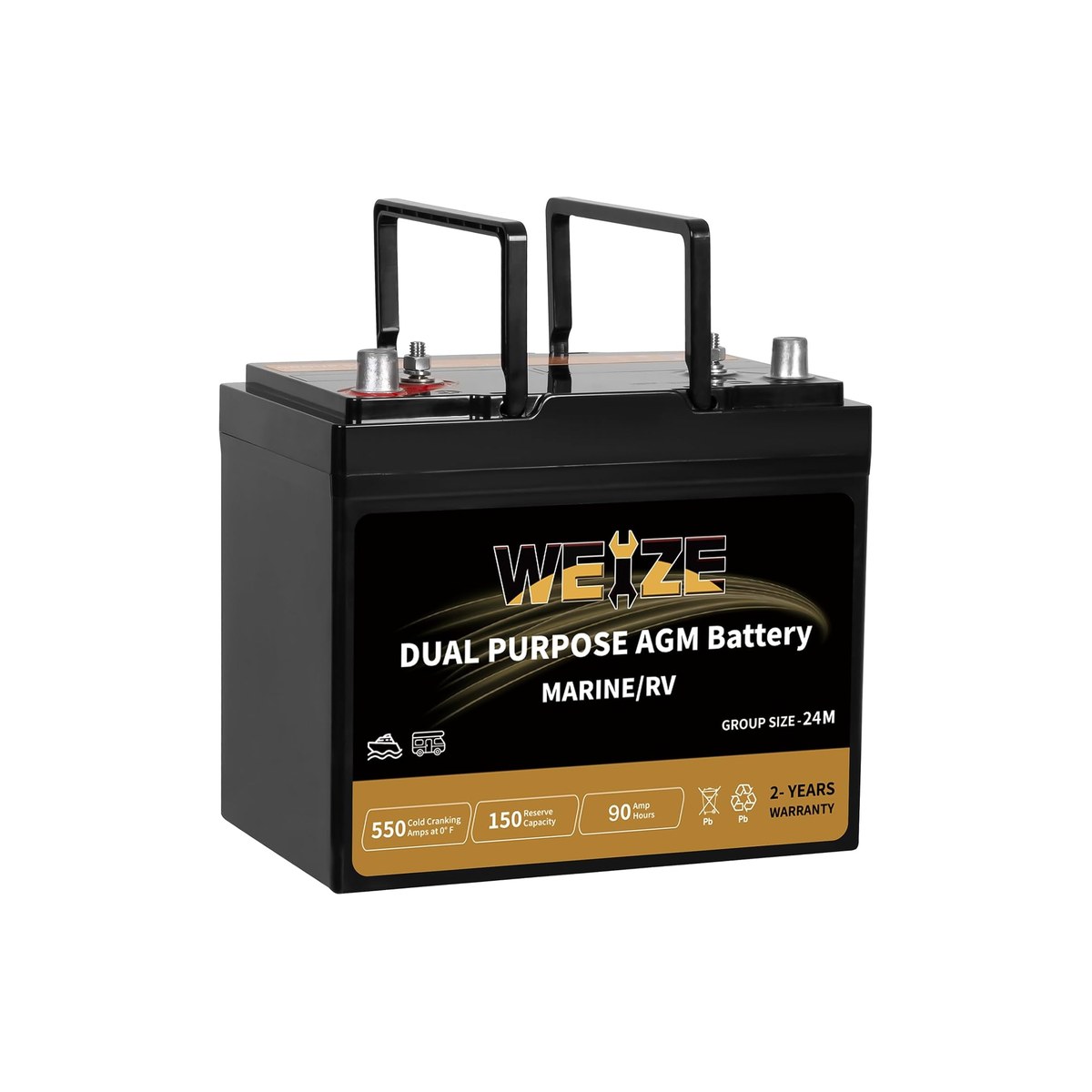
WEIZE Dual Purpose Group 24M AGM (the compact Group 24 dual purpose for pontoon and small-boat owners on a budget)
The WEIZE Dual Purpose Group 24M is the budget AGM the pontoon and small-boat audience this guide also serves actually buys, and the right answer for the owner whose battery box is sized for Group 24 and whose budget is sized for $200, not $340. The 90 Ah capacity, 550 CCA rating, and 150 minutes of reserve capacity are right-sized for the boat: starts the outboard, runs the bilge pump and the fishfinder and the navigation lights, and accepts whatever the existing charging system was already configured to put back in. 4.4 stars across 219 Amazon owner reviews with '50+ bought past month' velocity is a solid signal at this price tier, materially better than the unverified low-review-count budget brands the WEIZE competes against. The central risk on the WEIZE is batch-to-batch quality consistency: a January 2026 BobIsTheOilGuy thread and a May 2025 YouTube deep-dive both document the same pattern of some buyers receiving batteries that perform as advertised and others receiving dead-on-arrival or fail-in-months units. The probability of drawing a bad unit is meaningful; customer service is reasonable about replacements, but the inconvenience matters for boats at moorings. Where the WEIZE is the right pick: pontoon boats, runabouts, aluminum fishing skiffs, and any single-battery boat where the OEM battery box is Group 24 and the budget is firm at $200. Where the WEIZE is the wrong pick: any 25-plus foot boat with a dedicated house bank, saltwater cruising primary roles, and boats kept at moorings where return shipping for a failed unit is operationally hard. As a 'replace what came with the boat' pick at the small-boat tier, this is the WEIZE we'd buy and the honest budget-AGM answer for the audience this slot serves.
- + 4.4 stars across 219 Amazon owner reviews with '50+ bought past month' velocity, a solid signal at this price tier, lower than the Optima D34M's 1,459 but materially better than the unverified low-review-count budget brands the WEIZE competes against
- + Right-sized capacity for the persona: 90 Ah, 550 CCA, 150 minutes of reserve capacity, enough to start an outboard and run the bilge pump, fishfinder, and navigation lights on a small fishing boat or pontoon, with no charging-system upgrade required
- + Compact Group 24M footprint (10.25 x 6.8 x 8.875 inches) fits in OEM battery boxes most production small-boats are built for, particularly on boats under 24 ft where an Optima D34M would not physically fit
- + Sealed AGM construction means maintenance-free service, any-angle installation, no off-gassing requirement, and no monthly water-level check, the AGM advantages flooded lead-acid does not have at a price tier most owners assume requires flooded chemistry
- × Batch-to-batch quality consistency is the central WEIZE risk: a January 2026 BobIsTheOilGuy thread and a May 2025 YouTube deep-dive both document the same pattern of some buyers receiving batteries that perform as advertised and others receiving dead-on-arrival or fail-in-months units. The probability of drawing a bad unit is meaningful (the iRV2 forum captures both happy and DOA reports in the same thread); customer service is reasonable about replacements, but the inconvenience of the replacement process matters for boats that live at moorings
- × Wrong tool for any saltwater cruising primary house bank, especially boats kept at moorings or anchorages where the QC-failure recovery process is operationally hard. Use cases the WEIZE serves well are freshwater lake weekenders, secondary or backup batteries, and starting-only roles on boats with separate house banks
- × Maximum charging current spec of 15.8A means high-output alternators (50A and above on a small inboard) can over-drive the WEIZE if the regulator is set for a bigger battery; the bigger AGMs in this guide tolerate higher charge rates with no issue, the WEIZE wants charge current capped by either a smaller alternator or a regulated charger setting
Also worth considering.
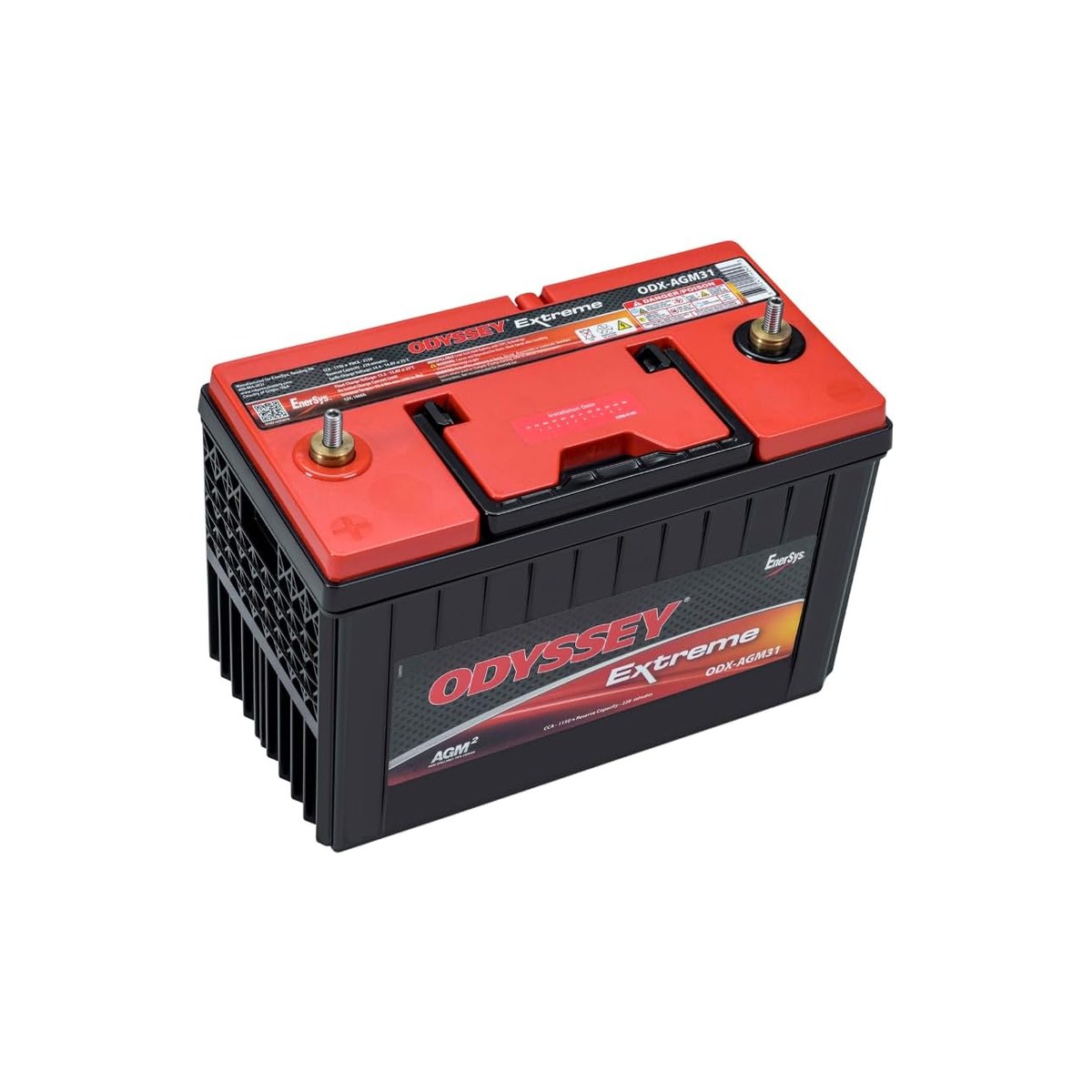
Odyssey ODX-AGM31 Extreme Series (Thin-Plate Pure-Lead AGM, the closest AGM gets to lithium cycle life if you also install the 40A recommended charger)
The Odyssey ODX-AGM31 Extreme Series is the thin-plate pure-lead (TPPL) AGM specialty pick, and the right answer for the cruiser who runs the battery hard every day AND has the charging-system to support it. TPPL construction uses pure-lead plates (not the lead-calcium or lead-antimony alloys most AGM batteries use) cast thinner than conventional AGM plates, which yields roughly 400 cycles at 80 percent depth of discharge (vs roughly 150 to 200 for a typical entry-level AGM per Trojan and VMAXTANKS datasheets) and a faster recharge acceptance rate. 103 Ah, 1,150 CCA, 220 reserve minutes, the strongest pure-spec sheet of any AGM in this guide. The single most-repeated owner complaint on this battery is the charging requirement most owners do not read until after they buy it: Odyssey's documentation specifies a 10A absolute minimum, a recommended 40 percent of C10 rating (roughly 40 amps for the ODX-AGM31), and a maximum of 100 amps. Most standard marine chargers, particularly older 10 to 15 amp units, will NOT fully charge the TPPL chemistry, and a BobIsTheOilGuy thread documents an owner trying three different chargers (including an Optimate 6 at 14.7V) and only getting 12.69V out of a new Odyssey, the symptom of a chronic undercharge that sulfates the TPPL plates and ends cycle life. A December 2024 Facebook thread shows an owner of a 'quite new' ODX-AGM31 reporting 58 percent health after only a few months, almost certainly a charger-mismatch failure. Two further friction points: the 29 Amazon reviews are the lowest count of any battery in this guide by a wide margin and the social-proof signal is thin (the pick is carried on Pacific Yacht Systems, Cruisers Forum, and Marine How To writeups; owners considering it should read the forum writeups, not just the Amazon reviews), and the 77.8 lb weight is the heaviest in the lineup. For a weekend cruiser who anchors overnight a few times a season, the Optima D34M is the right call and the Odyssey price gap is unnecessary. For a liveaboard or full-time cruiser who cycles the battery hard most days AND has a 40-amp three-stage charger or is willing to install one, the Odyssey Extreme is the AGM that comes closest to lithium endurance without crossing into LiFePO4 chemistry or its charging-system requirements.
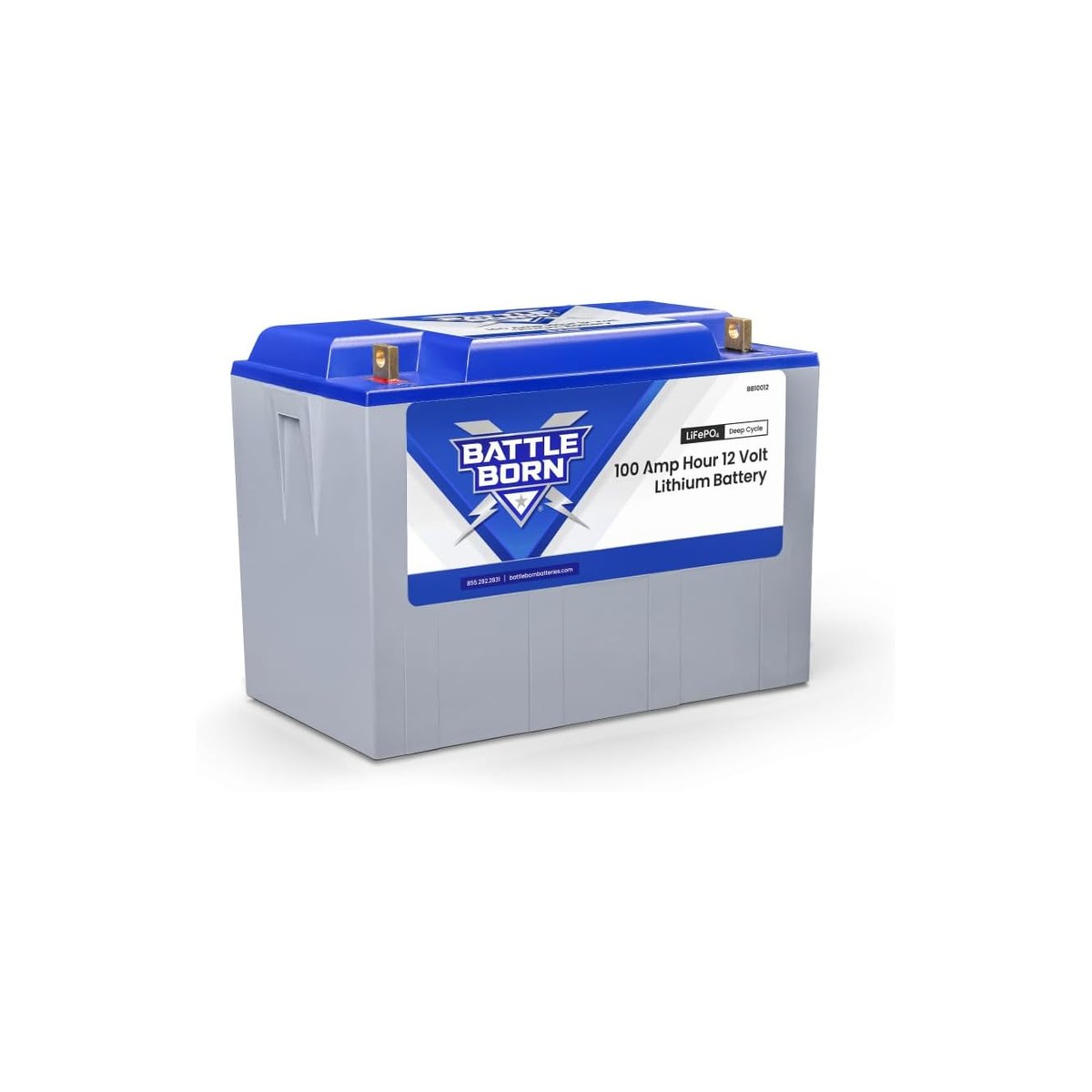
Battle Born BB10012 100Ah LiFePO4 (the cruiser brand-of-record, currently flagged for an active 2025 to 2026 terminal-overheating safety story)
Battle Born is the LiFePO4 marine battery the cruising community has considered the brand-of-record for nearly a decade, and the reason this pick is in the guide at all. It is the fifth-ranked pick in this 2026 edition rather than the runner-up because of an active safety story we cannot in good faith bury. Starting in late 2025, battery teardown specialist Will Prowse published video evidence of a structural design flaw in the positive terminal of the BB10012 specifically: the terminal is secured by an aluminum nut against a plastic cell spacer with no direct contact to the positive bus bar inside the battery. Over time, especially in vibration-heavy environments like boats, the nut loosens, the connection arcs internally, and the joint can reach temperatures sufficient to melt the plastic spacer (the specific plastic's melt point is roughly 250 degrees Fahrenheit, a temperature an arcing electrical joint can reach under load even when the bulk-terminal exterior reads under 100 degrees on an infrared thermometer), creating a fire risk. Dragonfly Energy's public response called the melting plastic 'a purpose-built thermal failsafe,' a position engineers and independent reviewers (RV Electricity, Mike Sokol) rejected because the plastic melts while current continues to flow. Multiple warranty claims for terminal overheating have been DENIED. An Airstream forum member reported four BB10012 batteries continuously overheating in winter 2024. The 270 Ah GameChanger model uses different terminal construction and appears unaffected; the 100 Ah BB10012 (this SKU) and reportedly the 50 Ah version are the SKUs the community has flagged. What the Battle Born still has going for it: 4.5 star Amazon rating across 809 owner reviews, 10-year manufacturer warranty (the longest in the category), and Dragonfly Energy's Reno Nevada US support that was the reason cruisers paid the price gap in the first place. What it does not have in mid-2026: a documented fix or recall. If you want this battery, the practical owner workaround documented across the forums is a routine torque-check schedule on the positive terminal and infrared thermometer monitoring under load; the underlying terminal design flaw is unresolved. For the cruiser who is paying for Dragonfly Energy's US support specifically and accepts the safety-inspection routine, the BB10012 stays in this guide. For the cruiser who wants LiFePO4 chemistry without the active safety story, the LiTime Group 31 at rank 2 is the right pick and what we'd buy.
Skip this guide if...
Three audiences should skip this guide. First, owners of pure starting-only single-battery skiffs and small fishing boats under 18 ft running an outboard with no electronics and no overnight anchoring: a pure starting battery (Optima RedTop or a similar automotive-starting AGM, not the BlueTop) at $200 is the right tool, and the deep-cycle picks in this guide are oversized for the role. Second, full-time cruisers and liveaboards designing a new house bank from scratch on a 35-plus foot boat where the right answer is a multi-battery LiFePO4 bank of 200 to 600 Ah, full Victron or Mastervolt charging-system integration, and a system-level design that goes well beyond the single-battery scope of this guide. Third, owners running serial-only trolling motor configurations on bass boats and kayaks where a dedicated trolling-motor battery (a 12V or 24V deep-cycle sized for thrust requirements) is the right tool; the trolling motor audience is adjacent to coastal cruising but a separate buying decision, and we cover it as a routing note in the FAQ rather than as a numbered pick here.
Don't bother with.
- × Skip Automotive starting batteries (Optima RedTop, AGM car batteries) used as marine deep-cycle batteriesStarting batteries are engineered for short high-amperage discharge then immediate recharge from the alternator. Deep-cycle marine use (running anchor lights, livewell pumps, fishfinders, stereos over hours of anchored use) discharges the battery to 50 percent or lower and recharges slowly from solar or shore power. Starting batteries fail rapidly under deep-cycle use (sulfation, plate damage). The Optima RedTop at $200 looks like a deal vs the BlueTop at $340, but it is the wrong chemistry profile for any application beyond pure cranking. Failure mode: chemistry-mismatch under deep discharge, documented across r/boating and Cruisers Forum threads from 2020 forward.
- × Skip Generic '12V deep cycle' batteries under $100 from unknown brandsSub-$100 12V batteries marketed as 'marine deep cycle' on Amazon (no-name AGM clones, rebranded flooded golf-cart batteries) deliver 30 to 50 percent of rated Ah capacity and fail within 1 to 2 years. The CCA spec is often inflated or fabricated outright. Forum consensus across iboats, SailNet, and r/boating is consistent: anything under $100 is buy-twice-cry-twice. Failure mode: capacity-spec fabrication and premature failure under normal cycle use.
- × Skip Cordless tool batteries (Milwaukee M18, DeWalt 20V) adapted for marine 12V use via converterThe cordless tool battery hack (M18 to 12V via adapter) is a real DIY pattern for low-power applications such as small fishfinders and navigation lights. It is NOT a primary house battery. M18 batteries are 5 Ah at 18V (90 Wh), about one-fourteenth the capacity of a 100 Ah LiFePO4. They lack low-temperature protection, they are not waterproof, and they fail catastrophically when discharged below 3.0V per cell. Failure mode: scale and protection mismatch. Fine for backup electronics, never for primary house power.
- × Skip Lead-acid flooded 'wet cell' batteries as the primary house battery on a new build or refitFlooded batteries (the 'what came with the boat 5 years ago' baseline) need monthly water-level checks, vent off-gas hydrogen (requires a ventilated battery box), cannot be installed at an angle, and lose 30 to 40 percent of usable Ah capacity below 50 percent depth of discharge per the standard Trojan, Crown, and US Battery deep-cycle datasheets. For roughly $50 to $100 more, AGM (Optima, WEIZE, Odyssey) delivers maintenance-free service, sealed off-gassing, any-angle installation, and identical or better Ah-per-dollar economics. Flooded only makes sense for boats already wired and ventilated for it AND the owner who genuinely does not mind the maintenance routine. Failure mode: maintenance overhead plus capacity loss under partial-state-of-charge use, documented on Trawler Forum and Pacific Yacht Systems writeups.
- × Skip Lithium 'drop-in replacement' marketing copy used as installation guidanceThis is the editorial honesty hook the guide is built around, and the failure mode that organizes the FAQ. Battle Born, Renogy, LiTime, and other LiFePO4 brands market 'drop-in replacement for AGM' in product copy. The literal claim is true at the terminal voltage level (12.8V nominal lithium vs 12.6V nominal AGM). The practical failure mode is that most boat alternators charge at profiles wrong for LiFePO4: too high a float voltage damages the lithium cells, and the alternator overheats trying to charge a near-full lithium that demands current the alternator cannot safely deliver. The fix is a DC-DC charger ($150 to $300) sitting between the alternator and the lithium battery. None of the 'drop-in' marketing copy puts this requirement on the product page; the installation manuals do, the product pages do not. Failure mode: marketing oversimplification of a charging-system upgrade. Owners who 'just drop it in' against an unmodified alternator setup are documented on Marine How To, Pacific Yacht Systems, and Cruisers Forum threads from 2022 through 2026 with two recurring outcomes: lithium killed prematurely or alternator burned out. Not actually a 'do not buy this product' so much as 'do not skip the charging-system upgrade the marketing copy implies you can skip.'
- × Skip No-name 'maintenance-free sealed' marine batteries from unbranded Amazon sellersUnbranded or rebadged-from-Alibaba batteries listed on Amazon as 'maintenance-free sealed marine deep cycle' at $80 to $150 are documented across r/boating and iboats archive threads as failing inside the first season, with the failure pattern consistently being separator breakdown leading to internal short circuit. Many of these listings use stock photos and rotated brand names ('VOLTECH,' 'POWERSONIC MARINE,' generic '12V 100Ah deep cycle') and disappear from Amazon after a few months of negative reviews accumulate. Failure mode: unknown manufacturer with no warranty service path and no quality-control floor. Buy a known brand from a known seller with a verifiable warranty service path; the WEIZE at $200 is the price-floor we would defend at the Group 24 budget tier.
How we picked.
Sources we read and the methodology we used
We did not run these batteries through a calendar-year cycle test on a single boat. We read the Optima, Battle Born, LiTime, Odyssey, and WEIZE manufacturer specifications and BMS documentation directly, including the Battle Born lithium-installation manual (which explicitly documents the DC-DC charger requirement the product page does not lead with), the Odyssey Extreme Series TPPL technical bulletin, the Optima D34M spec sheet, and the LiTime BMS specification. Then we cross-referenced those manufacturer claims against the independent practitioner sources most cited by cruisers: Marine How To (RC Collins, the de facto authority on marine electrical systems in English), Pacific Yacht Systems (Jeff and Wayne Cote, the second authority cruisers cite for charging-system design), the Will Prowse YouTube channel (the most-cited independent LiFePO4 teardown source for budget lithium brands including LiTime), and the Practical Sailor multi-year battery test program. We discarded sources that could not be attributed to a named author, a dated publication, or a specific test methodology, and we report both sides where manufacturer guidance and owner consensus diverge.
Lithium drop-in replacement: the marketing line vs the installation reality
The single most-important piece of forum-cited honesty in this guide is the lithium charging-system requirement and the failure mode of skipping it, documented on Marine How To and Pacific Yacht Systems in detail. Every lithium product page markets drop-in compatibility and every installation manual and practitioner writeup documents the DC-DC charger requirement. The marketing line is true at the terminal voltage and optimistic on the boat, and the answer for most cruisers is 'AGM unless you have already upgraded the charging system.'
The shortlist: AGM dual-purpose, TPPL, LiFePO4 cruiser, LiFePO4 brand-of-record
The shortlist started with the design families that owners on Cruisers Forum, Trawler Forum, The Hull Truth, Sailing Anarchy, and Pacific Yacht Systems actually recommend for the 25 to 40 ft coastal cruiser persona. AGM dual purpose (the Optima D34M and WEIZE Group 24M, two volume sellers covering the top-end and budget price tiers respectively), AGM high-end thin-plate pure-lead (the Odyssey Extreme Series, the cycle-life specialty), LiFePO4 cruiser-accessible (the LiTime Group 31 with Bluetooth BMS and no active SKU safety issue), and LiFePO4 brand-of-record (the Battle Born BB10012, with the 2025 to 2026 terminal-overheating safety story documented in its rank-5 product card).
Three alternatives we considered: Epoch Marine, Renogy Smart Lithium, flooded lead-acid
We considered three additional picks worth knowing about. First, the Epoch Marine 460 Ah LiFePO4, the battery that Panbo's Ben Stein called 'the best battery he has tested to date,' which meets emerging ABYC lithium battery guidelines, has tethered monitoring with audible alerts, integrates natively with Victron V2, and runs an 11-year warranty from a veteran-owned American company. It is the right answer for a serious cruiser building a single-battery 35 to 40 ft house bank at the $1,800 to $2,200 price tier (Morgan's Cloud names Epoch as a second-tier high-value choice below top-end custom lithium builds), but the Amazon availability is limited, the price tier sits well above this guide's persona, and the install is a system-level decision rather than a single-battery purchase. Second, the Renogy Smart Lithium. Strong feature set (Bluetooth, self-heating, full-feature BMS) and Renogy's reputation in the solar-storage world is strong, but the Amazon review count on the Smart Lithium ASIN is thin (under 50 last we checked) and the Renogy direct-affiliate program (when approved) will be the better path to surface that product. Third, flooded lead-acid as a numbered pick; the maintenance burden and the off-gassing requirements make flooded the wrong default for a new buy on any boat that does not already have flooded-compatible ventilation, and the AGM price gap is too small to justify the maintenance trade-off. We did not include any 24V or 36V dedicated trolling-motor batteries; the audience is real but separate from coastal cruising, and a dedicated trolling-motor battery guide is a future spoke this guide routes to in the FAQ.
How the lineup is defended: two-brand-per-design-family + two-brand-per-chemistry
The lineup is two AGM dual purpose (Optima D34M Top Pick at $340, the Optima BlueTop the Amazon search results return for almost any 'optima marine battery' query, and WEIZE Group 24M Budget at $200, the top-end and budget price tiers of the same design family) plus two LiFePO4 (LiTime Group 31 Runner-up at $310, the LiTime marine battery that returns the strongest brand-pull search volume in the cluster, and Battle Born BB10012 Specialty at $770, the battle born marine battery the cruising community has used for the better part of a decade) plus one AGM thin-plate pure-lead (Odyssey Extreme Specialty at $524 with explicit 40-amp recommended charger requirement, 10-amp absolute minimum). Two-brand-per-design-family on AGM dual purpose is the price-tier defensibility (Optima at top-end volume seller, WEIZE at budget Group 24), and two-brand-per-chemistry on lithium is the safety-finding defensibility (LiTime at the cruiser-accessible no-known-SKU-safety-issue tier, Battle Born at the brand-of-record tier with the documented active terminal-overheating finding). Same defensibility shape we used for two-AGM-substrates on Marine Sealants (the two 3M picks at different substrates), two-Star-brite-substrates on Boat Cleaners, and two-roll-bar-scoops on Marine Anchors (Mantus M1 and Manson Supreme at different brand-tier positioning).
The Optima D34M earns the Top Pick on review-count signal first (1,459 reviews, by a wide margin the strongest on Amazon for any marine battery) and on dual-purpose fit second (single-battery 25 to 40 ft cruiser is the persona this guide centers). WEIZE earns the Budget Pick at $200 because the pontoon and small-boat owner whose budget is firm at $200 is a real audience the lineup needs to address. Odyssey Extreme earns its Specialty rank as the longest-cycle AGM the lineup can offer, with the explicit 40-amp recommended charger requirement (10-amp absolute minimum; below the recommended rate the TPPL plates chronically undercharge and sulfate) that 90 percent of buying guides do not flag.
Why LiTime ranks Runner-up over Battle Born: the 2025-2026 terminal-overheating finding
LiTime earns the Runner-up over Battle Born because of the 2025 to 2026 Battle Born BB10012 positive-terminal overheating finding that Will Prowse documented and Dragonfly Energy has not yet issued a fix for (the rank-5 Battle Born product card carries the full story); without that finding, Battle Born would have earned the Runner-up on brand reputation alone, and the editorial honesty is that this rank order reflects 2026 reality not 2024 reality.
FAQs.
Q01 How long do marine batteries last?
+
Q02 AGM vs lithium marine battery, which should I actually buy?
+
Q03 Can I 'drop in' a lithium battery to replace my AGM without changing anything else?
+
Q04 Do I need a DC-DC charger if I upgrade to lithium?
+
Q05 What group size battery does my boat need? Where is the marine battery group size chart?
+
Q06 What's the difference between a deep-cycle, a starting, and a dual-purpose marine battery?
+
Q07 Is the lithium price high-end actually worth it long-term?
+
Q08 Will lithium batteries work in cold weather?
+
Q09 How do I know if my alternator can charge a lithium battery safely?
+
Q10 Should I buy a battery from Amazon or buy direct from the manufacturer?
+
If you, then this.
- IF you have a single-battery boat that starts the motor and runs the house load off one battery, no charging-system upgrades plannedGET Optima D34M BlueTop AGM Dual Purpose$340 →
- IF you want LiFePO4 chemistry, the Bluetooth BMS visibility, and a battery without the Battle Born 2026 terminal-overheating safety storyGET LiTime 12V 100Ah Group 31 LiFePO4$310 →
- IF you have a pontoon, small fishing boat, or any single-battery setup where the battery box is sized for BCI Group 24 and the budget is tight at $200GET WEIZE Dual Purpose Group 24M AGM$200 →
- IF you are a liveaboard cycling the battery hard daily AND you have a 40-amp three-stage marine charger (Odyssey's recommended charge rate) or are willing to install oneGET Odyssey ODX-AGM31 Extreme Series TPPL AGM$524 →
- IF you specifically want Battle Born for the Dragonfly Energy US support, have read the rank-5 product card on the 2025 to 2026 terminal-overheating finding, and accept the inspection routine until Dragonfly issues a fixGET Battle Born BB10012 100Ah LiFePO4~$770 →
- IF your boat is at the upper end of the persona (35 to 40 ft) with a dedicated house bank and you are designing a multi-battery configurationGET Multiple LiTime Group 31 in parallel (a 200 to 300 Ah bank) or multiple Odyssey ODX-AGM31 if staying on AGM; the Epoch Marine 460 is the worth-knowing upmarket upgrade path documented in the methodologyvaries →
- IF you need a true starting-only battery on a boat with a separate house bankGET A dedicated starting AGM (not in this guide; Optima RedTop is the conventional pick). This guide's picks are dual-purpose or deep-cycle, not pure crankingvaries →
Boat Gear: The Complete Guide
The whole-boat picture →Every system on a 20 to 45 ft coastal boat, organized in one place, with the one guide we trust for each.