Know Your Real State of Charge: 3 Battery Monitors (2026)
Three shunt-based coulomb-counting battery monitors for the 25 to 45 ft coastal cruising sailboat or trawler owner running a house bank on AGM, flooded, or LiFePO4 chemistry. The 3 picks span $37.80 to $200, sorted by install type, brand ecosystem, and whether you want a panel display or a phone app. We read Maine Sail (Rod Collins, marinehowto.com) on the SG200 1 percent SoC and SoH bench accuracy for LiFePO4, Practical Sailor's BMV-700 lineage Best Choice citation, the Cruisers Forum BMV-712 vs SmartShunt antenna-placement mega-thread, Footprint Hero's two-month installed test naming the AiLi 350A as Budget Pick, the Victron Community Archive corrosion thread on lug installs in Bahamas off-gas conditions, and the documented Renogy Battery Shunt 300 firmware version 0 meltdown plus Renogy's own blog disclosure of 8 percent SoC discrepancy vs BMS. The load-bearing honesty point: voltage on a LiFePO4 plateau is dangerous, not just sloppy.
- 01 Victron BMV-712 Smart Battery Monitor (B084M2XYK4) , the Top Pick for a 30 to 42 ft cruiser with nav-station panel, 2,155 Amazon reviews 4.7 star Overall Pick, ~$200
- 02 Victron SmartShunt IP65 500A (B0BF636VBX) , the Runner-up for Cerbo GX integrated stacks or fiberglass interior installs, 1,237 reviews 4.7 star, ~$170
- 03 AiLi Battery Monitor with Shunt 8-120V / 500A (B07FGFFHC6) , the Budget Pick wired-display answer for weekenders on AGM, flooded, or budget LiFePO4, 1,443 reviews 4.4 star, $37.80
Not sure what size you need? Our Sailboat Battery Bank & Solar Calculator sizes your house bank, solar array, and charge controller from your onboard loads. →
Free toolRunning new wire for it? Our Marine DC Wire-Gauge Calculator sizes the gauge for your load and run, checking both voltage drop and ampacity the ABYC way. →
How they compare.
| Rank | Product | Best for | Price | Our score |
|---|---|---|---|---|
| 01 | Victron BMV-712 Smart (B084M2XYK4, 2,155 reviews, ~$200)
Top Pick
| 30 to 42 ft cruiser, nav-station panel mount, no Cerbo GX, ecosystem default | $200
Buy → | 9.0/10 |
| 02 | Victron SmartShunt IP65 500A (B0BF636VBX, 1,237 reviews, ~$170) | Cerbo GX integrated stack OR fiberglass interior where Bluetooth reaches helm | $170
Buy → | 8.8/10 |
| 03 | AiLi Battery Monitor 500A (B07FGFFHC6, 1,443 reviews, $37.80) | 18 to 25 ft weekender on AGM, flooded, or budget LiFePO4; wired display preferred | $37.80
Buy → | 8.3/10 |
Prices are current Amazon prices at time of publication and can change. Scores reflect our editorial evaluation, not vendor input.
Our #1 pick: Victron BMV-712 Smart Battery Monitor (panel-mounted display with built-in Bluetooth antenna, 500A shunt, 6.5 to 70 VDC range, programmable relay, VE.Direct port for Cerbo GX integration, 5-year warranty upgradable to 10 years, 99.6 percent coulomb-counting accuracy, ASIN B084M2XYK4).
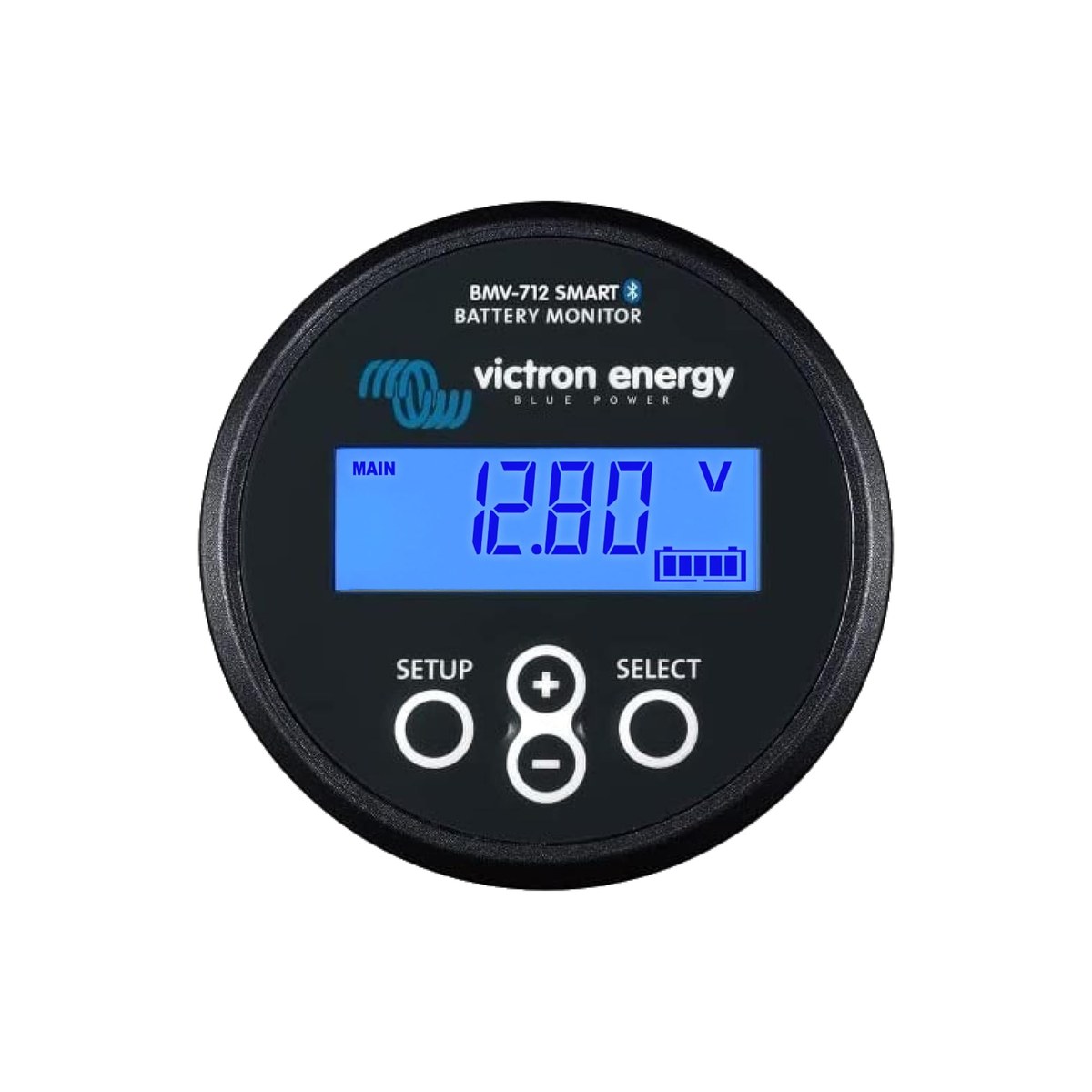
Victron BMV-712 Smart Battery Monitor (panel-mounted display with built-in Bluetooth antenna, 500A shunt, 6.5 to 70 VDC range, programmable relay, VE.Direct port for Cerbo GX integration, 5-year warranty upgradable to 10 years, 99.6 percent coulomb-counting accuracy, ASIN B084M2XYK4)
The cruiser default, because the panel antenna lives where Bluetooth works.
Who it's for: the 30 to 42 ft coastal cruiser or trawler owner with a 200 to 400Ah house bank, a nav-station panel, and no Cerbo GX or Touch 50/70 display, who wants a glanceable always-on state of charge readout without opening a phone, needs a programmable relay for low-voltage alarms or generator start, and is buying into the VictronConnect ecosystem (SmartSolar MPPT, Blue Smart IP67 charger, future Lynx Smart BMS). The BMV-712 is the 2026 cruiser default because its Bluetooth antenna lives in the panel where it works.
What we found: 2,155 Amazon reviews at 4.7 star with the Overall Pick badge is the dominant marine battery monitor signal in 2026, larger than the SmartShunt's 1,237 and an order above the AiLi's 1,443 and the Renogy Battery Shunt 300's 109. Footprint Hero measured 150 feet of Bluetooth range unobstructed and 100 feet inside an enclosed battery compartment, versus 30 feet for the SmartShunt, because the BMV's radio sits in the panel-mounted head, not at the shunt buried in the bilge. The Victron Community Archive documents one Bahamas corrosion failure on a lug install; the fix is tinned lugs, heat shrink, and Lanocote. The VE.Direct port reaches a Cerbo GX, but the BMV head stays required in the chain.
Bottom line: this is the right Top Pick for a typical metal-cored sailboat or trawler with a nav-station panel and no Cerbo GX. The brand-of-record alternative is the Balmar SG200, which Rod Collins bench-tested within 1 percent on SoC and SoH for LiFePO4; it lists at ~$240 to $260 from marine distributors with no confirmed Amazon ASIN as of May 2026. We skipped it because it has no VictronConnect-equivalent app and a troubled 2019 to 2022 firmware launch. The BMV-712 at ~$200 is the answer.
- + Panel-mounted Bluetooth antenna at the nav station is the load-bearing advantage over the SmartShunt; in Footprint Hero's hands-on backyard bench test the BMV-712 connected at ≥150 feet unobstructed (test ran out of room) and 100 feet through an RV battery compartment, compared to the SmartShunt's 30 feet interrupted in the same compartment, these are real-world environment tests not vendor-claimed specs (Victron's own SmartShunt datasheet rates baseline Bluetooth range at 10-15 meters / 33-49 feet in unobstructed conditions, with a warning that conducting elements like metal hulls and seawater can reduce it to "an unacceptable level")
- + Always-on glanceable display means anyone at the chart table reads state of charge without opening VictronConnect on a phone; for a partner running anchor watch or a charter guest checking the bank before bed, the panel display is the difference between trust and friction
- + Programmable Form A relay (potential-free contact, programmable thresholds on voltage, SoC, time, temperature, or low-voltage cutoff) covers automatic generator start, low-voltage load shedding, alarm horn triggers, and bilge pump arming patterns that the SmartShunt cannot do without a separate relay module
- + Practical Sailor's predecessor citation noted the BMV-700 line as "the only unit to even mention lithium iron technology" in its mid-2010s bench coverage, which is the documented historical anchor for the BMV's persistence as the cruiser-community default Bluetooth lithium battery monitor through the 2018 to 2026 SmartShunt-was-announced-as-replacement era; 5-year warranty with global Victron distributor support (Defender Marine, West Marine, eMarine Systems)
- × Routes 6.5 to 70 VDC through the same display head; the BMV-712 head unit is REQUIRED in the cable chain when integrating with a Cerbo GX (the display head is not optional, the Cerbo cannot read the shunt directly without going through the BMV head), which makes the BMV-712 redundant when Cerbo GX is already in the stack and the SmartShunt is the cleaner architecture in that case
- × **Critical undisclosed limitation, B2 auxiliary port is either/or, never both:** the BMV-712's second input can monitor a starter battery voltage OR a temperature sensor, but NOT both simultaneously. Victron's own troubleshooting documentation confirms this hardware limit: "Cannot monitor temperature AND start battery at the same time." For a LiFePO4 cruiser in cold cruising waters (Pacific NW, New England, Great Lakes), the temperature sensor (Victron part ASS000100000, ~$30-40) is the right choice; but that means giving up starter-battery voltage monitoring on the same head. Cruisers who want both must add a second SmartShunt (~$170 IP65 / ~$85 standard) for the start bank or step up to a Cerbo GX with full system integration
- × One documented corrosion failure mode in the Victron Community Archive on a Bahamas install (off-gassing combined with salt air); the fix is tinned ring lugs plus glue-lined heat shrink plus Lanocote or marine grease on all DC connections, which is install practice not product defect, but the failure pattern is published and worth surfacing
- × Display cable is an RJ12 6-conductor with a 33 foot maximum run; longer runs to a separate flybridge or aft cabin require either relocating the head to a midship panel or stepping up to a Cerbo GX with Touch 50 display, which is a $650 architecture decision
Runner-up: Victron SmartShunt IP65 500A Battery Monitor (IP65-rated enclosure suitable for wet bilge installs, 500A / 50mV shunt, 6.5 to 70 VDC range, 99.6 percent coulomb-counting accuracy, VE.Direct port for Cerbo GX integration, phone-only readout via VictronConnect Bluetooth, no display head, 300A / 1000A / 2000A variants also available, 5-year warranty, ASIN B0BF636VBX).
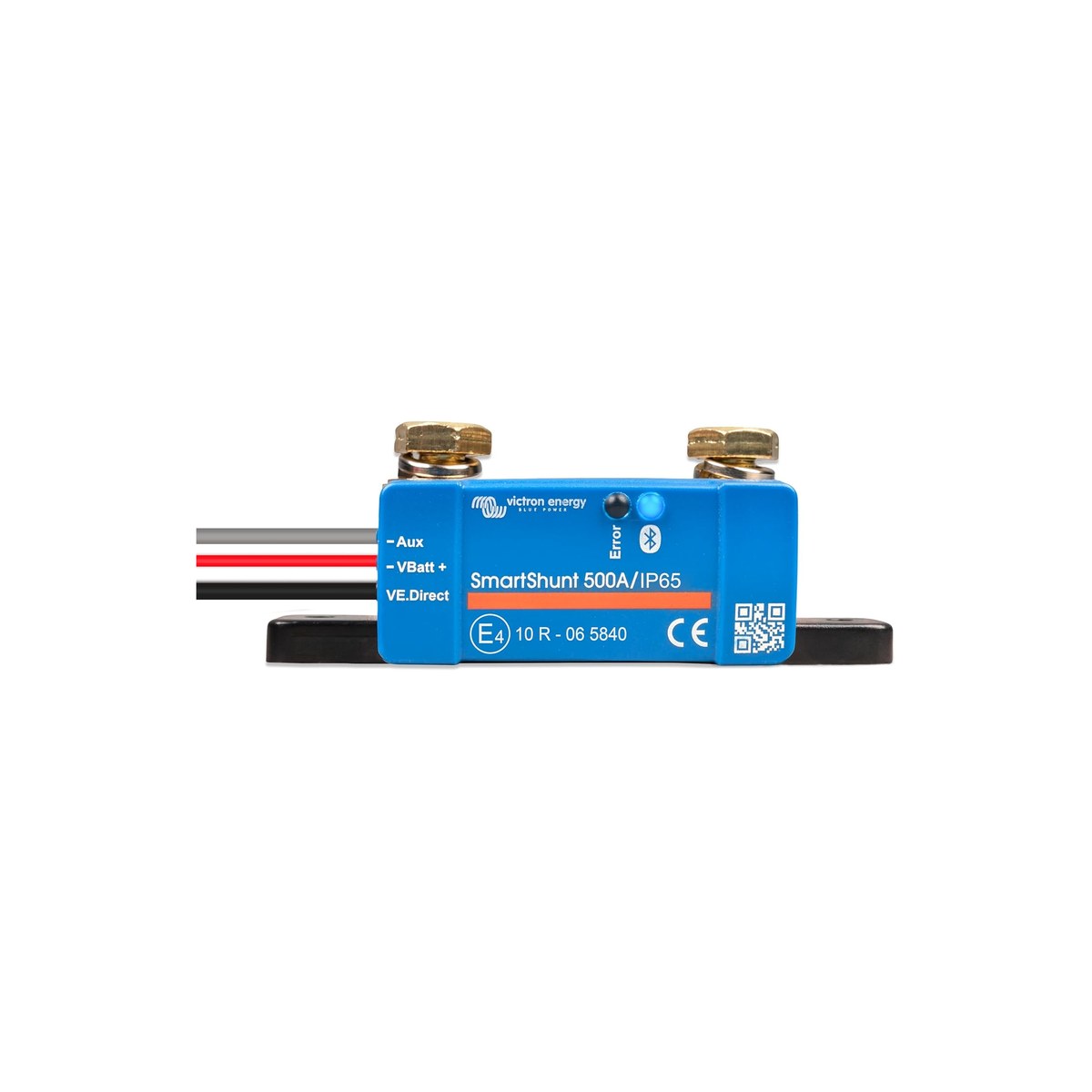
Victron SmartShunt IP65 500A Battery Monitor (IP65-rated enclosure suitable for wet bilge installs, 500A / 50mV shunt, 6.5 to 70 VDC range, 99.6 percent coulomb-counting accuracy, VE.Direct port for Cerbo GX integration, phone-only readout via VictronConnect Bluetooth, no display head, 300A / 1000A / 2000A variants also available, 5-year warranty, ASIN B0BF636VBX)
The right pick when Cerbo GX is in the stack or the antenna reaches.
Who it's for: the cruiser with an existing or planned Cerbo GX plus Touch 50/70 display (~$650 architecture) where the BMV's panel display would be redundant, OR a fiberglass interior install where the Bluetooth antenna can reach a phone at the nav station without metal-cored bulkheads in the way, OR a buyer prioritizing the smaller form factor, the lower price (~$30 below the BMV-712), and a cleaner install with no RJ12 cable and no panel cutout. Victron experts recommend the SmartShunt once a Cerbo GX is in the stack.
What we found: 1,237 Amazon reviews at 4.7 star and 200+ bought per month on the IP65 variant, the correct marine spec for any compartment that sees condensation, spray, or a nearby bilge water level. The standard IP21 SmartShunt carries roughly 3,900 reviews (3x more adoption), which we note but do not recommend for marine installs. Footprint Hero measured 100 feet of BMV-712 range inside an enclosed battery compartment but only 30 feet for the SmartShunt, because its radio sits at the shunt in the bilge while the BMV's sits in the panel head. Victron's datasheet warns that a metal chassis or seawater around a hull can cut Bluetooth range badly; the fix is the VE.Direct Bluetooth Dongle (ASS030536011, ~$50).
Bottom line: the SmartShunt IP65 is the right pick for Cerbo GX integrated systems where the BMV head is redundant, for fiberglass interior installs where the antenna can reach a paired phone, or for buyers who prefer the smaller form factor and lower price and accept phone-only readout. The BMV-712 is the right pick anywhere Bluetooth at the helm without a $50 dongle is a hard requirement, which is most metal-cored sailboat refits. For a 200 to 400Ah refit with no Cerbo GX, the BMV-712 at ~$200 is the answer.
- + IP65 enclosure rating is the genuine marine differentiator over the standard IP21 SmartShunt; the IP65 variant is what we recommend for any install that sees condensation, occasional spray, or proximity to a bilge water level, which covers most marine electrical compartments below deck
- + Same 99.6 percent coulomb-counting accuracy internals as the BMV-712 (identical Victron shunt math, same VictronConnect firmware) at a lower price; cleaner install with no RJ12 cable run to a display head and no panel cutout to make in the nav station joinery
- + Direct VE.Direct port to a Cerbo GX integrates without the BMV head unit in the cable chain; this is the structural argument for the SmartShunt when the Victron community expert consensus on a Cerbo GX install is that the BMV display becomes redundant once a Touch 50 or 70 is mounted at the helm
- + 1,237 Amazon reviews at 4.7 star with 200+ bought per month is meaningful platform adoption on the IP65 variant specifically; the standard IP21 variant carries roughly 3,900 reviews (about 3x more adoption) but the IP65 rating is the correct marine spec and the structurally honest pick for wet-locker installs
- × Bluetooth antenna placement is the documented marine caveat that the BMV-712 does not have; Victron's own datasheet states verbatim that "the proximity of other electrically conducting elements, such as the metal chassis of a vehicle or seawater around the hull if a boat, may reduce the range of the Bluetooth signal to an unacceptable level." The documented fix is the VE.Direct Bluetooth Smart Dongle (Victron part ASS030536011, ~$50) plus switching off the SmartShunt's internal Bluetooth, which moves the radio to a more accessible mounting location
- × Phone-only readout means anyone checking state of charge has to open VictronConnect on a paired phone; for partners not paired or for charter guests, the lack of a panel display is the friction trade-off against the lower install cost
- × No programmable relay; the SmartShunt cannot trigger automatic generator start, low-voltage alarm horns, or bilge pump arming patterns the way the BMV-712 relay can, which is the architectural reason cruisers running generator-start automation still default to the BMV head
Budget pick: AiLi Battery Monitor with Shunt (8-120V range per current Amazon listing, up to 500A current, state of charge display up to 999Ah, wired panel display via harness not Bluetooth, compatible with LiFePO4 lithium, AGM, gel, and flooded chemistry, three-button programmable interface, 1-year warranty, ASIN B07FGFFHC6).
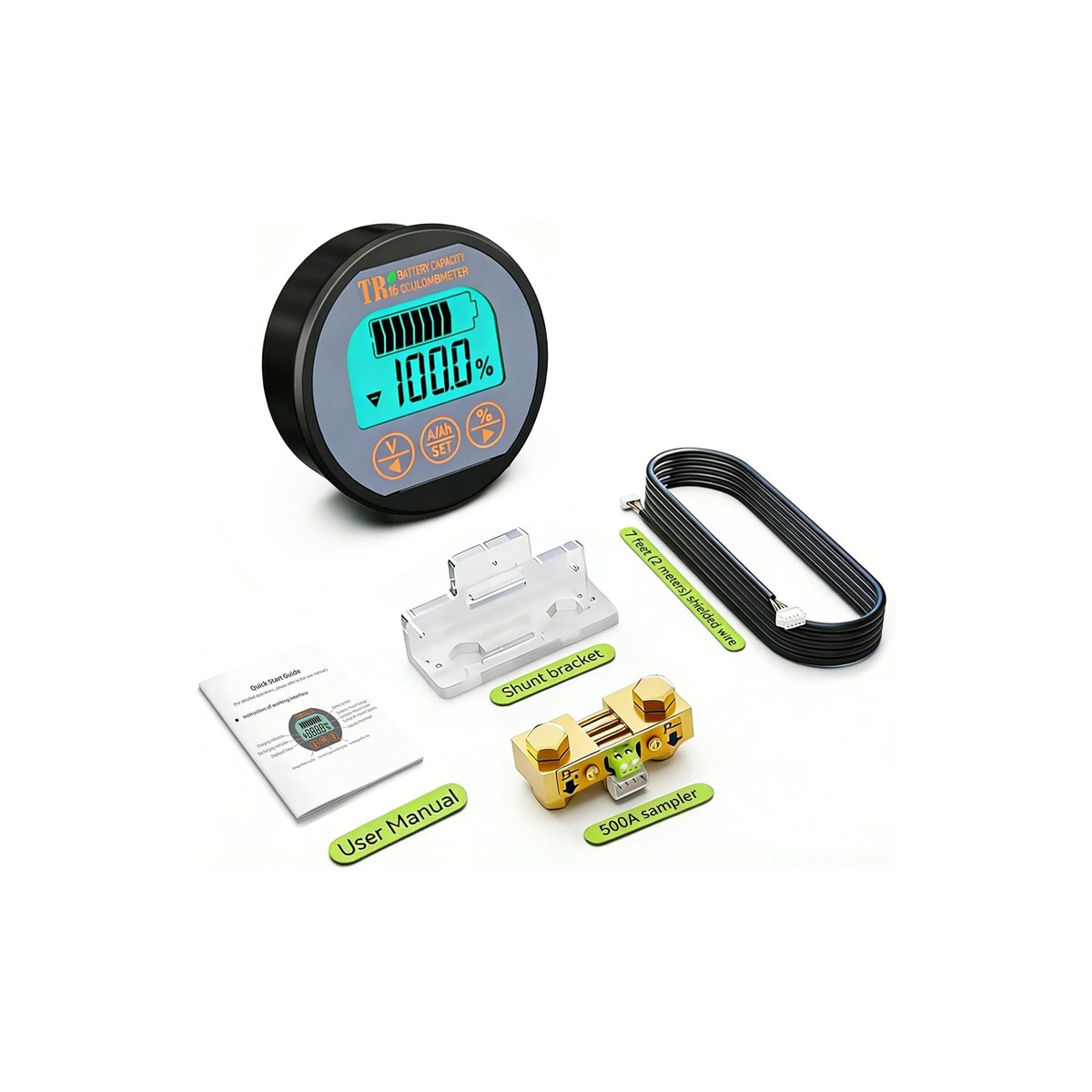
AiLi Battery Monitor with Shunt (8-120V range per current Amazon listing, up to 500A current, state of charge display up to 999Ah, wired panel display via harness not Bluetooth, compatible with LiFePO4 lithium, AGM, gel, and flooded chemistry, three-button programmable interface, 1-year warranty, ASIN B07FGFFHC6)
The wired-display answer that dodges both the bilge antenna and ecosystem traps.
Who it's for: the 18 to 25 ft trailerable sailboat or coastal weekender owner with a single 100 to 200Ah house bank on AGM, flooded lead-acid, or a budget LiFePO4 install (Battle Born 100Ah or LiTime 100Ah Mini), who charges to full every weekend, prefers a screen over an app, has a total system value under $1,500 where a $170 SmartShunt is the wrong ratio against a $400 battery, and will trade Bluetooth for a wired display that dodges the bilge antenna problem and the Renogy hub trap.
What we found: 1,443 Amazon reviews at 4.4 star with 50+ bought per month is the strongest budget-tier shunt-monitor signal in 2026, roughly 13x the review depth of the hypothesized Renogy Battery Shunt 300 (109 reviews at 3.9 star) at a fifth the price of the BMV-712. One spec-sheet note: AiLi re-uses ASINs across revisions, and the same B07FGFFHC6 SKU family has shipped as an older 8-80V variant alongside the current 8-120V unit, so verify your unit against the live listing. Footprint Hero's two-month installed test named the AiLi 350A as Budget Pick over the BMV-712 and SmartShunt, finding it covers every necessary monitor function. Backlight dimming after 2 to 3 years is the maintenance item; panels run roughly $15.
Bottom line: this is the locked Budget Pick after the hypothesized Renogy Battery Shunt 300 (B0CNJWZCCY) was refuted on three failure modes during the Perplexity Deep Research cold review. The Renogy 300 is not standalone, it is a Bluetooth sensor that needs the Renogy ONE Core hub; field reports show SoC locked at 99 percent, and Renogy's own blog discloses up to 8 percent SoC discrepancy versus the BMS because the shunt predicts charge from voltage. That is disqualifying for LiFePO4 owners. The AiLi at $37.80 is the right answer.
- + True shunt-based coulomb counter with a wired standalone display (shunt and display connected by a wired harness, NOT Bluetooth), which structurally eliminates the SmartShunt's metal-cored bulkhead range problem AND the Renogy Battery Shunt 300's requirement for a separate Renogy ONE Core hub to function as a monitor at all; the display is the monitor, no app, no hub, no ecosystem dependency offshore
- + 1,443 Amazon reviews at 4.4 star with 50+ bought per month is the platform's strongest budget-tier shunt-monitor adoption signal in 2026, roughly 13x the review depth of the Renogy Battery Shunt 300 (109 reviews) and comparable to LiTime's 500A monitor (which post-dates AiLi on Amazon and is the same basic architecture); Footprint Hero's two-month installed hands-on test names the AiLi 350A explicitly as Budget Pick, noting "It performs all the necessary functions of a battery monitor for a fraction of the price of the other options"
- + $37.80 price point is $130 below the SmartShunt and $160 below the BMV-712, which is the structurally honest answer when the total electrical system value is under $1,500; installing a $170 monitor on a $400 battery is the wrong ratio, and the wired-display AiLi at $38 puts the monitor cost back in proportion to the rest of the stack
- + Compatible with LiFePO4, AGM, gel, and flooded chemistry with three-button programmable interface for capacity, Peukert exponent (lead-acid only), and charge-efficiency factor; for a budget LiFePO4 install where the buyer is not committing to the Victron ecosystem and wants a screen at the panel, the AiLi covers the same coulomb-counting math at a fifth the cost
- × No Bluetooth, no app, no VE.Direct port, no programmable relay; this is intentionally a wired display with three buttons, which is the trade-off that makes it a Budget Pick and not a Top Pick contender. Cerbo GX integration is impossible, generator-start automation is impossible, and remote phone monitoring is impossible
- × 1-year warranty is materially shorter than the Victron BMV-712 and SmartShunt 5-year warranty; AiLi's vendor support reputation is thinner than Victron's global distributor network (Defender Marine, West Marine, eMarine Systems), so a warranty claim on a 2-year-old unit is unlikely to resolve cleanly
- × Display backlight is a known maintenance item per multi-year cruiser field reports; some users document backlight dimming after 2 to 3 years of continuous operation, with replacement display panels available at roughly $15 from AiLi or via aftermarket sources; this is the documented recurring failure pattern to plan around
- × 8V minimum operating voltage is below normal use but creates an edge case for deeply discharged lead-acid banks: a 12V flooded battery that has dropped below ~10V (because the bank was left dead at the slip overnight) may blank the AiLi display just when the owner most needs to read state of charge during recovery charging; the BMV-712 has a 6.5V floor that handles deeper discharge
Also worth considering.
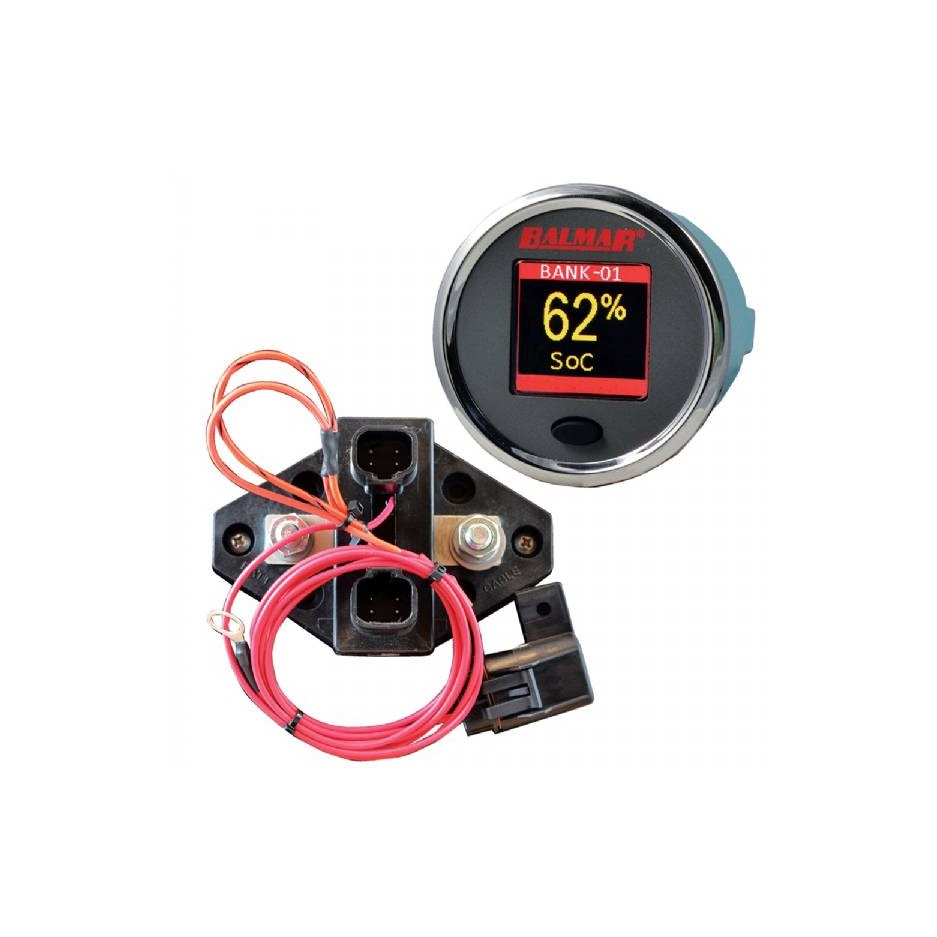
Balmar SG200 Battery Monitor Kit (color display, shunt, 10M cable, 12-48 VDC, SmartGauge state-of-charge + state-of-health algorithm, Bluetooth + SmartLink optional CAN integration, currently sold via marine distributors only with no confirmed Amazon ASIN as of May 2026)
The most accurate marine battery monitor in 2026 if you can buy through a marine distributor.
Who it's for: the cruiser who wants the strictly most accurate SoC plus State of Health measurement for a LiFePO4 bank, has a relationship with a marine distributor (Anchor Express, Poco Marine, Overton's, Hamilton Marine, eMarine, Defender, or West Marine), and will give up the VictronConnect ecosystem and Amazon Prime in exchange for the bench-test accuracy crown. This is a high-end NMEA-2000 build choice, not a quick Amazon refit.
What we found: Maine Sail (Rod Collins, marinehowto.com) bench-tested the SG200 within 1 percent on both SoC and SoH for LiFePO4, the most accurate published independent marine battery monitor measurement we know of in 2026, and Practical Sailor co-named the SmartGauge lineage the SG200 inherits from as Best Choice. The price correction matters: street price runs about $240 to $260 from marine distributors (Overton's lists $259.99), not the ~$400 MSRP that surfaces in older content. There is no confirmed Amazon ASIN as of May 2026, the operational reason it sits here instead of the Top 3. The 2019 to 2022 firmware launch was troubled (Panbo documented the drama plus Deutsch connector issues plus SoH stickiness); the September 2022 manual revision is where field reports turn mostly positive, though case-grounded alternator installs still show quirks per Trawler Forum (Sep 2024), Tugnuts (Dec 2022), and Morgan's Cloud (June 2023).
Bottom line: for the buyer building a high-end NMEA-2000 system around SoH measurement with a marine-distributor relationship already in place, the SG200 is the accuracy answer. For everyone else, the BMV-712 at ~$200 with global Victron distributor support is the right call, since you get the VictronConnect ecosystem and Amazon Prime delivery without giving up shunt-based coulomb counting.
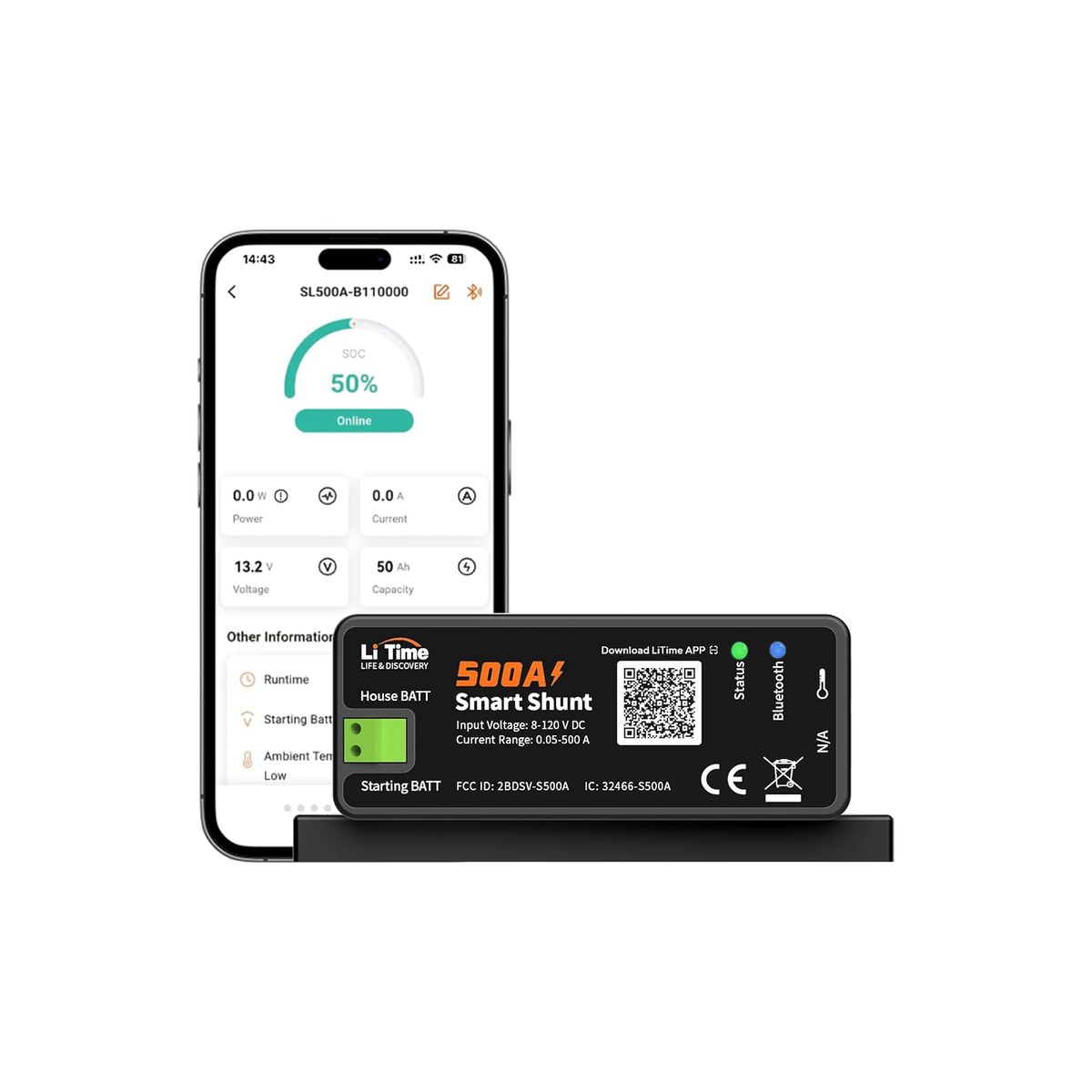
LiTime 500A Smart Shunt Bluetooth Battery Monitor (8-120V range, 500A current, Bluetooth + LiTime app, SoC display, alarm alerts, history records, compatible with lithium / LiFePO4 / AGM / gel, ASIN B0GWCG4Q6P)
The budget Bluetooth alternative if you want app monitoring without the SmartShunt antenna problem.
Who it's for: the buyer who wants Bluetooth app monitoring at the budget tier and is willing to trust a thin 2026 review signal (5 reviews as of May) in exchange for 8 alarm modes and 30-day history records the AiLi does not have, on an install where the shunt mounts with reasonable Bluetooth line of sight to the helm (fiberglass interior or open compartment, not buried in a metal-cored bilge).
What we found: we considered the LiTime 500A for the Budget Pick slot and dropped it in favor of the wired-display AiLi for three reasons. First, the review signal is structurally thin: 5 Amazon reviews at 5.0 stars as of May 2026 is positive but not load-bearing the way the AiLi's 1,443 or the BMV-712's 2,155 are, and the line is new enough that multi-year saltwater field data does not exist. Second, Bluetooth at the budget tier reintroduces the SmartShunt-in-bilge antenna problem without the SmartShunt's IP65 rating, and the LiTime app does not integrate with SmartSolar MPPT, Blue Smart, or Cerbo GX the way Victron's stack does. Third, Footprint Hero has not published a marine-condition bench test of this SKU; the comparison that named the AiLi as Budget Pick predates the LiTime 500A entry.
Bottom line: for the buyer who specifically wants Bluetooth plus alarm modes plus 30-day data logging at the $109.99 tier and is mounting the shunt with Bluetooth line of sight to the helm, the LiTime 500A is a defensible alternative. For the wired-display preference or any install where antenna placement is constrained, the AiLi at $37.80 remains the better answer.
Skip this guide if...
You might not need a standalone battery monitor at all. The Victron Lithium Smart NG (2024+ generation) integrates the shunt directly into the battery case, which means a BMV-712 or SmartShunt becomes redundant once your house bank moves to the NG line; the same applies to the Victron Lynx Smart BMS 500A or 1000A, which includes a shunt in the BMS housing and replaces the SmartShunt entirely within a Victron lithium ecosystem. Lithionics battery systems with the NeverDie BMS also integrate shunt-based state of charge and display it via the Lithionics Bluetooth app; adding an external monitor on top of a Lithionics install is duplicate hardware. If you have a Victron Cerbo GX with a Touch 50 or Touch 70 display already at the helm and a Lynx Smart BMS or Lithium NG in the bank, you are reading state of charge at the helm without any of the monitors in this guide. If you only ever run a single 100Ah AGM start battery for engine cranking with no house loads (laptop, refrigeration, lighting beyond running lights), a $30 panel voltmeter from West Marine covers that use case; the coulomb-counting shunt math becomes useful only when daily Ah consumption exceeds 20 percent of bank capacity and you need to know how much you have left before you run out at anchor.
Don't bother with.
- × Skip Renogy Battery Shunt 300 (B0CNJWZCCY, $119.99, formerly our Budget Pick hypothesis)Three independent disqualifying findings from the Perplexity Deep Research cold review (the same recommend-not-validate pattern that has now surfaced critical editorial saves on four consecutive Sea > Electrical guides). Reason 1, ecosystem lock-in: Renogy's own product page explicitly states "Note: This Battery Shunt 300 is only compatible with the Renogy ONE Core monitor", the shunt is NOT a standalone device with its own display, it is a Bluetooth sensor that requires the Renogy ONE Core hub to function as a monitor at all (and is explicitly NOT compatible with Renogy's own M1 remote monitor); if the ONE Core fails offshore, the shunt is inoperable with no fallback display. Reason 2, firmware instability: Renogy's own troubleshooting documentation confirms the SoC alarm parameter resets to factory defaults after firmware events, and multiple field reports plus the Renogy YouTube community thread document SoC locked at 99 to 100 percent post-install (one DIY Solar Forum user logged a complete meltdown where the shunt reported firmware version 0 after a battery disconnect with Renogy support unable to resolve remotely; Renogy released a firmware update sequence to address some of these issues in mid-2024). Reason 3, voltage-based SoC algorithm: independent YouTube testing by Freedom in a Can documented up to 8 percent SoC discrepancy between the Shunt 300 and a Renogy BT-2 BMS readout, attributing it to the Shunt 300 estimating SoC from voltage rather than coulomb-counting from current integration; for a LiFePO4 owner buying a monitor precisely because voltage on the flat 13.0 to 13.3V plateau is useless, this is disqualifying. The wired-display AiLi at $37.80 is the honest Budget Pick replacement.
- × Skip Blue Sea M2 OLED Vessel Systems Monitor (multi-bank with integrated AC + DC + bilge + tank)Blue Sea is normally the trusted brand for switches, fuses, busbars, and ACRs across the cruiser community, but the M2 OLED Vessel Systems Monitor line has documented 1-star review patterns at multiple marine retailers (Defender Marine, Hamilton Marine, Amazon) citing "voltage display jumps to 90V and gets stuck," "so many glitches it is laughable," and "unhelpful technical support." For buyers who specifically need integrated AC + DC + bilge + tank monitoring on one head unit, the M2 is the only Amazon-buyable option designed for that use case, but plan to replace it in 5 years rather than the 15-year service life you would expect from a Victron product. The cleaner multi-bank answer for cruisers is two Victron SmartShunts on the VictronConnect app (one per bank), which costs about the same and avoids the documented reliability gap.
- × Skip Bayite, DROK, KETOTEK, and other generic Chinese $20-50 battery monitorsReframed from the original brief which incorrectly called them "fancy voltmeters"; per the operator harvest these are functional coulomb counters with adequate SoC algorithms, the math is not the problem. The disqualifying issue is build quality and marine environmental sealing: unpotted printed circuit boards, non-marine grade connectors that corrode in salt-fog seasons, no IP rating on the shunt body, no temperature compensation, and documented field reports on DIY Solar Forum of shunt screws backing out under vibration (fire concern on a boat); plus no vendor support response when units fail (zero warranty resolution documented). The Amazon-bestseller battery monitors in the $20 to $50 range count coulombs correctly on a bench but the first sustained bilge splash or salt-fog season renders them unreliable. The wired-display AiLi at $37.80 covers the same budget tier with 1,443 reviews of multi-year field service data behind it and a properly sealed panel display (the AiLi shunt body is itself unsealed and benefits from a dry mount, but the display housing is the marine-grade differentiator).
- × Skip LiTime 500A Smart Battery Shunt (Bluetooth, 8-120V, ~$60-70)Considered for the Budget Pick slot and dropped in favor of the wired-display AiLi. The LiTime 500A is a direct Amazon-buyable competitor that adds Bluetooth, 8 alarm modes, and 30-day data logging, features the AiLi lacks entirely. We kept the AiLi as the Budget Pick because (a) the AiLi's wired display works without a phone, which matters at anchor with a dead phone battery; (b) the AiLi's community track record in marine environments is longer with 1,443 reviews vs LiTime's limited but positive review history on this specific SKU; and (c) the LiTime's 8V floor is essentially identical to the AiLi's so the spec differential does not favor LiTime on chemistry compatibility. For a cruiser specifically prioritizing Bluetooth + alarm modes over a wired display at the same price tier, the LiTime is a reasonable alternative; we did not Top Pick it because Bluetooth at the budget tier reintroduces the SmartShunt-in-bilge antenna problem without the SmartShunt's IP65 rating or Victron ecosystem depth.
- × Skip Renogy 500A Battery Monitor with Shunt (standalone wired display, $87.99 MSRP, currently 'Unavailable' on renogy.com)Different product from the refuted Renogy Battery Shunt 300 covered above: the 500A version IS a true standalone monitor with a wired display, 10-120V range, and coulomb counting; it would have been an acceptable budget alternative to the AiLi at the $88 price point. We did not include it as an active pick because Renogy.com listed it as Unavailable as of May 2026 (consumer-facing stockouts and supply pauses on this SKU have been recurring per Renogy community threads). If Renogy restores supply, the 500A unit would merit a fresh look as a Budget Pick alternative; until then, the AiLi at $37.80 is the right wired-display answer.
How we picked.
Who this guide is for
We started from the operator harvest brief: a 25 to 45 ft coastal cruising sailboat or trawler owner running a 100 to 400Ah house bank on AGM, flooded lead-acid, or LiFePO4 chemistry, anchored out 50 to 150 percent of cruising days, with daily Ah consumption typically 30 to 100 Ah from refrigeration plus navigation electronics plus laptop charging, who needs to know how many usable amp-hours remain before the bank reaches the low-voltage cutoff and the inverter or refrigeration compressor shuts down at anchor. Two buyer segments emerged: segment A doing a full Victron ecosystem refit (SmartSolar MPPT plus Blue Smart IP67 plus MultiPlus Compact already installed) where the monitor decision is BMV-712 vs SmartShunt depending on whether a Cerbo GX is in the stack, and segment B running a budget single-battery weekender install on AGM or flooded who wants a screen at the panel and not an ecosystem.
The brand-pillar landscape in 2026
The brand-pillar landscape in 2026 narrowed to four contenders. Victron Energy (BMV-712 Smart, SmartShunt IP65 500A, BMV-700 legacy, Lynx Smart BMS 500A and 1000A as the integrated alternative) holds the cruiser-community default position across Cruisers Forum, Trawler Forum, and SailNet threads from 2018 forward. Balmar (SG200) is the brand-of-record technical leader after the September 2022 manual revision stabilized a troubled 2019-2022 firmware launch; Maine Sail (Rod Collins, marinehowto.com) bench-tested the SG200 within 1 percent on SoC and SoH for LiFePO4, which is the most accurate published marine battery monitor measurement in independent hands. Renogy (Battery Shunt 300, ONE Core hub, ONE M1 remote) is the budget-tier Amazon-bestseller brand-variant we dropped from the Budget Pick slot after the Perplexity Deep Research cold review surfaced three independent failure modes (ecosystem lock-in, firmware instability, voltage-not-coulomb SoC algorithm). AiLi (350A and 500A wired-display variants) is the structurally honest Budget Pick replacement per the Footprint Hero two-month installed hands-on test, with 1,443 Amazon reviews of multi-year field service data on the B07FGFFHC6 listing.
Bluetooth antenna placement: the load-bearing editorial pivot
The Bluetooth antenna placement story is the load-bearing editorial pivot in this guide. The initial Amazon-review-count lineup would have ranked the BMV-712 first on platform adoption (2,155 reviews vs 1,237 on the SmartShunt) and then defaulted to the BMV without explaining why; the cruiser-community-relevant reason that Cruisers Forum threads consistently recommend the BMV-712 over the SmartShunt on metal-cored sailboats is documented in Victron's own datasheet: "the proximity of other electrically conducting elements, such as the metal chassis of a vehicle or seawater around the hull if a boat, may reduce the range of the Bluetooth signal to an unacceptable level." The Footprint Hero hands-on bench test measured 150 feet of BMV-712 range unobstructed and 100 feet inside an enclosed battery compartment, compared to 30 feet for the SmartShunt in the same compartment, because the BMV's radio is in the panel-mounted display head at the nav station and the SmartShunt's radio is at the shunt buried in the bilge. The documented fix when the SmartShunt is the architectural-right pick (Cerbo GX in the stack) is the VE.Direct Bluetooth Smart Dongle (Victron part ASS030536011, ~$50) plus switching off the SmartShunt's internal Bluetooth.
The LiFePO4 13.0 to 13.3V plateau math: why a voltmeter is dangerous
The LiFePO4 voltage plateau math is the second load-bearing editorial point, and it must be stated as a range not a single number. A 12V LiFePO4 pack (4S configuration of 3.2V nominal cells) exhibits a flat discharge plateau spanning roughly 13.0 to 13.3V at rest (open circuit) across approximately 20 to 80 percent state of charge; the exact plateau voltage varies by manufacturer cell chemistry and grade, whether the reading is taken under load or at rest, temperature (cold significantly depresses voltage), and discharge rate (higher C-rates suppress apparent voltage). A representative SoC table from EVE LiFePO4 chemistry shows 70 percent ≈ 13.28V, 60 percent ≈ 13.16V, 50 percent ≈ 13.08V, 40 percent ≈ 13.00V, the plateau is flat enough across 30 to 70 percent SoC that a panel voltmeter cannot distinguish bank conditions a coulomb counter measures cleanly. On an AGM or flooded bank the voltage curve sags more linearly with discharge, so a voltmeter is sloppy but not dangerous; you can guess SoC to within 20 percent. On LiFePO4 the voltmeter is dangerous because the low-voltage knee is steep: depending on BMS cutoff programming (commonly 10.0 to 10.5V system voltage, equivalent to 2.5 to 2.63V per cell, but tripped earlier under load due to voltage sag), the last 5 to 10 percent of capacity disappears between roughly 12.8V at rest and BMS disconnect. A buyer relying on voltage will hit the cutoff with no warning at anchor with the refrigeration compressor running. This is the structural reason a coulomb-counting shunt-based monitor is mandatory not optional for LiFePO4 owners and why every pick in this guide is shunt-based with current integration math, not voltage estimation.
ABYC E-11 shunt grounding and the LOAD vs CHARGE bypass failure modes
The ABYC-derived shunt grounding rule per Maine Sail's marinehowto.com work is the most under-discussed install rule in DIY battery monitor installations. Important precision: ABYC E-11 (AC and DC Electrical Systems on Boats) does not contain a named shunt-wiring clause; the rule emerges from applying E-11's DC negative bus and single-return-path topology to shunt placement. For LiFePO4 banks, ABYC E-13 (Lithium Battery Systems, ratified 2022, effective July 2023) also mandates BMS-integrated SoC monitoring. The shunt itself installs on the negative side of the battery, between the battery negative terminal and ALL DC loads + charge sources on the boat, only the battery negative jumper attaches to the battery terminal, every other negative wire must return through the shunt. The failure modes split by current direction (Maine Sail's "Measuring Nothing" section documents this exactly): any LOAD connected on the battery side of the shunt is invisible to the monitor, discharge amps sneak past, SoC drifts falsely HIGH because the bank loses Ah the monitor never counts. Any CHARGE SOURCE on the wrong side, most commonly a case-grounded alternator whose negative returns through the engine block when the engine block is bonded between the shunt and the battery, means charging amps sneak past and SoC drifts falsely LOW because the bank gains Ah the monitor never credits. Either way the monitor is lying. This is the #1 install error across all platforms; the fix is to relocate the engine block bonding wire to the LOAD side of the shunt so that all charge and discharge currents pass through. This is install practice not product defect, which is why the BMV-712 corrosion failure in the Bahamas thread and this grounding pattern are both editorially classified as install rules in the methodology section rather than product cons.
Why we dropped the Renogy Battery Shunt 300 (the 4-build recommend-not-validate streak)
Renogy's removal from the Budget Pick slot is the fourth consecutive Sea > Electrical build where the Perplexity Deep Research recommend-not-validate cold review surfaced a critical editorial save. The Solar Panels build (Sea > Electrical #3) pivoted on the CPSC fire recall for the Renogy Flexible Solar Panel line. The Charge Controllers build (Sea > Electrical #4) pivoted on the Victron SmartSolar AIS interference issue documented in the Cruisers Forum mega-thread. The Inverters build (Sea > Electrical #5) pivoted on the Victron MultiPlus-II steel-case corrosion in humid bilge installs (which we ultimately handled by elevating the aluminum-cased MultiPlus Compact as Top Pick). This Monitors build (Sea > Electrical #6) pivots on the Renogy Battery Shunt 300 ecosystem lock-in plus firmware instability plus voltage-only SoC algorithm. Four consecutive builds where pure Amazon review-count math would have shipped a wrong pick at the budget tier; the recommend-not-validate cold review is the standing process gate that catches these saves.
Shunt sizing math: 300A vs 500A and dual battery monitor install patterns
Shunt sizing math is straightforward and worth showing explicitly because the 300A class is correct for some cruiser installs and the 500A class is over-spec for others. Victron's community guidance is that continuous current through the shunt should not exceed roughly 66 percent of the shunt rating for sustained accuracy. The formula: maximum continuous discharge current (Amps) at 12V equals largest single load in watts divided by 12V then multiplied by 1.2 safety factor. For a 2000W inverter (167A theoretical at 100 percent efficiency, ~200A actual at 90 percent efficiency with safety factor), a 300A shunt's 200A continuous ceiling is at the limit and a 500A shunt is the safer choice. For a 3000W inverter (about 250A peak at 12V, 300A with safety factor), 500A is mandatory. For a smaller install with a 1000W inverter and refrigeration only (max ~100A continuous draw), the 300A SmartShunt IP65 released October 2024 is the right answer at lower cost. We default to 500A in the recommendations because the stated cruiser persona (200 to 400Ah house bank with refrigeration plus future inverter expansion to 2000W) lands above the 300A class continuous ceiling; smaller-system buyers should specifically request the 300A variant to save roughly $30 and gain the same VictronConnect integration. Dual battery monitor and multi-bank install patterns are common on cruisers running a separate engine-start bank and house bank, where the cleanest answer is two Victron SmartShunts paired to one VictronConnect app instance (one per bank, each with its own ASIN B0BF636VBX or 300A variant); the Blue Sea M2 OLED Vessel Systems Monitor is the only Amazon-buyable single-head dual-bank unit in the category but the documented 1-star review patterns at Defender Marine, Hamilton Marine, and Amazon push it to the Don't Bother section regardless of architectural elegance. For a buyer specifically needing AC plus DC plus bilge plus tank monitoring in one head unit, the M2 is the only purpose-built option; for clean dual-bank DC monitoring on a typical cruiser refit, two SmartShunts is the right answer.
Model-variant naming reference for buyers searching by exact configuration
Model-variant naming reference for buyers searching by exact configuration. Victron's BMV line surfaces under multiple search shapes that all resolve to the Top Pick: Victron BMV 712, Victron BMV 712 Smart, Victron BMV 712 Smart Battery Monitor, Victron Energy BMV 712 Smart Battery Monitor, BMV 712 Smart Battery Monitor, Victron Bluetooth Battery Monitor, Victron Smart Battery Monitor, and Victron Battery Monitor BMV 712 Smart all resolve to the BMV-712 Smart panel-display unit (ASIN B084M2XYK4); the legacy Victron BMV 700 and Victron 700 Battery Monitor searches surface the predecessor unit which is still field-installed but lacks Bluetooth and is editorially superseded by the BMV-712. Victron's SmartShunt line surfaces as Victron SmartShunt, Victron SmartShunt Battery Monitor, Victron SmartShunt 500A, Victron SmartShunt 500A 50mV, Victron SmartShunt 300A, Victron SmartShunt IP65, and Smart Shunt Battery Monitor all resolving to the Runner-up SmartShunt IP65 500A (B0BF636VBX) or the 300A / 1000A / 2000A spec-equivalent variants. Renogy Battery Monitor, Renogy 500A Battery Monitor, and Renogy 500A Battery Monitor with Shunt surface the editorially-honorable-mention Renogy Battery Shunt 300 (B0CNJWZCCY) which we do NOT recommend at the Budget Pick slot. AiLi Battery Monitor and the AiLi 350A and 500A variants resolve to the locked Budget Pick (B07FGFFHC6); LiTime Battery Monitor and Eco Worthy Battery Monitor surface the generic-Chinese cohort in the Don't Bother section. Simarine Battery Monitor (Slovenian high-end NMEA 2000), Trimetric Battery Monitor (Bogart legacy US), and Xantrex Battery Monitor (LinkPro / LinkLite legacy) surface the brand-of-record alternatives covered in the FAQ.
Class-spec search shapes also resolve to the lineup. Battery monitor with shunt, smart battery monitor, Bluetooth battery monitor with shunt, shunt based battery monitor, and 12V battery monitor with shunt all surface the Top Pick BMV-712 and Runner-up SmartShunt as the class-spec answer (both are shunt-based coulomb counters with Bluetooth and 12V framing). Battery monitor 12V and battery monitor system surface the methodology head term framing for sizing math. Lithium battery monitor and battery monitor LiFePO4 surface the 13.0 to 13.3V plateau math editorial pivot covered above. The class-spec head term battery monitor at 8,100 MSV is heavily contaminated by mobile-app SERPs (Pattern E in our keyword pack: GSam Battery Monitor for Android, Bluetooth Battery Monitor app for iOS, laptop battery monitor utilities for Windows and macOS), which is why the marine framing and the shunt class-spec anchors matter for cluster capture without traffic dilution.
FAQs.
Q01 Why is the BMV-712 your Top Pick when the SmartShunt is the newer Victron design?
+
Q02 Why only 3 picks instead of 5? Don't I want more options?
+
Q03 Is a voltmeter enough for a LiFePO4 house bank? Battery monitor voltage readings vs coulomb counting?
+
Q04 How do I install the shunt? What ABYC standards apply?
+
Q05 What is the Balmar SG200 and why is it not your Top Pick?
+
Q06 I already have a Cerbo GX in my Victron stack. BMV-712 or SmartShunt?
+
Q07 Can I use one BMV-712 to monitor both my house bank and starter bank simultaneously?
+
Q08 What is Peukert's exponent and do I need to set it on my battery monitor?
+
Q09 What is the Victron temperature sensor accessory ASS000100000 and when do I need it?
+
Q10 Where do I find the Victron BMV 712 manual and Renogy battery monitor manual? Install resources for each pick?
+
Q11 What is the average price for a marine battery monitor in 2026?
+
If you, then this.
- IF 30 to 42 ft cruiser, nav-station panel mount, no Cerbo GX, VictronConnect ecosystemGET Victron BMV-712 Smart Battery Monitor$200 →
- IF Cerbo GX integrated stack OR fiberglass interior where antenna can reach helmGET Victron SmartShunt IP65 500A$170 →
- IF 18 to 25 ft weekender, AGM / flooded / budget LiFePO4, wants screen not appGET AiLi Battery Monitor with Shunt 500A$37.80 →
Boat Gear: The Complete Guide
The whole-boat picture →Every system on a 20 to 45 ft coastal boat, organized in one place, with the one guide we trust for each.