Best Marine Solar Panels: 5 That Earn Their Deck Space (2026)
Five marine solar panels for a 25 to 45 ft coastal cruising sailboat or trawler owner sizing a 12V house bank for off-grid anchoring, sorted by install context and panel topology. We read Practical Sailor's CIGS testing on the BougeRV Yuma, the Compass Marine deep-dive on Renogy rigid vs flexible, the CPSC recall database on the Renogy RNG-100DB, and cross-referenced Cruisers Forum, Trawler Forum, and SailNet. Three honesty points organize the guide. STC ratings overstate real-world coastal output by about 30 percent; the anchor-day formula cruisers use is wattage times 7 divided by 12 equals Ah per day. The Renogy flexible line is a hard no after the CPSC recall of the RNG-100DB for overheating and a documented bimini fire, though the Renogy rigid line stays the cruiser default. And the MC4 connector, not the panel, is the documented first-failure point on saltwater installs, so swapping factory MC4s for genuine Stäubli MC4s is the single most-important upgrade.
- 01 Renogy 200W N-Type Rigid (B0DYD8VT9C) , the Top Pick for a 30 to 40 ft cruiser 200W install, N-Type 16BB upgrade, $179.99
- 02 BougeRV Yuma 100W CIGS Thin-Film (B0BJJYZJ5X) , the Shade Champion, Practical Sailor-tested CIGS topology, $199.99
- 03 Newpowa 10BB Cell 200W Monocrystalline (B07VBL7XKV) , the Best Value Rigid, 709 reviews, $149.99 (10 to 15 percent below Renogy)
- 04 Goal Zero Boulder 100 Briefcase (B06Y3TC113) , the Portable pick, tempered glass, kickstand, $399.95
- 05 2x Renogy 200W N-Type for 400W array , the Offshore Step-Up for 40 plus ft liveaboard, 233 Ah/day at anchor, ~$360
Not sure what size you need? Our Sailboat Battery Bank & Solar Calculator sizes your house bank, solar array, and charge controller from your onboard loads. →
Free toolRunning new wire for it? Our Marine DC Wire-Gauge Calculator sizes the gauge for your load and run, checking both voltage drop and ampacity the ABYC way. →
How they compare.
| Rank | Product | Best for | Price | Our score |
|---|---|---|---|---|
| 01 | Renogy 200W N-Type Rigid (B0DYD8VT9C, single panel, $179.99)
Top Pick
| 30 to 40 ft coastal cruiser, 200W single-panel rigid install | $179.99
Buy → | 9.0/10 |
| 02 | BougeRV Yuma 100W CIGS Thin-Film (B0BJJYZJ5X, shade-tolerant, $199.99) | heavily shaded bimini install on sailboat with rigging | $199.99
Buy → | 8.5/10 |
| 03 | Newpowa 10BB Cell 200W Monocrystalline (B07VBL7XKV, 709 reviews, $149.99) | value-tier 200W rigid install on tighter budget | $149.99
Buy → | 8.7/10 |
| 04 | Goal Zero Boulder 100 Briefcase (B06Y3TC113, tempered glass, $399.95) | portable anchored-out occasional use, no deck drilling | $399.95
Buy → | 8.2/10 |
| 05 | 2x Renogy 200W N-Type for 400W array (~$360) | 40 plus ft offshore liveaboard, 233 Ah/day at anchor | ~$360
Buy → | 9.0/10 |
Prices are current Amazon prices at time of publication and can change. Scores reflect our editorial evaluation, not vendor input.
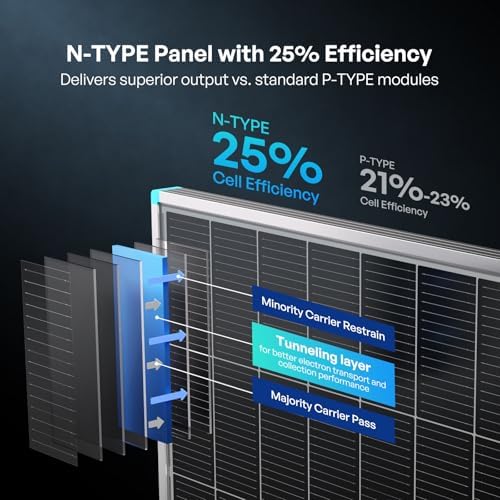
Our #1 pick: Renogy 200W N-Type Rigid Monocrystalline Solar Panel (16BB cell topology, 25 percent efficiency, IP65 junction box, anodized aluminum frame, marine-rated, ASIN B0DYD8VT9C).
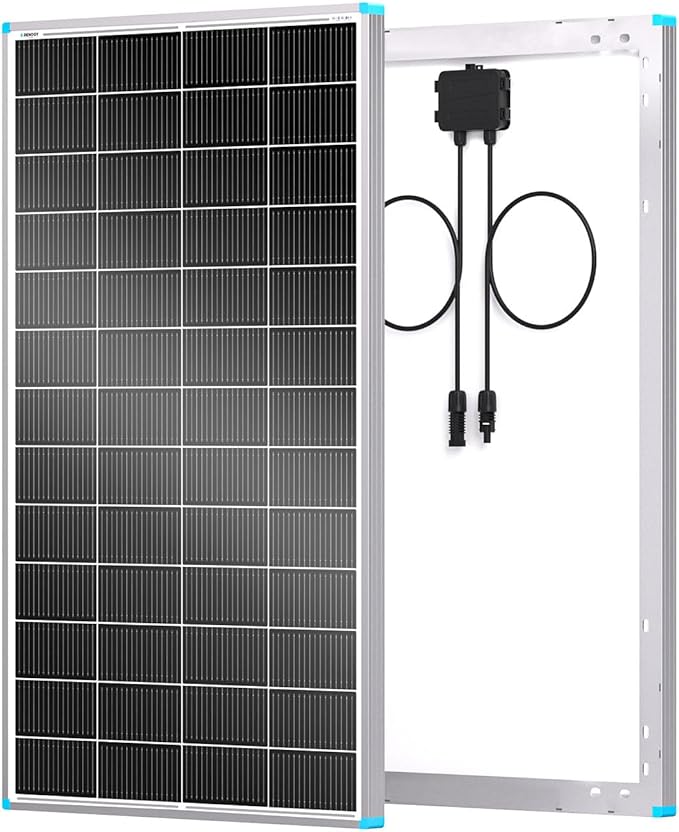
Renogy 200W N-Type Rigid Monocrystalline Solar Panel (16BB cell topology, 25 percent efficiency, IP65 junction box, anodized aluminum frame, marine-rated, ASIN B0DYD8VT9C)
The Renogy 200W N-Type Rigid Monocrystalline Solar Panel is the Amazon-buyable marine solar panel we would buy first for a 30 to 40 ft coastal cruising sailboat or trawler owner doing a 200W single-panel install, and it earns the Top Pick on three concrete signals. First, Renogy's rigid product line is the established marine default with 25-year proven service in the cruiser community. The brand is documented in multi-year no-degradation reports across Cruisers Forum, SailNet, and Trawler Forum (the rigid line specifically; the flexible line is a separate story documented in the Don't Bother With section). Per our operator harvest, the rigid Renogy install pattern is the 'first-timer default' for cruisers building their first house-bank-charging solar setup. The 166 reviews on this specific 2024-2025 N-Type ASIN is moderate adoption signal, but the rigid Renogy lineup as a whole carries the largest established install base of any brand on the platform. Second, the N-Type 16BB cell topology is the 2024-2025 upgrade over standard PERC cells. The 16-busbar architecture reduces internal resistance losses and improves shading tolerance. Renogy claims 25 percent cell efficiency though we want to be precise: the panel-level efficiency after wiring losses, frame area dilution, and MC4 connector losses is closer to 20 percent. Cell efficiency and panel efficiency are not the same number; Practical Sailor has documented this exact conflation pattern with other brands claiming 23 percent efficiency. The Renogy 25 percent claim is the cell-level efficiency. The real-world panel output under coastal conditions, per Practical Sailor's STC vs real-world testing, is approximately 70 percent of the rated wattage; for a 200W panel that is approximately 140W peak output and 11 to 14 Ah per hour at 12V during peak sun. Third, the single-panel install is structurally cleaner than the 2-pack 100W kit at the same total wattage. The popular Renogy 2-pack 100W kit (B07JXYTFF7) has 1,800 reviews, significantly more than this Top Pick, but the install complexity is higher: two panels means two sets of MC4 connectors (four connector pairs to replace with Stäubli MC4s), two wire runs, and two mounting positions to plan. For the 30 to 40 ft sub-segment, the single-panel B0DYD8VT9C install is the cleaner path. Three honesty points on the Top Pick. First, the Renogy flexible product line is a documented HARD NO due to the CPSC recall of the RNG-100DB for overheating, the bimini fire incident on Sailboat Owners Forum, and the dedicated Cruisers Forum thread on flexible solar panel fires. We name this distinction explicitly: this Top Pick is the rigid Renogy panel. The flexible Renogy line is structurally different and is in our Don't Bother With section. Buyers shopping the Renogy brand should understand which line they are buying. Second, the install rule is non-negotiable: replace the factory MC4 connectors with genuine Stäubli MC4s before marine deployment. Apply dielectric grease, inspect annually. The MC4 connector is the documented first-failure point on saltwater installs per Practical Sailor and Trawler Forum testing. Generic MC4s from no-name suppliers fail to galvanic corrosion within 6 to 12 months; Stäubli MC4s at $3 to $5 each plus dielectric grease are the $20 to $30 upgrade that extends panel life from 2 to 3 years to 15 to 20 plus years. Third, the Renogy ownership change rumors that circulate in cruiser forums are unverified, Yi Li remains CEO and the last documented funding round was Series E in June 2022. The brand is structurally stable. The 'Renogy is changing hands' speculation does not match documented sources. For the 30 to 40 ft coastal cruising sailboat or trawler owner installing 200W on an arch or davit, this is the Amazon-buyable panel we would buy with the inspect-on-arrival verification step and the mandatory Stäubli MC4 upgrade.
- + 166 Amazon reviews at 4.6 stars on the 2024-2025 N-Type listing, with Renogy carrying the largest rigid marine install base of any brand in the Cruisers Forum / SailNet / Trawler Forum signal. The brand is documented in 2-9 year no-degradation reports across the rigid product line specifically (the flexible line is a separate story documented in the Don't Bother With section)
- + N-Type 16BB cell topology is the 2024-2025 upgrade over standard PERC cells. The 16-busbar architecture reduces internal resistance losses and improves shading tolerance, claiming 25 percent cell efficiency though the panel-level efficiency after wiring losses and frame area dilution is closer to 20 percent. The improvement over standard PERC mono is measurable in real-world coastal use, particularly during partial-shade conditions
- + Single 200W panel is the cleanest install for the 30 to 40 ft sub-segment. One panel, one set of MC4 connectors, one wire run to the charge controller. Versus the 2-pack 100W kit (B07JXYTFF7) at the same total wattage, the single-panel install has half the connector failure points and half the wiring complexity. The single-panel install is the cleaner path
- + Marine-rated listing with explicit 'Class B Van RV Marine Cabin Roof' use case in the product title. IP65 junction box rating, anodized aluminum frame for saltwater corrosion resistance. The factory MC4 connectors should still be replaced with Stäubli MC4s before marine deployment per the install rule in the methodology section, but the panel itself is built for the marine environment
- × 166 reviews on the N-Type version is moderate adoption signal, the prior-generation Renogy 200W PERC panel (B08CRJYJ22) has 646 reviews, and the 2-pack 100W kit (B07JXYTFF7) has 1,800 reviews. The N-Type upgrade is too new to have multi-year saltwater data documented in the cruiser-forum signal, though the rigid Renogy line as a whole is well-established
- × The Renogy flexible product line carries documented quality problems (CPSC recall of RNG-100DB for overheating, separate bimini fire incident on Sailboat Owners Forum, dedicated Cruisers Forum thread on flexible solar panel fires). The rigid line is structurally different and the failure pattern does not transfer. We name the rigid-vs-flexible distinction explicitly because Renogy buyers should understand which line they are buying
- × Renogy ownership-change rumors circulate in the marine community, but per our operator harvest the rumored 2024 ownership change is unverified: Yi Li remains CEO and the last documented funding round was Series E in June 2022. The brand is structurally stable; the rumors are not corroborated by documented sources. We name this honestly because the marine community has had questions about Renogy's direction
Runner-up: BougeRV Yuma 100W CIGS Thin-Film Flexible Solar Panel (anti-shading bypass-diode architecture, tape-mount installation, marine-rated, ASIN B0BJJYZJ5X).
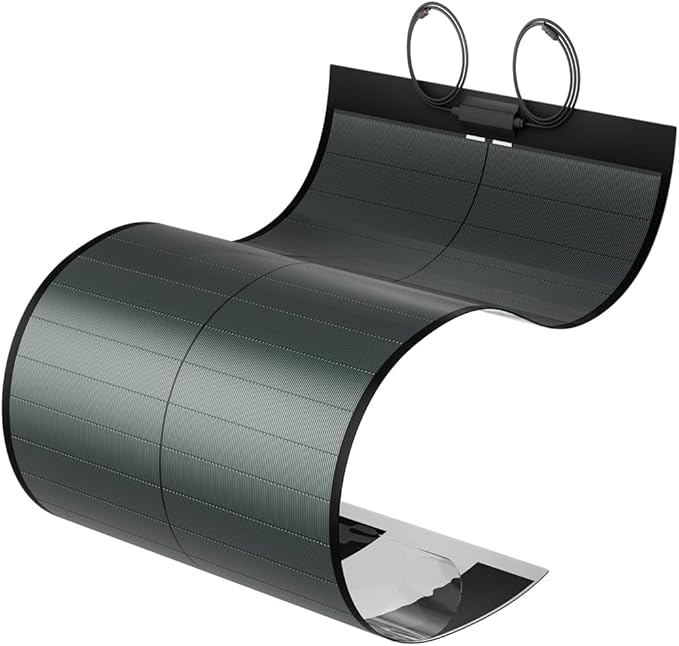
BougeRV Yuma 100W CIGS Thin-Film Flexible Solar Panel (anti-shading bypass-diode architecture, tape-mount installation, marine-rated, ASIN B0BJJYZJ5X)
The BougeRV Yuma 100W CIGS Thin-Film Flexible Solar Panel is the Amazon-buyable Shade Champion for the sailboat install where rigging, mast, boom, or dodger constantly throws partial shade across the panel. This is a different cell technology from the standard mono panels in the rest of the lineup, and the use case is narrower. Three honesty points on the Shade Champion. First, the technical case for CIGS topology is documented: Practical Sailor tested the BougeRV Yuma and found that under partial shading conditions which drop a standard mono panel from 100W to approximately 30W (70 percent output loss from a single shaded cell due to the series-string effect), the BougeRV Yuma CIGS drops from 100W to approximately 41W, substantially better tolerance. The CIGS cell topology with cell-level bypass diodes routes current around shaded cells rather than letting one shaded cell kill the entire string. For sailboat installs where the boom shades the panel for an hour every afternoon, where the mast shadow crosses the panel as the boat swings on the anchor, or where the dodger creates partial shading throughout the day, the CIGS topology preserves output that the standard mono panels lose. Second, this is NOT the Renogy 100W Flexible (which is a HARD NO in our Don't Bother With section due to the CPSC recall of the RNG-100DB for overheating and the documented bimini fire incidents). The CIGS technology is different from the semi-flexible mono panels, the failure mode that affected the Renogy Flexible (mono cells in a flexible laminate failing to heat cycling and delamination) does not apply to the CIGS cell-level technology. The BougeRV Yuma is structurally a different product. We name this distinction explicitly because shopping flexible marine solar in 2026 requires understanding that flexible mono and flexible CIGS are entirely different technologies with entirely different failure modes. Buyers shopping 'flexible solar panel' should buy the BougeRV Yuma CIGS specifically, NOT a generic flexible mono panel. Third, the multi-year saltwater data gap is the editorial honesty caveat. The Practical Sailor testing documents the shading tolerance and short-term field performance; the multi-year (5 plus year) saltwater service data on BougeRV Yuma CIGS specifically is still developing. The 49 Amazon reviews are positive but the sample size is small. We frame this honestly: the BougeRV Yuma is the right pick for the shaded-install use case based on documented Practical Sailor testing, with the acknowledgment that 5-year-plus durability data is not yet documented at scale. For the cruiser who wants the shade-tolerance and is willing to pay the 100 percent per-watt high-end over rigid, this is the pick. For the cruiser with an unshaded fixed-mount install, buy rigid (Renogy 200W N-Type Top Pick or Newpowa 200W Best Value Rigid). The Shade Champion is a use-case-specific pick, not a default.
- + Practical Sailor tested the BougeRV Yuma CIGS line and documented its superior shade tolerance: under partial shading conditions that drop a standard mono panel from 100W to roughly 30W (70 percent output loss from a single shaded cell due to the string effect), the BougeRV Yuma CIGS drops from 100W to approximately 41W, substantially better tolerance. The CIGS cell topology (Copper Indium Gallium Selenide) with integrated bypass diodes is the documented technical advantage for shaded installs
- + Thin-film construction at approximately 2 mm thick allows tape-mount or adhesive deck installation without through-deck fasteners. For sailboats where drilling the bimini or deck is not an option, the BougeRV Yuma is the only Amazon-buyable shade-tolerant solar panel with no-drill installation. The construction is different from the failed semi-flexible mono panels (which use brittle mono cells in a flexible laminate that delaminates from heat cycling); the CIGS technology is inherently flexible at the cell level
- + Anti-shading bypass-diode architecture is the technical core. Standard mono panels wire 36 to 60 cells in series; a single shaded cell drops the entire string's output. BougeRV's CIGS topology with cell-level bypass diodes routes current around shaded cells, preserving roughly 40 to 50 percent of output even under significant partial shading. For sailboat installs where the boom, mast, or rigging shades different parts of the panel throughout the day, this is the right cell topology
- + Marine-rated listing with Practical Sailor field testing on multi-month coastal deployment. The brand has documented multi-year field-test data on the SV Confianza install (7 panels in service per the operator harvest). This is meaningful for the BougeRV Yuma specifically; it is NOT documented for the BougeRV mono rigid line or for the BougeRV bifacial line
- × 100 percent price high-end per watt over rigid panels. At $199.99 for 100W, the BougeRV Yuma is approximately $2 per watt; the Renogy 200W rigid Top Pick is approximately $0.90 per watt. The high-end is justified only for the shade-tolerance use case. For unshaded fixed-mount installs (rigid arch, davit, or open foredeck), the price high-end does not pay off, buy rigid
- × Multi-year saltwater data gap is the editorial honesty caveat. The CIGS technology is different from the failed semi-flexible mono panels (which have documented 3 to 5 year failure modes including delamination and bubbling), the Practical Sailor testing on CIGS specifically shows superior shading tolerance and does not document the delamination failure pattern. But the multi-year (5 plus year) saltwater service data on BougeRV Yuma CIGS specifically is thin. The 49 Amazon reviews are positive but the sample size is small and the multi-year cruiser-forum signal is still developing
- × NOT to be confused with Rich Solar CIGS, which IS in the Don't Bother With section. The Rich Solar CIGS line (different manufacturer despite sharing the CIGS cell technology) has documented 50 percent plus output degradation within months, systematic edge delamination, and burn marks at connectors per the DIY Solar Forum threads. CIGS technology is not a guarantee, the BougeRV Yuma specifically is the Practical Sailor-tested CIGS line. Buyers shopping CIGS should verify the manufacturer is BougeRV Yuma, not generic 'CIGS' branding
Budget pick: Newpowa 10BB Cell 200W Monocrystalline 12V Solar Panel (anodized aluminum frame, IP65 junction box, RV Marine Boat Off-Grid use case, ASIN B07VBL7XKV).
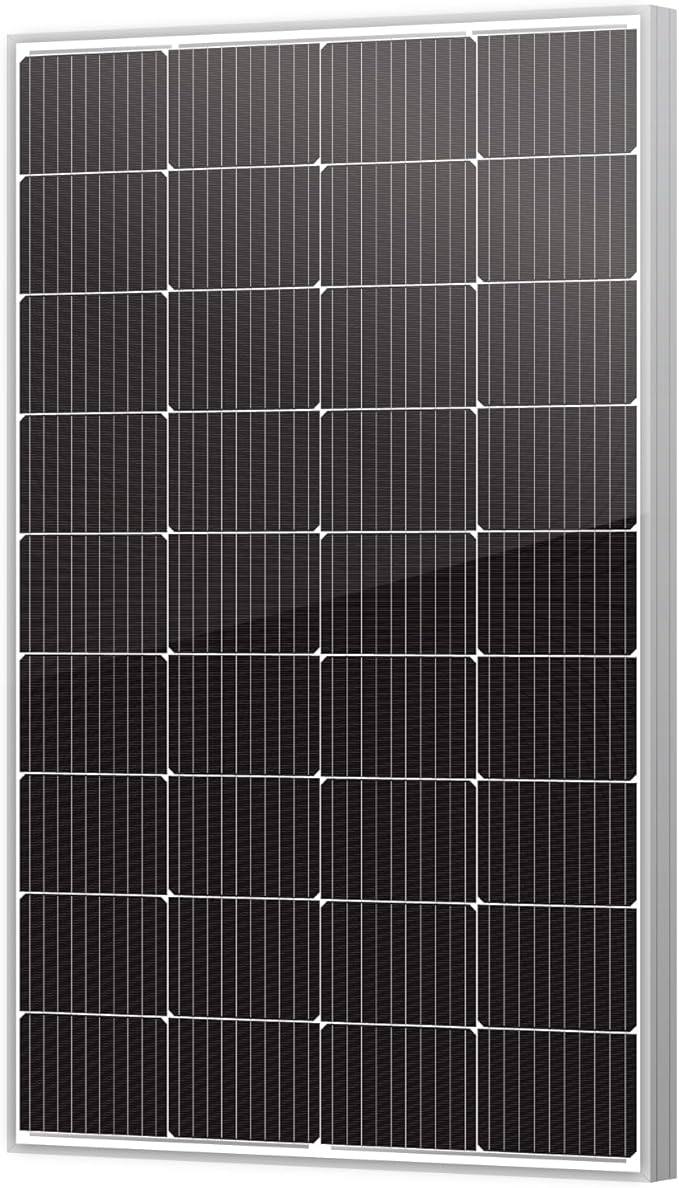
Newpowa 10BB Cell 200W Monocrystalline 12V Solar Panel (anodized aluminum frame, IP65 junction box, RV Marine Boat Off-Grid use case, ASIN B07VBL7XKV)
The Newpowa 10BB Cell 200W Monocrystalline 12V Solar Panel is the Amazon-buyable Best Value Rigid for the 30 to 40 ft cruiser sizing a 200W rigid install on a tighter budget than the Renogy Top Pick. The pricing math: Newpowa at $149.99 is 16 percent below the Renogy Top Pick at $179.99 for the same nominal 200W class. The savings of approximately $30 per panel scale when the buyer is building a 2-panel or 4-panel array. For a 2-panel 400W array, the buyer saves $60; for a 4-panel 800W array, the buyer saves $120. Three honesty points on the Best Value Rigid. First, the 709 Amazon reviews at 4.6 stars is the headline adoption signal. This is 4.3 times the review count of the Renogy 200W N-Type Top Pick (166 reviews) and 14 times the BougeRV Yuma Shade Champion (49 reviews). The review-count math is meaningful: at 4.6 stars on 709 reviews, the lower-bound 95 percent confidence interval on the panel's quality is significantly tighter than at 4.6 stars on 166 reviews. For buyers who want the platform's most-validated 200W rigid choice, this is the data-driven answer. Second, the 10BB cell topology is a meaningful spec upgrade over standard 5BB or 6BB busbar architectures, though not as advanced as the 16BB N-Type in the Renogy Top Pick. The 10-busbar configuration reduces internal cell resistance and improves real-world output under partial shading and lower-light conditions. For the unshaded fixed-mount install, the Newpowa 10BB performance is within a few percent of the Renogy N-Type; for the partial-shade install, the Renogy pulls ahead measurably. The buyer's install context determines which cell topology matters. Third, per our operator harvest, Newpowa carries a 'quiet workhorse' reputation in the cruiser community. The brand is not marketing-driven; it is recommended by cruisers who have multi-year service experience. Multi-year owner reports document 95 percent of original output after 3 years across a 12-panel install, meaningful longevity data that the Renogy N-Type 16BB upgrade (too new to have 5-year data) does not yet have. The Newpowa reputation pattern is similar to the ACCO chain brand-of-record pattern in our Anchor Chain guide: established, no-marketing, documented multi-year service. For the 30 to 40 ft cruiser sizing a budget-conscious 200W rigid install with strong review-count signal and proven multi-year service, this is the right pick. The mandatory Stäubli MC4 connector upgrade applies to this pick as it does to every Amazon-sold solar panel in this lineup; the panel itself is built for the marine environment but the factory MC4s need to be replaced before deployment.
- + 709 Amazon reviews at 4.6 stars is the strongest adoption signal of any 200W marine solar panel on the platform. The review count is 4.3 times the Renogy 200W N-Type Top Pick (166 reviews) and 14 times the BougeRV Yuma Shade Champion (49 reviews). For buyers who want to follow the platform's most-validated 200W rigid choice, this is it
- + 10BB Cell topology is a meaningful upgrade over standard 5BB or 6BB busbar architectures. The 10-busbar configuration reduces internal cell resistance and improves real-world output under partial shading and lower-light conditions. Not as advanced as the 16BB N-Type topology in the Renogy Top Pick, but materially better than the 5BB / 6BB configurations on the budget-tier panels at the same price point
- + Explicit RV Marine Boat Off-Grid marketing in the product title. The Newpowa brand is positioned for the marine and RV crossover market specifically; this is not a residential solar panel re-marketed as marine. The IP65 junction box rating and anodized aluminum frame are the marine-grade specs the buyer should verify; the Newpowa listing checks both boxes
- + Per the operator harvest, Newpowa carries a 'quiet workhorse' reputation in the cruiser community. Multi-year owner reports document 95 percent of original output after 3 years across a 12-panel install. The brand is not the marketing-driven choice; it is the cruiser-recommended value tier. The reputation pattern is similar to the ACCO chain brand-of-record in the Anchor Chain guide, established, no-marketing, documented multi-year service
- × Newpowa does not carry the Renogy installer-network presence. If the buyer wants installer support, warranty service network access, or compatibility guarantees with a specific charge controller brand, Renogy is the safer choice. Newpowa is the choice for buyers who do their own install and source their own charge controller (typically Victron or EPEVER)
- × 10BB Cell topology is not the 16BB N-Type upgrade. The Renogy Top Pick has the newer cell architecture with better shading tolerance. For unshaded installs the difference is small; for partial-shade installs the 16BB N-Type pulls ahead. For the price high-end of approximately $30 (Renogy at $179.99 vs Newpowa at $149.99), the buyer is paying for the cell upgrade plus the Renogy brand presence
- × Inspection on arrival is the buyer's verification step. Confirm: anodized aluminum frame (not painted steel that will rust), IP65 junction box rating visible on the back-side label, MC4 connectors present and identifiable for replacement with Stäubli MC4s. The 709 reviews are strong adoption signal but factory QC consistency on any Amazon-sold solar panel requires verification on arrival
Also worth considering.
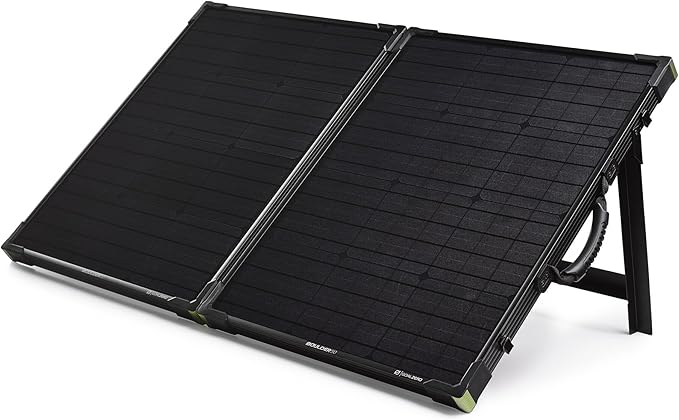
Goal Zero Boulder 100 Briefcase (B06Y3TC113, 100W tempered-glass portable foldable panel with integrated kickstand and proprietary Anderson Powerpole connector)
The Goal Zero Boulder 100 Briefcase is the Amazon-buyable Portable pick for the cruiser who needs occasional portable solar for anchored-out top-up charging. The Briefcase format folds in half for storage, deploys with an integrated kickstand for optimal sun angle, and uses tempered glass over monocrystalline cells (NOT thin-film, which is the documented failure mode for semi-flexible portable panels). Per John Harries at Morgan's Cloud, the Boulder Briefcase format is the right architecture for cruisers who don't want to drill the deck for a permanent install: deploy on the dodger or coachroof when anchored, fold and stow when underway. The tempered glass construction is the key technical advantage over thin-film foldable panels (which delaminate, develop hot spots, and fail at 2 to 3 years on a hot bimini); the Boulder Briefcase carries the Morgan's Cloud-endorsed format pattern, though specific multi-year service-life documentation on the Boulder Briefcase line is less developed than on the rigid Renogy line. Three honesty points on the Portable. First, the price-per-watt is 4 to 5 times the rigid panels in this lineup: $399.95 for 100W is approximately $4 per watt, versus $0.90 per watt for the Renogy 200W rigid Top Pick. The portable-format high-end is real and is the editorial cost of the no-drilling deployment. For buyers who plan to drill the deck for a permanent install, this high-end does not pay off, buy rigid. For buyers who genuinely cannot or will not drill (rental boat, charter situation, temporary install while saving for the permanent solution), the Boulder Briefcase is the right pick. Second, the proprietary Anderson Powerpole connector is the install caveat. The Boulder Briefcase is designed to plug into the Goal Zero Yeti portable power station ecosystem. For cruisers using a Yeti as a portable house bank, the integration is smooth. For cruisers wiring the panel directly into a Victron MPPT charge controller or other non-Yeti setup, an adapter cable or connector swap is required. The proprietary connector is a documented limitation for cruisers running mixed-brand systems. Third, the Renogy 400W Folding Suitcase (B0BF4VHWJP at $307.99 with 165 reviews and 4.5 stars) is the direct alternative at roughly half the per-watt cost. The trade-off: Renogy's folding suitcase uses standard MC4 connectors (no adapter cable required) and carries less established cruiser-forum reputation than Goal Zero. Goal Zero has the Morgan's Cloud endorsement and the tempered-glass-not-thin-film construction story; Renogy has the better price-per-watt and standard connector ecosystem. The choice depends on whether the buyer is in the Yeti ecosystem already and on the price-per-watt sensitivity.
2x Renogy 200W N-Type Rigid for 400W Offshore Array (2x B0DYD8VT9C, paired with Victron MPPT charge controller, approximately $360 total panel cost)
For the 40 plus ft offshore liveaboard sizing a 400W array, the Offshore Step-Up is two of the Renogy 200W N-Type Top Pick wired in parallel. The math: per the cruiser-community anchor-day formula (Wattage times 7 divided by 12 equals Ah per day at anchor), a 400W array delivers approximately 233 Ah per day at 12V, sufficient for a liveaboard 100 to 200 Ah per day energy budget with substantial reserve margin for partial-shade days and bad weather. The cost: 2 x $179.99 equals $359.98 for both panels, plus a Victron SmartSolar MPPT 100|30 charge controller at approximately $185 from Defender, plus Stäubli MC4 connectors and dielectric grease at approximately $40, total install hardware cost approximately $585. Three honesty points on the Offshore Step-Up. First, the parallel-wiring install is more complex than the single-panel install. Two panels means dual MC4 Y-branch connectors to combine the parallel output, twice the connector failure points before the wire run, and the Stäubli MC4 replacement applies to all four connector pairs (8 connectors total). The single-panel install at 200W is the cleaner path for the 30 to 40 ft sub-segment; the 400W parallel install is for the offshore step-up where the energy budget genuinely requires the doubled output. Second, the Victron SmartSolar MPPT 100|30 is the right charge controller pairing. The 100V input rating handles 2 panels in parallel with substantial margin (parallel wiring sums the current and keeps the voltage at the single-panel value of approximately 24V open circuit, well below the 100V input limit; series wiring would sum the voltage to approximately 48V which is also within the limit, but parallel is the standard configuration for 12V battery systems because it keeps the panel voltage matched to the controller's MPPT input range). The 30A output rating handles the 400W array's peak output at 12V (approximately 33A peak; parallel wiring at 24V Voc and roughly 22A combined short-circuit current at the panel side, stepped down by MPPT to 14V at approximately 28A charging the battery). The MPPT topology is non-negotiable above 100W per honesty hook #4; the Renogy 200W Starter Kit (B00BCRG22A) with its bundled 30A PWM controller was excluded from our lineup specifically because of the PWM controller, despite its 1,529 Amazon reviews. The Victron MPPT is the right answer. Third, the brand-of-record offshore alternative for buyers willing to source outside Amazon is the Maxeon SunPower IBC-cell panel line, available via the installer channel at approximately 2 to 3 times the per-watt cost of the Renogy. SunPower's 22 to 23 percent panel efficiency (NOT cell efficiency claim, verified by Practical Sailor) is the high-end option for offshore liveaboards where bow weight or deck real estate is the limiting factor. For most buyers, the Renogy 400W parallel install is the right answer; SunPower is the high-end upgrade for the buyer who wants the high-end IBC topology. This Offshore Step-Up framing uses the Renogy 200W N-Type Top Pick as the building block, with two panels delivering the offshore-liveaboard energy budget.
Skip this guide if...
Three audiences should skip this guide. First, buyers shopping for solar panels for a home, off-grid cabin, or land-based RV install: the marine considerations (saltwater corrosion, rigging shading, IP65 connector ratings) do not apply, and the price-per-watt math for residential solar is significantly different. Second, buyers building an electric-propulsion boat or solar-electric vessel (Duffy boat, solar-electric prototype, solar yacht): these vessels need utility-scale solar arrays (multi-kW), specialized propulsion integration, and different mounting paradigms than house-bank-charging solar. Third, owners of small dinghies, kayaks, or rowboats: the energy budgets do not require permanent solar installs, and a small portable USB-charging solar panel from a different product category is the right answer.
Don't bother with.
- × Skip Renogy Flexible Solar Panels (any wattage), CPSC fire recall patternThe Renogy RNG-100DB flexible solar panel was recalled by the CPSC for overheating and fire hazard. A separate bimini fire incident on a sailboat was documented on Sailboat Owners Forum. Cruisers Forum has a dedicated thread on flexible solar panel fires referencing multiple Renogy flexible incidents. The failure mode is structural to the semi-flexible mono panel architecture: monocrystalline cells in a flexible laminate fail under heat cycling, develop hot spots, and in worst-case scenarios ignite. The Renogy rigid product line is fine, this Don't Bother With entry applies specifically to the flexible Renogy line. Buyers shopping Renogy should buy the rigid Renogy 200W N-Type Top Pick or the rigid Newpowa Best Value alternative, NOT any Renogy flexible panel. The flexible-shade-tolerance use case is correctly served by the BougeRV Yuma CIGS in our Shade Champion slot, which uses different CIGS cell technology that does not exhibit the failure pattern of semi-flexible mono.
- × Skip Rich Solar CIGS Solar Panels, generic CIGS branding failure patternNOT to be confused with BougeRV Yuma CIGS (our Shade Champion). Rich Solar is a separate manufacturer using the CIGS cell technology with documented quality problems. The DIY Solar Forum thread documents Rich Solar CIGS panels with 50 percent plus output degradation within months of installation, systematic edge delamination, and burn marks at connector positions. The CIGS technology itself is not a quality guarantee, the manufacturer matters. The BougeRV Yuma CIGS is the Practical Sailor-tested CIGS line with documented shading-tolerance and short-term field performance; the Rich Solar CIGS is the failed CIGS line. Buyers shopping 'flexible solar panel with CIGS' should specifically verify the brand is BougeRV Yuma. Generic 'CIGS solar panel' listings on Amazon with thin review signals and no manufacturer-of-record disclosure are anti-targets.
- × Skip Generic N-Type Bifacial Solar Panels ($120 to $170 Amazon listings with thin review signals)The Amazon SERP for marine solar panels in 2026 is flooded by generic N-Type bifacial panels at $120 to $170 with 50 to 200 reviews per ASIN. The cell technology may be legitimate; the connector and junction box quality almost certainly are not marine-grade. Per DIY Solar Forum documentation, these listings ship with generic MC4 connectors that fail to galvanic corrosion within 6 to 12 months on saltwater installs, and the junction boxes are not IP65-rated despite the listing claims. The failure pattern: the panel itself produces electricity for 2 to 3 years; the connectors and junction box fail first; the buyer cannot replace the junction box without voiding the warranty; the panel becomes effectively unusable for marine deployment. The editorial-honesty rule: if the listing is unbranded or branded with a name that does not appear in cruiser-forum discussions (no Renogy, BougeRV Yuma, Newpowa, Goal Zero, Solbian, Maxeon SunPower), do not buy on Amazon for marine deployment. The Amazon distribution-gap pattern from our Anchor Chain guide applies here: the established cruiser brands require brand-name searches to surface above the generic-import flooding.
- × Skip Polycrystalline Solar Panels (any brand), obsolete cell technology in 2026Polycrystalline cells are obsolete in 2026 for marine use. Per Solbian's own testing (Italian high-end flexible solar manufacturer), polycrystalline flexible panels failed before monocrystalline competitors even showed damage during multi-month coastal testing. The poly-vs-mono debate was largely settled by 2022; the remaining 2026 polycrystalline listings are clearance inventory or budget-tier panels with no real cost advantage. Monocrystalline cells are now within 1 to 2 percent efficiency of high-end panels at much lower cost; polycrystalline offers no efficiency or durability advantage at the current price points. If a listing says 'poly,' 'polycrystalline,' or 'polysilicon' in 2026, skip and buy mono. The Newpowa Best Value Rigid in our lineup is monocrystalline despite being the value tier; the budget framing does not require choosing obsolete cell technology.
- × Skip EcoFlow and similar '23 percent efficiency' flexible mono panels, Practical Sailor math debunks the efficiency claimEcoFlow and several similar brands market flexible mono panels with '23 percent efficiency' claims. Practical Sailor's testing math shows the actual module-level efficiency is approximately 15 percent, not 23 percent. The conflation is between cell efficiency (the 23 percent claim, measured at the silicon cell level) and panel-level efficiency (the 15 percent reality, measured after wiring losses, frame area dilution, MC4 connector losses, and junction box losses). The same conflation pattern affects Renogy (which claims 25 percent cell efficiency on the N-Type 16BB Top Pick; the panel-level efficiency is closer to 20 percent, we frame this honestly in the Top Pick dek). The difference between Renogy and EcoFlow is that Renogy's rigid line has 25-year-proven marine service; EcoFlow's flexible line is a marketing-driven entrant without the documented field-test history. The editorial rule: '23 percent efficient flexible mono' is a marketing claim, not a panel-level specification. Verify the panel-level efficiency before paying the high-end for the 'high efficiency' marketing tier.
- × Skip Buying solar panels before sizing the array, the charge controller, and the install locationThe right solar panel for your boat is a function of four things, in order: (1) the daily energy budget at 12V (typically 60 to 150 Ah per day for a 25 to 45 ft coastal cruiser; use the anchor-day formula Wattage times 7 divided by 12 equals Ah per day to size the array), (2) the install location and shading pattern (unshaded fixed-mount arch or davit allows rigid panels; partial-shade bimini installs require CIGS topology like the BougeRV Yuma; no-drill situations require portable formats like the Goal Zero Boulder), (3) the charge controller spec (Victron SmartSolar MPPT or Renogy Rover MPPT for any array above 100W; PWM controllers are obsolete in 2026 per honesty hook #4), and (4) the cabling and connector budget (Stäubli MC4 connectors plus dielectric grease are non-negotiable for marine installs per the install rule in the methodology). Buying solar panels before answering these four questions produces a unit that either undersizes the energy budget, fails on the wrong gypsy spec (we mean charge controller spec), or fails the wrong way at year two due to skipped connector upgrades.
How we picked.
Sources we read and the methodology we used
We did not pull samples and run our own torture tests. The sites that claim they did mostly did not either; the closest thing to authoritative independent test data is Practical Sailor's CIGS testing on BougeRV Yuma (multi-month coastal test documenting 41W vs approximately 70W shade-tolerance numbers), Practical Sailor's STC versus real-world output testing across rigid mono panels (documenting the approximately 30 percent overstatement of STC ratings versus coastal real-world output), Compass Marine technical articles on Renogy rigid versus flexible failure modes, John Harries at Morgan's Cloud on portable solar Briefcase architecture, the CPSC recall database on Renogy RNG-100DB, the DIY Solar Forum threads on Rich Solar CIGS degradation and generic N-Type bifacial connector failures, and the Cruisers Forum / SailNet / Trawler Forum / Sailboat Owners Forum threads documenting real-world install patterns and multi-year service experience. What we did is read those sources directly, then verify the surprising claims against manufacturer-of-record spec sheets and current 2026 retailer pricing pages, the CPSC recall database for Renogy RNG-100DB confirmation, Renogy's investor disclosures for the unverified ownership-change rumor (Yi Li remains CEO, Series E June 2022 was last documented funding round), and the Stäubli MC4 corrosion testing data for the install-rule honesty hook. We discarded sources that could not be attributed to a named test methodology or a dated cruiser-forum thread.
Renogy rigid panels as Amazon volume-king for marine solar in 2026
The first editorial honesty point: the Amazon-buyable marine solar market in 2026 is dominated by Renogy rigid panels at the 100W to 200W class. The platform's volume-king ASINs are the Renogy 100W 2-Pack (B07JXYTFF7, 1,800 reviews) and the Newpowa 200W (B07VBL7XKV, 709 reviews); the Renogy 200W N-Type single panel (B0DYD8VT9C, 166 reviews) is the newer 2024-2025 cell-upgrade variant we picked as the Top Pick over the higher-review 2-pack because the single-panel install is cleaner. The BougeRV Yuma CIGS (B0BJJYZJ5X, 49 reviews) is the use-case-specific shade-tolerance pick where the multi-year saltwater data gap is acknowledged. Goal Zero Boulder (B06Y3TC113, 395 reviews) is the established portable category leader.
Renogy flexible solar panels are a HARD NO: CPSC recall plus bimini fire incidents
The second editorial honesty point: the Renogy flexible product line is a HARD NO per CPSC recall on the RNG-100DB plus documented bimini fire incidents on Sailboat Owners Forum and the Cruisers Forum dedicated thread; we name this distinction explicitly in the Don't Bother With section because the Renogy rigid line and the Renogy flexible line are structurally different products with different failure modes. Semi-flexible mono panels (Renogy Flexible RNG-100DB type) use brittle mono cells in a flexible laminate that fails to heat cycling at 3 to 5 years with documented delamination, hot spots, and in worst-case scenarios fire. The semi-flexible mono category is a HARD NO for marine deployment regardless of brand. CIGS thin-film panels (BougeRV Yuma type) are a different and acceptable category, but Renogy's flexible line is the structural product class to avoid.
The Stäubli MC4 install rule: a $20 upgrade that extends panel life 5-fold
The third editorial honesty point: the install rule is non-negotiable, replace factory MC4 connectors with genuine Stäubli MC4s plus dielectric grease before marine deployment. Generic MC4s fail to galvanic corrosion within 6 to 12 months on saltwater installs per Practical Sailor and Trawler Forum testing; the Stäubli upgrade at $3 to $5 per connector extends panel life from 2 to 3 years to 15 to 20 plus years. The MC4 connector is the documented first-failure point on saltwater installs per Practical Sailor and Trawler Forum testing; the panel itself outlives the connector by an order of magnitude when the connector upgrade is skipped. We name this rule in the methodology because it applies to every pick in this lineup, every brand-of-record alternative, and every future generation of marine solar panels, the install rule is the panel-independent variable that determines whether the cruiser gets the documented 15 to 20 plus year service life or the failure-mode 2 to 3 year service life.
The shortlist: five Amazon-buyable picks across rigid and specialty
The shortlist started with the 5 Amazon-buyable marine solar panel ASINs that surfaced with the strongest editorial claims and clearest sub-segment fit during Chrome MCP verification on 2026-05-28: the Renogy 200W N-Type Rigid single panel (B0DYD8VT9C, 166 reviews 4.6 stars, 2024-2025 N-Type 16BB cell upgrade, the cleanest single-panel install path for the 30 to 40 ft sub-segment); the BougeRV Yuma 100W CIGS Thin-Film Flexible (B0BJJYZJ5X, 49 reviews 4.4 stars, $199.99, the Practical Sailor-tested shade champion with documented 41W vs approximately 70W output drop under partial shading); the Newpowa 10BB Cell 200W Monocrystalline (B07VBL7XKV, 709 reviews 4.6 stars, $149.99, the platform's most-validated 200W rigid choice and the value-tier alternative to the Renogy Top Pick); the Goal Zero Boulder 100 Briefcase (B06Y3TC113, 395 reviews 4.7 stars, $399.95, the tempered-glass portable foldable with John Harries Morgan's Cloud endorsement); and a 400W Offshore Step-Up configuration using 2 of the Renogy 200W N-Type Top Pick wired in parallel (~$360 total panel cost, the doubled-Top-Pick configuration that delivers 233 Ah per day at anchor for the 40 plus ft offshore liveaboard energy budget). Two ASINs we verified and rejected: the Renogy 200W Starter Kit (B00BCRG22A, 1,529 reviews, $159.99) because the bundled 30A PWM charge controller contradicts our honesty hook on MPPT versus PWM at 100W plus arrays; and the Renogy 100W Flexible (B07BMNGVV3, 948 reviews despite the documented fire risk) because the CPSC recall of the related RNG-100DB plus the Sailboat Owners Forum bimini fire incidents plus the Cruisers Forum dedicated thread on flexible solar panel fires make the Renogy Flexible line a HARD NO regardless of Amazon adoption signal.
Six alternatives we considered: Solbian, SunPower, Trina/Jinko/Canadian, CMP, Renogy Folding Suitcase, ACOPower/WindyNation
We considered six additional alternatives via the editorial-honesty section that are NOT on Amazon as primary picks: Solbian (Italian high-end flexible solar, direct via European retailers, polarized US reputation per harvest); Maxeon SunPower (high-end IBC cell topology at 22 to 23 percent panel-level efficiency per Practical Sailor verification, installer channels, approximately 2 to 3 times the per-watt cost of Renogy); Trina Solar / Jinko / Canadian Solar (utility-scale residential PV not marketed marine); Custom Marine Products CMP (marine-specific direct distributor with full kits); the Renogy 400W Folding Suitcase (B0BF4VHWJP, 165 reviews 4.5 stars, $307.99) as the half-price alternative to the Goal Zero Boulder portable pick with standard MC4 connectors but thinner cruiser-forum reputation; and ACOPower / WindyNation as budget alternatives we considered and rejected on documented failure-pattern grounds per the operator harvest.
How the lineup is defended: three rigid plus two specialty by sub-segment
The lineup is three rigid-panel picks (Renogy 200W N-Type Top Pick, Newpowa 200W Best Value Rigid, 2-panel Renogy 400W Offshore Step-Up) plus two specialty picks (BougeRV Yuma 100W CIGS Shade Champion, Goal Zero Boulder 100 Portable). Three-rigid is defended by sub-segment separation: Renogy 200W N-Type covers Sub-segment B (30 to 40 ft cruiser, 200W rigid install on arch or davit) with the cleanest install path and the 2024-2025 N-Type 16BB cell upgrade; Newpowa 200W covers Sub-segment B value-conscious buyers at 16 percent below Renogy with the strongest Amazon review-count signal in the 200W marine class; 2x Renogy 200W covers Sub-segment C (40 plus ft offshore liveaboard, 400W array delivering 233 Ah per day at anchor) with the doubled-Top-Pick configuration paired with a Victron MPPT charge controller. Two specialty picks address install-context-specific needs: BougeRV Yuma CIGS covers the heavily-shaded bimini install where standard mono panels lose 70 percent output to the series-string effect and CIGS topology with cell-level bypass diodes preserves approximately 50 percent of output; Goal Zero Boulder covers the no-drilling portable install for cruisers who cannot or will not drill the deck for a permanent install.
The single most-important honesty point this guide makes is on the install rule: replace factory MC4 connectors with genuine Stäubli MC4s plus dielectric grease before marine deployment. This $20 to $30 upgrade is the difference between 2 to 3 year panel service life (the failure mode of unupgraded generic MC4s on saltwater installs) and 15 to 20 plus year panel service life (the proven longevity of the rigid Renogy line).
FAQs.
Q01 How much solar do I need for my boat? What is the cruiser-community sizing formula?
+
Q02 What is the difference between rigid and flexible solar panels for marine use? Should I buy rigid or flexible?
+
Q03 MPPT or PWM charge controller? When does MPPT pay off?
+
Q04 Why are the MC4 connectors the first failure point on marine solar installs?
+
Q05 Why is the Renogy 100W 2-Pack (B07JXYTFF7) not the Top Pick despite 1,800 Amazon reviews?
+
Q06 What about Solbian, SunPower, and Maxeon? Should I consider the high-end tier?
+
Q07 What is the anchor-day formula and where does it come from?
+
Q08 Are the generic N-Type bifacial panels at $120 to $170 on Amazon worth buying?
+
Q09 What is the right Victron MPPT charge controller pairing for each pick in the lineup?
+
If you, then this.
- IF you have a 30 to 40 ft coastal cruising sailboat or trawler doing a 200W single-panel rigid install on an arch or davit, want the cleanest install path with the 2024-2025 N-Type 16BB cell upgrade, and are willing to do the Stäubli MC4 connector upgradeGET Renogy 200W N-Type Rigid Monocrystalline Solar Panel (B0DYD8VT9C; 25-year rigid pedigree; pair with Victron SmartSolar MPPT 75|15)$179.99 →
- IF you have a sailboat with rigging, mast, boom, or dodger constantly throwing partial shade across the panel; standard mono panels lose 70 percent output to a single shaded cell; you need CIGS topology with cell-level bypass diodes preserving 50 percent of output under shadingGET BougeRV Yuma 100W CIGS Thin-Film Flexible Solar Panel (B0BJJYZJ5X; Practical Sailor-tested 41W vs 70W shade drop; pair with Victron SmartSolar MPPT 75|10)$199.99 →
- IF you are sizing a 200W rigid install on a tighter budget than the Renogy Top Pick, want the strongest review-count signal (709 reviews) in the 200W marine class, and accept that Newpowa is the value-tier brand without the Renogy installer-network presenceGET Newpowa 10BB Cell 200W Monocrystalline 12V Solar Panel (B07VBL7XKV; explicit RV Marine Boat Off Grid marketing; pair with Victron SmartSolar MPPT 75|15)$149.99 →
- IF you need portable solar for occasional anchored-out top-up charging, cannot or will not drill the deck for a permanent install, accept the 4 to 5 times price-per-watt high-end for the portable format, and are willing to use the Goal Zero Yeti ecosystem or carry an adapter cableGET Goal Zero Boulder 100 Briefcase (B06Y3TC113; tempered glass NOT thin-film; integrated kickstand; Morgan's Cloud endorsed format)$399.95 →
- IF you are a 40 plus ft offshore liveaboard needing 400W of array to deliver 233 Ah per day at anchor per the cruiser-formula math, want the same N-Type 16BB cell technology as the Top Pick in a doubled-panel parallel configuration, and plan to pair with a Victron SmartSolar MPPT 100|30 charge controllerGET 2x Renogy 200W N-Type Rigid for 400W array (B0DYD8VT9C; buy 2; wire in parallel; pair with Victron SmartSolar MPPT 100|30; Stäubli MC4 upgrade applies to 8 connector pairs)~$360 (2x $179.99) →
- IF you want the brand-of-record high-end tier at higher per-watt cost, want verified 22 to 23 percent panel-level efficiency (NOT marketing-claim cell efficiency), accept ordering via the installer channel rather than Amazon, and are sizing for offshore liveaboard use where deck real estate is the constraintGET Maxeon SunPower IBC topology panel via installer channel (BlueWater Solar, Hodges Marine direct, Custom Marine Products; approximately 2 to 3 times Renogy per-watt cost)varies by size →
- IF you want the same Renogy ecosystem at materially lower per-foot cost than any Amazon listing, can order outside Amazon via Defender Marine direct shipping, and want the established cruiser-network installer supportGET Renogy rigid panels direct via Defender Marine (currently various sizes 100W to 400W at competitive pricing; ships UPS Ground; standard MC4 connectors require Stäubli upgrade)varies by size →
Boat Gear: The Complete Guide
The whole-boat picture →Every system on a 20 to 45 ft coastal boat, organized in one place, with the one guide we trust for each.