Best Marine VHF Radios: The 5 We'd Mount in 2026
Five radios that earn their spots for a 25 to 40 foot coastal helm, three fixed-mount and two handheld, sorted by install context and the one spec that decides fit. We read Boating Magazine's handheld comparison test, Yachting World's Icom M94D review, the USCG NavCen licensing guidance and the FCC Part 80 type-acceptance rules, plus every Amazon, The Hull Truth, Cruisers Forum, and GradyWhite Boat Owner's Forum thread we could find. We sorted the IPX4 splash-resistant from the IPX8 submersible, the built-in-GPS from the chartplotter-dependent, and the AIS-receive from the AIS-blind, then named what to skip. The load-bearing honesty point: the cheapest fixed-mount is IPX4 splash-only and wrong for an exposed helm, and a DSC distress call only transmits your position if the radio has GPS, internal or fed over NMEA from a chartplotter, so the right radio depends on your helm and your electronics, not the price.
- 01 Uniden UM385BK , top pick for a protected coastal helm, $149 and 2,675 owner reviews
- 02 Standard Horizon GX1850 , step-up fixed-mount with NMEA 2000 and the marine industry's trust
- 03 Uniden Atlantis 275 , budget handheld that floats, the dinghy and ditch-bag pick
- 04 Icom M94D , the handheld with built-in AIS receive and 5-star audio, $400
- 05 Cobra MR F77W GPS , fixed-mount with built-in GPS for the boat without a chartplotter
How they compare.
| Rank | Product | Best for | Price | Our score |
|---|---|---|---|---|
| 01 | Uniden UM385BK
Top Pick
| Protected coastal helm | $149
Buy → | 8.9/10 |
| 02 | Standard Horizon GX1850 | Helm with NMEA 2000 | $270
Buy → | 8.7/10 |
| 03 | Uniden Atlantis 275 | Budget handheld backup | $127
Buy → | 8.5/10 |
| 04 | Icom M94D | Handheld with AIS receive | $400
Buy → | 8.4/10 |
| 05 | Cobra MR F77W GPS | Fixed-mount with built-in GPS | $200
Buy → | 8.2/10 |
Prices are current Amazon prices at time of publication and can change. Scores reflect our editorial evaluation, not vendor input.
Our #1 pick: Uniden UM385BK.
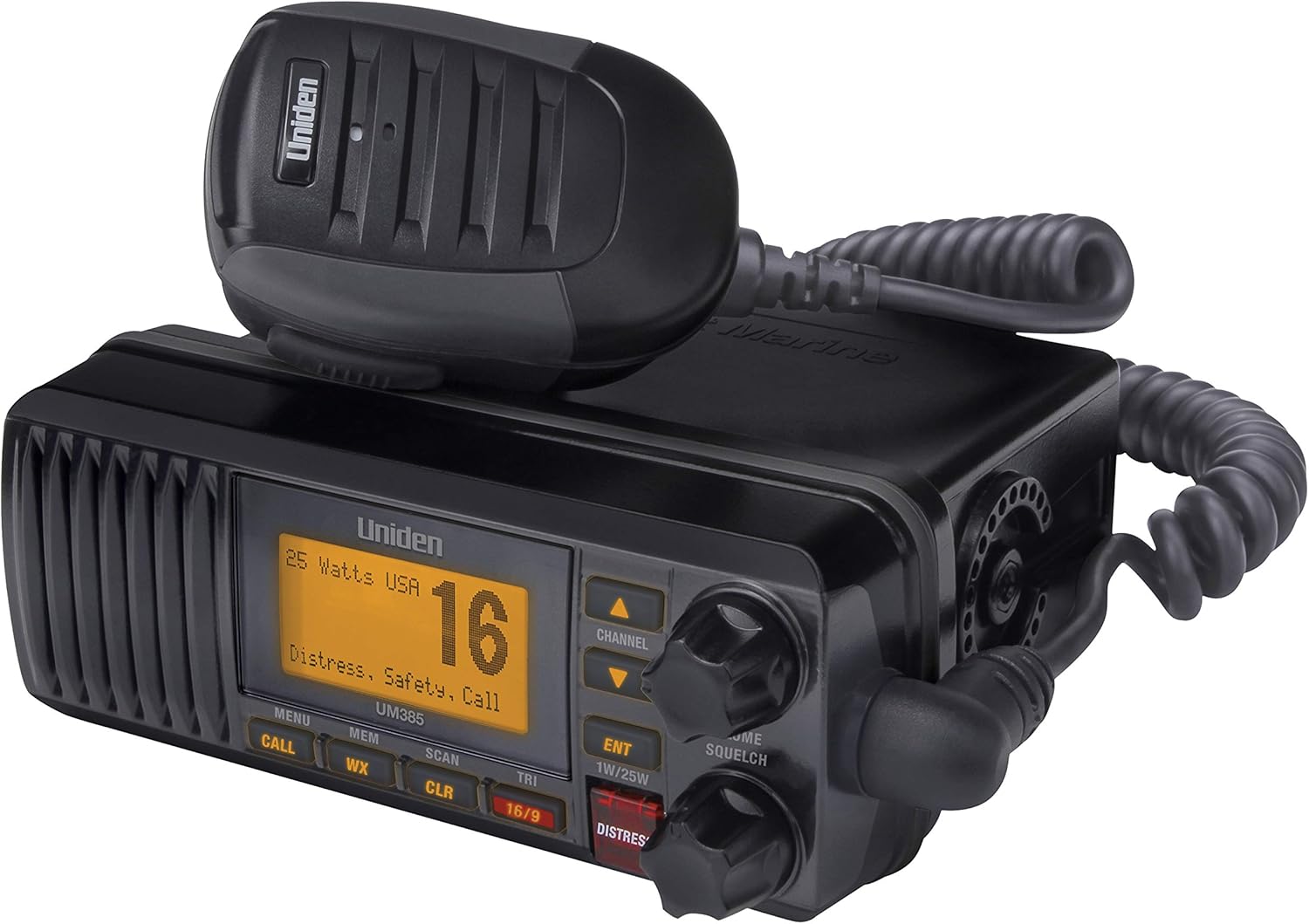
Uniden UM385BK
The Amazon value leader for a protected helm, backed by 2,675 reviews.
Who it's for: the coastal cruiser with a protected helm under a hardtop or behind a windshield, a chartplotter already wired in over NMEA 0183 for DSC position, and a preference for the best audio-per-dollar in a $149 fixed-mount. This is the radio Amazon's coastal cruisers actually buy, and the 2,675-review signal is the cleanest value-per-dollar read on this list.
What we found: 25 watts of transmit power, DSC built in, NOAA SAME weather alerts, and all USA, International, and Canadian channels. Owners praise the audio clarity as punching above its price tier, and the compact footprint fits flush cutouts the larger Standard Horizon and Cobra units do not. Two honest catches decide the fit. First, IPX4 is splash-resistant, not submersible, and on an open console with salt spray it slowly fails, with owners reporting that even a little dew triggers intermittent buttons and display flicker. Second, the UM385BK has no built-in GPS, so DSC distress calls only transmit your position if a chartplotter feeds it over NMEA 0183. No chartplotter means no coordinates in a distress alert.
Bottom line: the UM385BK is not a bad radio. It is the wrong radio for an exposed helm or a boat without a chartplotter, and the right radio for everything else at this price. For an open helm in regular spray, step up to the UM435BK, the IPX8 sibling at $152 (just $3 more). For a boat with no chartplotter, the Cobra MR F77W GPS ($200) further down the list gives DSC distress real coordinates out of the box.
- + 2,675 owner reviews on Amazon, by far the largest signal base on this list
- + Audio clarity consistently praised as above-class for the $149 price point
- + Compact footprint fits flush-mount cutouts where larger radios do not
- + NOAA SAME weather alerts work reliably without false triggers, per long-term owners
- × IPX4 splash-resistant only, not submersible (the single biggest complaint)
- × No built-in GPS, requires NMEA 0183 from a chartplotter for DSC position
- × Channel selector is unintuitive for the first month of ownership
Runner-up: Standard Horizon GX1850.
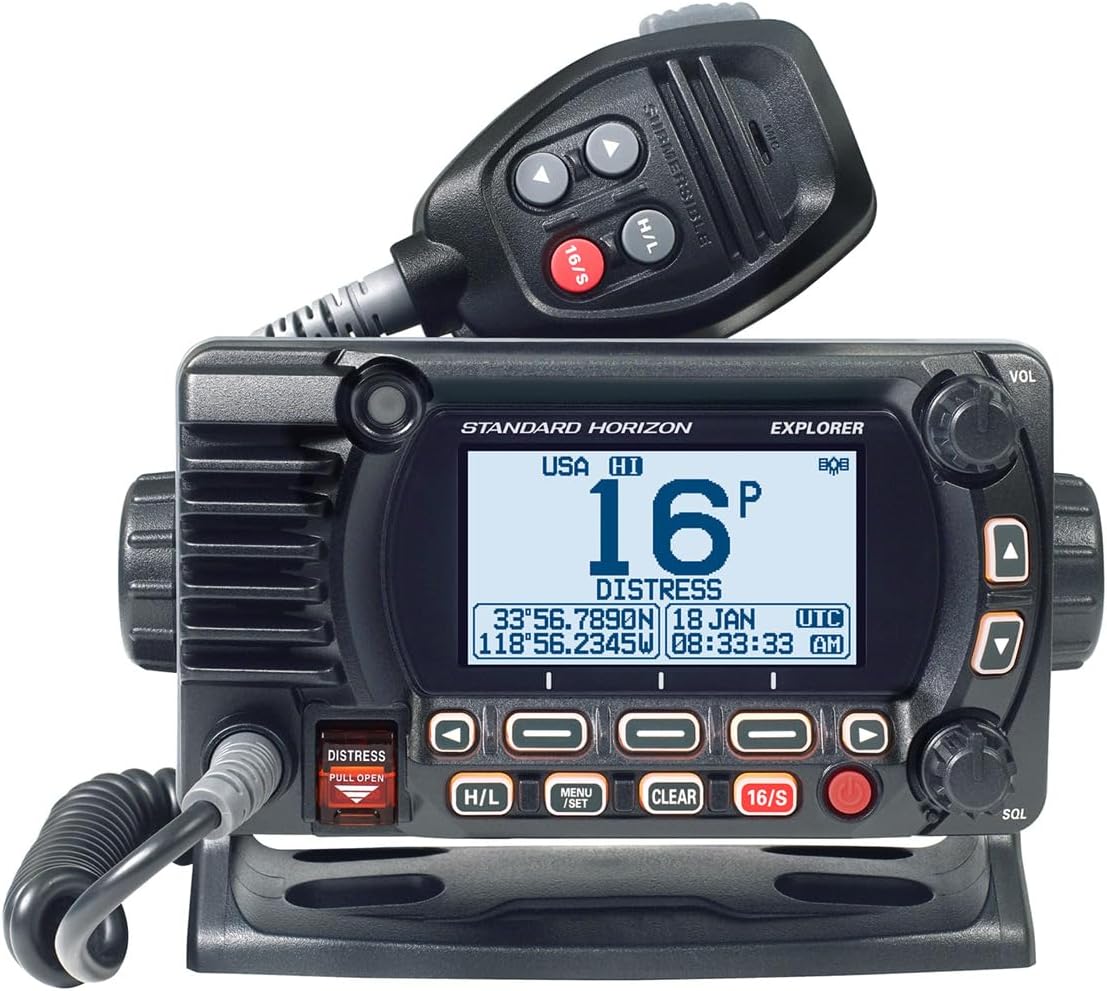
Standard Horizon GX1850
The NMEA 2000 fixed-mount that integrates GPS, AIS, and instruments, the marine-dealer default.
Who it's for: the coastal cruiser whose helm already has a NMEA 2000 backbone wired in (chartplotter, AIS receiver, engine instruments) and who wants the radio to integrate as a networked node on that bus rather than sit alongside the electronics as a standalone box. This is what serious coastal cruisers buy at marine-electronics counters, and it earns the runner-up slot on a single feature: NMEA 2000.
What we found: plug it into the boat's NMEA 2000 backbone and it becomes a networked node, GPS position from the chartplotter, AIS targets from the receiver, instrument data from the engine bus, all on the radio. The 3-year waterproof warranty is the longest in the category, the Class D DSC runs a dedicated Channel 70 watch that monitors distress traffic continuously, and Standard Horizon's marine-specialty reputation is why this is the default SKU at every serious dealer counter. The honest catch is GPS: the standard retail GX1850 at the verified Amazon ASIN (B07MM346VC) is the non-GPS variant, and we have seen one-star reviews from buyers who pressed the distress button on an unwired install and got no position transmitted.
Bottom line: if you have a chartplotter this is moot, because NMEA 2000 feeds GPS to the radio automatically, and the GX1850 is the radio that integrates rather than sits alongside. If you don't have a chartplotter, see our marine GPS chartplotter guide for the right pairing before you buy this radio, or step down to the Cobra MR F77W GPS where the GPS receiver is internal and self-contained.
- + The only sub-$300 fixed-mount with NMEA 2000 plug-and-play, which feeds it GPS, AIS targets, and engine data from the boat's electronics network
- + 3-year waterproof warranty, the longest in the category
- + The default stocked SKU at Defender Marine and The GPS Store
- + Class D DSC with a dedicated Channel 70 watch that monitors digital distress traffic continuously without interrupting your voice channel
- × Standard retail SKU at the verified Amazon ASIN (B07MM346VC) is the non-GPS variant, so for GPS-linked DSC you need either NMEA 2000 from a chartplotter or the separately sold GPS-SMART1 antenna
- × Display is dimmer than Garmin MFDs sharing the same helm in direct sun
- × Smaller Amazon review count (63) because the marine-specialty audience buys this at Defender, not Amazon
Budget pick: Uniden Atlantis 275.
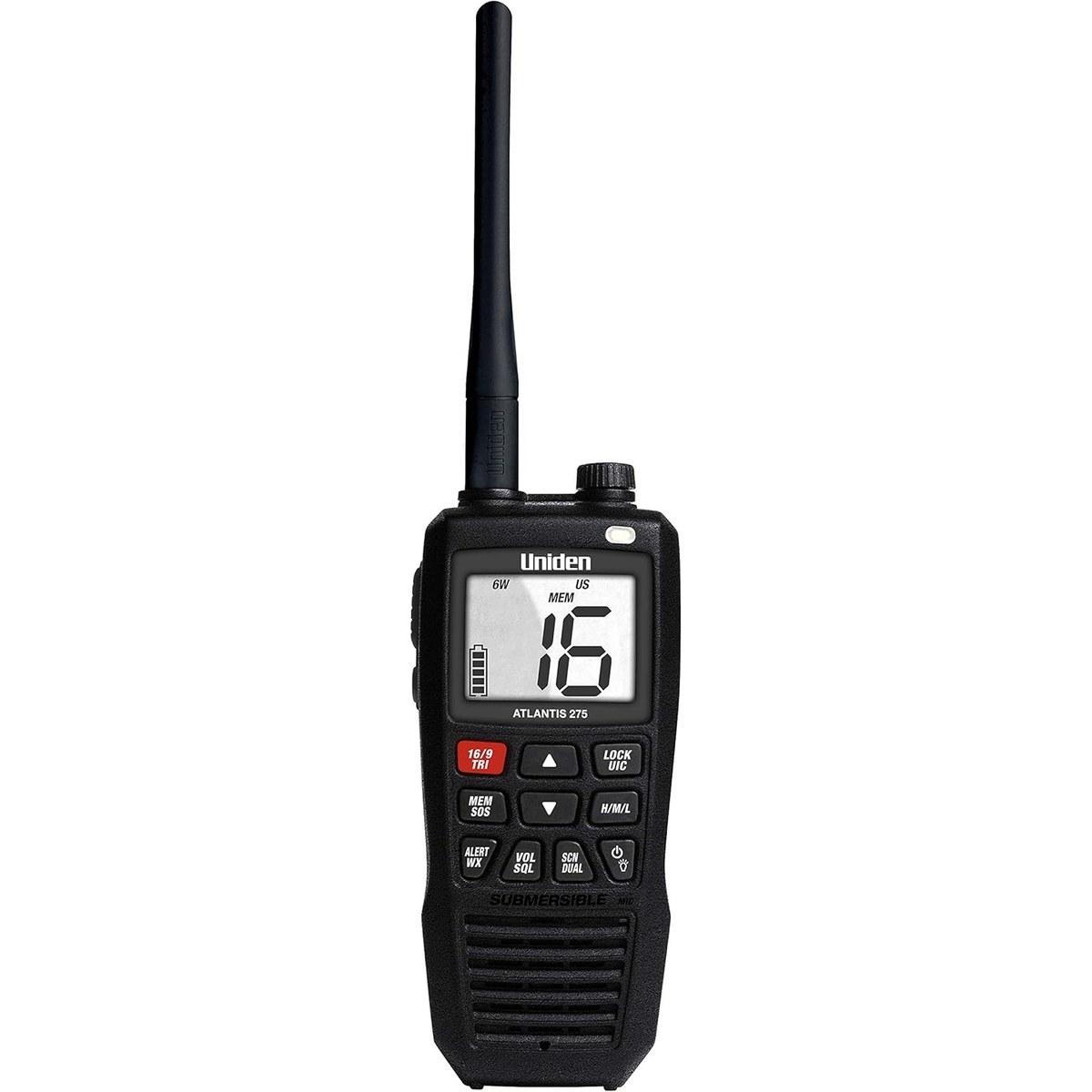
Uniden Atlantis 275
The floating IPX8 handheld with the best display under $200, the seasonal-coastal backup radio.
Who it's for: the coastal cruiser who wants a floating, submersible handheld as the backup radio in the cockpit or the ditch bag, for seasonal coastal use where a multi-day battery is not the constraint and recovering a dropped radio matters more than offshore endurance. Every coastal cruiser eventually buys a handheld, and at $127 the Atlantis 275 is the one Amazon's buyers reach for first.
What we found: IPX8 submersible and floats on the surface, so a knocked-overboard radio is a recoverable radio rather than a sunk one. Boating Magazine's hands-on test praised the dual-color LCD as the best display in the sub-$200 group, with paper-white daylight readability unusual at this price, and the hard keys for the four functions you use under way (watts, weather, backlight, dual scan) beat menu-diving when your hands are wet or gloved. Two honest catches: the belt clip does not reliably stay attached under extended use (the most-mentioned hardware complaint), and the lithium battery is non-removable, so when the pack dies you cannot drop in AA cells the way you can with the Standard Horizon HX890.
Bottom line: for seasonal coastal use the battery life is more than enough, and at $127 this is the right floating-handheld backup for the cockpit or the ditch bag, where the 528 reviews and best-seller spot confirm it is the one buyers trust. For extended offshore work where you might run out of charge across several days, step up to the AA-backup Standard Horizon HX890 instead, since dropping in fresh alkaline cells is the feature that matters once you are past easy recharge range.
- + IPX8 submersible (continuous beyond 1 meter for 30 minutes) and floats on the surface
- + Paper-white daylight LCD with red and white dual backlight, called the best display in its price tier by Boating Magazine's handheld comparison test
- + Dedicated hard keys for watts, weather, backlight, and dual scan, so no menu diving with wet or gloved hands
- + 528 owner reviews and the Amazon best-seller spot for marine handhelds
- × Belt clip does not stay attached reliably under extended use (the single most-mentioned hardware complaint)
- × Internal lithium battery, non-removable, with no alkaline emergency backup like the Standard Horizon HX890
- × 6W transmit power is standard for the price tier but lower than higher-end handhelds like the Icom M94D
Also worth considering.
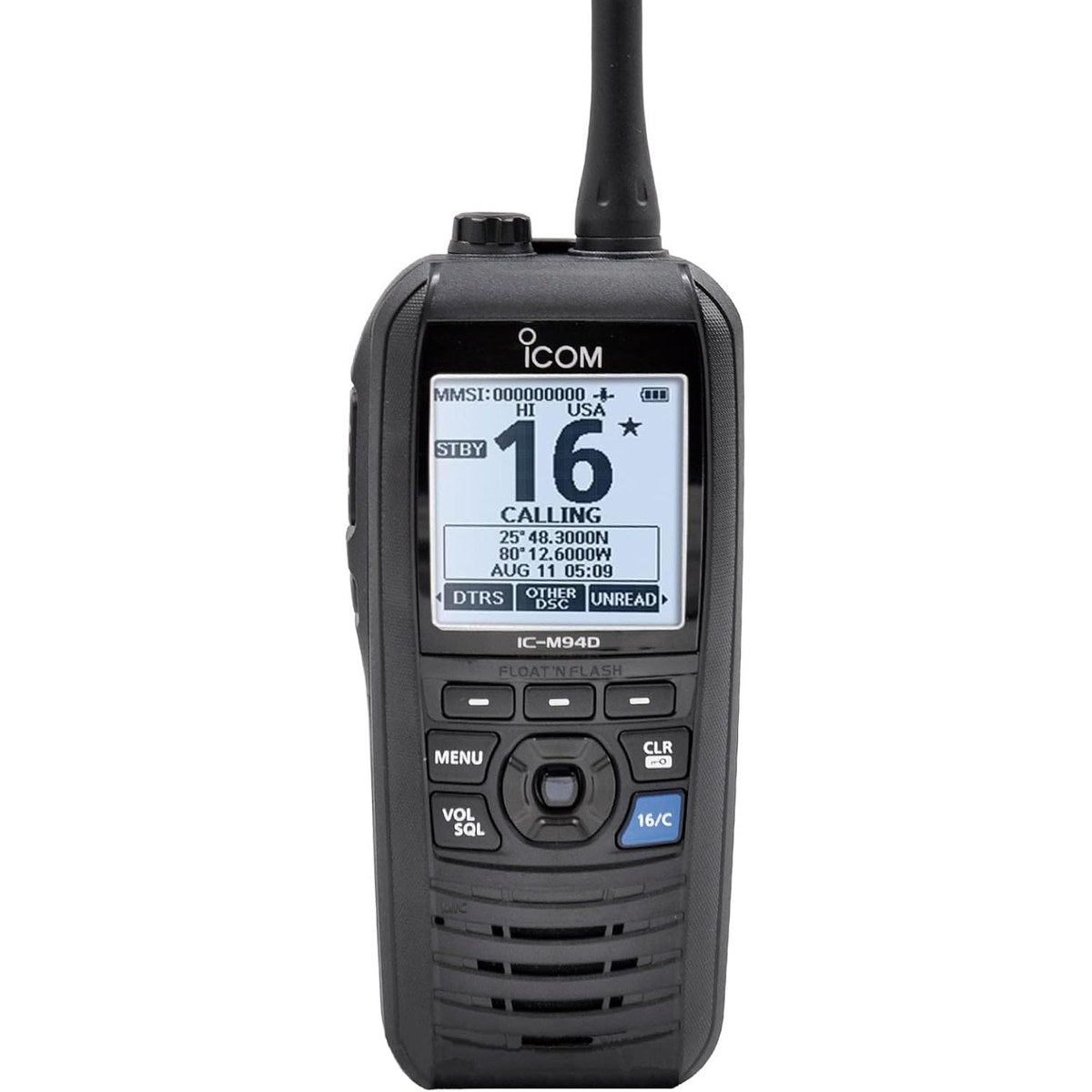
Icom M94D
The only handheld with built-in AIS receive, vessel traffic on the radio screen without a full AIS install.
Who it's for: the coastal cruiser whose usual cruising area has commercial traffic but who does not yet have a full AIS install, and wants nearby vessel awareness on the same screen as the radio without the cost of a fixed AIS system. The M94D is the only handheld on this list with a built-in AIS receiver, and that is the entire reason to spend $400 on a handheld VHF.
What we found: mount it in the cockpit and you have nearby AIS-equipped vessel traffic, names, courses, and closest point of approach, on the radio's own screen. A Cruisers Forum user reported relying on the M94D's AIS specifically for a Croatia-to-Kiel passage where charter boats don't transmit, and Boating Magazine's multi-radio test gave it 5/5 for both transmission and reception clarity, the highest in the test group. Float'n Flash on water contact, AquaQuake speaker-clearing, and noise-cancelled 6W transmit are the safety extras owners actually use. The clarification that has to be stated plainly: the AIS is receive-only, you see them and they don't see you, and a dedicated Class B AIS transponder is what makes other vessels' chartplotters render your boat as a target (see our AIS transponders guide for that). Two honest tradeoffs at this price: battery life under active AIS monitoring drops to roughly 5 to 10 hours versus Icom's rated 10 under standby-heavy use, and a small but recurring battery-fault indicator during cradle charging that resolves with a reseat.
Bottom line: if your cruising area has commercial traffic and you don't yet have a full AIS install, this is the handheld that gives you the awareness on the cheap. If you already run a Class B transponder and a chartplotter with AIS overlay, the receive-only handheld is redundant and the Atlantis 275 covers the backup-radio job for $273 less.
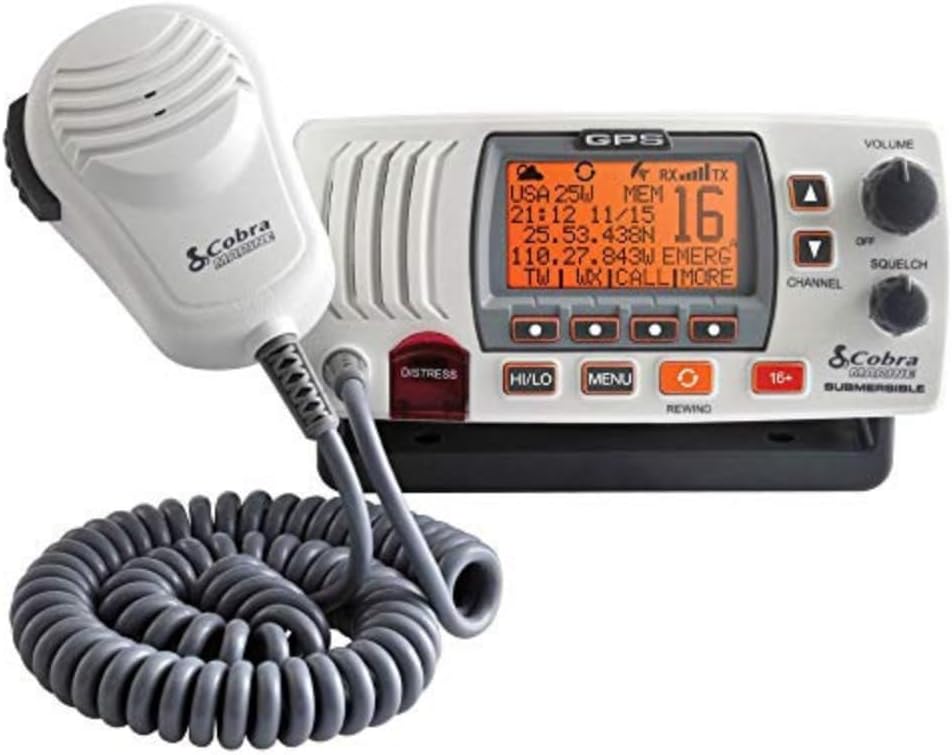
Cobra MR F77W GPS
The sub-$200 fixed-mount with internal GPS, DSC distress position out of the box for the chartplotter-less helm.
Who it's for: the coastal cruiser without a chartplotter at the helm who wants DSC distress calls to transmit position out of the box, on an open helm or under a canvas bimini rather than a fully-enclosed fiberglass hardtop. If you don't yet have a chartplotter and you want self-contained DSC position, the F77W GPS is the honest answer at sub-$200.
What we found: an internal 56-channel WAAS GPS receiver, IPX7 submersible (not just splash-resistant), and Cobra's Rewind-Say-Again 20-second incoming replay, which long-time owners specifically call out as a feature they actually use. The recurring failure mode is install-dependent: the internal GPS uses a patch antenna with limited sky view, so under a fiberglass hardtop or in a fully enclosed helm station, GPS lock degrades and the DSC position transmission stops working. Open helm or under canvas bimini, the GPS works as designed.
Bottom line: if you have a chartplotter, the GX1850 is the better pick (true multi-channel GPS, NMEA 2000 integration, longer warranty). If you don't, and your helm is open or under canvas, the Cobra is the sub-$200 GPS-included answer.
Skip this guide if...
You only run a familiar lake or river under 5 miles from the launch, your phone has solid cell coverage everywhere you go, and you have never crossed a shipping channel or run in fog. A handheld in a dry bag is plenty for that use case, and the $127 Atlantis 275 covers it. Pay for a fixed-mount when you start running unfamiliar coastal water, when your boat lives in salt, or when you want DSC distress functionality wired into the helm. Not before.
Don't bother with.
- × Skip Used or refurbished VHF radios from an estate sale or marketplace listingMMSI numbers cannot be re-programmed into most DSC radios more than once without factory support. A used radio with someone else's MMSI is essentially a non-DSC radio until you ship it to Uniden, Cobra, Standard Horizon, or Icom for a reset. New is cheaper than the labor and shipping on a reset.
- × Skip Citizens Band (CB) radios as a marine VHF substituteUSCG stations don't monitor CB. Boat traffic doesn't monitor CB. The only thing CB does on the water is talk to other CB users, which approaches zero. A $127 marine handheld with DSC is the entry point that actually works in an emergency.
- × Skip No-name Amazon VHF radios at $50 to $80Type-acceptance certification at FCC Part 80 is real and the bargain radios skip it, either selling unauthorized hardware or relabeling spec sheets that don't match real performance. A non-Part 80 radio that fails DSC under load is the one piece of safety equipment you cannot save money on. Buy a real brand on this list or step up.
How we picked.
Sources we read and the methodology we used
We don't run a lab and we don't have a boat to test these on. The sites that claim they do, mostly don't either. We read every owner thread we could find: Amazon, The Hull Truth marine electronics forum, Cruisers Forum, GradyWhite Boat Owner's Forum, Boating Magazine's handheld comparison test, Yachting World's M94D review, and YouTube field reports from real owners. Then we ranked by consistency of complaint and consistency of praise, not by the loudest review.
The shortlist: the brands actually sold on Amazon for this audience
The shortlist started with the brands actually sold on Amazon for this audience. Uniden, Cobra, Standard Horizon, Icom, Garmin, and Raymarine. We dropped Garmin and Raymarine VHF because both are network accessories sold mostly as part of helm electronics bundles, not as standalone radios for a 25 to 40 foot coastal cruiser shopping on Amazon. We considered the Standard Horizon GX2200 (with AIS receive) but it isn't carried on Amazon at the price point our reader is shopping. We considered the Icom IC-M510 (smartphone-controlled fixed-mount) but it's only available on Amazon as $850+ bundles rather than the standalone $349 price the marine-specialty stores list. The five that made the cut are the radios a coastal cruiser actually walks out with, balanced between Amazon's market shape (Uniden plus Cobra dominate by review count) and the marine-industry trust pattern (Standard Horizon is what serious cruisers buy at Defender Marine).
Why two Uniden picks
Two of these are Uniden. That's not laziness. Uniden owns Amazon's marine VHF market by owner review count. The UM385BK has 2,675 owner reviews. The Atlantis 275 has 528. The combined Uniden review count is more than every other brand on this list combined. We name what wins by what actual buyers do, not by spreading brand variety across five slots that don't deserve it. Each pick earns its position on what it does, not on brand diversity.
What our scores mean, and what they don't
Our scores reflect the consistency of the owner review signal across hundreds to thousands of reviews, not lab measurements. A score of 8.9 means owners consistently agree the unit works as advertised for the conditions it's sold for. It does not mean we tested it ourselves.
FAQs.
Q01 Do I need an FCC license to use a marine VHF radio in US waters?
+
Q02 What is an MMSI and how do I register one for free?
+
Q03 How far can a marine VHF radio really transmit?
+
Q04 What's the difference between IPX4, IPX7, and IPX8, and does it actually matter?
+
Q05 What does the DSC distress button actually do, and why might it not work?
+
Q06 Does the Icom M94D transmit my position to other vessels?
+
Q07 Which channels can a recreational boater actually use?
+
Q08 Why is my antenna SWR reading high, and what should it actually be?
+
Q09 Do I really need both a fixed-mount and a handheld?
+
Q10 Will a new VHF radio work with my existing antenna?
+
If you, then this.
- IF you have a protected helm under a hardtop or behind a windshieldGET Uniden UM385BK$149 →
- IF you have an open helm or center console with regular salt sprayGET Uniden UM435BK$152 →
- IF you have a chartplotter and want NMEA 2000 integrationGET Standard Horizon GX1850$270 →
- IF you want one handheld for the dinghy and the ditch bagGET Uniden Atlantis 275$127 →
- IF you want AIS situational awareness in a handheldGET Icom M94D$400 →
- IF you don't have a chartplotter and need built-in GPS for DSCGET Cobra MR F77W GPS$200 →
Boat Gear: The Complete Guide
The whole-boat picture →Every system on a 20 to 45 ft coastal boat, organized in one place, with the one guide we trust for each.