Best Inflatable Life Jackets: 5 We Trust on Deck (2026)
Five inflatable PFDs that earn their spots for a 25 to 40 foot coastal helm, three auto-inflate vests, one manual-only belt pack, one hydrostatic offshore work vest. We read Boating Magazine's April 2024 four-vest lab test, the USCG approval standards (46 CFR 160.076 and 33 CFR 175.15), every Amazon, Cruisers Forum, The Hull Truth, r/sailing, and r/kayaking owner thread we could find, plus YouTube field reports from Kristine Fischer, Great Lakes Paddling, and Inventive Fishing. We ranked by consistency of complaint and praise across hundreds to thousands of reviews, sorted the auto-inflate from manual from hydrostatic, and named who should not wear an inflatable at all. The load-bearing honesty point: inflatables are prohibited for kids under 16, for under-80-lb wearers, for PWC operation, and for freezing conditions, and the belt pack everyone buys for fishing will not turn an unconscious wearer face-up.
- 01 Onyx A/M-24 , top pick for a coastal helm, $122 and 3,142 owner reviews
- 02 Bluestorm Stratus 35 , step-up vest with 35 lb buoyancy and a zippered pocket
- 03 Onyx M-16 Manual Belt Pack , the kayak and dinghy form factor, manual-only
- 04 Mustang Survival MIT 100 , Mustang vest with the foldable bladder that does not chafe, $185
- 05 Mustang Survival HIT Work Vest , hydrostatic offshore vest for high spray and commercial work
How they compare.
| Rank | Product | Best for | Price | Our score |
|---|---|---|---|---|
| 01 | Onyx A/M-24
Top Pick
| Coastal helm, auto/manual | $122
Buy → | 8.9/10 |
| 02 | Bluestorm Stratus 35 | Step-up coastal, Type II, 35 lb | $140
Buy → | 8.7/10 |
| 03 | Onyx M-16 Manual Belt Pack | Kayak, SUP, dinghy | $85
Buy → | 8.5/10 |
| 04 | Mustang Survival MIT 100 | Step-up recreational | $185
Buy → | 8.4/10 |
| 05 | Mustang Survival HIT Work Vest | Offshore, hydrostatic | $325
Buy → | 8.3/10 |
Prices are current Amazon prices at time of publication and can change. Scores reflect our editorial evaluation, not vendor input.
Our #1 pick: Onyx A/M-24 Automatic/Manual Inflatable Life Jacket.
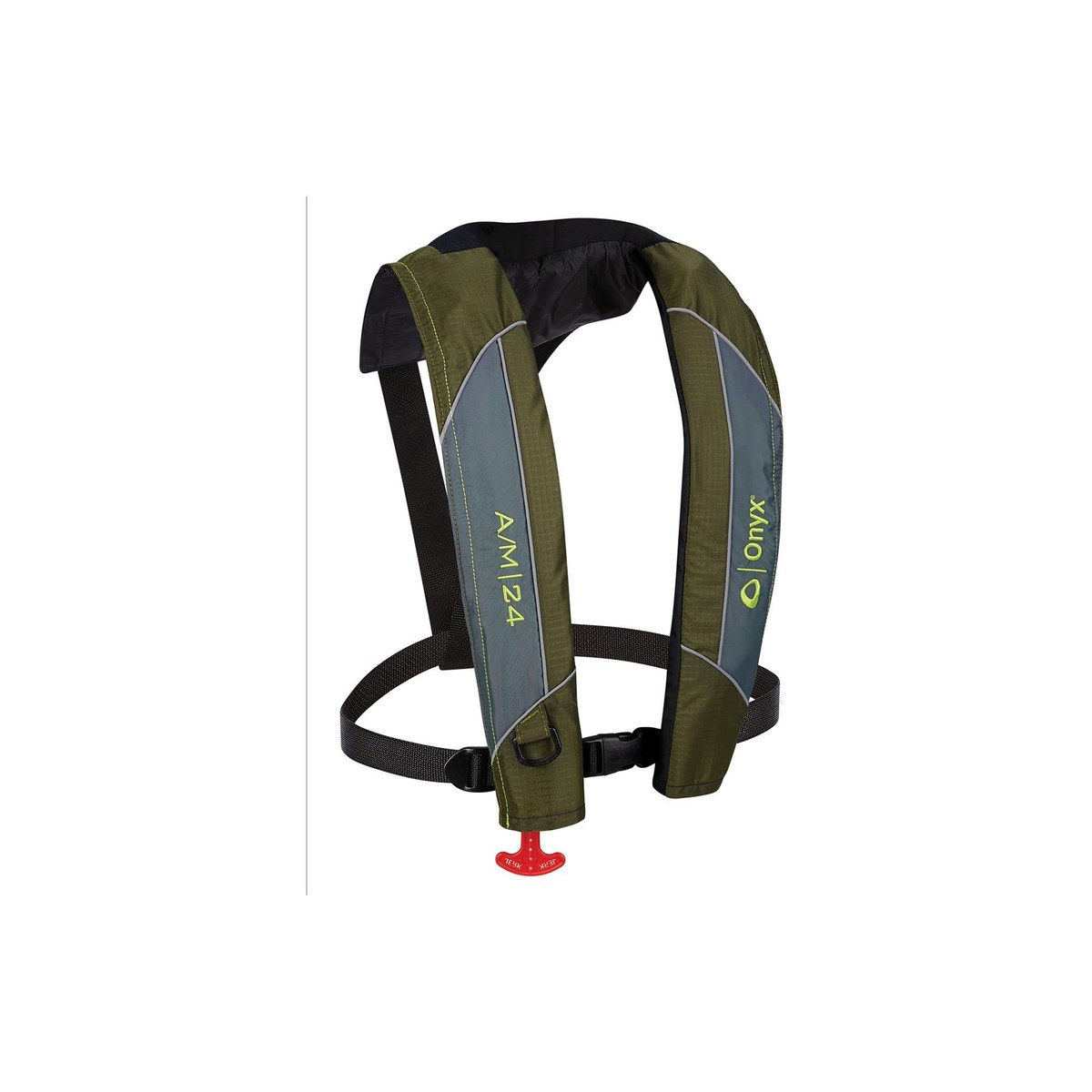
Onyx A/M-24 Automatic/Manual Inflatable Life Jacket
The Amazon best-seller for the coastal helm, auto/manual hybrid backed by 3,142 owner reviews.
The A/M-24 is the inflatable life jacket Amazon's coastal cruisers actually buy, and the 3,142 review signal is the cleanest social proof on this list. It is a Type V conditional with Type III performance, USCG approved, with 22.5 lb of buoyancy when fired. The auto/manual hybrid is the feature owners reach for first. Swap the inflator cap and the vest converts from automatic on water contact to manual cord pull, which matters for a paddler or fisher who plans to get wet and does not want the bobbin firing every time the boat takes spray. One Walmart owner wrote: "So lightweight and comfortable you won't know you have it on, until you may need it." That captures the vest's character better than the spec sheet does. The honest limitation is the missing inspection window. Where the Bluestorm Stratus 35 and Mustang HIT both let you check the green indicator with a glance, the A/M-24 makes you unscrew the cylinder to verify it is armed. For most owners this is a once-a-season annoyance, but it is the thing that owners consistently flag as the one thing they would change. If you have never bought an inflatable vest before, this is the one.
- + 3,142 owner reviews on Amazon, the largest signal base of any inflatable life jacket on the list by an order of magnitude
- + Auto/manual hybrid inflation, swap the inflator cap to disarm the auto-trigger for wet-entry kayak or fishing days
- + USCG approved, 22.5 lb of buoyancy, fits chest sizes 30 to 52 inches
- + 360 degree reflective piping is genuinely visible at night, owners specifically call this out
- × No inspection window to verify CO2 cartridge status, you have to unscrew the cylinder to check it (Bluestorm Stratus 35 and Mustang HIT both have one)
- × 22.5 lb of buoyancy is the Type III floor, the Bluestorm and the Mustang HIT both give you more for not much more money
- × Can ride up toward the chin during active movement if the waist strap is not snugged tight
Runner-up: Bluestorm Stratus 35 Inflatable Life Jacket.
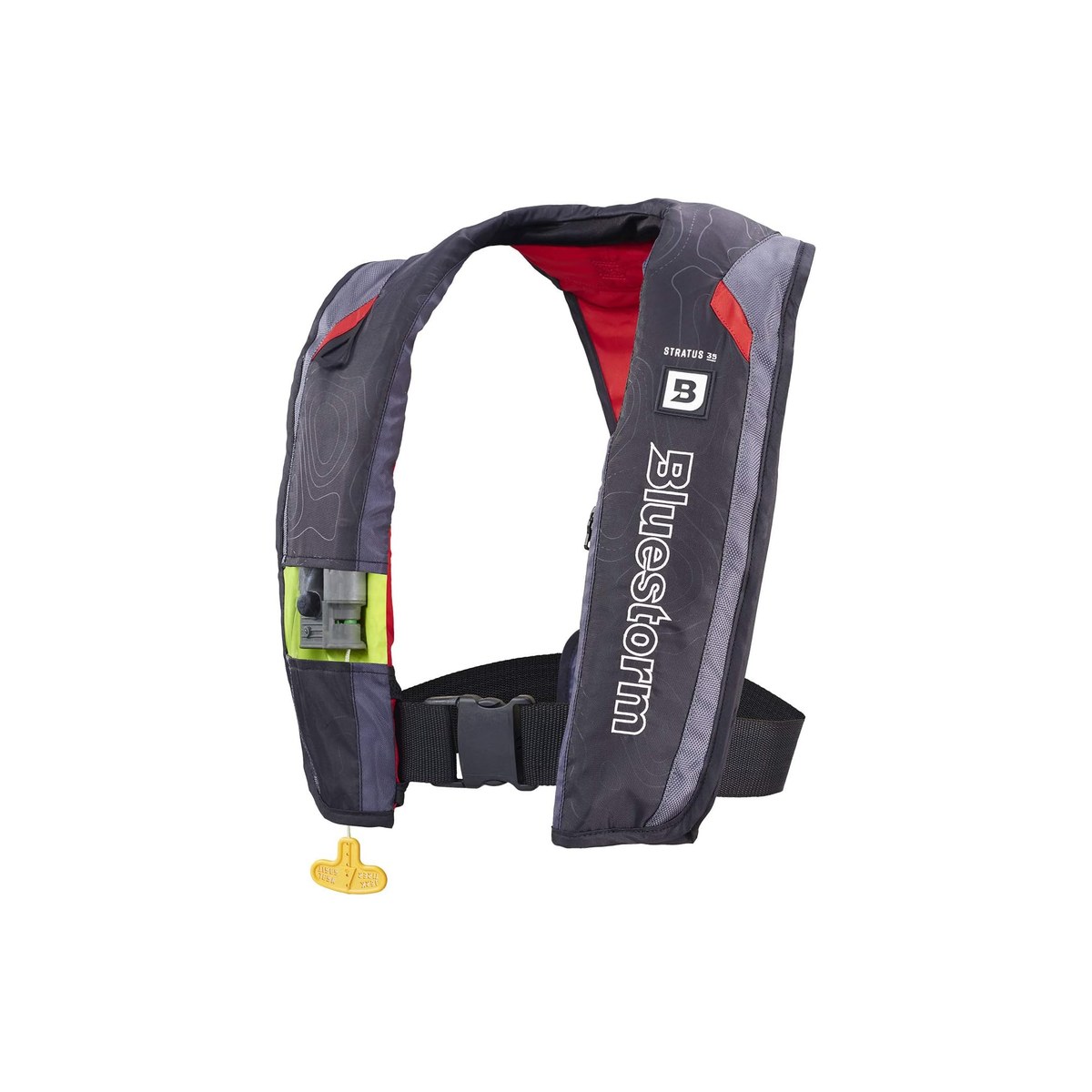
Bluestorm Stratus 35 Inflatable Life Jacket
The step-up with 35 lb of buoyancy and a glance-check inspection window.
The Bluestorm Stratus 35 is what you buy when you want more buoyancy than the Onyx A/M-24 gives you for an extra $18. 35 lb of buoyancy is a Type II rating (the A/M-24 is Type III), which matters in beam seas or in any condition where you want margin above the minimum. The breathable polyester collar is the feature Boating Magazine specifically praised in their April 2024 inflatable PFD test, and the kayak fisher Kristine Fischer wrote on YouTube: "Super lightweight, it's ergonomically friendly and I feel like I'm not even wearing a PFD when I have this thing on." The clear inspection window means you can verify armed status without unscrewing anything, the way the Onyx makes you do. The bladder repacks in four steps and folds into the outer shell rather than stuffing inside it, which Boating Magazine said a kid could manage. The honest tradeoff is brand recognition. Bluestorm is newer than Mustang or Onyx and the 805 reviews is good but not Onyx-A/M-24-good. For a buyer who wants the spec advantage over the Onyx without paying Mustang prices, this is the right pick at $140.
- + 35 lb of buoyancy, Type II rated, more than double the buoyancy floor of a foam Type III vest (15.5 lb)
- + Breathable polyester collar that does not chafe, confirmed by Boating Magazine's April 2024 four-vest lab test
- + Bladder repacks in four steps because it folds into the outer shell rather than accordion-stuffing inside it, Boating Magazine called it the kind of repack a kid could manage
- + Clear inspection window with green indicator, you can verify armed status at a glance
- × 6 second deployment time in the Boating Magazine dunk tank, slower than the Mustang MIT 100's 4 seconds (in cold water shock, 2 seconds matters)
- × Less recognized brand than Mustang or Onyx, the 805 reviews is solid but smaller than the Onyx A/M-24's 3,142
- × Some residual bladder contact at the jaw if the waist strap is not snugged tight
Budget pick: Onyx M-16 Manual Inflatable Belt Pack.
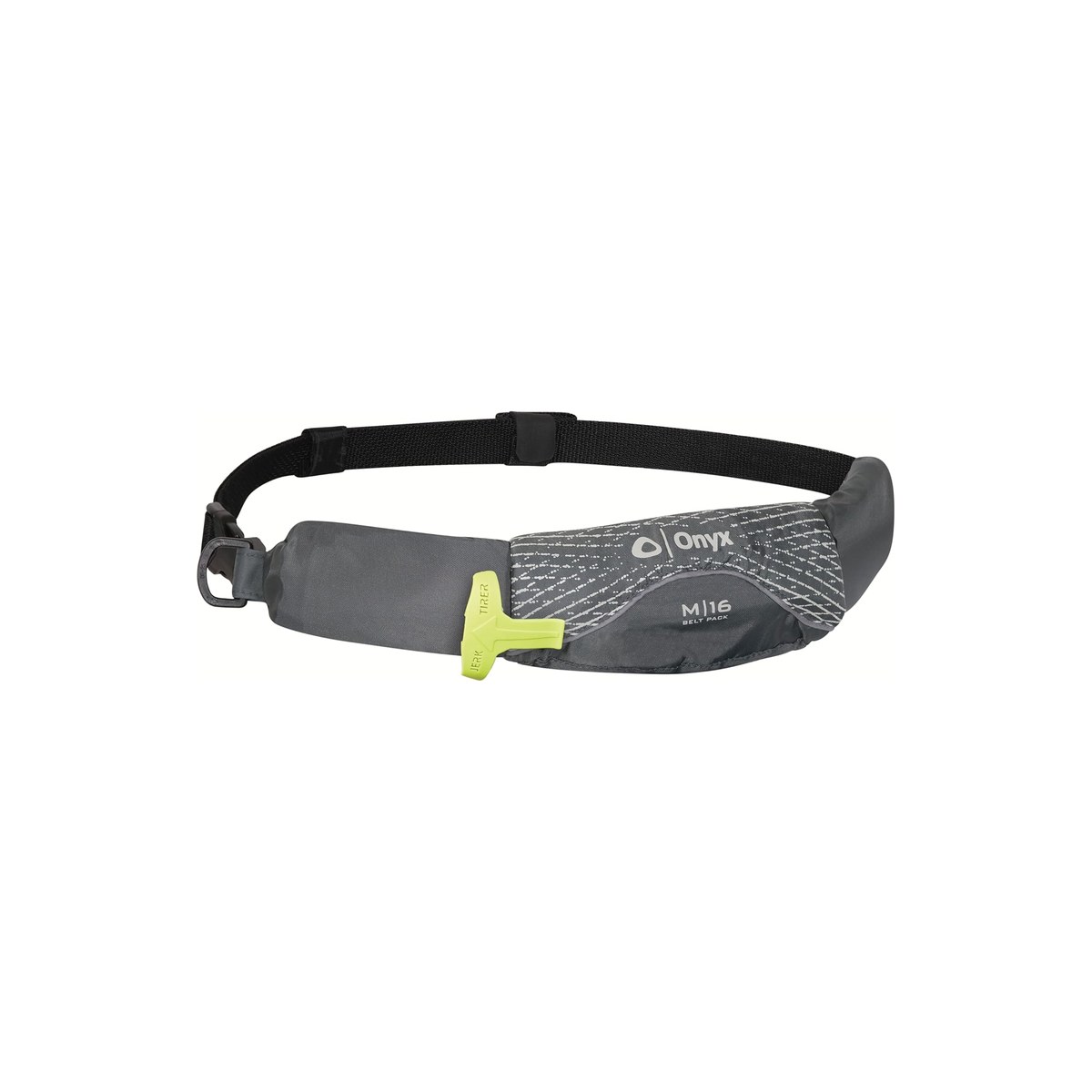
Onyx M-16 Manual Inflatable Belt Pack
The manual-only belt pack for kayak, SUP, and fishing, a second PFD.
This is the belt-pack form factor for the dinghy run, the kayak, the paddleboard, and the fishing skiff. It is not the pick for the helm of your 35 footer on an offshore passage. If you came here looking for the best inflatable life jacket for fishing, the belt-pack form is what serious anglers actually wear. A vest interferes with casting and rod handling, while a waist inflatable life jacket sits out of the way. Same logic for kayakers and paddleboarders. The manual-only design is correct for someone who expects to get wet and chooses when to inflate. Paddlers, fly fishers, duck hunters, and SUP boarders are the right audience because the auto-inflate bobbin in any other vest on this list would false-fire the first time a wave broke over the deck. The honest reframing the Amazon best-seller status does not surface is in the safety case. A Great Lakes Paddling YouTube reviewer put it directly: "It will not float you upright or change you. So if you were to happen to hit your head on something when you're falling in the water, this PFD will not help you." If you are an unconscious-overboard candidate, on a coastal cruiser in beam seas, doing overnight passages, this is the wrong vest for that scenario. The right vest is the Onyx A/M-24 at the helm and the Mustang HIT Work Vest offshore. Carry the M-16 for the boat-within-the-boat use cases. It is the second PFD on the boat, never the first.
- + Absolute minimum profile, weighs less than 1 lb, wraps around the waist and does not interfere with paddling or casting
- + Manual-only inflation is the right call for activities where you expect to get wet, no false-fire risk in heavy spray or wet re-entry
- + Uses generic 16g CO2 cartridges with 3/8 inch thread, the same size sold at paintball and beverage retailers, so rearming is cheap
- + 2,603 owner reviews on Amazon, second-largest signal base on the list
- × Will NOT turn an unconscious wearer face-up, 17 lb of waist-attached buoyancy is the lowest of all five picks on this list
- × Manual cord can be hard to find in the water under cold-water shock conditions, the YouTube Great Lakes Paddling review confirmed this in controlled testing
- × Multiple Dick's Sporting Goods owners flag the side velcro pouch popping open and spilling contents, a recurring construction complaint
Also worth considering.
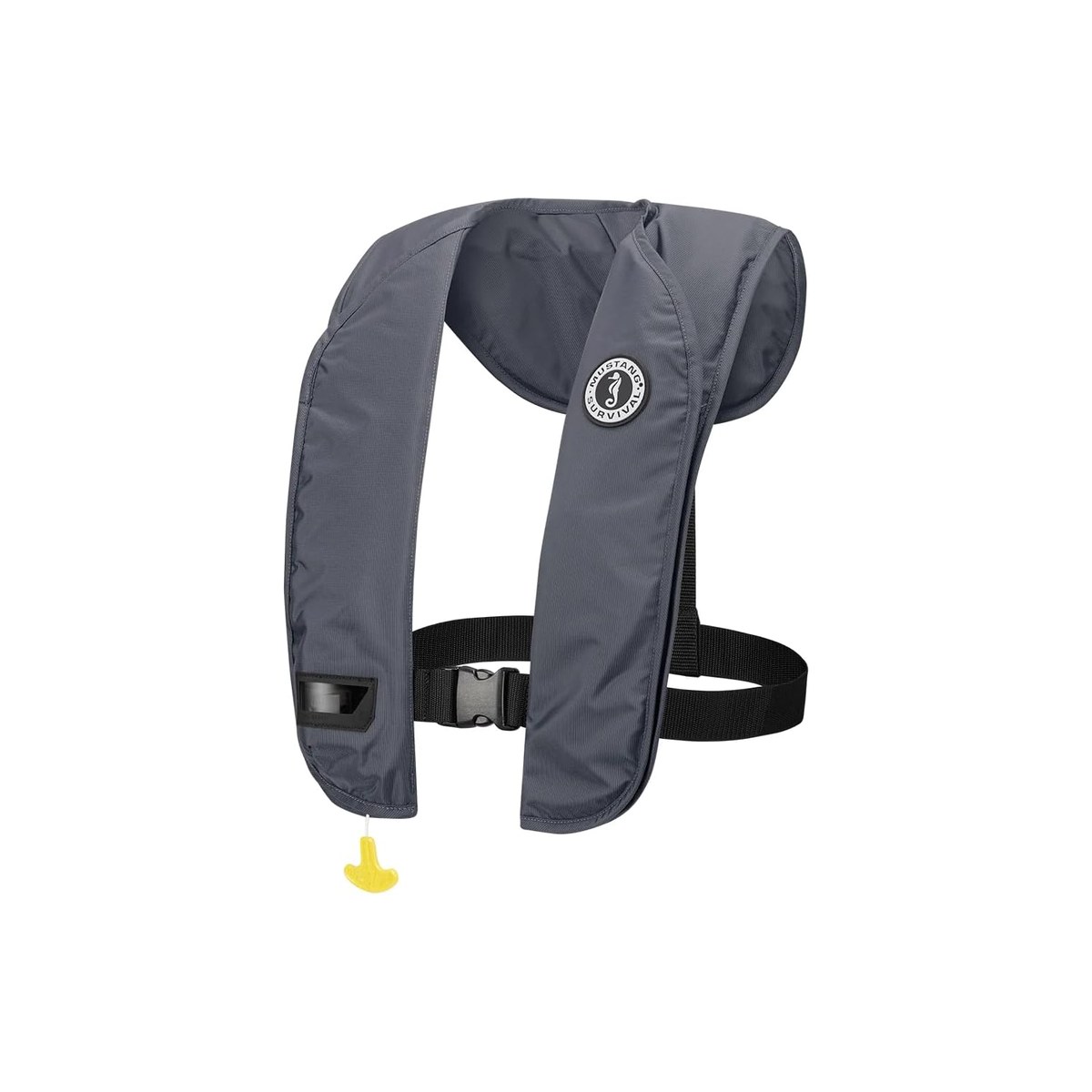
Mustang Survival MIT 100 Automatic Inflatable PFD
The Mustang pick with the no-chafe foldable bladder, size it tight or it rides up.
The MIT 100 is the Mustang Survival inflatable life jacket for the buyer who wants the brand and the membrane inflatable technology, which is Mustang's name for a bladder that integrates into the outer shell rather than accordion-stuffing inside it. Boating Magazine's April 2024 four-vest test concluded: "The design of the MIT ensures that there is no sharp bladder edge anywhere near the neck or chest. The only one that gave us protection from chafing." Boating Magazine timed the larger MIT 150 (same M.I.T. Bladder design) at 4 seconds in the dunk tank, the fastest of the test group. The MIT 100 uses a smaller 33g CO2 cartridge and may deploy marginally slower in practice. The convertible auto/manual cap swap lets you change modes the way the Onyx A/M-24 does. The honest complaint pattern across Amazon and retail reviews is that the vest rides up on active wearers. One owner wrote: "I'm very frequently pulling it down. As I move the PFD tends to ride up. I've tried tightening the strap but nothing keeps it from riding up." That is not an isolated report, it is a recurring shape complaint. Within the Mustang inflatable life jacket line, the MIT 100 is the recreational pick and the HIT Work Vest covers offshore. The MIT 100 is the right pick if you want Mustang and you size it tight. It is the wrong pick if you want the highest social proof on Amazon, which is the Onyx A/M-24's job at $63 less.
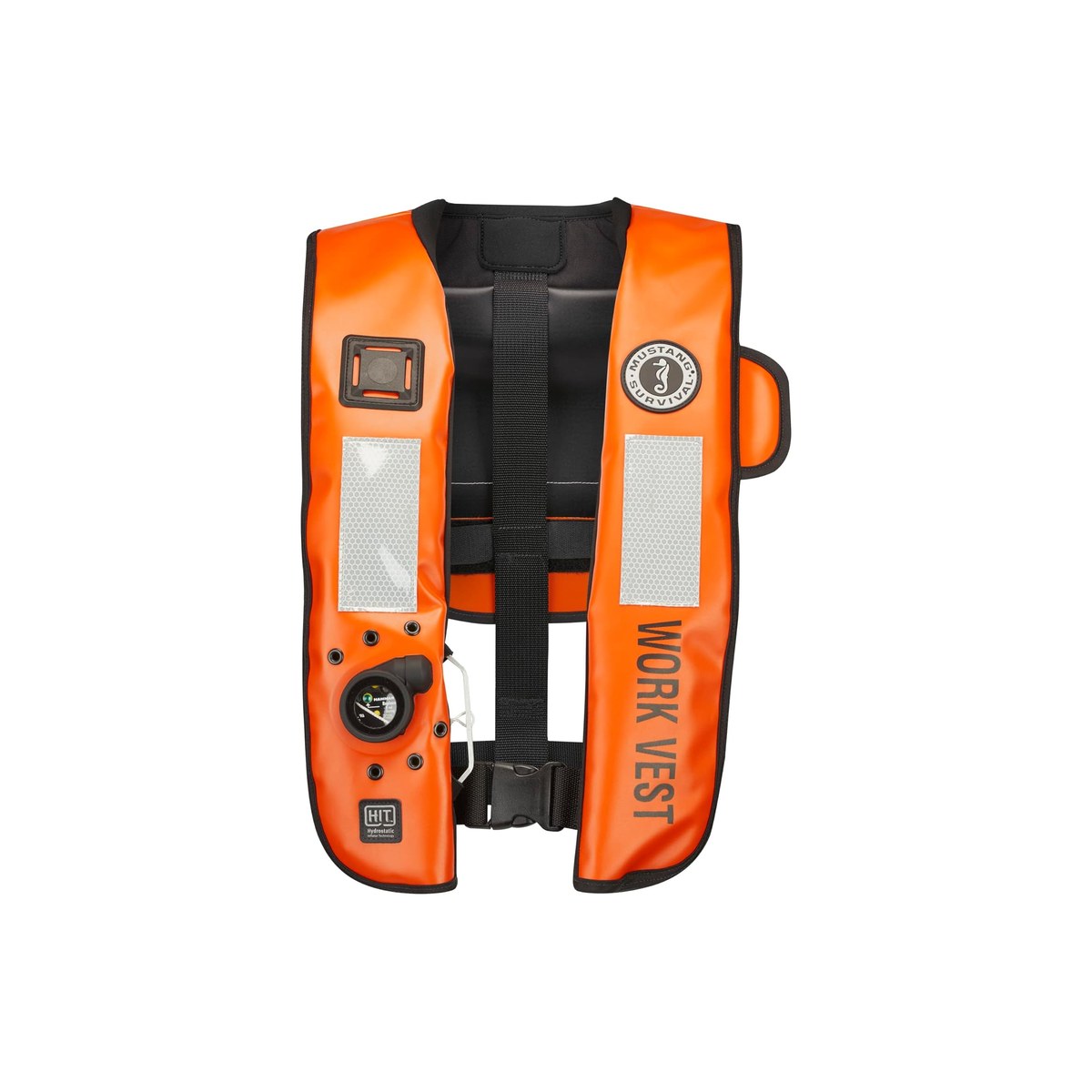
Mustang Survival HIT Inflatable Work Vest
The offshore hydrostatic vest that spray and humidity can't false-fire, with harness tether points.
The HIT Work Vest is the offshore inflatable life jacket with harness tether attachment points, built for the cruiser who is tired of bobbin-based vests false-firing in spray and humidity. The Spinlock Deckvest sells through marine specialty retailers, not Amazon, and this Mustang HIT is the realistic Amazon-available option for that category. Hydrostatic inflator technology (Hammar HIT, licensed exclusively to Mustang Survival) only triggers below 4 inches of submersion depth. Rain, spray, wet decks, and Gulf humidity cannot fire it. Boating Magazine confirmed the Hammar mechanism in a Spinlock test deployed in 3.8 seconds, faster than any bobbin in the same test group. The vest carries USCG Type V conditional approval (with Type II performance), with 38 lb of buoyancy, SOLAS reflective tape, and a 5 year maintenance-free window on the entire inflator assembly. The Type V worn-only caveat is the legal nuance most owners miss: a Type V Work Vest in a locker does NOT count toward the boat's required carriage PFDs. It only satisfies USCG carriage when it is actually being worn. The other honest concern is the yellow manual pull handle, which a Mustang Survival product page review specifically warned about: "Be careful with the yellow hand pull as it can easily get caught up in some fishing gear." For a commercial operator, a charter captain, or a coastal cruiser doing humid-coast or offshore passages where unconscious-overboard is plausible and harness tether points matter, this is the only pick on this list that gets the inflator mechanics right.
Skip this guide if...
You boat exclusively in freezing conditions (air temperature below 32°F), you operate a personal watercraft (jet ski), or you are outfitting kids under 16. The USCG advisory on cold-weather inflatable failure means inflatables are not reliable for ice-out fishing or winter passages, switch to foam PFDs for cold weather. PWC operation requires foam PFDs, full stop. Kids under 16 or under 80 lbs are explicitly prohibited from any inflatable. In all three cases, the picks in this guide are not for you.
Don't bother with.
- × Skip Any inflatable life jacket for kids under 16 or under 80 lbsThe USCG approval standard (46 CFR § 160.076-7) sets a hard 80 lb weight floor and a 16-year age minimum for inflatables. There are no youth inflatable PFDs with USCG approval on the recreational market. If you have kids aboard, they need inherently buoyant foam PFDs sized to their weight. No exceptions.
- × Skip Inflatable PFDs for personal watercraft (jet ski) operationExplicitly prohibited by USCG regulations. PWC requires foam Type III PFDs. An inflatable is not a substitute. If your boating includes PWC, buy foam.
- × Skip No-name Amazon inflatable PFDs under $50Type acceptance certification at 46 CFR § 160.076 costs real money, and the bargain inflatables skip it. A PFD that fails to inflate when needed is the one piece of safety equipment you cannot save money on. Buy a real brand on this list or step up.
How we picked.
Sources we read and the methodology we used
We don't run a lab and we don't have a boat to test these on. The sites that claim they do, mostly don't either. We read every owner thread we could find: Amazon, The Hull Truth marine electronics forum, Cruisers Forum, Reddit r/sailing, Reddit r/kayaking, Boating Magazine's April 2024 four-vest lab test, plus YouTube field reports from Kristine Fischer, Great Lakes Paddling, and Inventive Fishing. Then we ranked by consistency of complaint and consistency of praise, not by the loudest review.
The shortlist: the brands actually sold on Amazon for this audience
The shortlist started with the brands actually sold on Amazon for this audience. Mustang Survival, Onyx, Stearns SOSpenders, Bluestorm, and Spinlock. We dropped Spinlock Deckvest because the Amazon presence is two or three reviews per SKU and the brand sells mainly through marine specialty retailers like Defender Marine. We dropped Stearns SOSpenders because the line was absorbed into the Onyx brand, and Amazon search now returns Onyx products instead of Stearns. The five that made the cut are the inflatables a coastal cruiser actually walks out of Amazon with, balanced between the Amazon best-sellers (Onyx by a wide margin) and the marine-industry trust pattern (Mustang Survival and Bluestorm).
Why two Onyx picks
Two of these are Onyx. That's not laziness. Onyx owns the Amazon recreational inflatable PFD market by owner review count. The A/M-24 has 3,142 owner reviews. The M-16 Belt Pack has 2,603. The combined Onyx review count is more than every other brand on this list combined. We name what wins by what actual buyers do, not by spreading brand variety across five slots that don't deserve it.
What our scores mean, and what they don't
Our scores reflect the consistency of the owner review signal across hundreds to thousands of reviews, not lab measurements. A score of 8.9 means owners consistently agree the unit works as advertised for the conditions it's sold for. It does not mean we tested it ourselves.
FAQs.
Q01 What's the difference between USCG Type I, II, III, and V?
+
Q02 Auto-inflate vs manual vs hydrostatic, which inflator should I get?
+
Q03 How do I rearm my inflatable PFD after it fires?
+
Q04 Why did my PFD inflate by itself in the garage?
+
Q05 Will my inflatable PFD work in cold weather?
+
Q06 Can my kids wear these?
+
Q07 What buoyancy do I actually need: 22, 28, 35, or 38 lb?
+
Q08 Is the Spinlock Deckvest worth it? Why isn't it on this list?
+
Q09 Did Stearns SOSpenders disappear?
+
Q10 Should I wear a harness with my inflatable PFD when singlehanding?
+
If you, then this.
- IF you want Amazon's most-trusted inflatable PFD with auto/manual hybridGET Onyx A/M-24$122 →
- IF you want 35 lb of buoyancy and a zippered pocket for $20 moreGET Bluestorm Stratus 35$140 →
- IF you kayak, paddleboard, or fly-fish and expect to get wetGET Onyx M-16 Manual Belt Pack$85 →
- IF you want the Mustang foldable bladder design that does not chafeGET Mustang Survival MIT 100$185 →
- IF you cruise the Gulf or any high-humidity coast (false-fire risk)GET Mustang HIT Work Vest$325 →
- IF you operate a commercial vessel or charter and need Type V Work Vest approvalGET Mustang HIT Work Vest$325 →
- IF you boat year-round in freezing Northeast or Great Lakes conditionsGET (do not buy an inflatable, switch to foam PFD for cold weather)n/a →
Boat Gear: The Complete Guide
The whole-boat picture →Every system on a 20 to 45 ft coastal boat, organized in one place, with the one guide we trust for each.