A Radio in Your Pocket: 5 Handheld VHFs (2026)
A handheld VHF is the radio you reach for when the fixed set at the helm goes quiet: the boat lost power, you are in the dinghy, or you have just put the ditch bag over the side. It is the backup, the portable, and the abandon-ship radio, and on a small enough boat it is the only VHF you own. For a 20 to 45 ft boat the decision splits on three things: does it float, does it carry GPS and DSC to send a one-button distress call with your position, and is it current. Most marine handhelds float and strobe when wet; the ultra-compacts that do not are the trap. The point most roundups miss: a 6W handheld is short-range no matter the wattage, because range is set by antenna height, not power. That is the case for the handheld as a backup, not a replacement. Our top pick is the $260 Standard Horizon HX891 BT.
- 01 Standard Horizon HX891 BT (B0D932SHN7) , the Top Pick and best all-around handheld, floating 6W with GPS, DSC, strobe, alkaline tray and Bluetooth, the only pick that sends a distress call with your position, ~$260
- 02 Standard Horizon HX210 (B07TD9855T) , the Best Value, floating 6W with the longest standby battery in class, no GPS or DSC, the smart backup for a boat with a DSC set at the helm, ~$120
- 03 Uniden Atlantis 275 (B07N8S3S59) , the Budget pick, floating IPX8 submersible 6W with the sharpest screen in the cheap class, no DSC, ~$126
- 04 Icom M25EVO (B0FKN2WY4G) , the Best Compact, the lightest radio here, floating, and the only one that charges over USB-C off a power bank, 5W, no GPS or DSC, ~$172
- 05 Icom M94D (B095L6VKJM) , the only handheld with a built-in AIS receiver on its own screen, plus GPS and DSC, worth it on a boat with no chartplotter, ~$360
How they compare.
| Rank | Product | Best for | Price | Our score |
|---|---|---|---|---|
| 01 | Standard Horizon HX891 BT (B0D932SHN7, ~$260)
Top Pick
| the do-everything backup; floating, GPS, DSC, strobe, alkaline tray, Bluetooth, the only one that sends a distress call with position | $260
Buy → | 9.3/10 |
| 02 | Standard Horizon HX210 (B07TD9855T, ~$120) | the best value; floating 6W, longest standby battery in class, no GPS or DSC, the smart backup-to-fixed radio | $120
Buy → | 9.0/10 |
| 03 | Uniden Atlantis 275 (B07N8S3S59, ~$126) | the budget floater; IPX8 submersible, sharpest screen in the cheap class, no DSC | $126
Buy → | 8.6/10 |
| 04 | Icom M25EVO (B0FKN2WY4G, ~$172) | the slim everyday carry; lightest here, floats, USB-C charging off a power bank, 5W, no GPS or DSC | $172
Buy → | 8.5/10 |
| 05 | Icom M94D (B095L6VKJM, ~$360) | the only handheld that shows AIS targets on its own screen; right on a boat with no plotter, overkill if you already have AIS | $360
Buy → | 8.4/10 |
Prices are current Amazon prices at time of publication and can change. Scores reflect our editorial evaluation, not vendor input.
Our #1 pick: Standard Horizon HX891 BT (floating 6W handheld marine VHF, built-in 66-channel WAAS GPS, Class H DSC, water-activated white strobe that fires even when the radio is off, FM broadcast receiver, alkaline emergency battery tray included, NMEA 0183 GPS output, Bluetooth for the optional SSM-BT20 headset sold separately, IPX8 submersible to 1 meter for 30 minutes, 3-year waterproof warranty, ASIN B0D932SHN7).
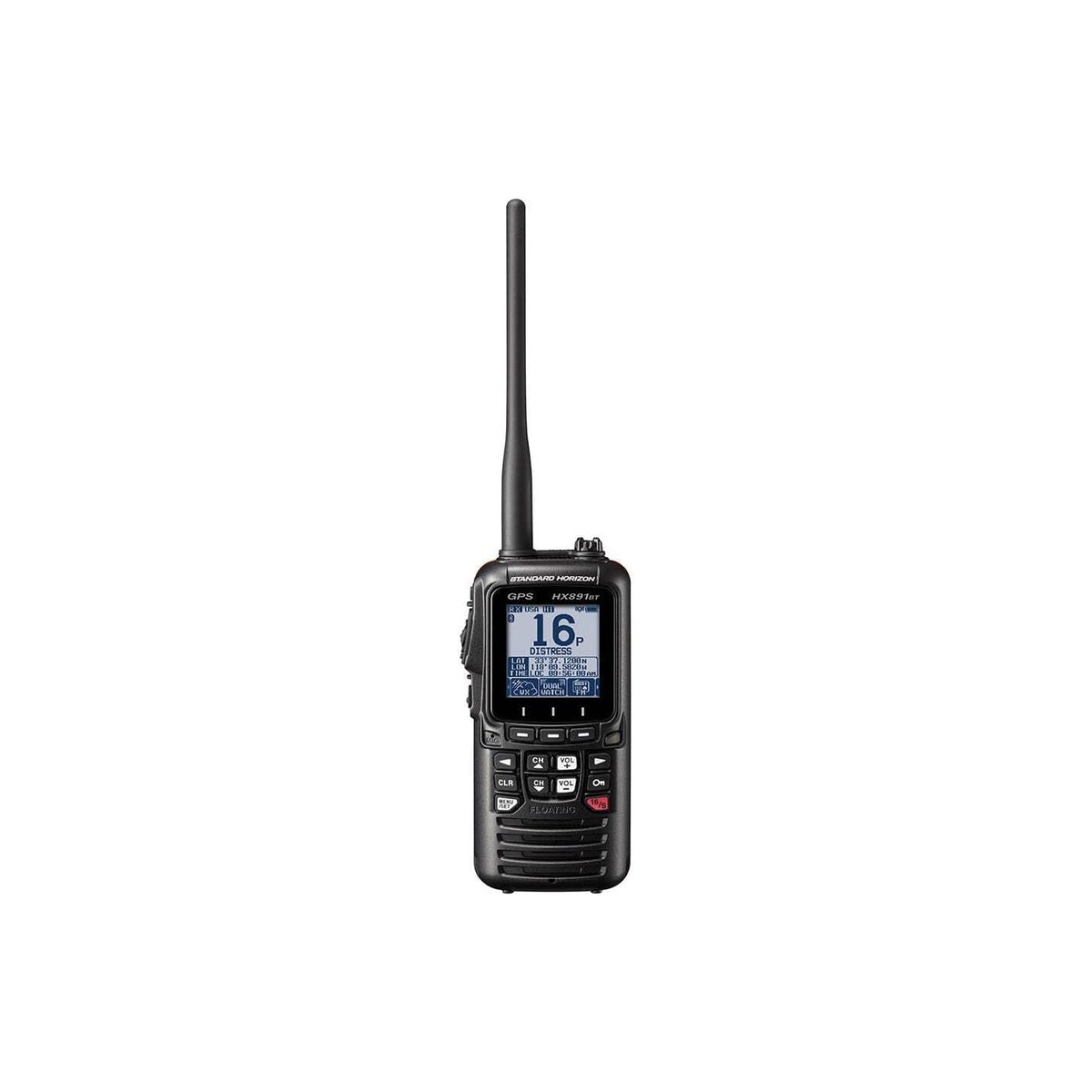
Standard Horizon HX891 BT (floating 6W handheld marine VHF, built-in 66-channel WAAS GPS, Class H DSC, water-activated white strobe that fires even when the radio is off, FM broadcast receiver, alkaline emergency battery tray included, NMEA 0183 GPS output, Bluetooth for the optional SSM-BT20 headset sold separately, IPX8 submersible to 1 meter for 30 minutes, 3-year waterproof warranty, ASIN B0D932SHN7)
It floats, it flashes, and it sends a Mayday with your position.
Who it's for: the cruiser who wants a single handheld that handles every backup role and is fully capable on its own. The HX891 BT floats, strobes, runs FM radio, takes alkaline cells in a pinch, and, alone among our picks, sends a DSC distress call stamped with a GPS position. It is the radio we would clip into the ditch bag.
What we found: the forums treat the HX890 and its HX891 BT refresh as the default answer for a serious backup handheld, and the reason is the combination rather than any one spec. Yachting World's testing of the same hardware named it the best handheld on test, citing the GPS, DSC, IPX8 submersion, and strobe as unmatched at the price, and the standby battery as one of the longest measured. Owners echo it, with the one consistent gripe being that it charges in a cradle rather than over USB-C.
Bottom line: if you are buying one handheld for the boat and you want it grab-bag ready with a one-button distress call, this is the one, the floating GPS and DSC radio with the alkaline tray for the day the pack is flat. If your helm already has a DSC radio and you mainly want a floating talk-and-listen backup, you can spend less, and the HX210 is the next entry for exactly that reason.
- + This is the only pick here that can send a DSC distress call with your GPS position encoded in it: once you have programmed its MMSI, you press the guarded red button and every DSC radio in range, including the Coast Guard, gets your number and your exact coordinates, which is the single feature that turns a handheld from a talk radio into a safety device for the ditch bag
- + It floats face-up, so the screen and controls stay visible in the water, and a water-activated white strobe fires the moment it gets wet even when the radio is switched off, which is exactly the man-overboard case where nobody had time to turn anything on
- + The alkaline emergency tray is the feature cruisers single out: when the rechargeable pack is flat, and owners will tell you it is always flat the day you need it, you drop in fresh alkaline cells and keep transmitting, the thing the sealed-battery compacts cannot do
- + It is the proven platform, the third generation of the HX870 to HX890 line that the forums treat as the default serious handheld, and the HX891 BT adds Bluetooth and a refreshed case while keeping the 6W output, IPX8 submersion, GPS, DSC, FM radio, and 3-year waterproof warranty intact
- × It still charges in a cradle, not over USB-C: the micro-USB port is for PC programming only and cannot charge the radio, so you top it up on the supplied 12V or AC cradle and cannot run it off a phone power bank the way you can the M25EVO, and the exposed cradle contacts are the part owners report corroding in salt air
- × The menu system is dense, and more than one tester calls it the radio you have to read the manual for; programming the MMSI in particular trips people up, and DSC radios cap how many times you can enter an MMSI before they lock out, so you get it right once or not at all
- × At about $260 it is more than double the price of the HX210, and most of that premium is the GPS and DSC; the Bluetooth the BT name advertises also needs the SSM-BT20 headset, a roughly $70 to $100 separate purchase, and a boat that already has a DSC-capable set at the helm is paying for a second distress-calling radio it may not strictly need as a backup
- × Rated battery life is about 11 hours, fine for a day and a long way short of the HX210's standby figure, so on a multi-day passage you are charging it every couple of days or leaning on the alkaline tray
Prices were accurate when we last checked and change often. The eBay figure is the lowest new listing we found, and its search can include newer or older models. We may earn a commission from these links, at no extra cost to you.
Runner-up: Standard Horizon HX210 (floating 6W handheld marine VHF, water-activated emergency strobe, FM weather alert, IPX7 waterproof to 1 m for 30 minutes, 1,850 mAh lithium-ion battery, no GPS, no DSC, ASIN B07TD9855T).
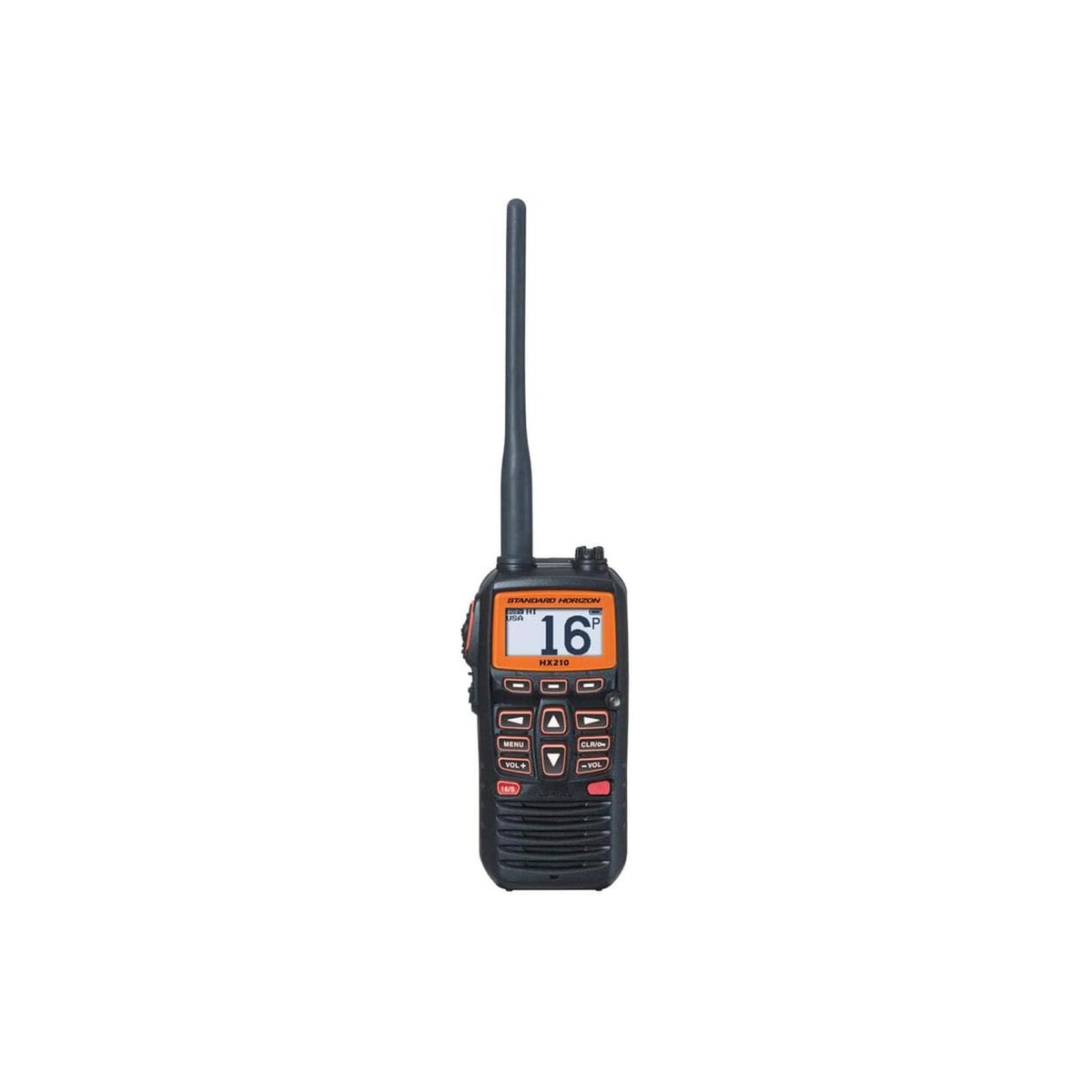
Standard Horizon HX210 (floating 6W handheld marine VHF, water-activated emergency strobe, FM weather alert, IPX7 waterproof to 1 m for 30 minutes, 1,850 mAh lithium-ion battery, no GPS, no DSC, ASIN B07TD9855T)
It floats, it flashes, it lasts, and it costs half the flagship.
Who it's for: the boat that already has a DSC radio at the helm and needs a floating backup that can take a beating and sit unused for months. The HX210 does the two things a backup most needs, it floats and it lasts on the longest standby battery in this guide, and it skips the GPS and DSC you are already covered for at the nav station. At about $120 it is easy to buy a second one for the crew.
What we found: across the owner forums the HX210 comes up beside the Icom M25 series as the sensible non-GPS floater, praised for battery life and toughness and dinged only for being a little quiet next to the louder flagship. It transmits at the full 6W, carries a water-activated strobe and FM weather-alert reception, and gives up nothing on range. Yachting World measured it as the longest standby of the radios in its roundup and framed it as the value companion for the tender or as backup, which is exactly how we rank it.
Bottom line: if the flagship's GPS and DSC are duplicating what your fixed set already does, the HX210 gets you the float, the strobe, and the longest standby battery in the class for half the money, about $120 against $260. Buy up to the HX891 BT only if this handheld needs to be a standalone distress-caller in its own right, the ditch-bag radio rather than the second station.
- + It floats and fires a water-activated strobe the moment it hits the water even when switched off, the same core safety behavior as the flagship, in a radio that sells for about $120
- + It posts the longest standby battery life of any radio in this guide, which is the number that matters for a backup radio that lives in a locker or a foul-weather pocket and has to work weeks after its last charge
- + At 6W it transmits at full handheld power, so it gives up nothing to the pricier picks on range, which is set by antenna height rather than the radio anyway, and it carries FM weather-alert reception for the forecast
- + It is the simple, rugged answer when you do not need GPS or DSC: fewer menus to get lost in, a proven Standard Horizon platform, and a price that makes it easy to buy a second one for the crew
- × No GPS and no DSC, so it cannot send a one-button distress call with your position; in an emergency you speak a Mayday on channel 16 and read out your coordinates, which is why it is the right backup behind a DSC fixed set rather than the right sole radio for a boat without one
- × It charges in a cradle only, with the same exposed-contact corrosion risk in salt air as the rest of the cradle-charged field, and no USB-C option
- × Testers note it is a touch quiet next to the louder flagship and the Icom M94D, audible but not the radio you pick if maximum speaker volume in a blow is the priority
- × The screen and feature set are basic, which is the point, but a buyer who wants GPS, a strobe they can reprogram, or AIS will outgrow it quickly
Prices were accurate when we last checked and change often. The eBay figure is the lowest new listing we found, and its search can include newer or older models. We may earn a commission from these links, at no extra cost to you.
Budget pick: Uniden Atlantis 275 (floating handheld marine VHF, 6W, IPX8 submersible to 1.5 m for 30 minutes, dual-color day and night LCD with the sharpest screen in the budget class, built-in strobe and flashlight, FM weather alert, no GPS, no DSC, ASIN B07N8S3S59).
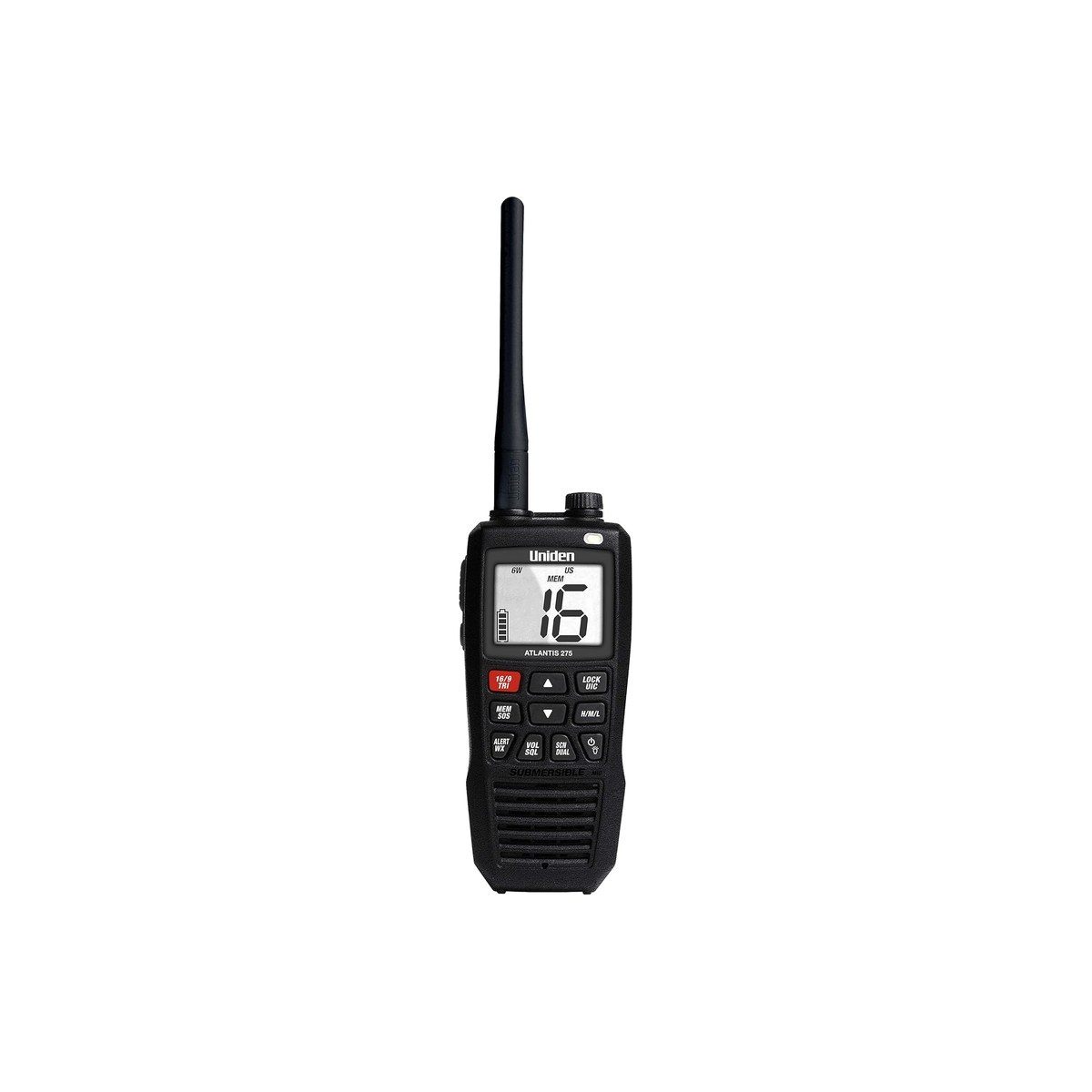
Uniden Atlantis 275 (floating handheld marine VHF, 6W, IPX8 submersible to 1.5 m for 30 minutes, dual-color day and night LCD with the sharpest screen in the budget class, built-in strobe and flashlight, FM weather alert, no GPS, no DSC, ASIN B07N8S3S59)
The cheapest floating radio worth owning: submersible, sharp screen, strobe and flashlight built in.
Who it's for: the boater who wants a floating radio that will survive a dunk and is genuinely easy to read, for the least money that still buys a real marine handheld. The Atlantis 275 floats, submerges to IPX8, and puts the clearest screen in its class in your hand, and it skips the GPS and DSC to hit its price.
What we found: Boating Magazine called out its dual-color LCD, paper-white by day and red by night, as the sharpest of the budget radios, and owner reviews are solidly positive on clear audio and easy controls, with the recurring complaint being the belt clip rather than the radio. It floats, carries an IPX8 submersible rating to a meter and a half for half an hour, runs the full 6W, and builds in a strobe and a flashlight. It is the value floater to hand a crew member or keep in the tender when DSC is not the job.
Bottom line: if you want the cheapest radio here that still floats and survives the water, and you are covered for distress calling by a DSC set at the helm, the Atlantis 275 is the buy. Step up to the HX210 for much longer standby battery, or to the HX891 BT if this radio needs to make its own distress calls.
- + It floats and carries an IPX8 submersible rating, rated to a meter and a half for half an hour, which is a deeper waterproof spec than the IPX7 on several pricier radios, at about $126
- + The screen is the standout: in Boating Magazine's testing its sharp dual-color LCD, paper-white by day and red by night, read as the clearest display in the budget class
- + It builds in a strobe and a flashlight, so it doubles as a signal and a deck light if it goes over the side or you are fumbling at the mooring in the dark, and it runs full 6W output
- + It is the honest budget answer: a floating, submersible, 6W radio from a mainstream brand with a 3-year waterproof warranty, for roughly the same money as the no-GPS Standard Horizon and a fraction of the AIS Icom
- × No DSC, which is the one feature that matters most in a real emergency: it cannot send a position-stamped distress call, so like the HX210 it is a backup behind a DSC set rather than the radio for a boat without one
- × The multi-function buttons confuse some owners at first, and the most common hardware gripe is a belt clip that does not stay secured to the unit
- × No GPS, so even the DSC it lacks could not be position-aware; this is a talk, listen, and strobe radio, not a safety-calling one
- × The battery is a 1,200 mAh pack, toward the lower end of the field, so it is a day radio you recharge, not a long-standby locker radio like the HX210
Prices were accurate when we last checked and change often. The eBay figure is the lowest new listing we found, and its search can include newer or older models. We may earn a commission from these links, at no extra cost to you.
Also worth considering.
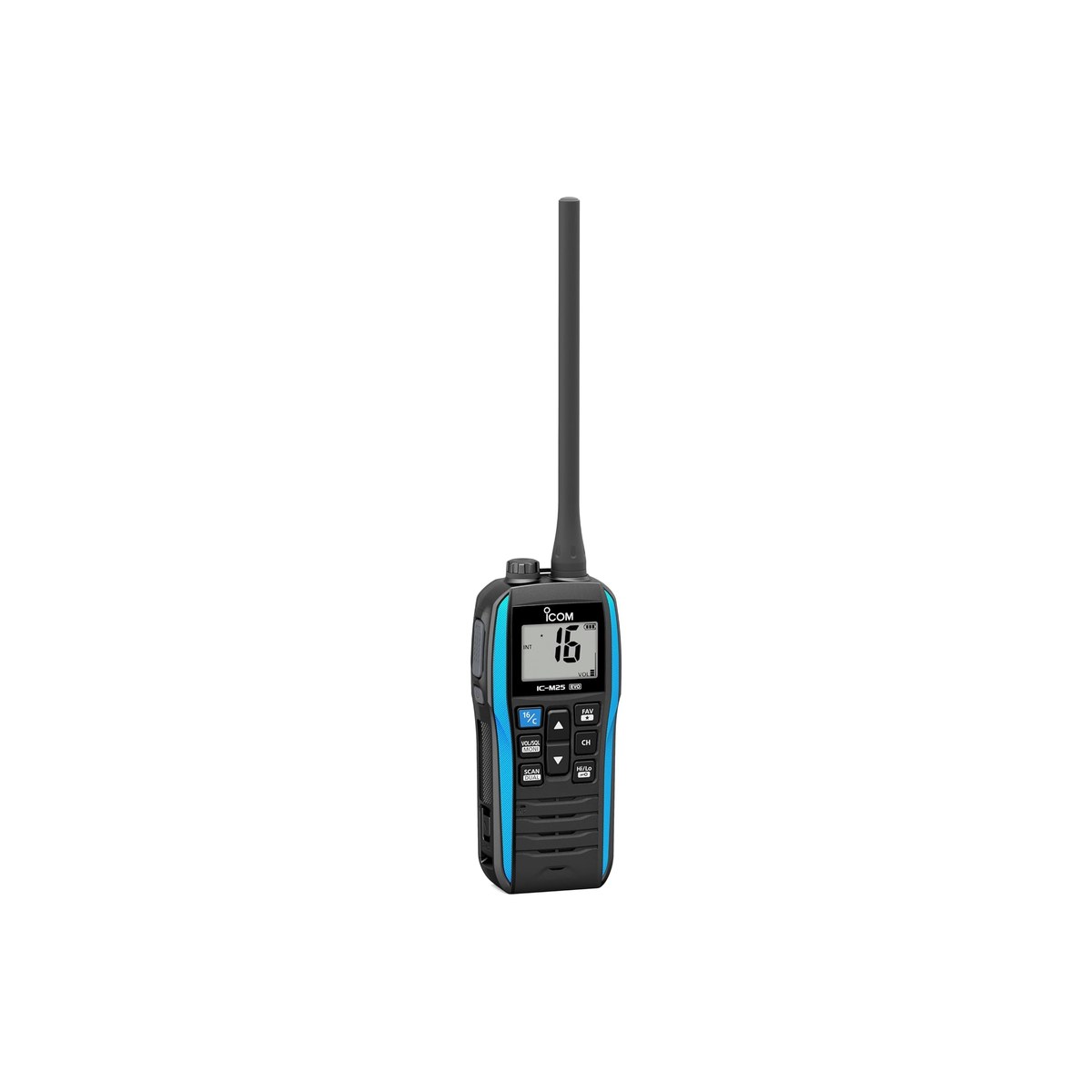
Icom M25EVO (floating handheld marine VHF, 5W, USB-C charging, Float'n Flash so it floats and flashes when submerged, Eco Mode for about 14 hours of battery, IPX7 waterproof to 1 m for 30 minutes, 228 g, no GPS, no DSC, ASIN B0FKN2WY4G)
The slim one you actually keep on your belt, and the only pick that charges over USB-C.
Who it's for: the boater who wants the lightest, most pocketable floating radio and values charging off any USB-C power bank over GPS, DSC, or an extra watt of output. At 228 g the M25EVO is the lightest radio in this guide, the one you clip on and forget is there, for the belt, the PFD pocket, or the tender.
What we found: the M25EVO is the 2026 USB-C refresh of Icom's IC-M25, and it answers the one complaint cruisers had about the old model, charging over USB-C instead of a proprietary cradle so you can top it up from the same power bank that charges your phone. It floats and runs Icom's Float'n Flash so it flashes when it hits the water, and an Eco Mode stretches the battery to about 14 hours. The honest caveat is power: it transmits at 5W, not the 6W the rest of the field runs, though Icom's spec sheet confirms the difference is negligible because antenna height sets range, not the last watt.
Bottom line: it has no GPS and no DSC, so it is a floating talk-and-listen radio, not a distress-caller. For a 20 to 45 ft boat with a charging cradle at the helm the USB-C edge matters less than it does on a kayak or a tender. For the person who wants the slimmest everyday-carry floater that charges off a power bank, at about $172, it is the pick.
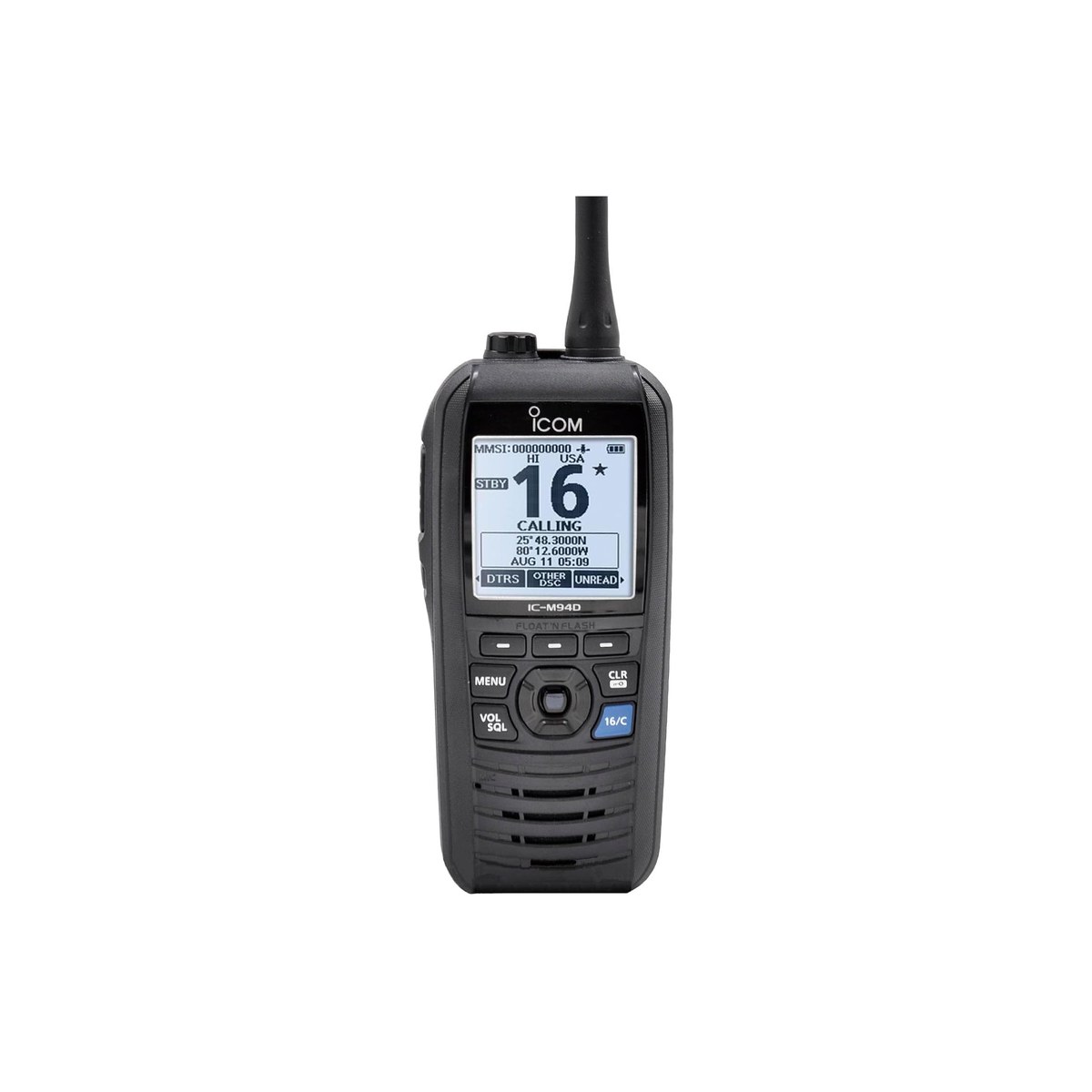
Icom M94D (floating handheld marine VHF with a built-in AIS receiver, GPS, Class H DSC, 6W, Float'n Flash, AquaQuake water-draining speaker, NMEA 0183 GPS output, IPX7 waterproof to 1 m for 30 minutes, 357 g, ASIN B095L6VKJM)
The only handheld that shows AIS targets on its own screen, which is exactly as niche as it sounds.
Who it's for: the boater on a day-boat or older boat with no chartplotter AIS who wants nearby ship traffic on a portable screen, or anyone who wants a backup view of AIS targets if the boat's main electronics fail, rather than the cruiser who already has AIS at the helm and would just be buying a duplicate.
What we found: the M94D is a genuine one-of-a-kind, the only handheld VHF on the market with a built-in AIS receiver, so it shows AIS-equipped vessels as targets on its own screen, with name, range, speed, course, and a closest-approach alarm, on top of GPS, DSC, 6W, and the Float'n Flash float-and-strobe system. On a boat with no chartplotter, in fog, or in a busy shipping lane, owners and testers agree that seeing the tanker bearing down on you, by name, on the radio in your hand is genuinely useful. The honest boundary is what ranks it last here: it is the priciest radio in the guide at about $360, the heaviest at 357 g, and the shortest on battery at roughly 10 hours because the AIS screen drains it, and the small display clutters fast in heavy traffic.
Bottom line: its AIS is receive-only, so it shows you other vessels but does not make you visible to them, which makes it no substitute for a Class B transponder. It is the right buy for a boat with no AIS at all and a duplicate on a boat that already shows AIS on a plotter. If being seen by commercial traffic is the goal, that is a transponder, covered in our AIS transponders guide, not this radio.
Skip this guide if...
You might not need a dedicated handheld at all, or you might need a different radio entirely. If your boat is a tender, a small day-sailer, or a kayak with no room for a fixed set, the handheld is not your backup, it is your only VHF, and you should buy up to the HX891 BT so that sole radio has GPS and DSC and can make its own distress call. If instead you are shopping for the main radio at the helm of a 25 to 45 ft boat, you want a 25W fixed-mount with a masthead antenna, not a 6W handheld, because range comes from antenna height and the fixed set will reach five to twenty times as far; that is our marine VHF radios guide. And if your real worry is summoning rescue when the boat is going down, a VHF of any kind is line-of-sight and short-range, so the device that actually alerts the Coast Guard from anywhere is a 406 MHz EPIRB or PLB, covered in our EPIRBs and PLBs guide. Buy a handheld VHF as the floating, portable backup to a fixed set, the radio for the dinghy and the ditch bag, and pair it with a beacon rather than treating it as one.
Don't bother with.
- × Skip Land GMRS, FRS, or ham handhelds (Baofeng and similar) used on marine channelsThese turn up in marine searches because they are cheap and look like marine radios, and they are the wrong buy twice over. They are not FCC type-accepted for the marine service, so transmitting on marine VHF channels from one is a Part 80 violation, and they transmit a wider signal than marine radios use, which interferes with other boaters on adjacent channels. They also lack the weather-alert format and the channel 16 priority a real marine radio has. Whatever the price, a land radio on marine channels is illegal and technically inferior. Buy a type-accepted marine handheld.
- × Skip No-name Amazon marine handhelds with no FCC Part 80 numberThe marketplace is full of anonymous-brand VHF handhelds that undercut the mainstream radios and quietly skip the things that matter: an FCC Part 80 certification you can actually verify, an IP rating that holds up in the water rather than just on the box, and a warranty if it floods. The test is simple: find the FCC Part 80 ID and confirm it in the FCC equipment database. If you cannot, it is not authorized for marine use. Stick to Standard Horizon, Icom, and Uniden, where the certification and the reputation are real.
- × Skip 3W budget floaters (Uniden Atlantis 155, Cobra MR HH150 FLT)These look like a bargain next to the 6W radios above, and they give up half the transmit power to get there. At 3W they have meaningfully less margin in a blow or for a distress call, and the Atlantis 155 runs on AAA cells with well under the capacity of the 6W radios' lithium packs. The catch is the price gap is small: the floating, submersible, 6W Atlantis 275 costs about the same as these 3W models. There is no reason to accept half the power on a safety radio when full power costs the same money. Buy the 6W.
- × Skip Receive-only marine scannersA handful of products marketed as marine radios are receive-only scanners that monitor harbor and AIS traffic but cannot transmit. They are fine for listening from the dock, but they cannot answer a call, hail a bridge, or summon help, so they are not VHF radios in any sense that matters on a boat and do not belong on this list.
- × Skip The Cobra MR HH500 FLT BT, now effectively discontinuedCobra's Bluetooth floater was a reasonable radio in its day, but as of 2026 it has moved off Cobra's current lineup to legacy status, and on US Amazon the stock is now thin and mostly third-party. It also never had GPS or DSC. The skip is on support and longevity grounds rather than outright unavailability, since a few marine retailers still carry it; with the better-supported picks above covering every role it filled, there is no reason to chase down an end-of-production radio. Skip it.
- × Skip Ultra-compact non-floating handhelds as your only radioThe pocket-sized radios like the Standard Horizon HX40 are genuinely appealing for size and they run a real 6W, but the HX40 does not float without an optional case, and that is a trap for buyers who assume every marine handheld floats. As a second radio for a PFD pocket on a boat that already has floating VHFs aboard, fine. As the one radio that goes in the ditch bag or rides in the tender, no, because the moment it goes in the water it is gone. For a sole or grab-bag handheld, buy one that floats.
How we picked.
Who this guide is for and how we researched it
We wrote this for the owner or crew of a 20 to 45 ft coastal cruising or fishing boat who wants a portable VHF, a marine handheld radio, as the backup to the fixed set at the helm: the radio for the dinghy, the foredeck, the ditch bag, and the day the boat loses power. The same picks serve the small-boat or tender owner whose handheld is their only VHF, with one change we flag throughout, that a sole radio should have GPS and DSC. We did not write it for the land GMRS or ham user, who shares the words handheld VHF radio but needs a different and, on marine channels, an illegal device. We do not run a lab. What we did was read the owner-level signal on The Hull Truth, Cruisers Forum, r/SailboatCruising, and the YBW forum, alongside the on-water testing at Yachting World, Practical Sailor, Boating Magazine, and Cruising World, plus the USCG Navigation Center's MMSI and licensing rules and the manufacturers' spec sheets. Then we ranked for the boat: float first, then whether it can send a distress call with position, then battery and charging, then how each holds up in salt air over seasons.
Float, GPS, and DSC: the three things that actually decide it
Three features separate a marine handheld worth buying from the pile, and none of them is wattage. The first is whether it floats, because a floating VHF radio is recoverable when it goes over the side and a sinking one is gone. Most modern marine handhelds do float, and the good ones add a water-activated strobe that fires the moment the radio gets wet, even switched off, so a dropped radio is recoverable and a man-overboard radio flashes on its own. Standard Horizon radios float face-up so the screen stays visible; Icom's Float'n Flash floats them on their back with the light skyward. The radios that do not float, the ultra-compacts and the commercial-grade IC-M73, are the trap, because buyers assume every marine handheld floats and these need a tether or an accessory case.
The second and third are GPS and DSC, and they travel together. A handheld with both can send a digital distress call on channel 70 that carries your MMSI and your exact position to every DSC radio in range and to the Coast Guard, at the press of one guarded button. Without GPS the call goes out with no coordinates; without DSC you are speaking a Mayday on channel 16 and reading your position aloud. Only two of our picks, the HX891 BT and the M94D, have GPS and DSC. The honest rule from the forums: if the handheld is your only radio, or your grab-bag radio, pay for GPS and DSC; if it is a backup behind a DSC fixed set that already does the automated distress call, a floating 6W radio like the HX210 or Atlantis 275 is enough.
The MMSI rule for a handheld, stated precisely
This is the point owners get wrong most often, and it is worth getting right because a DSC handheld VHF radio can only send that one-button distress call if it has a programmed MMSI, the nine-digit identity tied to a vessel. The US Coast Guard Navigation Center states the rule plainly: except for a handheld not intended for dedicated use on the vessel, every radio on a boat should use the same, identical MMSI. That carve-out is the whole nuance. If your handheld lives on one boat and never leaves it, you program that boat's existing MMSI into it and the handheld is simply a second station on the vessel; a free BoatUS or US Power Squadrons MMSI, which is a vessel MMSI, is fine for this (Sea Tow used to issue these but has withdrawn from the program, moving its accounts to the US Power Squadrons).
If instead the handheld travels between boats, a club boat, a charter, a friend's boat, or is a genuinely portable grab-bag device, it needs its own separate handheld MMSI, a different format that starts with the digits 8, and only the FCC and Shine Micro issue those; a BoatUS vessel MMSI must not be used in a roaming handheld. One nuance for cruisers who leave US waters: a Shine Micro handheld MMSI, like a BoatUS number, sits only in the US Coast Guard's database and not the international SAR database, so if you cruise to Canada or the Bahamas the FCC-issued handheld MMSI is the one to get. The licensing layer sits on top: a recreational boater in US waters needs no FCC license at all to use a VHF, but the moment you cross to a foreign port, Canada, the Bahamas, Mexico, you need an FCC Ship Station License, and the FCC-issued MMSI that comes with it replaces the BoatUS number. Two warnings owners learn the hard way: DSC radios cap how many times you can enter an MMSI before they lock out, so program it once and correctly, and an MMSI that is never registered in the Coast Guard database reaches rescuers as a nine-digit number tied to nothing.
AIS on a handheld: where the Icom M94D makes sense and where it does not
The Icom M94D is the only handheld VHF with a built-in AIS receiver, and the honest read on it sits between the two things reviewers say. On one hand, seeing AIS-equipped ships as named targets on the radio in your hand, with a closest-approach alarm, is genuinely useful in fog, in a busy shipping lane, or on a boat with no chartplotter to show the same picture. On the other, the screen is small and clutters fast in heavy traffic, the AIS drains the battery to about ten hours, and the radio is the heaviest and priciest here. The deciding fact is that the M94D's AIS is receive-only: it shows you other vessels but does not transmit your boat to them.
So the boundary is this. The M94D earns its price on a day-boat, an older boat, or a charter with no AIS at all, where it is the only way to get target awareness without installing anything, and as a backup that still shows traffic if the boat's main electronics die. It is a duplicate, and overkill, on a boat that already shows AIS on a plotter at the helm. And if what you actually want is to be seen by commercial traffic, no receiver does that; you want a Class B AIS transponder, which transmits as well as receives, and that is a different product we cover in our AIS transponders guide.
Power, range, and why a handheld is a backup, not a replacement
Handheld VHF radios run about 5 to 6W against a fixed set's 25W, and that five-to-one power gap matters far less than the marketing implies, because VHF is line-of-sight and range is set by antenna height, not power. A fixed-mount feeding an antenna at the masthead, fifty feet up, reaches fifteen to sixty miles; a handheld held at chest height sees only a few miles to the horizon no matter the wattage. Owners put real numbers on it: handheld-to-handheld is often only one to three miles in flat water, and effectively nothing when you are down in the trough of a swell. The one-watt difference between a 5W M25EVO and a 6W HX210 is not something you will ever hear on the water.
That physics is the entire case for the handheld as a backup rather than a replacement. On a 20 to 45 ft boat the primary radio is the fixed set with the tall antenna; the handheld earns its place in four specific roles. It is the power-loss backup that still transmits when a dead battery bank silences the helm, ideally with GPS and DSC so it can still call for help with a position. It is the foredeck and crew radio when voice across the boat will not carry. It is the dinghy and tender radio that keeps the shore party in touch with the mothership. And it is the ditch-bag radio that becomes your only VHF the moment you abandon ship, which is the one role that most argues for buying the floating, GPS-and-DSC HX891 BT.
No subscription, and the US licensing reality
One clean advantage over the satellite communicators in our other communications guides: a VHF radio has no subscription, no monthly fee, and no activation cost. You buy the radio and it transmits on the marine channels for free, forever. That is worth stating because shoppers cross-shopping a handheld against a satellite messenger often miss it.
The licensing reality is just as simple for most readers, and worth getting exactly right. A recreational boater operating a VHF in US waters needs no FCC license of any kind, an exemption that also covers your EPIRB and radar. You need an FCC Ship Station License only if you take the boat to a foreign port, including Canada, the Bahamas, or Mexico, or if the vessel is over 65.6 feet (20 meters) or carries more than six passengers for hire, or runs single-sideband HF. For a foreign voyage you also need a document most guides forget: a Restricted Radiotelephone Operator Permit (RROP) for the person operating the radio, a one-time roughly $35 lifetime permit, on top of the vessel's Ship Station License. The FCC license is also the route to an FCC-issued MMSI, which is the one you want if you cruise internationally. For a boater staying in US waters, there is no license and no fee at all; the radio just works.
Charging contacts, batteries, and the gotchas owners report
The single most common hardware failure across every brand is charging-contact corrosion. The spring-loaded contacts on a charging cradle, and on the radio that sits in it, collect salt and corrode, until the radio stops charging even though the battery is fine; owners on the forums describe scraping contacts clean with a fiberglass pen and report it on Standard Horizon, Icom, and Cobra cradles alike. The fix is maintenance, a fresh-water rinse of the contacts after saltwater use and a little dielectric grease, and it is the quiet argument for the USB-C M25EVO, whose connector tolerates salt better than exposed cradle springs. The second recurring failure is the battery itself: lithium-ion packs noticeably weaken after two to four salt seasons, an eleven-hour radio dropping to six or seven, which is exactly why the HX891 BT's alkaline emergency tray matters, because the rechargeable pack is reliably flat the day you reach for it.
A few more worth knowing. Waterproof ratings are lab figures on new seals, and aging gaskets and unseated port caps let water in over seasons, so a radio that flooded is usually a radio whose cap was not closed; rinse and check the seals. Screen readability in direct sun varies, and the Uniden Atlantis 275's sharp dual-color display is the one testers single out as easiest to read. DSC setup defeats a surprising number of owners, who never finish programming the MMSI and so never activate the DSC at all, and the MMSI entry lockout means you cannot keep retrying. And float behavior differs by brand in a way that matters: Standard Horizon floats face-up so you can read and work the radio in the water, Icom floats on the back with the strobe up for visibility from above. None of this is a dealbreaker; all of it is the difference between a radio that lasts five seasons and one that dies in two.
2026 model currency: the refreshes that make the old lists wrong
Half the value of a current guide is naming the radios that just changed. Standard Horizon's HX890, the model most best-of lists still headline, has been refreshed as the HX891 BT, which keeps the same 6W, IPX8, floating, GPS, DSC, alkaline-tray platform and adds Bluetooth for a wireless headset and a new case; there is no non-Bluetooth HX891, the refresh is the BT. Icom's slim IC-M25 has become the M25EVO, whose headline change is USB-C charging in place of the old proprietary connector, plus an Eco Mode for longer battery; it stays a 5W, no-GPS, no-DSC floater. The Icom M94D is unchanged and still the only AIS-receive handheld on the market. And the Cobra MR HH500 FLT BT has slipped to legacy status in US retail, which is why it is on the skip list rather than in the lineup.
The one trend worth tracking is USB-C, which is arriving unevenly. It is now standard on the slim Icom value line and on Standard Horizon's newer mid-tier, but the 6W GPS-and-DSC flagships, the HX891 BT and the M94D included, still charge in a cradle in 2026. So if charging off a power bank is a priority, that currently points you at the M25EVO and away from the flagships, a real trade-off between USB-C convenience and the GPS-and-DSC capability that only the cradle-charged radios offer today. We verified every pick as live and buyable on US Amazon at the prices listed before linking it.
FAQs.
Q01 What makes a good handheld VHF radio for a boat?
+
Q02 Do I need GPS and DSC on a handheld, or is a cheap floating radio enough?
+
Q03 Does a handheld VHF with DSC need its own MMSI, separate from the boat's?
+
Q04 Do I need an FCC license to use a handheld VHF radio in the US?
+
Q05 Is AIS on a handheld, like the Icom M94D, actually useful?
+
Q06 How far can a handheld VHF radio actually transmit?
+
Q07 Why is there no 25-watt handheld VHF radio?
+
Q08 Is the Standard Horizon HX890 still current, or should I buy the HX891?
+
If you, then this.
- IF One handheld that does everything, grab-bag ready, sends a distress call with positionGET Standard Horizon HX891 BT$260 →
- IF A floating backup behind a DSC set at the helm, with the longest battery and half the priceGET Standard Horizon HX210$120 →
- IF The cheapest radio that still floats and survives a dunk, with the sharpest screenGET Uniden Atlantis 275$126 →
- IF The lightest everyday-carry floater that charges over USB-C off a power bankGET Icom M25EVO$172 →
- IF AIS targets on the handheld's own screen, on a boat with no chartplotterGET Icom M94D$360 →
Boat Gear: The Complete Guide
The whole-boat picture →Every system on a 20 to 45 ft coastal boat, organized in one place, with the one guide we trust for each.