Best Travel Routers: The 5 We'd Pack to Work From a Van, RV, or Boat (2026)
A travel router is the most useful box a mobile worker carries that nobody explains: it logs into a hotel, cafe, marina, or campground wifi once, hands one private network to all your gear, and wraps the whole thing in a VPN so a shared public connection cannot see your traffic. For a van, RV, or boat that moves between borrowed networks, it turns flaky public wifi into one stable, secure connection, and it is not the same thing as a hotspot. We don't run a lab. We read the owner-review signal across Amazon and the manufacturer specs for 2026, weighted for the mobile worker, and ranked five from a $38 pocket router to a $420 5G model with its own SIM. We weigh how it handles captive-portal public wifi, whether the VPN is built in, and how many ways it can get online, and we name what each one is for.
- 01 GL.iNet Slate 7 , top pick, the WiFi 7 do-everything with a touchscreen and VPN
- 02 GL.iNet Beryl 7 , best for most, the same WiFi 7 and 2.5G ports for less
- 03 GL.iNet Beryl AX , best value, the deepest-proven travel router at about $99
- 04 TP-Link Roam 6 , the rock-bottom budget pick, a secure network for $38
- 05 GL.iNet MUDI 7 , the 5G option, makes its own internet from a SIM
How they compare.
| Rank | Product | Best for | Price | Our score |
|---|---|---|---|---|
| 01 | GL.iNet Slate 7 (WiFi 7)
Top Pick
| Do-everything flagship, touchscreen | $170
Buy → | 8.9/10 |
| 02 | GL.iNet Beryl 7 (WiFi 7) | Best for most, WiFi 7 for less | $130
Buy → | 8.7/10 |
| 03 | GL.iNet Beryl AX (WiFi 6) | Best value, deepest-proven | $99
Buy → | 8.6/10 |
| 04 | TP-Link Roam 6 AX1500 | Cheapest secure network | $38
Buy → | 8.4/10 |
| 05 | GL.iNet MUDI 7 (5G + eSIM) | Its own cellular, no wifi needed | $420
Buy → | 8.3/10 |
Prices are current Amazon prices at time of publication and can change. Scores reflect our editorial evaluation, not vendor input.
Our #1 pick: GL.iNet Slate 7 (GL-BE3600) Travel Router.
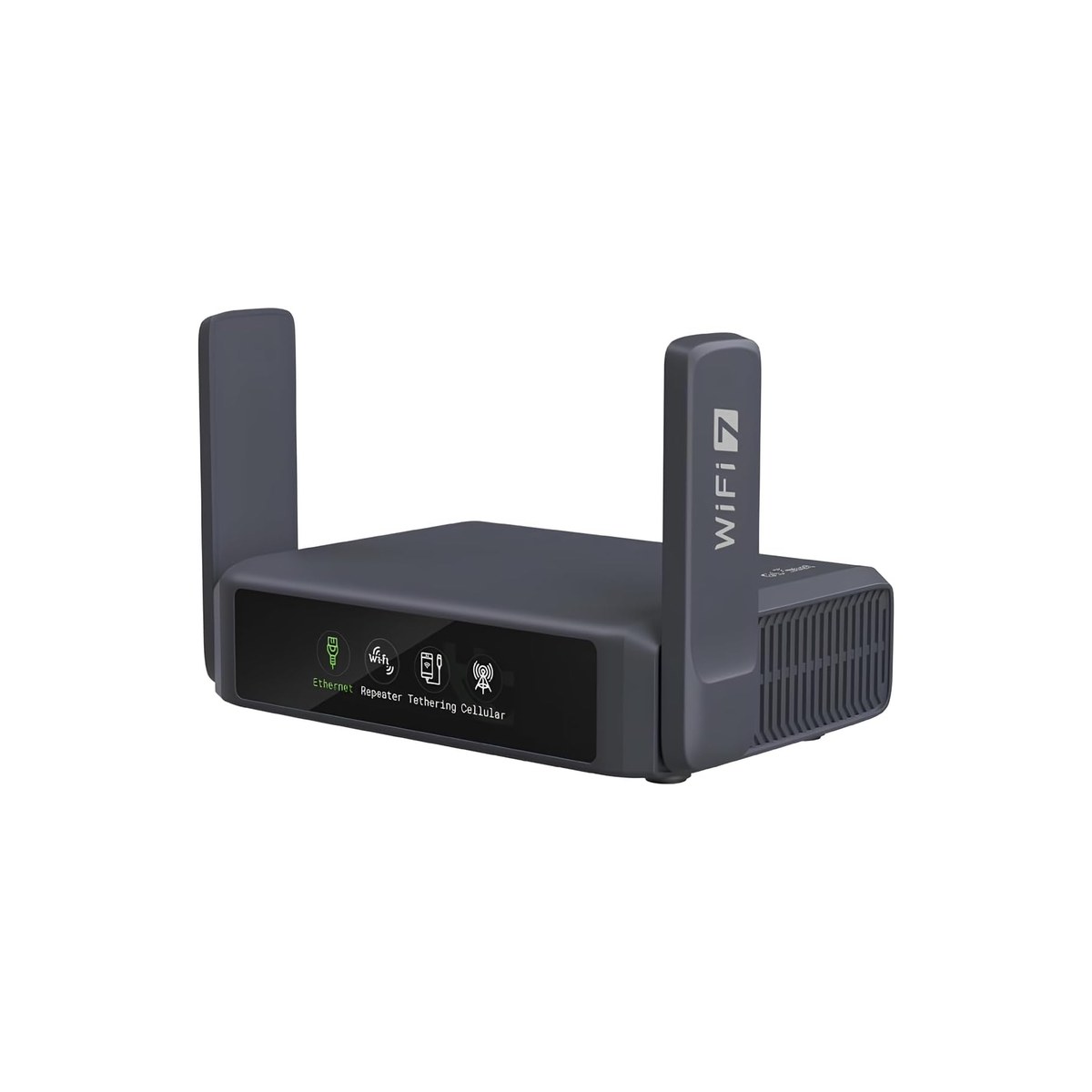
GL.iNet Slate 7 (GL-BE3600) Travel Router
A WiFi 7 pocket router that turns any borrowed wifi into one secure network.
Who it's for: the mobile worker who connects through a different network every few days, a hotel one night, a marina the next, a campground after that, and wants one box that makes all of it behave. The pick for someone who runs a laptop, a phone, and a few other devices, cares about a VPN on networks they do not control, and would rather buy the do-everything router once than fight captive portals on every device.
What we found: the Slate 7 is the current flagship and it earns it. It is a WiFi 7 router with dual 2.5G Ethernet ports and a small touchscreen that lets you scan a wifi QR code, flip the VPN on, or switch between Ethernet, a tethered phone, and a repeated wifi network without opening a settings page. It runs OpenWRT with OpenVPN and WireGuard preinstalled and works with thirty-plus VPN services, so your whole rig rides one encrypted, private network off whatever you plug it into. The honest catch is that WiFi 7 is faster than most public wifi you will ever borrow, so you are paying for the touchscreen, the ports, and the headroom more than raw speed.
Bottom line: if you want the one travel router that does everything and never feels like the limit, buy the Slate 7, and at about $170 across more than 1,300 reviews it is the proven top of the line. Pair it with a phone plan you can tether and you are online almost anywhere. Drop to the Beryl 7 to save forty dollars for the same WiFi 7 without the touchscreen, or step to the MUDI 7 if you need cellular built in.
- + WiFi 7 with dual 2.5G Ethernet ports and a USB 3.0 port
- + Touchscreen to scan wifi, toggle the VPN, and switch source modes
- + OpenWRT with OpenVPN and WireGuard preinstalled, 30+ VPN providers
- + 4.6 stars across more than 1,300 reviews, about $170
- × The priciest non-cellular pick here
- × WiFi 7 is faster than most public wifi you will ever borrow
- × Needs a source to share, it makes no internet of its own
Runner-up: GL.iNet Beryl 7 (GL-MT3600BE) Travel Router.
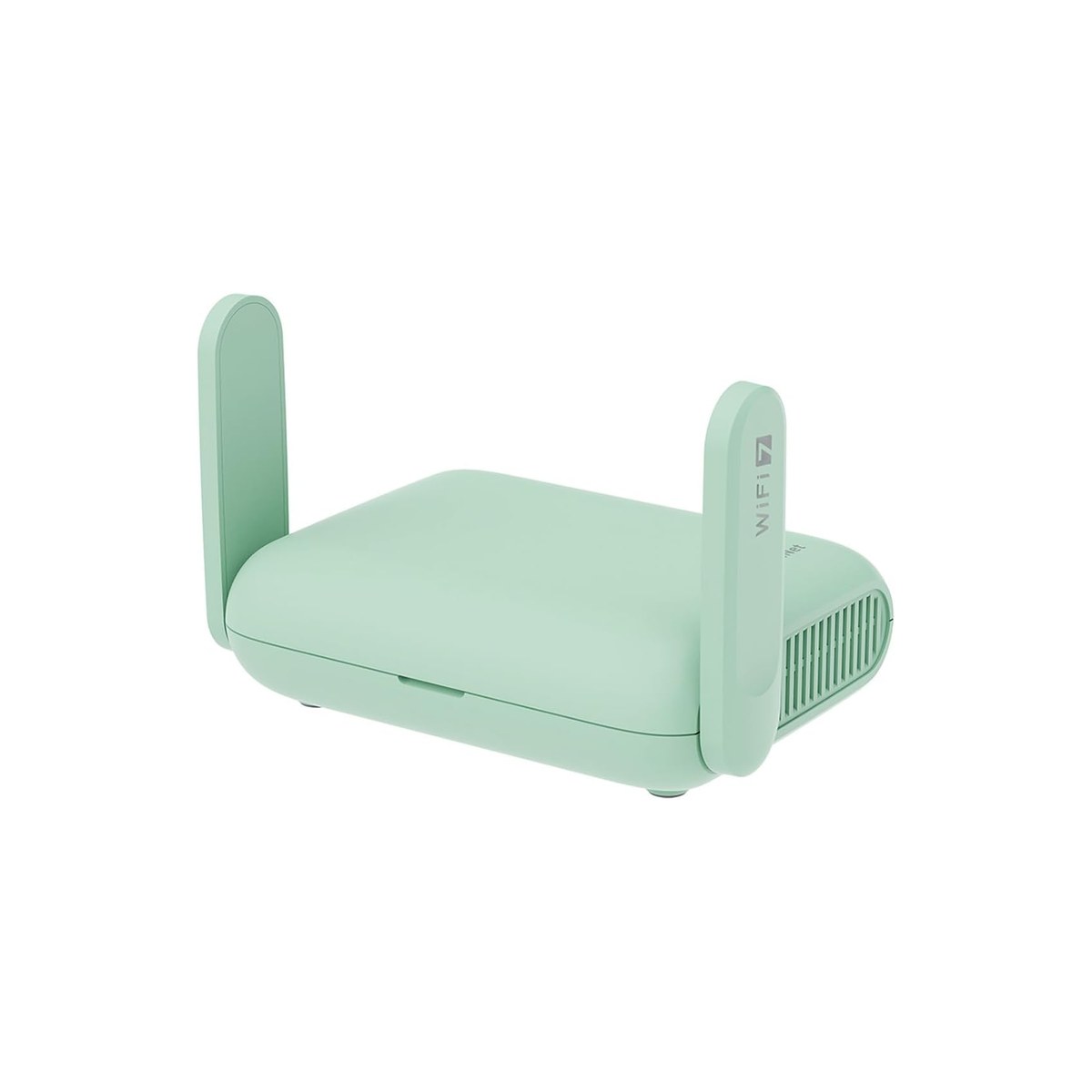
GL.iNet Beryl 7 (GL-MT3600BE) Travel Router
The best for most: WiFi 7 and dual 2.5G ports for forty dollars less.
Who it's for: the worker who wants current WiFi 7 hardware without paying flagship money, and does not need the Slate 7's touchscreen to be happy. The pick for most mobile workers, really, someone who runs a laptop, a phone, and a few other devices through borrowed hotel, cafe, and marina wifi, wants a fast built-in VPN, and would rather spend forty dollars less than the top pick for the same wifi standard and the same dual 2.5G ports.
What we found: the Beryl 7 is the travel router most people should buy in 2026. It is the same WiFi 7 standard as the Slate 7, with the same dual 2.5G Ethernet ports, the same OpenWRT firmware, and OpenVPN and WireGuard preinstalled for thirty-plus VPN services, and its WireGuard VPN runs up to about 1,100 Mbps, far past the WiFi 6 picks below it. What you give up versus the Slate 7 is the touchscreen and a little polish, not capability. At about $130 it sits forty dollars under the flagship and forty above the proven Beryl AX, which is exactly the sweet spot for someone buying current hardware to keep for years.
Bottom line: buy the Beryl 7 if you want the newest standard at a fair price and do not care about a touchscreen, which describes most buyers. It is the cleanest all-rounder in the guide, with WiFi 7 speed you will not outgrow and a VPN fast enough to never notice. Step up to the Slate 7 for the touchscreen and dual 2.5G polish, or save thirty dollars with the deeply-proven WiFi 6 Beryl AX if you do not need WiFi 7 at all.
- + WiFi 7 with dual 2.5G Ethernet ports and a USB 3.0 port
- + WireGuard VPN up to 1,100 Mbps, far faster than the WiFi 6 picks
- + Same OpenWRT, OpenVPN, and WireGuard as the flagship, 30+ providers
- + About $130, forty dollars under the Slate 7 with the same WiFi 7
- × No touchscreen like the Slate 7
- × Newer than the Beryl AX, so a shallower review record
- × Needs a source to share, it makes no internet of its own
Budget pick: GL.iNet Beryl AX (GL-MT3000) Travel Router.
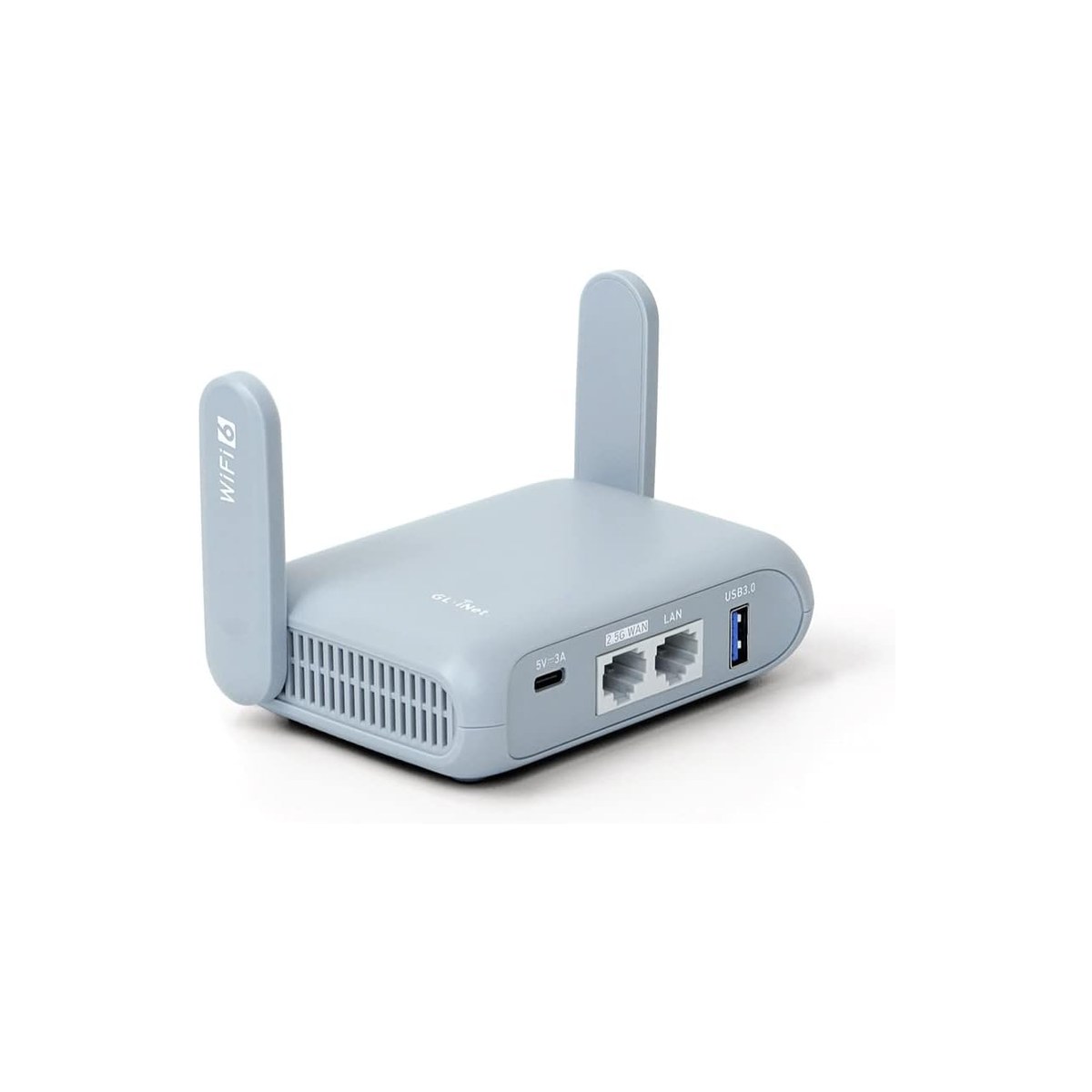
GL.iNet Beryl AX (GL-MT3000) Travel Router
The deepest-proven travel router, almost everything the flagship does for less.
Who it's for: the worker who wants the safest, most-proven travel router for the money and does not need the newest WiFi 7, and would rather trust thousands of reviews than a fresh model. The pick for the practical nomad who knows the bottleneck is the public wifi, not the router, and wants the workhorse that has handled hotels, marinas, and campgrounds for years, with the same VPN and OpenWRT the pricier GL.iNet picks run.
What we found: the Beryl AX is the deepest-proven router in this guide and the value sweet spot of the category. It is WiFi 6 rather than 7, but it has the same OpenWRT firmware, the same OpenVPN and WireGuard with thirty-plus providers, a 2.5G WAN port, and WPA3, and it can run a VPN client and server at once to reach your home network while you browse. At about $99 with more than 5,000 reviews it has by far the longest track record here, and the WiFi 6 versus 7 gap is invisible when your source is a shared hotel network running at a fraction of either. The only thing cheaper is the bare-bones TP-Link Roam 6.
Bottom line: buy the Beryl AX when you want the proven, cheaper choice and WiFi 6 is plenty, which for most workers it is. It is also the router we recommend for marina wifi in our boat internet guide, which tells you how reliable it is. Step up to the WiFi 7 Beryl 7 for thirty dollars more if you want current hardware, or drop to the TP-Link Roam 6 at about $38 if rock-bottom price is the only thing that matters.
- + More than 5,000 reviews, the deepest track record in this guide
- + Same OpenWRT, OpenVPN, and WireGuard as the flagship, 30+ providers
- + WiFi 6 with a 2.5G WAN port, WPA3, and a VPN client and server at once
- + About $99, the value sweet spot of the category
- × WiFi 6, not 7, and a slower VPN than the Beryl 7
- × The TP-Link Roam 6 is cheaper still at about $38
- × Needs a source to share, it makes no internet of its own
Also worth considering.
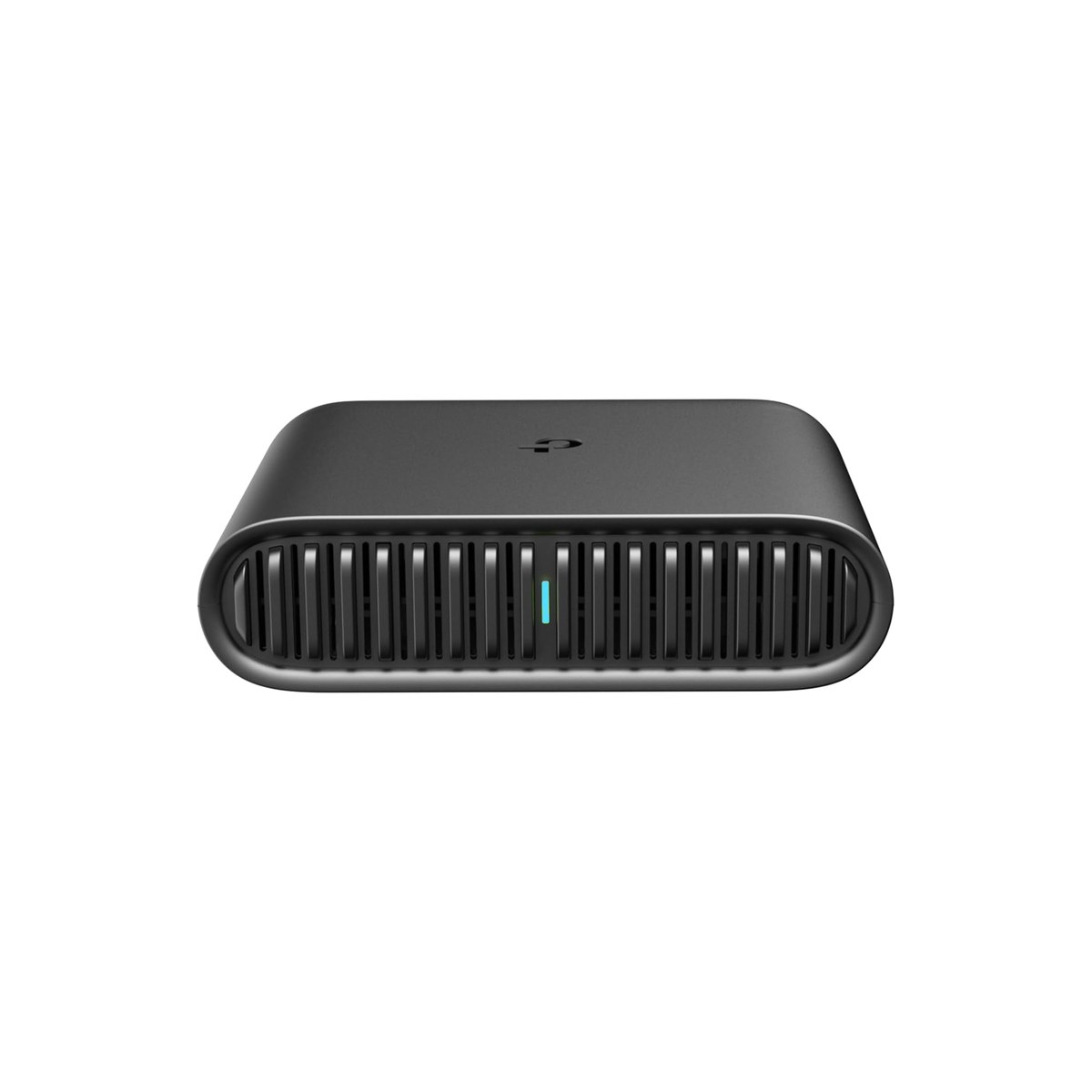
TP-Link Roam 6 AX1500 Travel Router
The cheapest way to a private, secure network on the road.
Who it's for: the worker who wants the security and one-login convenience of a travel router for the least money possible, and does not need open-source firmware or a 2.5G port. The pick for the weekender, the new nomad testing whether a travel router earns its place, or anyone who just wants to log into hotel wifi once, get a private network for the laptop and phone, and not think about it again.
What we found: the Roam 6 is the cheapest travel router worth buying and the most-reviewed product in this guide. For about $38 you get WiFi 6 and the same core trick as the pricier picks, connecting to public wifi and handing your devices a private, secure network with VPN support, plus router, hotspot, and extender modes. It is USB-C powered so it runs off a power bank, and it is genuinely pocket-sized. The honest limits versus the GL.iNet picks are real: it carries the lowest rating here at 4.2, there is no 2.5G port, and TP-Link's app is more closed than GL.iNet's open OpenWRT.
Bottom line: buy the Roam 6 if price is the only thing that decides it, with the deepest review record in the guide behind it. It does the one thing that matters, a private secure network off borrowed wifi, for a fraction of the others. Step up to the Beryl AX when you want OpenWRT, a faster port, and the higher rating, which most workers doing this daily eventually will, but the Roam 6 is the honest place to start.
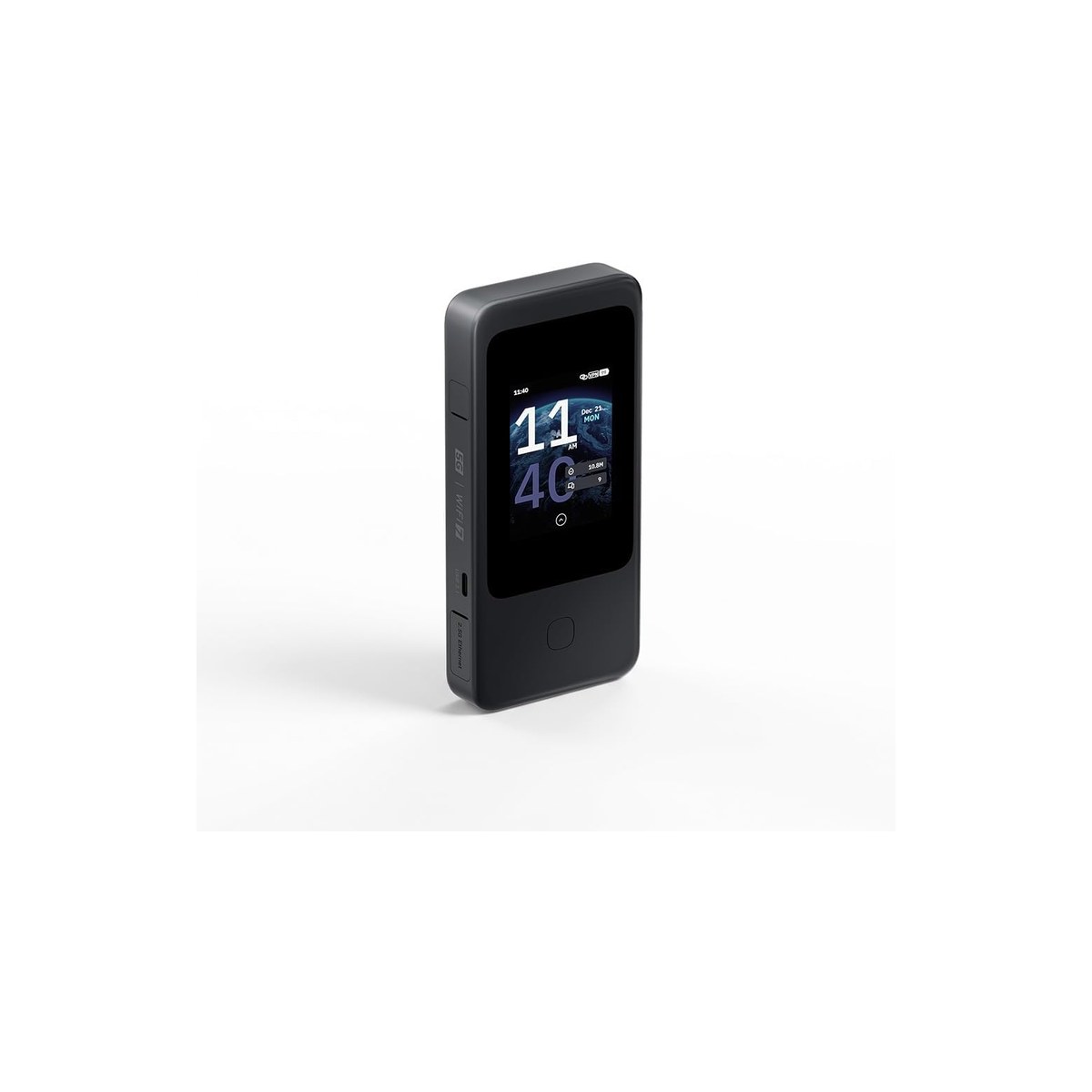
GL.iNet MUDI 7 (GL-E5800) 5G Travel Router
A WiFi 7 router with its own 5G, for when there is no wifi.
Who it's for: the worker who cannot count on borrowing wifi at all, who parks where there is no hotel network and no campground signal. The MUDI 7 does everything the other routers do, log into and reshare borrowed wifi behind a VPN, and adds its own 5G so it can make internet when there is none to borrow. The pick for the true off-gridder, the creator uploading from nowhere, or anyone who wants cellular failover so a dropped wifi never means a dropped call.
What we found: the MUDI 7 is a travel router and a 5G modem in one. It takes an eSIM or one of two nano-SIMs, makes its own WiFi 7 network, and lets you configure Ethernet, a repeated wifi, a tethered phone, and 5G all at once, then fails over between them automatically, so if the active link drops the next takes over in seconds. A 13.5-hour battery means it works untethered, and a 2.5G port and 10 Gbps USB-C cover wired backhaul and fast file offload. The catches are price and proof: at about $420 it is by far the most expensive pick here, and it is brand new with only a handful of reviews.
Bottom line: buy it only if you genuinely need to make your own internet on the move, in which case nothing else here competes. For most workers who can usually find a wifi network to borrow, one of the wifi-only routers plus a tethered phone is far cheaper. If you want a fixed RV or boat internet system instead of a pocket device, our RV internet and boat internet guides cover hotspots and Starlink.
Skip this guide if...
You already get a reliable connection from a single device and never share it. If you travel with just a phone on an unlimited plan and never need a laptop or a second device online at the same time, a travel router is an extra box you do not need. It earns its place when you connect multiple devices through borrowed, untrusted wifi and want them private, secure, and logged in once, or when you need to fail over between wifi and cellular.
Don't bother with.
- × Skip A travel router as your only internet source (it is not a hotspot)This is the most common mistake. A travel router shares an internet connection; it does not create one, except for cellular models like the MUDI 7. If you plug a wifi-only travel router into nothing, you get nothing. Pair it with public wifi, an Ethernet jack, or a tethered phone, or buy a cellular model or a dedicated hotspot if you need internet from thin air.
- × Skip A full-size home or mesh router for travelHome routers and mesh systems are built for coverage and wall power, not a backpack. They are bulky, run on AC, and have none of the public-wifi repeater and captive-portal handling that makes a travel router useful in a hotel or marina. A portable travel router does the mobile job in a fraction of the size and runs off USB-C or a power bank.
- × Skip The cheapest no-name pocket router with a handful of reviewsTravel routers live or die on firmware and on how they handle flaky public wifi, and the bargain-bin no-names are where both fall apart, dropping the connection or stalling on captive portals. The picks here have thousands of reviews and active firmware behind them. A router you have to reboot in a hotel lobby is worse than none, so spend a little more on a proven one.
How we picked.
How we picked, and why we don't claim to test
We don't run a lab. We read the owner-review signal across Amazon and the manufacturer spec sheets, weighted for the mobile worker rather than the home or office user, and ranked five by the things that decide whether a travel router earns space in a rig: how well it handles borrowed, captive-portalled public wifi, whether a VPN is built in, how many ways it can get online, and how small and power-flexible it is. A portable travel router that runs off USB-C or a power bank fits a rig in a way a home router never will. We verified every pick was in stock with a current price the day we published, and left out home and mesh routers, because they are built for wall power and coverage, not travel. We also considered the Ubiquiti UniFi UTR travel router, the slim WiFi 5 ecosystem option, but left it out because on Amazon it lists at roughly twice its $79 list price, a poor buy there for anyone who does not already run UniFi gear at home.
Travel router vs hotspot, and the two wins for a worker
The single thing to understand before buying is that a travel router is not a hotspot. A travel router shares an internet connection you already have, public wifi, an Ethernet jack, or a tethered phone, and turns it into one private, secure network for all your devices. A hotspot, or MiFi, makes its own internet from a cellular SIM. Most of the picks here are wifi-only routers that need a source; the GL.iNet MUDI 7 is the exception, a 5G travel router with its own SIM, which is why it costs the most.
The reason a worker wants one is two practical wins on borrowed networks. First, the captive portal: you log into the hotel or campground sign-in page once on the router, and then every device, your laptop, phone, tablet, and anything else, rides the router's private network without signing in again. Second, security: public wifi is shared and untrusted, so the router wraps everything behind a built-in VPN like WireGuard or OpenVPN, which matters far more on a marina or cafe network than on your own.
For a van, RV, or boat the travel router is the portable, borrow-any-network layer of your connectivity, the box you carry into a hotel, a cafe, a marina, or a campground. It is different from a fixed rig internet system built around a rooftop antenna, a dedicated cellular hotspot, or Starlink, which we cover in our RV internet and boat internet guides. Many full-timers run both: a travel router to harvest and secure whatever wifi is around, and a hotspot or Starlink for when there is none.
What our scores mean, and a note on the picks
Our scores reflect how consistent the owner signal is and how well each router fits mobile, borrowed-wifi use, not lab throughput numbers. Two honest notes on the ranking. The Beryl AX has the deepest review record here and still sits at number three, not higher, only because it is WiFi 6 where the two picks above it are WiFi 7; on proof and value it is the safest buy in the guide. And the MUDI 7 is brand new, with a handful of reviews and a $420 price, so we rank it on its unique capability, its own 5G, rather than a deep track record, and we say plainly that most workers do not need it. We name the cheaper or more proven alternative on every pick so brand is never the reason to buy.
FAQs.
Q01 What is a travel router, and what does it do?
+
Q02 Is a travel router worth it for hotel wifi?
+
Q03 What is the difference between a travel router and a hotspot?
+
Q04 Do I need a travel router with a VPN?
+
Q05 What is the best travel router for most people?
+
Q06 Can a travel router work on a cruise ship?
+
Q07 Does a travel router give me internet where there is no wifi?
+
Q08 Is a WiFi 6 travel router enough, or do I need WiFi 7?
+
If you, then this.
- IF you want the do-everything flagship that never feels like the limitGET GL.iNet Slate 7$170 →
- IF you want WiFi 7 at a fair price, the best for most peopleGET GL.iNet Beryl 7$130 →
- IF you want the deepest-proven router and WiFi 6 is fineGET GL.iNet Beryl AX$99 →
- IF you want the cheapest secure network off borrowed wifiGET TP-Link Roam 6 AX1500$38 →
- IF you need a router that makes its own internet from a SIMGET GL.iNet MUDI 7$420 →
Work-from-Anywhere Gear: The Complete Guide
The whole mobile-office picture →Every system in a work-from-anywhere setup, organized in one place, with the foundation every remote worker needs and the one guide we trust for each.