Best Bilge Pumps: The 5 We'd Trust to Keep You Dry (2026)
Five automatic bilge pumps for an 18 to 32 ft outboard or inboard boat, sorted by review-count signal and editorial honesty on GPH ratings. We read the SEAFLO, Rule-Mate, MAXZONE, Attwood, and Rule manufacturer specifications, then cross-referenced them against The Hull Truth, Cruisers Forum, iboats, SailboatOwners.com, Practical Sailor archives, r/boating, and r/sailing. The key honesty point: manufacturer GPH ratings are tested at 0 ft head, and real-world output at 3 to 4 ft head is roughly 50 to 65 percent of the nameplate. The 1100 GPH pump is really 600 to 750 GPH in practice. Automatic float switches also fail more often than the motors, and sealed integrated-switch designs reliably out-survive separate mechanical floats. And a bilge pump is a nuisance-water removal system, not a sinking-prevention system: above 1500 GPH at any head height, no off-the-shelf pump saves you.
- 01 SEAFLO 06 Series 1100 GPH Automatic , the sealed integrated-switch automatic with a 4-year warranty (longer than every brand-name competitor), $28
- 02 Rule-Mate RM1100B 1100 GPH Automatic , the high-end build with Auto Sense Intelligence, thermal cut-off, and backflow prevention, $125
- 03 MAXZONE 1100 GPH Automatic Submersible , the budget pick, 4,089 Amazon reviews (strongest signal in the cluster), $25
- 04 Attwood Sahara MK2 S500 500 GPH Automatic , the dedicated 500 GPH automatic for small-boat single-pump installs, $64
- 05 Rule 4000 GPH Non-Automatic (heavy-duty) , the emergency-capacity backup for cruiser dual-pump installs, $252
How they compare.
| Rank | Product | Best for | Price | Our score |
|---|---|---|---|---|
| 01 | SEAFLO 06 Series 1100 GPH Auto (sealed switch, 4-yr warranty)
Top Pick
| 18 to 32 ft coastal cruiser single-pump install | $28
Buy → | 9.0/10 |
| 02 | Rule-Mate RM1100B 1100 GPH Auto (high-end build) | Cruiser wanting Auto Sense + thermal cut-off | $125
Buy → | 8.8/10 |
| 03 | MAXZONE 1100 GPH Automatic (4,089 reviews) | Pure budget value, known-working spare | $25
Buy → | 8.5/10 |
| 04 | Attwood Sahara MK2 S500 500 GPH Auto | Small-boat 14-22 ft single-pump install | $64
Buy → | 7.8/10 |
| 05 | Rule 4000 GPH Non-Automatic (heavy-duty) | Cruiser emergency-capacity backup, dedicated panel switch | $252
Buy → | 8.4/10 |
Prices are current Amazon prices at time of publication and can change. Scores reflect our editorial evaluation, not vendor input.
Our #1 pick: SEAFLO 06 Series 1100 GPH Automatic Submersible Bilge Pump (sealed integrated float switch, 4-year manufacturer warranty).
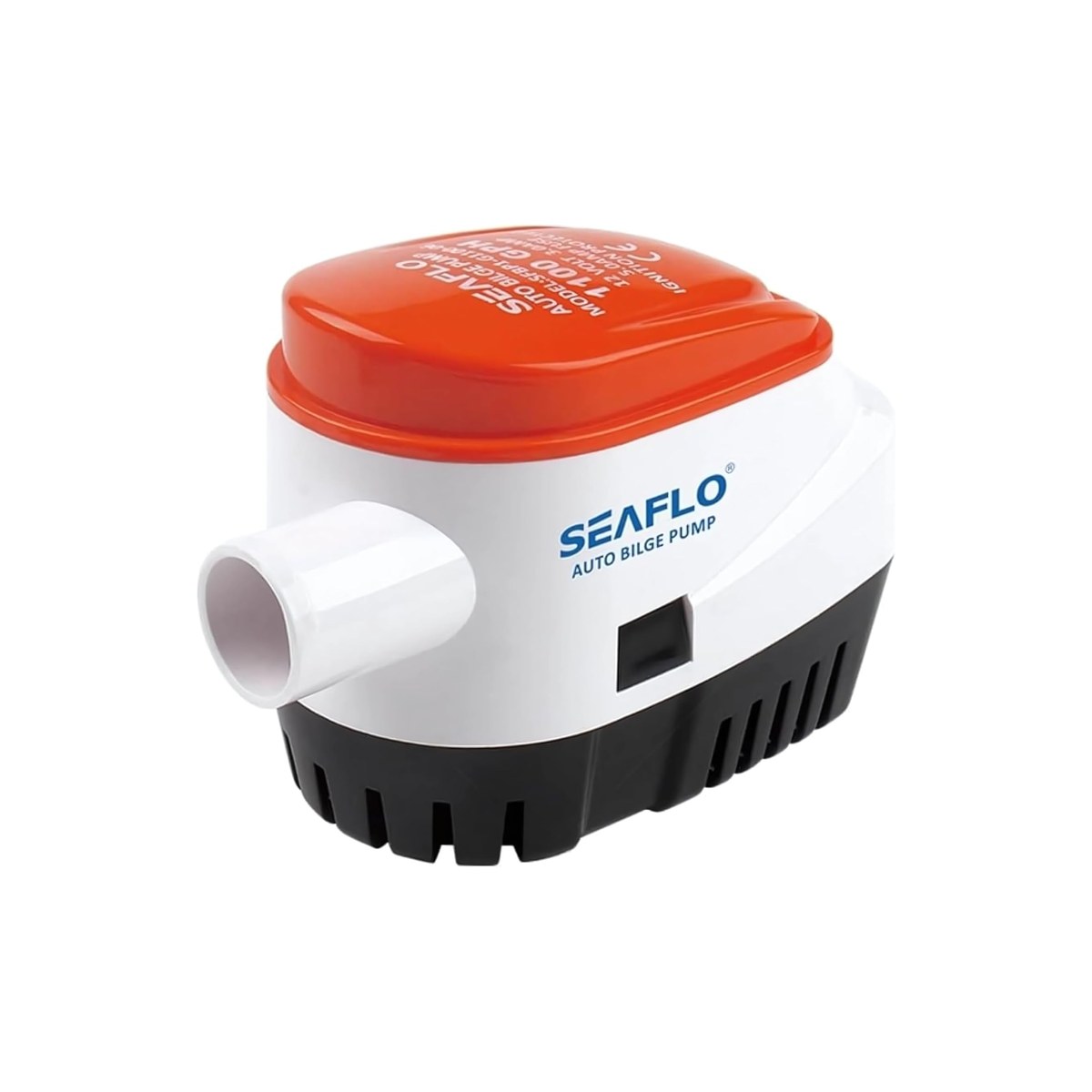
SEAFLO 06 Series 1100 GPH Automatic Submersible Bilge Pump (sealed integrated float switch, 4-year manufacturer warranty)
The SEAFLO 06 Series 1100 GPH Automatic is the bilge pump we would buy first for an 18 to 32 ft coastal cruiser, runabout, or center console doing a single-pump install. The 4-year manufacturer warranty is the longest in the category and the cleanest signal that SEAFLO's documented failure rate is below the named-brand competitors who only back their pumps for 1 to 3 years. The sealed integrated float switch design avoids the single most-common bilge-pump failure mode (mechanical float lever jamming with sediment or saltwater corrosion), and the 1-1/8 inch outlet matches the standard hose ID on most 18 to 32 ft boats with no adapter. The 391 Amazon reviews at 4.5 stars is more than twice the review volume of the brand-name Rule-Mate RM1100B at one-fifth the price; the rating is identical, the volume is materially better, the price gap is the value the SEAFLO captures. Two honesty points on the SEAFLO: first, the 1100 GPH nameplate is the manufacturer rating at 0 ft head and the real-world output at typical 3 to 4 ft bilge-to-thru-hull discharge height is roughly 600 to 700 GPH per third-party testing. This is the central buying truth nobody puts on the box, and it applies to every 1100 GPH pump in the category, not a SEAFLO-specific issue. Second, SEAFLO is a Chinese-direct brand and the warranty service path requires shipping back to SEAFLO directly (no West Marine counter or chandlery network); the 4-year warranty is real on paper but the practical inconvenience of mid-season replacement is the trade-off for the price tier. For the single-pump install on a coastal cruiser, runabout, or center console where the bilge pump fits a standard pump base and the owner wants the longest warranty in the category, this is the SEAFLO we would buy and the right default for the persona this guide serves.
- + 4.5 stars across 391 Amazon owner reviews, a meaningful signal at the entry-level price tier and a higher rating than the brand-name Rule-Mate's 4.5 across 168 reviews (the SEAFLO has more than twice the review volume at one-fifth the price)
- + 4-year manufacturer warranty is the longest in the category (Rule-Mate is 3 years, Attwood Sahara is 3 years, MAXZONE is 1 year). The SEAFLO is one year past the named-brand standard, the cleanest signal that SEAFLO is willing to back the pump for longer than the competitors and the practical advantage when a mid-season failure happens in year 3
- + Sealed integrated float switch is the design class that reliably out-survives separate mechanical float switches, the documented failure mode that ends most bilge-pump replacements. No external lever to jam with sediment, no separate switch to wire, fewer ways for the install to go wrong
- + 1-1/8 inch outlet matches the standard hose ID on most 18 to 32 ft boats with no adapter required, snap-off strainer base for sediment cleaning, CE and RoHS certified construction
- × 1100 GPH is the manufacturer nameplate at 0 ft head; real-world output at 3 to 4 ft head (bilge to thru-hull discharge height on a typical 18 to 32 ft boat) is roughly 600 to 700 GPH per third-party testing. This is true of every 1100 GPH pump in the category, not a SEAFLO-specific issue, but it is the central buying truth nobody puts on the box
- × SEAFLO is a Chinese-direct brand and the warranty service path requires shipping back to SEAFLO directly (no West Marine counter or chandlery network); the 4-year warranty is real on paper but the practical inconvenience of mid-season replacement is the trade-off for the price tier
- × Single-pump install only; for a 25 ft and up coastal cruiser doing overnight at anchor or any boat with a separate house bank, this pump is the primary in a dual-pump system, with a higher-capacity manual emergency pump (the Rule 4000 GPH at rank 5) wired to a separate dedicated panel switch
Runner-up: Rule-Mate RM1100B 1100 GPH Automatic Bilge Pump (Auto Sense Intelligence, thermal cut-off, backflow prevention).
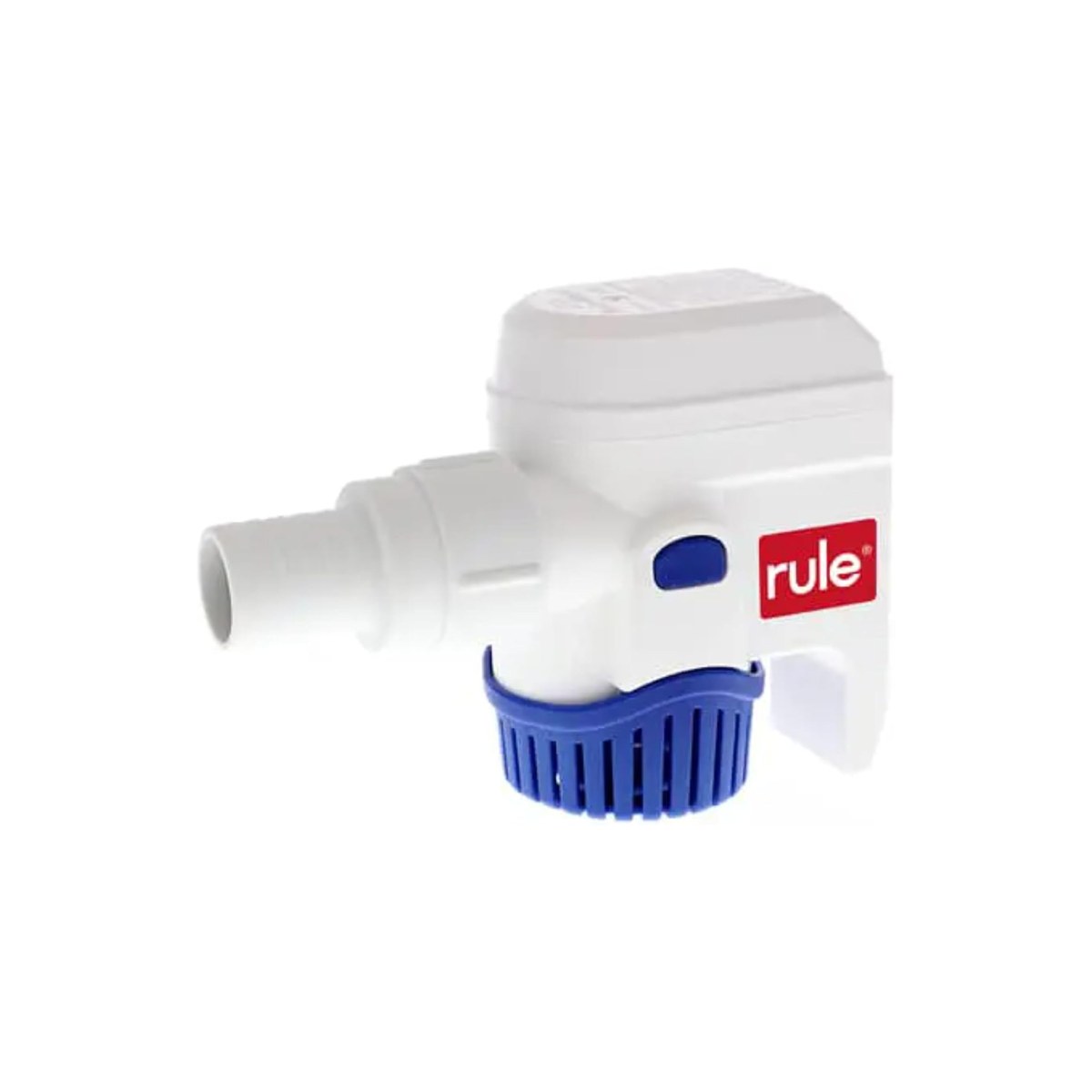
Rule-Mate RM1100B 1100 GPH Automatic Bilge Pump (Auto Sense Intelligence, thermal cut-off, backflow prevention)
The Rule-Mate RM1100B is the high-end 1100 GPH automatic bilge pump and the runner-up rather than the Top Pick because the price gap above the SEAFLO is the central buyer hesitation in this category. The Rule-Mate has 168 Amazon owner reviews at 4.5 stars, the Auto Sense Intelligence solid-state field-effect electronics that detect water by sensing the dielectric constant of fluid (the pump will not false-trigger on motor oil or fuel, unlike a mechanical float), a thermal cut-off circuit that protects the motor from overheating, and backflow prevention that reduces the standing-water sulfation cycle. The Rule brand-name service network through West Marine, Defender, and local chandleries is the practical advantage no Chinese-direct manufacturer matches at the price gap, and the brand is the legacy market leader most cruisers reach for by default. Three friction points: first, the price is roughly 4.5 times the SEAFLO 06 Series for the same 1100 GPH nameplate, and the cycle-life math at typical 3-year replacement intervals does not always justify the price gap for a single-pump install where the SEAFLO would deliver equivalent service life. Second, the 168 Amazon reviews is materially below the SEAFLO's 391 and the MAXZONE's 4,089; the Rule brand upcharge does NOT come with a stronger Amazon social-proof signal, and the rating parity at 4.5 stars across both Rule-Mate and SEAFLO suggests the manufacturer-level quality is closer than the price gap implies. Third, the Auto Sense Intelligence has a documented 2.5-minute safe-mode cycle pattern that can drain a small house battery if the pump is wired direct-to-battery (without a panel switch) and the boat sits unmonitored for weeks. The workaround is to wire through a panel switch with an inline fuse, which is the install pattern every pump in this guide actually rewards. For the cruiser who specifically wants the Rule brand-name service network, the Auto Sense Intelligence motor protection, and is willing to pay the Rule brand upcharge, the RM1100B is the runner-up we would buy.
- + Rule is the legacy market leader for marine bilge pumps and the brand most cruisers reach for by default; Xylem manufactures Rule pumps and the brand-name service network through West Marine, Defender, and local chandleries is the practical advantage when a mid-season failure happens
- + Auto Sense Intelligence is the integrated solid-state field-effect electronics that detect water by sensing the dielectric constant of fluid around the sensor (it will not false-trigger on motor oil or fuel, unlike a mechanical float), eliminating the most-common bilge-pump failure mode (float switch sticking from sediment or saltwater corrosion). The pump runs a 15-second self-check every 2.5 minutes in safe mode (the motor-load fallback) when the field-effect sensor is fouled; this is the documented Auto Sense behavior
- + Thermal cut-off circuit shuts the motor down before overheating destroys the impeller; backflow prevention reduces the standing-water cycle that sulfates the impeller in cyclic-duty applications. Both are documented features in the spec sheet and confirmed in third-party teardowns
- + 4.5 stars across 168 Amazon owner reviews, with the Rule brand-name trust signal that no Chinese-direct manufacturer in this category can offer at the price gap
- × Roughly 4.5 times the SEAFLO price for the same 1100 GPH nameplate; the price gap buys the Rule brand-name service network and the Auto Sense + thermal cut-off features, but the cycle-life math at typical 3-year replacement intervals does not always justify the price gap for a single-pump install where the SEAFLO would deliver the same 3-year service life
- × 168 Amazon reviews is materially below the SEAFLO's 391 and the MAXZONE's 4,089; the Rule brand upcharge does NOT come with a stronger Amazon social-proof signal, and a meaningful fraction of forum discussion centers on whether the Auto Sense Intelligence is worth the price gap
- × Auto Sense Intelligence has a documented 2.5-minute safe-mode cycle pattern that can drain a small house battery if the pump is wired direct-to-battery (without a panel switch) and the boat sits unmonitored for weeks; the workaround is to wire through a panel switch with an inline fuse, which is the install pattern the SEAFLO and MAXZONE also reward
Budget pick: MAXZONE 1100 GPH Automatic Submersible Bilge Pump (Compact Marine Boat Yacht, the volume seller on Amazon).
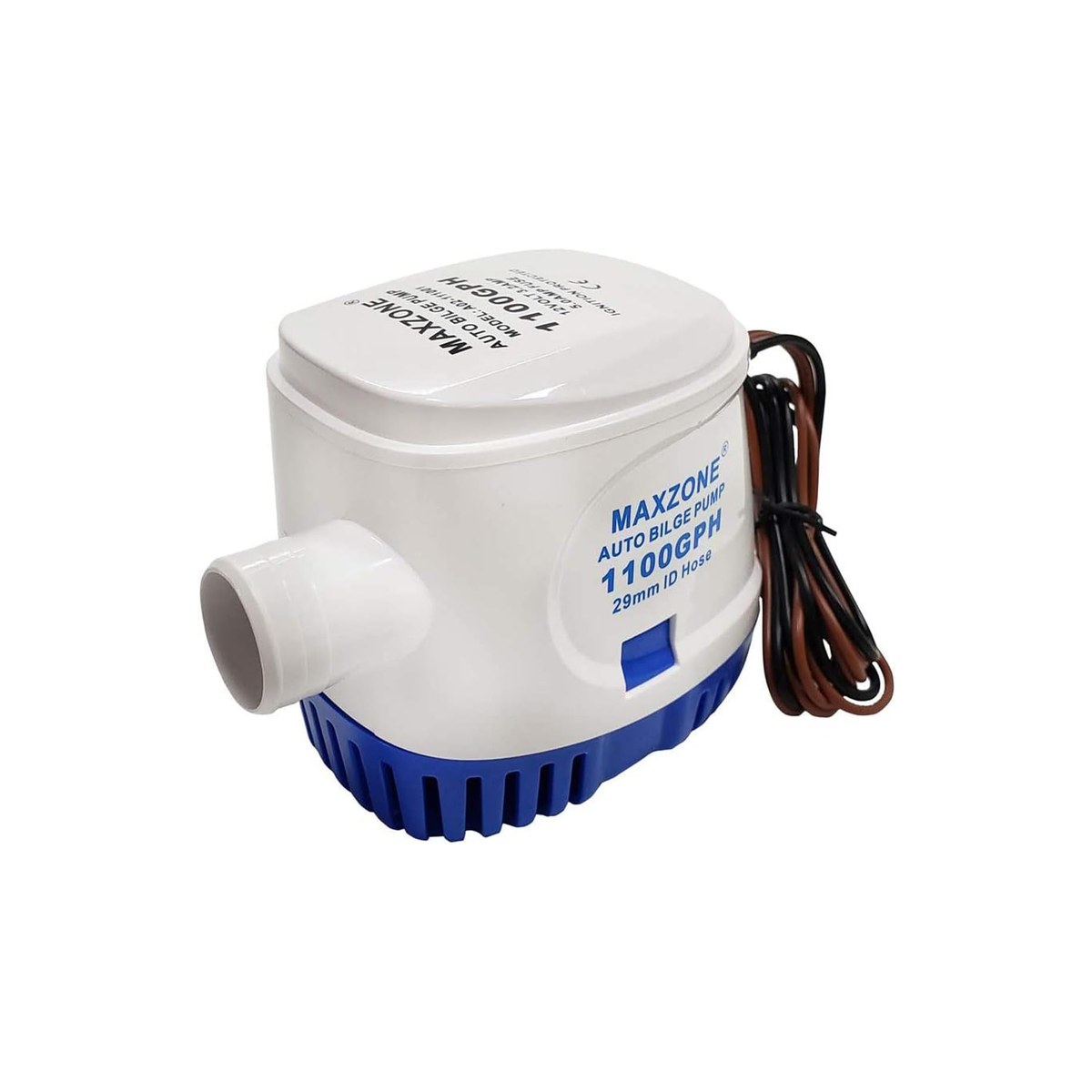
MAXZONE 1100 GPH Automatic Submersible Bilge Pump (Compact Marine Boat Yacht, the volume seller on Amazon)
The MAXZONE 1100 GPH Automatic Submersible is the budget bilge pump the volume of Amazon buyers actually buys, and the right answer for the owner who wants a known-working spare on the boat at half the SEAFLO price OR a freshwater lake weekender single-pump install where saltwater corrosion is not the primary failure mode. The 4,089 Amazon owner reviews at 4.5 stars is by a wide margin the strongest review-count signal of any marine bilge pump on Amazon (roughly 10 times the SEAFLO's 391 reviews and 24 times the Rule-Mate's 168). The MAXZONE is sold under multiple Amazon-platform brand labels (the same physical pump appears under MAXZONE, KOLERFLO, Dontmiss, and others) and the manufacturing is consistent across them; the practical advantage is that replacement is cheap and frictionless on Amazon Prime. Where the MAXZONE is the wrong tool: primary-pump duty on a saltwater coastal boat where the documented 12 to 18 month saltwater corrosion failure mode means the SEAFLO at $28 (and a 4-year warranty) is the better cost-per-year despite the price gap. Sorted Gear voice does not pretend the MAXZONE is a name-brand product; the 4,089 reviews tell you the pump works out of the box, the 1-year warranty tells you the manufacturer is not betting on it lasting 4. For the budget-conscious owner who wants a known-working spare on the boat OR the freshwater lake weekender on a small budget, the MAXZONE at $25 is the right call and the budget bilge pump we would buy for that role.
- + 4,089 Amazon owner reviews at 4.5 stars, by a wide margin the strongest review-count signal of any marine bilge pump on Amazon; roughly 10 times the SEAFLO's 391 reviews and 24 times the Rule-Mate's 168. Whatever else the MAXZONE is, it is the pump the largest volume of Amazon buyers have actually installed and lived with
- + Lowest price in the lineup at $25, roughly half the SEAFLO 06 Series and one-fifth the Rule-Mate RM1100B; the right tier for a known-working spare pump kept in the cabin for emergency replacement, OR for a freshwater lake weekender on a small budget
- + 1-1/8 inch outlet, compact form factor, float-switch automatic, 12V, the same baseline feature set as the SEAFLO and Rule-Mate at this size class; the spec sheet matches the category default and the 4,089 reviews suggest the build is reliable enough to keep the pump running for the typical 2 to 3 year freshwater service life
- + No-name budget tier reality: the MAXZONE is sold under multiple Amazon-platform brand labels (the same physical pump appears under MAXZONE, KOLERFLO, Dontmiss, and others) and the manufacturing is consistent across them; the practical advantage is that replacement is cheap and frictionless on Amazon Prime
- × 1-year manufacturer warranty (vs SEAFLO's 4-year and Rule-Mate's 3-year) is the shortest in the category; the brand-name trust signal is absent and the warranty service path is essentially "buy another one if it fails", which works at the $25 tier but does not scale up
- × Saltwater corrosion failure mode is documented across forum threads on the multi-brand MAXZONE platform; the motor housing is plastic with a metal impeller shaft that pits in saltwater over 12 to 18 months, materially shorter than the SEAFLO and Rule-Mate. For coastal saltwater service, the SEAFLO is the better cost-per-year despite the price gap
- × No-name brand reality: the Sorted Gear voice does not pretend the MAXZONE is a name-brand product. The 4,089 reviews tell you the pump works out of the box, the 1-year warranty tells you the manufacturer is not betting on it lasting 4. For a freshwater lake weekender or a known-working spare on a coastal boat, the price is right. For a primary pump on a saltwater boat, the SEAFLO is the better call
Also worth considering.
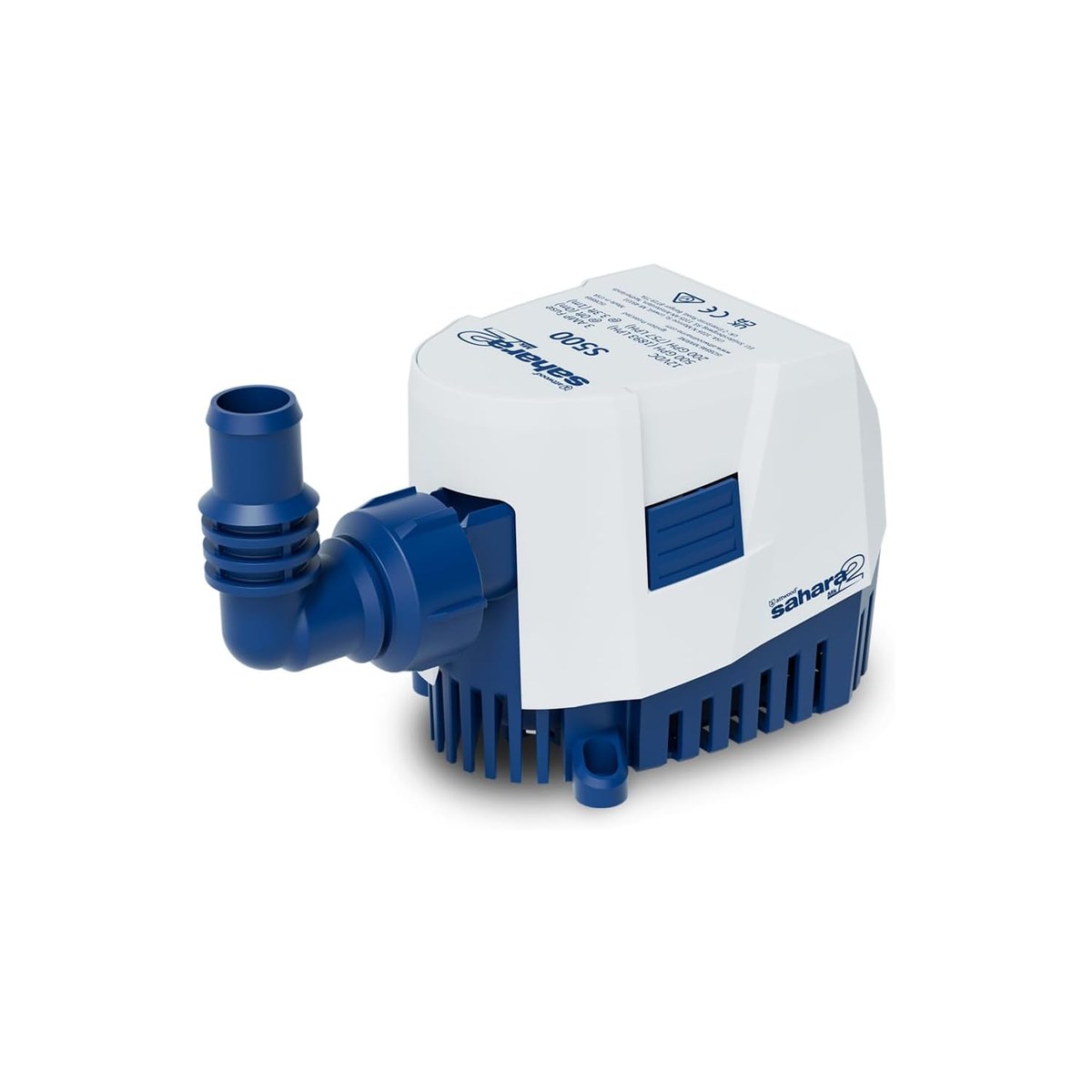
Attwood Sahara MK2 S500 500 GPH Automatic Bilge Pump (the dedicated small-boat 500 GPH for runabouts and bowriders)
The Attwood Sahara MK2 S500 is the dedicated 500 GPH automatic bilge pump for small-boat single-pump installs and the right answer for a 14 to 22 ft jon boat, runabout, bass boat, or small bowrider where the standard 1100 GPH form factor is too large for the bilge cavity. Attwood is the small-boat brand-name default and the Sahara MK2 is the modern mechanical-float-switch automatic that replaces the original Attwood 4505-7 Sahara series. The 500 GPH nameplate is the right capacity for the typical wet-load profile on a small boat (rainwater, accidental wave splash, normal hull seepage) where a 1100 GPH pump would short-cycle and waste battery. The Sahara MK2 has 90 Amazon reviews at 4.0 stars, the lowest rating in this guide by a wide margin, and the documented failure mode is the mechanical float switch sticking from sediment or saltwater corrosion (the same failure mode the integrated-switch SEAFLO and Rule-Mate avoid). For a small boat where the pump fits the bilge cavity AND saltwater corrosion is not the primary concern (freshwater lake, well-flushed coastal use), the Attwood Sahara MK2 is the small-boat default that earns its place on review-count signal and brand-name reputation despite the lower rating. For any 18 ft and up boat, the SEAFLO 06 Series at rank 1 is the better pick at half the price.
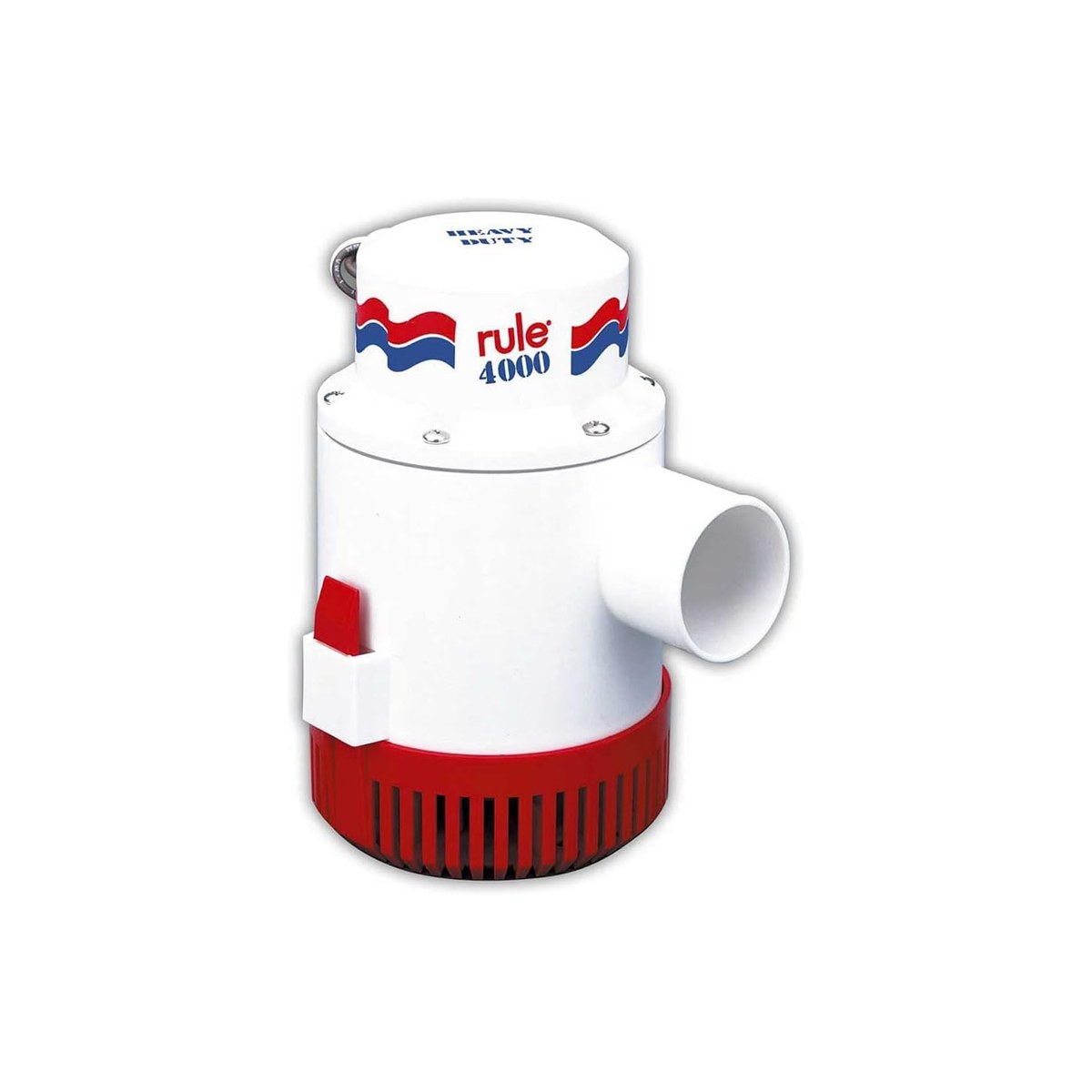
Rule 4000 GPH Marine Bilge Pump, Non-Automatic (the emergency-capacity backup pump for cruiser dual-pump installs)
The Rule 4000 GPH is the heavy-duty manual bilge pump for cruiser dual-pump installs and the right answer for a 25 to 40 ft coastal cruiser running a primary automatic at rank 1, 2, or 3 of this guide PLUS this emergency-capacity backup wired to a dedicated panel switch. Rule's 4000 GPH nameplate at 0 ft head translates to roughly 1,900 to 2,200 GPH at the typical 3 to 4 ft bilge-to-thru-hull discharge height per third-party testing, which is the actual high-capacity output a coastal cruiser needs for any genuine water-ingress event (failed hose clamp, cracked thru-hull, lost shaft seal) where the primary 1100 GPH automatic cannot keep up. The manual-only (non-automatic) configuration is intentional: the emergency pump must NOT cycle on the float during routine rainwater accumulation (that is the primary pump's job), and the dedicated panel switch lets the owner activate it deliberately when needed. 38 Amazon reviews is the lowest count in this guide by a wide margin, and the cruiser-community justification for the price is the actual high-capacity dewatering capability that no 1100 GPH pump matches. For any single-pump install where the boat is under 25 ft OR the owner is not doing the dual-pump electrical, the Rule 4000 GPH is the wrong tool: the SEAFLO at rank 1 covers the routine-water-removal job at one-ninth the price. Two brand picks (Rule-Mate at rank 2 and Rule 4000 at rank 5) defended by role separation: the RM1100B is the cruiser-accessible automatic with thermal protection; the Rule 4000 is the high-capacity manual emergency. Both are Rule (Xylem) but serve materially different roles in the bilge-water-removal system, the same two-brand-pick role-separation defensibility that Marine Sealants used for two 3M picks and Boat Cleaners used for two Star brite picks.
Skip this guide if...
Three audiences should skip this guide. First, owners of sub-14 ft jon boats, kayaks, or small fishing skiffs that anchor in calm freshwater only and do not have a 12V house battery system: a manual hand bilge pump (Whale Tempest or Beckson Thirsty Mate) at $30 is the right tool, and the automatic submersibles in this guide need a 12V power source the small boat does not have. Second, offshore or bluewater cruisers running boats 40 ft and up where the right answer is a multi-pump system with engine-driven crash pumps, electric primary plus backup plus emergency-capacity, and a manual diaphragm pump in the cabin; the dual-pump framing in this guide covers the 25 to 40 ft coastal cruiser, but offshore bluewater is a separate system-design decision that needs a marine electrician, not a buying guide. Third, owners of boats with shallow specialty bilge cavities (some sailboats with shoal-draft fin keels, certain pontoon boats, deck boats) where a standard pump base does not fit; the low-profile Rule LoPro or Whale Supersub are the right answers for those specific applications and are documented in the methodology section as worth-knowing alternatives we considered but did not include as numbered picks due to limited Amazon availability and price.
Don't bother with.
- × Skip Generic submersible pumps from unknown Amazon brands at sub-$15 pricesSub-$15 12V submersible pumps marketed as 'marine bilge pump' on Amazon (no-name AGM brands, generic plastic housings) deliver 30 to 50 percent of rated GPH capacity in the first season and fail within 6 to 12 months of saltwater service. The motor windings are wound with insufficient enamel insulation, the impeller is brittle plastic that cracks on the first sediment ingestion, and the float switch is a cheap mechanical lever that sticks on first deployment. The 4,089 reviews on the MAXZONE 1100 GPH at $25 tell you what the sub-$15 generics do not: the MAXZONE is the price floor where the pump actually works. Anything below that is buy-twice-cry-twice, documented across iboats and r/boating threads from 2022 forward.
- × Skip Pool dewatering pumps, basement sump pumps, or aquarium pumps adapted for marine bilge usePool dewatering pumps (Wayne, Superior, Flotec) are designed for continuous-duty AC operation at 120V, the wrong voltage and the wrong duty cycle for marine bilge service. Basement sump pumps (Zoeller, Liberty) are continuous-duty 120V designed to pump well-water-clear fluid through a fixed PVC discharge line, also wrong voltage and wrong duty cycle. Aquarium recirculating pumps are designed for fish-tank water (no sediment, no debris, no air ingestion) at much lower head heights. None of these survive the intermittent-duty 12V marine bilge environment (sediment, debris, air ingestion, saltwater corrosion, vibration) for more than weeks. Buy a pump designed for marine bilge service.
- × Skip Livewell pumps repurposed as bilge pumpsLivewell pumps (Attwood Tsunami T800, Rule LiveWell, Johnson Aerator) are designed to recirculate baitwater at low head heights with continuous-duty motor operation. The motor bearings are not designed for the intermittent-duty bilge service profile (start, run for 2 minutes, stop for an hour, repeat). Livewell pumps also lack the integrated-switch automatic logic that makes a bilge pump self-sufficient. Adapter kits sold on Amazon to convert a livewell pump into a bilge pump produce a pump that runs but fails inside 6 months. Buy a dedicated bilge pump.
- × Skip Cordless tool battery powered bilge pumps as primary or backupCordless tool battery (M18, DeWalt 20V) adapter kits sold on Amazon to power a 12V bilge pump from a Milwaukee or DeWalt drill battery are a real DIY pattern marketed for emergency backup use. They are NOT a primary or even secondary bilge pump system. M18 batteries at 5 Ah deliver roughly 90 Wh of usable energy; a 1100 GPH pump at 4A continuous draw exhausts the battery in roughly 15 minutes. For any genuine water-ingress event needing more than 15 minutes of pumping, the cordless adapter is the wrong tool. Use a hardwired automatic + a hardwired manual emergency pump from a dedicated battery bank.
- × Skip Manufacturer GPH ratings as the buying criterionManufacturer GPH ratings are tested at 0 ft head with a free-flowing discharge directly into a calibrated tank. Your bilge sits 3 to 4 ft below the discharge thru-hull on a typical 18 to 32 ft boat. The real-world output at that head height is roughly 50 to 65 percent of the nameplate per third-party testing (Practical Sailor 1991 and 2009 bilge pump tests, available in archive form, are the most-cited references). The 1100 GPH pump is really 600 to 750 GPH in your bilge. The 1500 GPH pump is really 750 to 900 GPH. The 4000 GPH pump is really 1,900 to 2,200 GPH. Buy 2x what the spec sheet says you need, not the nameplate.
- × Skip Buying a bilge pump as the primary defense against sinkingA bilge pump is a nuisance-water removal system designed to evacuate routine rainwater, condensation, and accidental wave splash. It is NOT a sinking-prevention system. If you are taking on water faster than 1500 GPH at any head height (a failed hose clamp, a cracked thru-hull, a damaged shaft seal), no off-the-shelf bilge pump in this guide saves you; even the Rule 4000 GPH at the 1,900 to 2,200 GPH real-world output is overwhelmed by a serious water-ingress event. The cruiser community's real protection is a manual diaphragm pump (Whale Gusher, Edson) in the cabin, AND an oversized emergency submersible wired to a dedicated battery bank, AND a knowledge of where every thru-hull and hose connection is so you can address the source. The bilge pump in this guide handles the routine job. Sinking-prevention is a system-design question, not a pump-shopping question.
How we picked.
Sources we read and the methodology we used
We did not test these bilge pumps across a season on our boat. The sites that claim they did mostly did not either; the closest thing to an authoritative independent test is the Practical Sailor archive (the 1991 and 2009 bilge pump comparison tests are the most-cited references in the cruising community) plus the third-party flow rate measurements documented across The Hull Truth, iboats, and SailboatOwners.com forum threads. What we did is read the SEAFLO, Rule-Mate, MAXZONE, Attwood, and Rule manufacturer specifications and warranty documentation directly, then cross-referenced those manufacturer claims against The Hull Truth, Cruisers Forum, Trawler Forum, iboats, SailboatOwners.com, Practical Sailor archives, r/boating, and r/sailing threads on bilge pump failure modes, real-world GPH at head height, float switch reliability, and saltwater corrosion patterns. We discarded sources that could not be attributed to a named owner, a dated publication, or a specific test methodology, and we report both sides where manufacturer guidance and owner consensus diverge.
GPH ratings at 0 ft head vs real-world output at 3 to 4 ft head: the load-bearing honesty point
The single most-important piece of forum-cited honesty in this guide is the GPH-at-0-ft-head rating vs the real-world output at 3 to 4 ft head. The nameplate is the 0 ft head value, the real-world is 50 to 65 percent of that at typical 3 to 4 ft bilge-to-thru-hull discharge height, and the buying rule is buy 2x what the spec sheet says you need.
Auto-pump panel switch and inline fuse: the non-negotiable install rule
The single most-important install rule is that automatic bilge pumps should be wired through a panel switch with an inline fuse rather than direct-to-battery (the workaround for Auto Sense safe-mode cycling and the protection against a stuck float draining the house battery).
The shortlist: 1100 GPH automatic, 500 GPH small-boat, 4000 GPH emergency backup
The shortlist started with the design families that owners on The Hull Truth, Cruisers Forum, and SailboatOwners.com actually recommend for an 18 to 32 ft coastal cruiser: sealed integrated-switch 1100 GPH automatic (the SEAFLO 06 Series at $28 and the Rule-Mate RM1100B at $125, the entry-level and upmarket tiers of the same design family), generic-brand budget 1100 GPH automatic (the MAXZONE at $25, the volume-seller value play), brand-name 500 GPH automatic for small boats (the Attwood Sahara MK2 S500 at $64), and brand-name 4000 GPH manual for cruiser emergency-capacity backup (the Rule 4000 GPH at $252).
Four alternatives we considered: Johnson Pro-Line, Whale Supersub, Rule LoPro, manual diaphragm
We considered four additional picks worth knowing about. First, the Johnson Pump Pro-Line cartridge bilge pump series (1250 GPH at ~$120-150), the European-market upmarket bilge pump that uses a cartridge-replaceable motor design Whale popularized; available on Amazon but with a thin US Amazon presence and limited West Marine stock that made it a methodology-section worth-knowing rather than a numbered pick. Second, the Whale Supersub low-profile 650 GPH automatic, the right answer for sailboats with shoal-draft fin keels and shallow bilge cavities where a standard pump base does not fit; available direct via Hodges Marine and a small Amazon presence at ~$140 that made it the methodology worth-knowing for the shallow-bilge specialty. Third, the Rule LoPro 900 GPH low-profile alternative; same shallow-bilge application but with a thinner Amazon review count that did not justify a numbered slot. Fourth, manual diaphragm cabin pumps (Whale Gusher 10, Edson Diaphragm) for the cruiser emergency-pump-in-the-cabin role; outside the submersible-bilge-pump scope of this guide but the right answer for the genuine sinking-prevention question this guide explicitly does not solve.
How the lineup is defended: three-brand-on-1100-GPH + two-brand-on-Rule
The lineup is three 1100 GPH automatic submersibles (SEAFLO Top Pick at $28, Rule-Mate Runner-up at $125, MAXZONE Budget at $25, the entry, mid, and value tiers of the same design family) plus one 500 GPH small-boat automatic (Attwood Sahara MK2 Specialty at $64) plus one 4000 GPH manual emergency backup (Rule 4000 Specialty at $252). Three-brand-on-1100-GPH is the price-tier defensibility (SEAFLO at the longest-warranty entry tier, Rule-Mate at the Auto-Sense mid tier, MAXZONE at the volume-seller value tier), and two-brand-on-Rule is the role-separation defensibility (RM1100B is the cruiser-accessible automatic with thermal protection; Rule 4000 is the high-capacity manual emergency). Same defensibility shape we used for two-3M-picks on Marine Sealants (different substrates), two-Star-brite-picks on Boat Cleaners (different substrates), and two-roll-bar-scoops on Marine Anchors (different brand-tier positioning).
The SEAFLO Top Pick earns the rank on the 4-year manufacturer warranty (the longest in the category by a wide margin), the 391 Amazon reviews at 4.5 stars (more than twice the Rule-Mate's 168 at the same rating), and the sealed integrated float switch that avoids the most-common bilge-pump failure mode. The Rule-Mate earns the Runner-up over the MAXZONE because the brand-name service network and the Auto Sense + thermal cut-off protection materially matter at the price gap for an owner who wants the upmarket build. The MAXZONE earns the Budget Pick at $25 because the 4,089 Amazon reviews is the strongest social-proof signal of any marine bilge pump on Amazon and the budget-tight owner buying a known-working spare is a real audience the lineup needs to address. The Attwood Sahara MK2 earns the small-boat 500 GPH slot on brand-name reputation despite the 4.0 star rating, and the Rule 4000 earns the cruiser-emergency slot on actual high-capacity dewatering capability.
FAQs.
Q01 How do I wire an automatic bilge pump? Is a wiring diagram required?
+
Q02 Are GPH ratings honest? What is the real-world flow rate at typical bilge-to-thru-hull head height?
+
Q03 Automatic float switch vs separate float switch, which actually lasts longer?
+
Q04 What size bilge pump do I need for my boat?
+
Q05 Do I need two bilge pumps?
+
Q06 Why does my bilge pump keep running or cycling?
+
Q07 Can a bilge pump save my boat if I'm taking on water from a serious leak?
+
Q08 How do I install a bilge pump without a separate panel switch?
+
If you, then this.
- IF you have a single-pump 18 to 32 ft coastal cruiser, runabout, or center console and want the longest warranty in the category at the entry-level price tierGET SEAFLO 06 Series 1100 GPH Automatic$28 →
- IF you want upmarket build quality with Auto Sense Intelligence + thermal cut-off + backflow prevention + Rule brand-name service networkGET Rule-Mate RM1100B 1100 GPH Automatic$125 →
- IF you want a known-working spare bilge pump on the boat at the lowest price OR you have a freshwater lake weekender and saltwater corrosion is not the failure mode you care aboutGET MAXZONE 1100 GPH Automatic Submersible$25 →
- IF you have a small-boat 14 to 22 ft jon boat, runabout, bass boat, or small bowrider where the standard 1100 GPH form factor is too large for the bilge cavityGET Attwood Sahara MK2 S500 500 GPH Automatic$64 →
- IF you are doing a cruiser dual-pump install (25 ft and up, primary automatic plus emergency-capacity backup) and need the high-capacity manual pump for the emergency roleGET Rule 4000 GPH Marine Bilge Pump, Non-Automatic$252 →
- IF you have a sailboat with a shoal-draft fin keel, a pontoon, or a deck boat with a shallow specialty bilge cavity where the standard pump base does not fitGET Whale Supersub or Rule LoPro low-profile alternatives (worth-knowing in methodology, not numbered picks due to limited Amazon availability)varies →
- IF you need a manual cabin diaphragm pump as the genuine sinking-prevention layer alongside the submersibles in this guideGET Whale Gusher 10 or Edson Diaphragm pump (outside the submersible-bilge-pump scope of this guide; see methodology)varies →
Boat Gear: The Complete Guide
The whole-boat picture →Every system on a 20 to 45 ft coastal boat, organized in one place, with the one guide we trust for each.