Seal It Once: 5 Marine Sealants We'd Buy in 2026
Five marine sealants ranked by what job they actually fit, not which one is strongest overall, for the coastal cruiser bedding deck hardware, sealing through-hulls, recaulking teak seams, or making a permanent structural bond. We read the 3M technical data sheets for 4200 and 5200, the Sika TDS for Sikaflex 291, the BoatLIFE LifeCalk and Loctite PL Marine specs, Boating Magazine's caulk explainer and BoatUS's polyurethane-versus-polysulfide guidance, plus every Cruisers Forum, Trawler Forum, iBoats, and bertram31.com thread we could find on 4200-vs-5200 destruction stories. The single most-searched question in this category, 5200 vs 4200, has a clean answer that 3M's own application guidance spells out: 5200 is for permanent assembly you will never separate, 4200 is for everything else. The load-bearing honesty point: most owners reach for 5200 when 4200 is the right call, and pay for it years later when the hardware will not come off without taking gelcoat with it.
- 01 3M 4200 Fast Cure , the workhorse for 90% of bedding jobs, removable at next refit
- 02 3M 5200 Permanent , permanent structural bonds only, hull-deck joints and below-waterline
- 03 Loctite PL Marine , polyether budget pick at $18, hardware-store availability
- 04 Sikaflex 291 , paintable polyurethane alternative for UV-exposed joints
- 05 BoatLIFE LifeCalk , polysulfide for teak deck seam recaulking, the one job polyurethane gets wrong
How they compare.
| Rank | Product | Best for | Price | Our score |
|---|---|---|---|---|
| 01 | 3M 4200 Fast Cure
Top Pick
| Deck hardware, ports, hatches, through-hulls | $33
Buy → | 9.1/10 |
| 02 | 3M 5200 Permanent | Hull-deck joints, permanent structural bonds | $35
Buy → | 8.9/10 |
| 03 | Loctite PL Marine | Budget bedding, hardware-store availability | $18
Buy → | 8.4/10 |
| 04 | Sikaflex 291 | UV-exposed and paintable joints | $19
Buy → | 8.3/10 |
| 05 | BoatLIFE LifeCalk | Teak deck seam recaulking | $18
Buy → | 8.1/10 |
Prices are current Amazon prices at time of publication and can change. Scores reflect our editorial evaluation, not vendor input.
Our #1 pick: 3M Marine Adhesive Sealant 4200 Fast Cure, White, 295 mL.
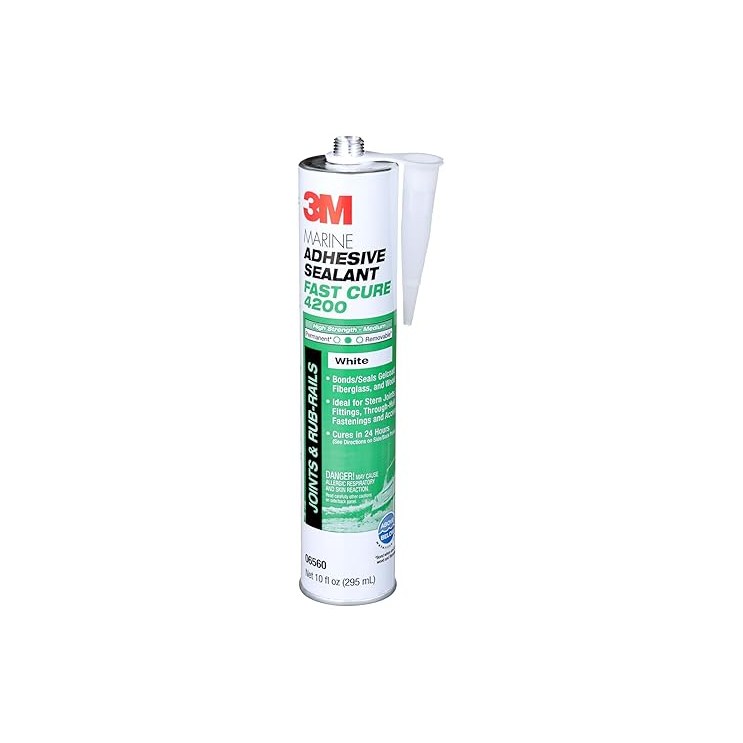
3M Marine Adhesive Sealant 4200 Fast Cure, White, 295 mL
The removable workhorse for 90% of bedding jobs, not the 5200 default.
The 4200 Fast Cure is the marine sealant that should be the default choice for most boat owners, and the reason it is not the Amazon best-seller is that 5200's marketing has convinced a generation of buyers that stronger is always better. It is not. The 3M technical data sheet for 4200 puts it plainly: this product is for joints where you expect future disassembly. That covers bedding cleats, stanchion bases, bow rollers, port lights, hatches, transducers, and most through-hull installations. The 4200 has a Shore A hardness of 40 and a tensile strength of 180 psi. The 5200 hits Shore A 68 and 700 psi. Those numbers are why 5200 destroys gelcoat on removal: at nearly four times the tensile strength and significantly harder than many gelcoat formulations, the sealant pulls laminate with it when hardware is levered off. Boating Magazine confirmed that 4200 is roughly half as tenacious as 5200 and provides more than enough adhesion for most marine applications. Irwin Yachts' official stanchion installation documentation states this directly: "5200 is not recommended as it is permanent. 4200 or equivalent will do." If you came here looking for the right marine sealant for bedding hardware, your boat, and your future self, this is it.
- + Manufacturer-rated for both above and below waterline, the same flexibility that makes 5200 over-engineered for bedding hardware
- + Shore A hardness of 40 and tensile strength of 180 psi means it releases from gelcoat with a putty knife at the next refit, not by destroying the surface
- + Tack-free in 1 to 2 hours and full cure in 24 hours at 70°F, fast enough to finish a project in a single day
- + 3M's own technical data sheet recommends 4200 over 5200 for any joint where future disassembly is anticipated, the manufacturer guidance is unambiguous
- × Not formulated with UV stabilizers, so white versions show yellowing and chalking after 2 to 4 seasons of direct sun (use 3M 4000 UV or Sikaflex 291 for high-exposure cosmetic joints)
- × Conditional paintability, the 3M TDS warns that some solvent-based marine paints may not cure on top of 4200 and the elongation mismatch can crack paint on flexing joints
- × Some owners report the fast-cure formulation skinning prematurely in hot humid conditions, leaving almost no working time and the cartridge curing inside within 24 hours of opening
Runner-up: 3M Marine Adhesive Sealant 5200, Black, 10 fl oz.
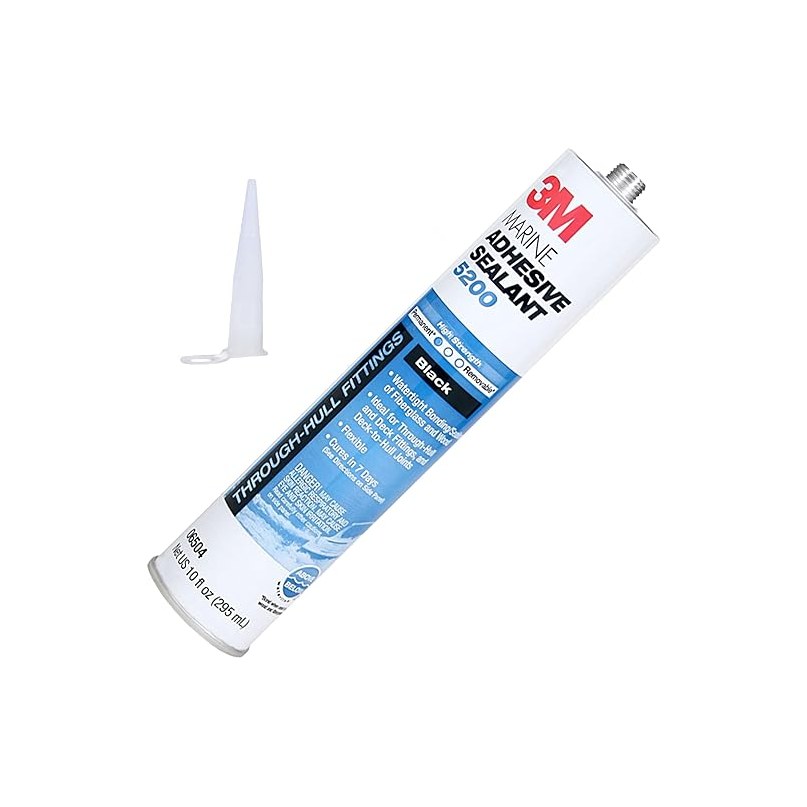
3M Marine Adhesive Sealant 5200, Black, 10 fl oz
The permanent structural bond for the one job you'll never separate.
The 5200 is correct for one job and one job only: a permanent structural bond between two parts that you will never need to separate. Hull-deck joints, keel bonds, and centerboard or rudder skeg attachments are the canonical applications. Everything else, every cleat, stanchion, port light, hatch, and through-hull fitting, belongs to 4200. The Bertram 38 owner thread on bertram31.com is the cautionary tale every coastal cruiser should read before reaching for 5200: the owner had to cut through the retaining bolts with a sawzall and abandon the original holes entirely, filling them with fiberglass and drilling new locations, because the 5200-bedded stanchion bases could not be removed without destroying the deck. A YouTube demonstration of 5200 removal from fiberglass titled "5200 and Why You Shouldn't Use It" shows the predictable outcome: the fitting comes off with the gelcoat and laminate attached. If you are bonding the hull to the deck on a structural refit, 5200 is the right answer and 4200 is wrong. For absolutely anything else, you want 4200.
- + Over 10,000 owner reviews on Amazon, the strongest single product signal of any marine sealant on this list by a wide margin
- + Tensile strength of 700 psi and Shore A hardness of 68 makes it the right choice for genuinely permanent structural joints like the hull-deck seam or below-waterline keel bonds
- + Rated for both above and below waterline by 3M, with documented overlap shear strengths on dissimilar materials: 350 psi on stainless steel, 390 psi on aluminum, 360 psi on fiberglass
- + Available in white, black, and mahogany so the seam matches the gelcoat or the hull color, the black version pictured here is the most-reviewed
- × Will destroy gelcoat on removal, the iBoats forum documents this directly: "The previous owner of my boat used 3M 5200 and to say that it was difficult to remove would be a vast understatement. I had a very difficult time removing it all when I replaced the transom core"
- × Tack-free time is 12 hours and full cure is 5 to 7 days, so the boat needs to sit while the bond develops (the standard non-fast-cure version is designed for long open times on large structural joints, which is the trade-off)
- × Often used for jobs that belong to 4200, the over-application is the failure mode rather than the product itself
Budget pick: Loctite PL Marine Fast Cure Adhesive Sealant, White, 10 fl oz.
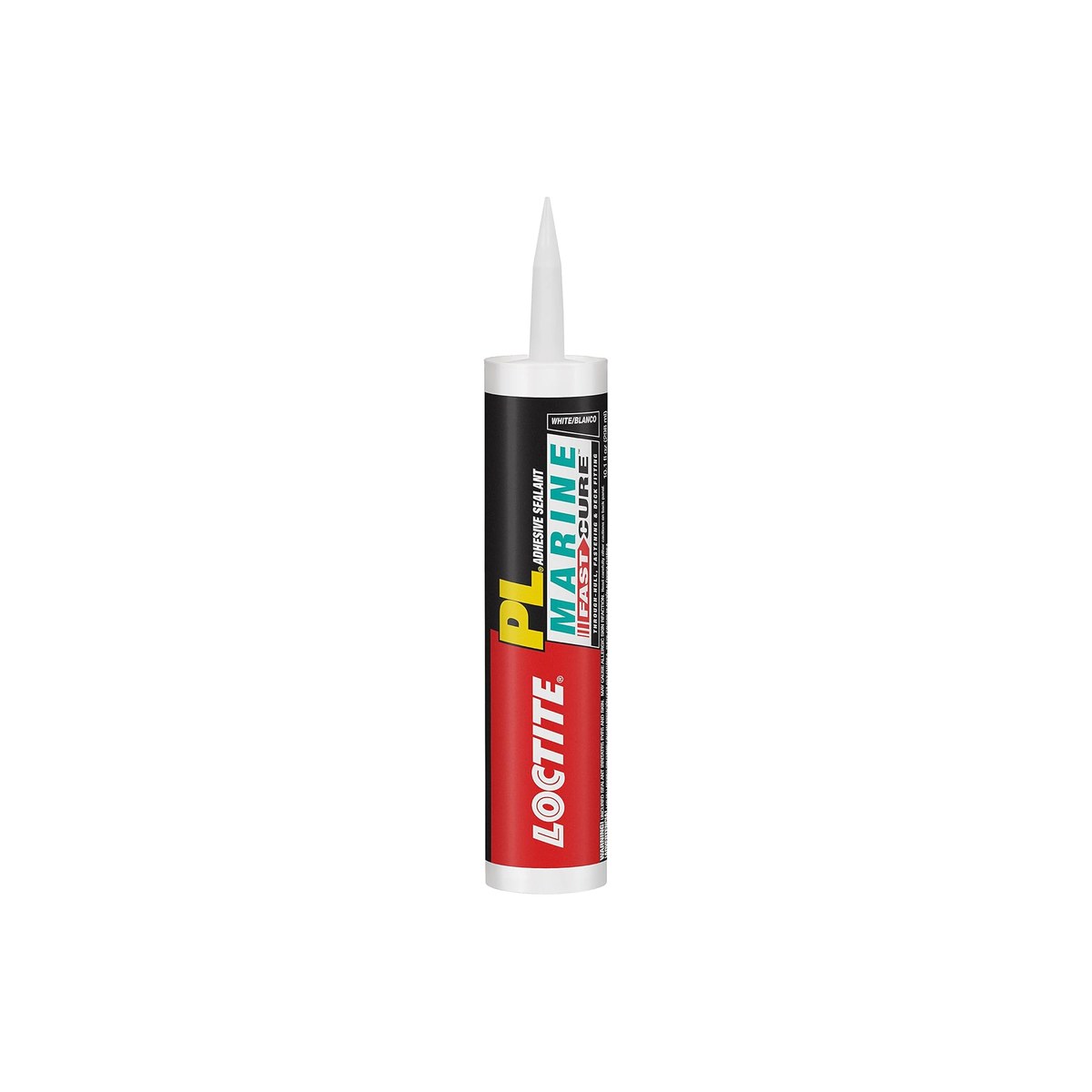
Loctite PL Marine Fast Cure Adhesive Sealant, White, 10 fl oz
The hardware-store polyether that tests comparable to 4200 at half the price.
The Loctite PL Marine Fast Cure is the hardware-store pick when the marine chandlery is closed or when the project is non-critical above-waterline bedding work. Practical Sailor's adhesion testing found it performs comparably to 3M 4200 at half the price, and the polyether chemistry has a specific edge on aluminum hulls because it avoids the isocyanate reactions that can damage bare aluminum surfaces. The product is widely available at Home Depot, Lowe's, and most marine retailers, so for owners who do not live near a Defender Marine or West Marine, this is the no-trip-required option for a Sunday afternoon bedding job. The trade-off is color (white only) and long-term UV behavior (yellowing more than polyurethane in 3 to 5 year service), so reach for 4200 or Sikaflex 291 when the joint will be visible and exposed to sun for the long haul. For bedding screws, small fittings, and any above-waterline work where failure is cosmetic rather than catastrophic, this is the right pick at $18.
- + Polyether chemistry rather than polyurethane, which means it is solvent-free, phthalate-free, and isocyanate-free, a meaningful advantage on aluminum hulls where standard polyurethanes can react with bare metal
- + Practical Sailor's adhesion test found it comparable to 3M 4200 in bond strength, and the Sailboat Owners Forum thread on polyether sealants confirms the mechanical durability is in the same range
- + Skin time of 30 minutes and full cure in 24 hours at 70°F, faster surface set than 4200 with similar full cure
- + Paintable per the manufacturer, sets in 30 minutes before painting, which is a real advantage over 4200's conditional paint compatibility
- × Available in white only, no black or other colors for matching gelcoat seams
- × Polyethers are more prone to yellowing and mildew than polyurethanes in long-term UV exposure per Sailboat Owners Forum, even though the manufacturer claims no UV discoloration
- × The Home Depot listing labels the chemistry as polyurethane in the spec table even though the product is polyether, a sourcing inconsistency that creates confusion
Also worth considering.
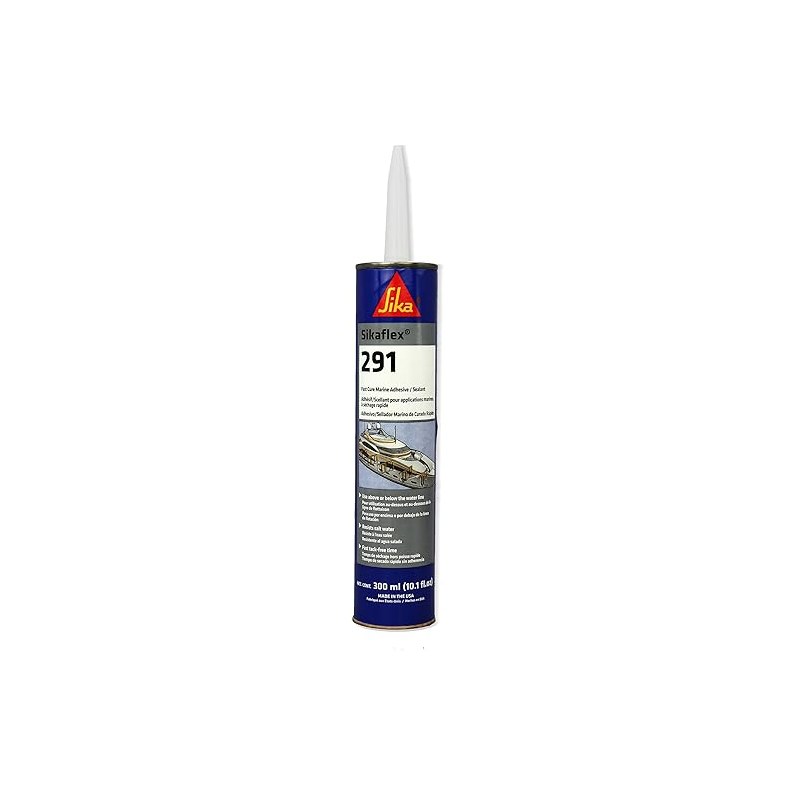
Sikaflex-291 General-Purpose Marine Adhesive Sealant, White, 10.1 fl oz
The paintable polyurethane for UV-exposed joints where 4200 would yellow within a year.
Sikaflex 291 is the polyurethane alternative to 3M 4200 for owners who want better paintability and longer UV stability in visible joints. The Sika technical data sheet specifies a skin time of 60 minutes and an elongation at break of 500%, slightly more flexible than 4200's 400% range, with similar Shore A hardness around 40. The practical case for 291 over 4200 is paintability: Sika explicitly recommends overpainting after skin formation, and the Aktivator-100 or 205 surface treatment improves paint adhesion further. Cruisers Forum and Sportfishing BC owner threads describe it as comparable to 4200 in marine performance, with one owner specifically calling it "a pretty good sealant, comparable to 4200 in adhesion and removal." The honest weakness is yellowing: despite Sika's marketing claims of "good aging and weathering resistance," a marine Facebook group member reported their white 291 turned noticeably yellow within a year on a fuel tank hatch, more than the 5200 they had used in other areas of the same boat. For visible UV-exposed joints, Sikaflex 291 is the better polyurethane choice; for hidden bedding work, 4200 stays the workhorse. Available in white and black.
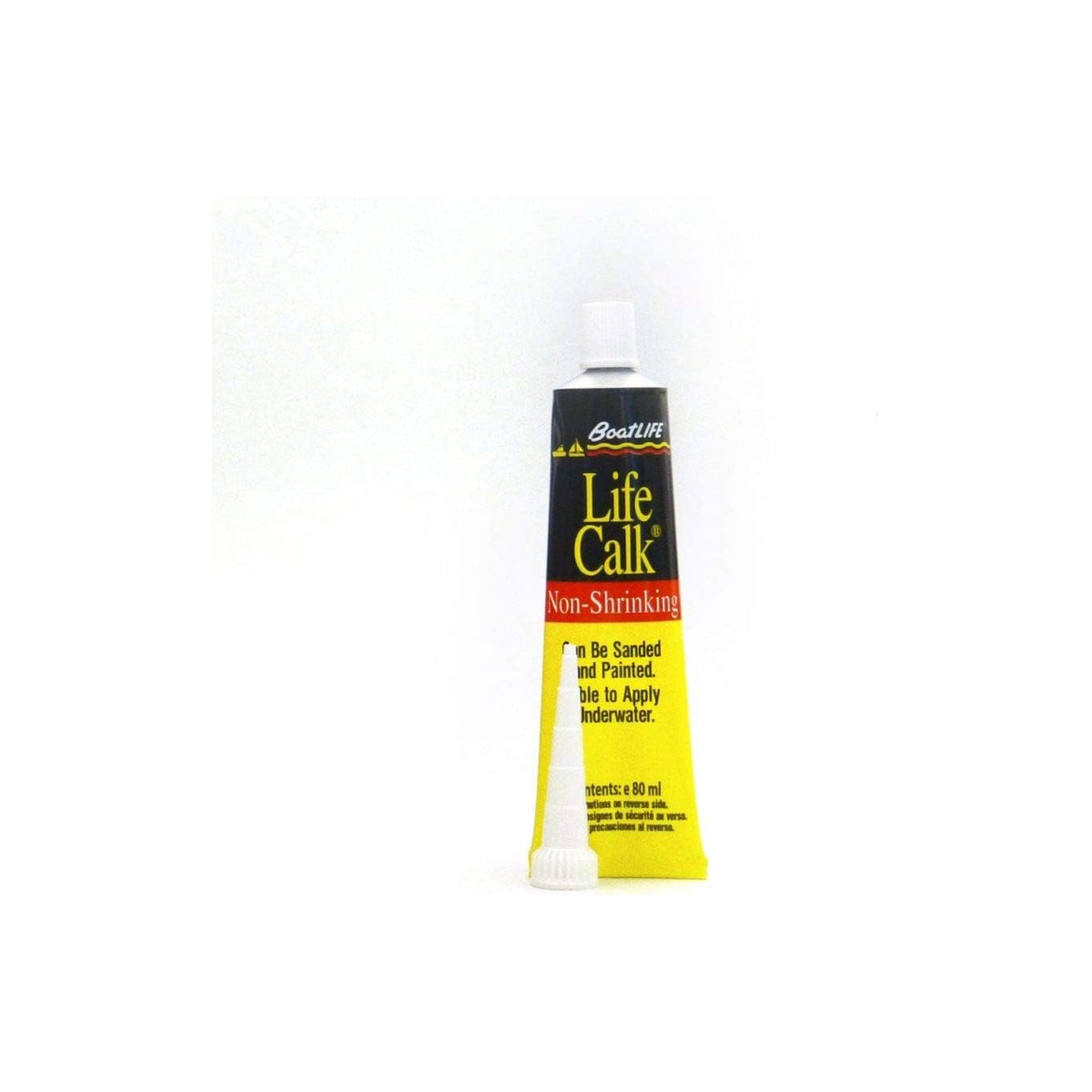
BoatLIFE LifeCalk Polysulfide Sealant, White, 10.6 fl oz Cartridge
The polysulfide for teak deck seams, the one job polyurethane gets explicitly wrong.
BoatLIFE LifeCalk is the answer to the single most-asked teak deck question: what marine sealant for wood seam recaulking? Polysulfide, specifically this one, and not polyurethane. The 3M technical data sheets for both 4200 and 5200 explicitly state that those products are "not recommended for use as a teak deck seam sealer" because extended exposure to teak cleaners, oxalic acid, and other harsh chemicals causes permanent softening. Polysulfide resists exactly these chemicals. A Cruisers Forum teak-deck-repair thread cites a Practical Sailor recommendation of LifeCalk for teak deck seam caulking. Practical Sailor is paywalled so the direct article is hard to verify, but the forum reference is consistent with the long-standing community consensus. A quick brand note: BoatLIFE also sells a separate polyurethane product called BoatLIFE LifeSeal in the same lineup, do not confuse the two. LifeCalk is the polysulfide for teak; LifeSeal is the polyurethane for general bedding. The defining characteristic of polysulfide chemistry is that it is a bedding compound rather than a structural adhesive: BoatUS Magazine's Mark Corke explains the distinction as "polyurethane adhesives are for attaching things you don't want to come apart, polysulfide bedding compounds are great for sealing things you might want to take apart later." Teak deck seams are definitionally designed for recaulking every 5 to 10 years, so the bedding-compound character is exactly right. The tack-free time is 1 to 3 days and full cure runs 7 to 10 days, so plan the project for a stretch when the boat can sit. Also useful for any below-waterline application where chemical resistance matters more than adhesive strength. Available in white and black.
Skip this guide if...
You are sealing a non-marine joint and stumbled here by accident. Marine sealants are formulated for saltwater, UV, and substrate combinations that household caulks cannot match, but if your project is a kitchen backsplash or a window frame, GE Silicone II or a polyurethane window-and-door sealant from the hardware store is the right answer. The picks in this guide are over-engineered for non-marine use and the price reflects it.
Don't bother with.
- × Skip Any silicone caulk for structural marine work (GE Silicone II Marine, generic kitchen/bath silicones, hardware-aisle clear silicone)Two failure modes, one underlying chemistry problem. Branded "marine" silicones like GE Silicone II are explicitly labeled "For Use on Marine: No" on the Home Depot and Rona product listings, despite the brand name suggesting otherwise. Generic kitchen/bath silicones (the unbranded hardware-aisle mistake) use acetic acid cure (the vinegar smell), which actively corrodes aluminum on aluminum hulls. Both fail the same way structurally: silicones release fatty acids that prevent paint adhesion, lack the bond strength polyurethane or polysulfide deliver, and have no below-waterline rating in 3M's comparison guide. Use silicone for non-structural interior cosmetic seals only, never for deck hardware, through-hulls, or any joint that loads the seal.
- × Skip 3M 4000 UV and 4000 UV+ for general bedding3M 4000 UV is a UV-stabilized SMP polymer designed for high-exposure structural seals on race boats and deck arches. For a coastal cruiser doing bedding work, it is overspec'd at 2 to 3 times the cost of 4200 for the same job. The marketing pitch is UV stability, but Sikaflex 291 at $19 covers that case more cheaply if UV exposure is the concern. Buy 4200 for the workhorse, Sikaflex 291 for UV-visible joints, and skip the 4000 UV unless you have a specific application that justifies the price.
- × Skip Off-brand 5200 clones and unbranded marine sealants under $10Marine forums document repeated bond failures and inconsistent cure on the discount clones of 5200 and other marine sealants. Real 3M 5200 is $35 a cartridge and real 4200 is $33. The cost delta versus a $10 unbranded clone is meaningful in a multi-tube project, but the failure of a marine sealant on a hull-deck joint or a through-hull is meaningfully more expensive than the savings. Buy the brands on this list, not the clones.
How we picked.
Sources we read and the methodology we used
We did not run a lab and we did not test these sealants on our boat. The sites that claim they do mostly did not either. We read the 3M technical data sheets for 4200 and 5200 plus the 3M Marine Sealants Comparison Guide directly, the Sika TDS for Sikaflex 291, the BoatLIFE product page for LifeCalk, and the Loctite PL Marine product specs (we also reviewed the 3M 4000 UV TDS to verify the don't-bother recommendation for that product). Then we cross-referenced those manufacturer claims against Cruisers Forum, Sailboat Owners Forums, Trawler Forum, iBoats, the Bertram 38 owner thread on bertram31.com, the Sportfishing BC and Grady-White Forum threads, plus Boating Magazine's marine caulk explainer and BoatUS Magazine's polyurethane-vs-polysulfide video. Where the manufacturer guidance and the owner consensus diverge, we report both with sources.
The shortlist: the five sealants owners actually search for and buy
The shortlist started with the marine sealants people actually search for and buy on Amazon. 3M 5200 and 4200 dominate the category by an order of magnitude in review count, with over 10,000 reviews on the 5200 listing alone, so they had to be on the list. Sikaflex 291 is the other polyurethane that owners consistently compare against the 3M products. BoatLIFE LifeCalk is the polysulfide pick because 3M's own TDS explicitly contraindicates polyurethane for teak deck seams and somebody needs to say that out loud. Loctite PL Marine is the budget polyether because Practical Sailor's adhesion testing confirmed it performs comparably to 4200 at roughly half the price.
5200 vs 4200: the single most-searched question, answered by 3M's own TDS
The decision framing that organizes this guide is not which sealant is strongest. It is which sealant fits which job. The single most-searched question in marine sealants is 5200 vs 4200, and the answer is in 3M's own technical data sheet: "3M Adhesive Sealant 5200 is for permanent assembly of wood and fiberglass parts bonded together. If a non-permanent bond is desired, use 3M Marine Adhesive Sealant 4200."
Why most owners reach for 5200 when 4200 is the right call
Most boat owners default to 5200 because the marketing pushes structural strength as the deciding factor. The result is fittings that cannot be removed without destroying gelcoat, transducers that cannot be replaced without grinding the hull, and chain plates that have to be cut out. The Bertram 38 owner who had to cut through retaining bolts with a sawzall is not an edge case, that is the predictable outcome of using a permanent adhesive for a serviceable fitting. We name the right tool for the right job because the cost of the wrong choice on a marine sealant is paid years later when the hardware needs to come out.
FAQs.
Q01 5200 vs 4200, what's the actual difference and which one do I need?
+
Q02 Can I use 4200 below the waterline?
+
Q03 What sealant for through-hull fittings?
+
Q04 What's the right sealant for teak deck seam recaulking?
+
Q05 Is silicone caulk a marine sealant?
+
Q06 Does sealant choice change for aluminum boats?
+
Q07 How long should marine sealant last?
+
Q08 Can I use 5200 to bond dissimilar materials like metal to fiberglass?
+
Q09 Why did my marine sealant turn yellow?
+
Q10 Can I paint over marine sealant?
+
If you, then this.
- IF you are bedding deck hardware (cleats, stanchions, port lights, hatches)GET 3M 4200 Fast Cure$33 →
- IF you are sealing the hull-to-deck joint or any permanent structural bondGET 3M 5200 Permanent$35 →
- IF you are installing a through-hull fitting (you may need to service it later)GET 3M 4200 Fast Cure$33 →
- IF you are recaulking a teak deck seam (polyurethane is contraindicated here)GET BoatLIFE LifeCalk$18 →
- IF you need a paintable sealant for a visible UV-exposed jointGET Sikaflex 291$19 →
- IF you are on an aluminum hull and need an isocyanate-free chemistryGET Loctite PL Marine (polyether)$18 →
- IF you are at the hardware store on a Sunday and need something for a non-critical bedding jobGET Loctite PL Marine$18 →
- IF you are bonding a centerboard, rudder skeg, or keel structurallyGET 3M 5200 Permanent$35 →
- IF you are bedding a deck-stepped mast step (no future disassembly expected)GET 3M 5200 Permanent$35 →
Boat Gear: The Complete Guide
The whole-boat picture →Every system on a 20 to 45 ft coastal boat, organized in one place, with the one guide we trust for each.