Best Boat Cleaners: The 5 That Actually Work (2026)
Five boat cleaner products picked for the right job, not the strongest formula, for the coastal cruiser washing fiberglass, removing waterline scum, cleaning vinyl seats and Sunbrella canvas, or restoring oxidized pontoon logs. We read the Star brite, Boat Bling, CRC Marykate, and 303 technical data sheets and material safety data sheets, the Sunbrella official care guide, the BoatUS Foundation 2009 and 2018 green cleaner tests, Boating Magazine's vinyl-care explainer, and every Cruisers Forum, Trawler Forum, BBC Boards, Club Bennington, r/Pontoons, r/boats, and r/Detailing thread we could find on wrong-cleaner substrate damage. The single most-asked alternative-to-marine-cleaner question, can I just use Dawn dish soap, has a clean answer that depends entirely on whether your boat has wax to protect. The load-bearing honesty point: every cleaner here is the right tool for exactly one job and the wrong tool for at least three others, and the substrate-damage stories in the forum archive are almost all someone reaching for the wrong one.
- 01 Star brite Concentrated Boat Wash , the fiberglass workhorse, wax-safe routine wash for most coastal cruisers at $9
- 02 Boat Bling Hot Sauce , quick-detail spray with polymer sealants, no rinse required, removes hard water spots
- 03 303 Marine Multi-Surface Cleaner , Sunbrella-recommended for canvas, the right pick for vinyl seats and cushions
- 04 Marykate On and Off , acid hull cleaner for waterline scum and rust stains, the once-a-season specialty
- 05 Star brite Ultimate Aluminum Cleaner , phosphoric and oxalic acid formula for pontoon log restoration without DIY-acid damage
How they compare.
| Rank | Product | Best for | Price | Our score |
|---|---|---|---|---|
| 01 | Star brite Concentrated Boat Wash
Top Pick
| Routine fiberglass and vinyl wash, wax-safe | $9
Buy → | 9.2/10 |
| 02 | Boat Bling Hot Sauce | Quick detail, water spots, between-wash maintenance | $23
Buy → | 8.8/10 |
| 03 | 303 Marine Multi-Surface Cleaner | Vinyl seats, Sunbrella canvas, soft-surface cleaning | $11
Buy → | 8.6/10 |
| 04 | Marykate On and Off | Waterline scum, rust stains, hull stain removal | $53
Buy → | 8.4/10 |
| 05 | Star brite Ultimate Aluminum | Pontoon logs, aluminum hull oxidation | $28
Buy → | 8.3/10 |
Prices are current Amazon prices at time of publication and can change. Scores reflect our editorial evaluation, not vendor input.
Our #1 pick: Star brite Concentrated Boat Wash, Heavy-Duty Non-Streak Formula, 32 oz.
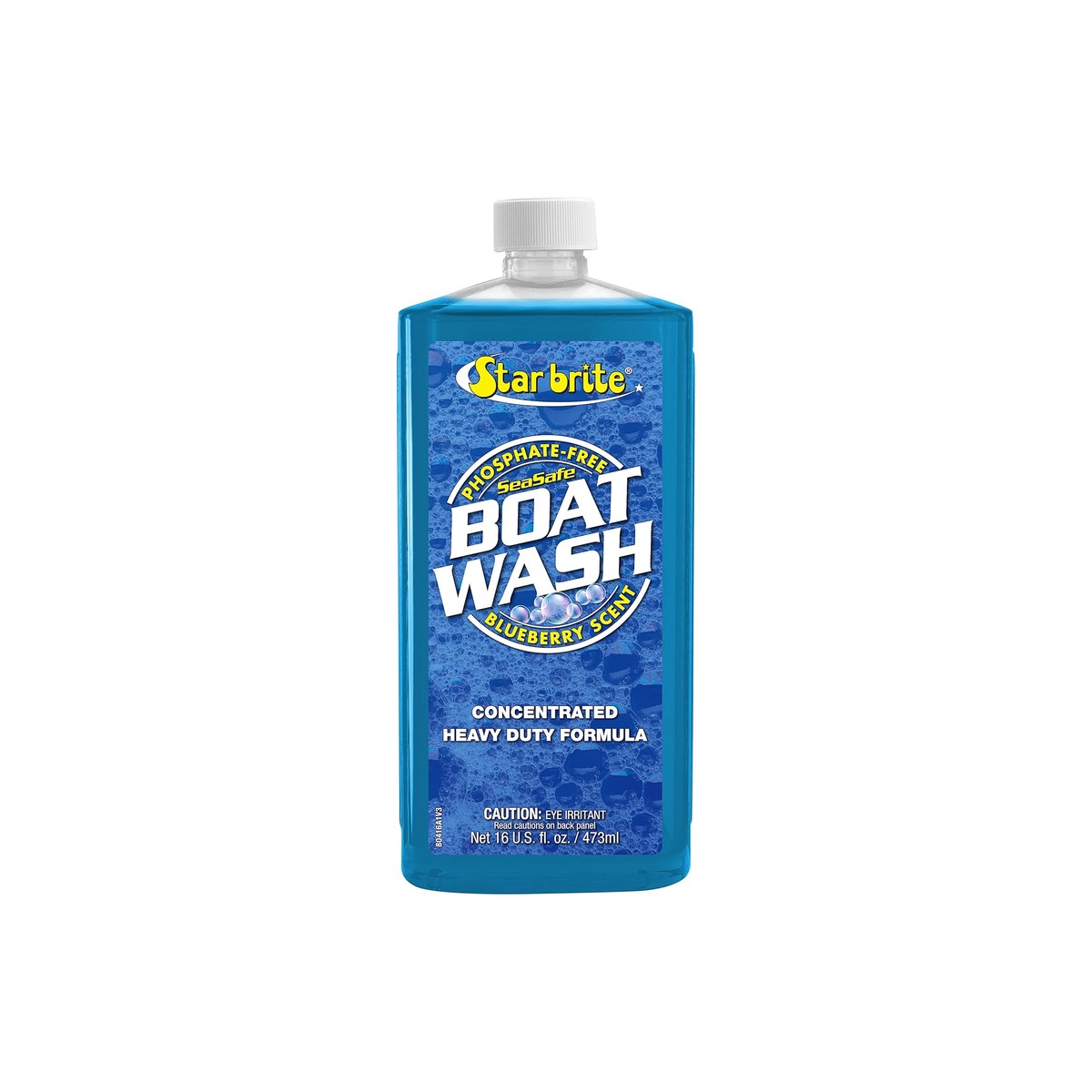
Star brite Concentrated Boat Wash, Heavy-Duty Non-Streak Formula, 32 oz
The wax-safe workhorse for 90% of wash days, under a dollar each.
The Star brite Concentrated Boat Wash is the fiberglass boat cleaner we reach for first because it does the one job most boat owners actually need a cleaner for: a wax-safe routine wash that removes salt, grime, exhaust smudges, and surface dirt without stripping the protective wax layer that defends the gelcoat. Star brite's product literature is explicit about the wax-safe claim, and owner experience on Cruisers Forum and r/boating consistently confirms it. The price is the second reason: at $9 for 32 oz of concentrate, the cost-per-wash on a typical coastal cruiser is under a dollar, and the wax stays on the boat after the wash rather than going down the dock with the rinse water. The third reason is what it is not. It is not a hull stain remover, not an aluminum oxidation cleaner, not a mildew killer, and not a vinyl conditioner. The Star brite Workhorse is for routine maintenance washing, and the rest of this guide covers the four cleaners you reach for when routine washing is not the job. For coastal cruisers, weekend boaters, and liveaboards running 18 to 40 foot fiberglass boats, this is the best fiberglass boat cleaner we'd buy and the right default for 90 percent of the wash days on the calendar.
- + Wax-safe alkaline detergent chemistry, Star brite explicitly states the formula "will not remove wax or polish," the single most-important property of a boat cleaner that gets used weekly
- + Concentrated formula at the manufacturer-spec'd 3 capfuls per bucket of water, the Star brite product guidance says 3 capfuls clean a 23-foot boat which means the cost-per-wash on a typical coastal cruiser drops below $1
- + Biodegradable and phosphate-free formula per the Star brite product literature, safe for routine use in or near freshwater (the related eco-purpose Sea Safe wash is the formula included in the BoatUS Foundation 2009 green cleaner cohort)
- + Over 1,300 owner reviews on Amazon, one of the highest review counts of any boat-specific routine wash we found on the platform and a strong signal of consistent quality across the user base
- × Heavy-duty alkaline pH means routine use on an unwaxed boat will still accelerate gelcoat oxidation faster than Sea Safe Boat Wash (Star brite's pH-neutral eco alternative), wax protection matters here
- × The fresh blueberry scent is divisive in owner reviews, several Cruisers Forum members specifically chose Sea Safe to avoid the scent on liveaboard boats where the smell lingers in confined spaces
- × Not the right boat cleaner for embedded mildew, set-in waterline scum, or any stain that has set deeper than the wax layer, those jobs belong to 303 Mold & Mildew or Marykate On and Off
Runner-up: Boat Bling Hot Sauce High-end Hard Water Spot Remover with High-Gloss Wax Sealants, 32 oz.
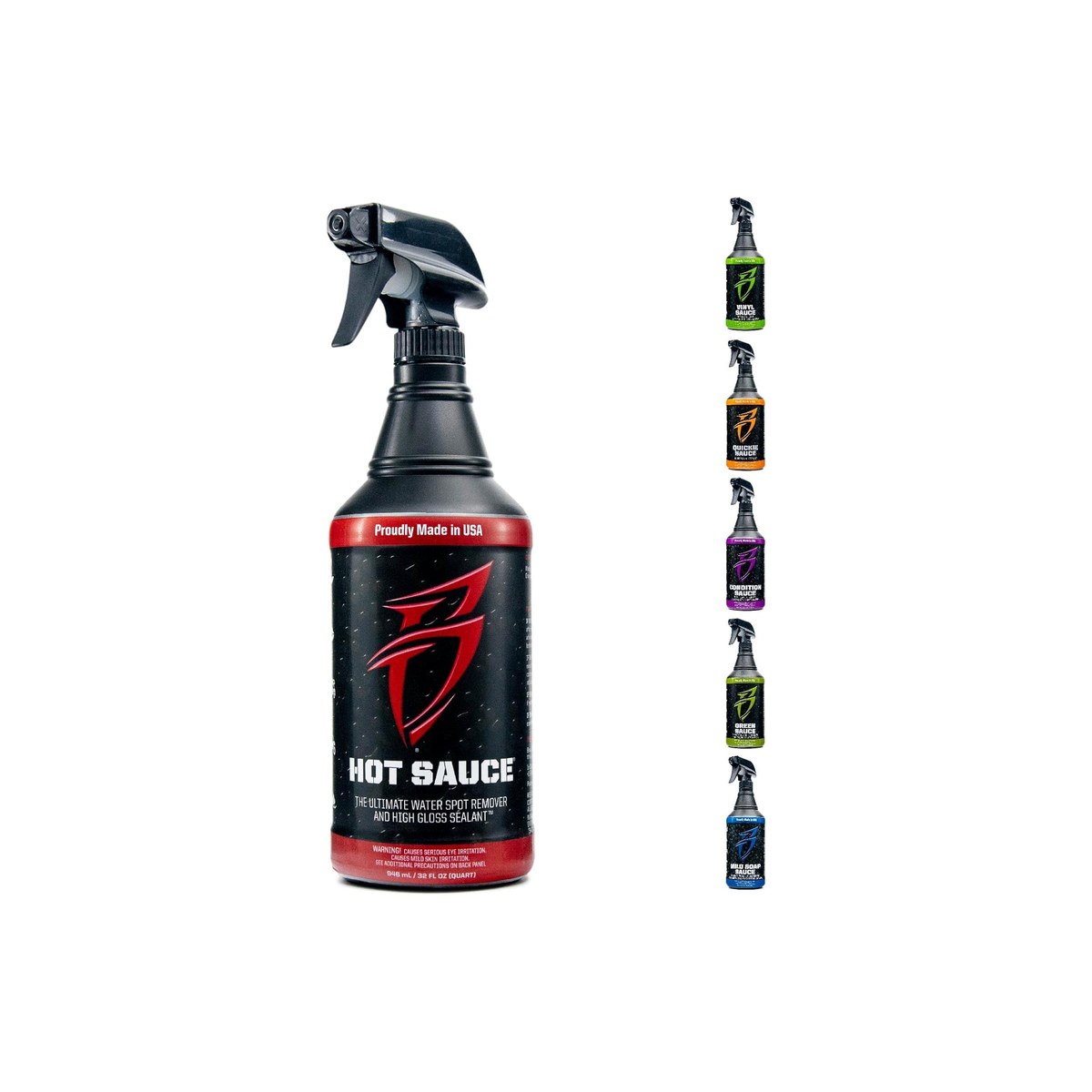
Boat Bling Hot Sauce High-end Hard Water Spot Remover with High-Gloss Wax Sealants, 32 oz
The between-wash detailer that lifts hard-water spots and leaves sealant behind.
Boat Bling Hot Sauce is the quick-detail spray for the boat that already has wax protection and needs a between-wash refresh. The Hot Sauce boat cleaner formula positions itself as a hard water spot remover, and on that specific job it is hard to beat: the polymer sealant chemistry lifts mineral deposits from sprinkler overspray, hard well-water rinses, and lake calcium spots while leaving a fresh layer of sealant behind. Owner-reported use cases on Club Bennington and r/boats consistently describe it as the go-to for waterline scum on pontoons and runabouts when the boat is otherwise clean. The critical caveat from owner experience: it is not a vinyl cleaner, despite the spray-and-wipe ease tempting that use. Boat Bling sells a separate product called Vinyl Sauce for soft surfaces, the seat-cleaning job belongs to Vinyl Sauce rather than Hot Sauce and following the brand's own product-line split keeps you on the purpose-built tool for each substrate. Over 5,700 owner reviews on Amazon make this the strongest single review signal in this guide, and that backs the editorial pick for the between-wash detailing slot. If your boat sees occasional use, gets routine washes with the Workhorse, and accumulates the kind of waterline scum and water spots that routine soap will not lift, this is the boat cleaner that handles that gap.
- + Adds polymer wax sealants while it cleans, the Boat Bling product page states explicitly that Hot Sauce "will NOT strip your wax, adds sealants instead," a different chemistry from acid hull cleaners that strip wax along with stains
- + No rinse required, spray and wipe with a clean microfiber towel, the practical advantage on a dock with no fresh-water hose hookup
- + Over 5,700 owner reviews on Amazon, the strongest social-proof signal of any product in this guide and a meaningful indicator that the formula performs as marketed across thousands of users
- + Effective on hard water spots from sprinkler overspray, lake calcium deposits, and exhaust residue, the common between-wash stains that routine boat soap cannot lift
- × Contraindicated for vinyl seats and unwaxed gelcoat, the chemistry is calibrated for waxed and polished fiberglass and Boat Bling sells a separate product called Vinyl Sauce for soft surfaces, ignore the spray-and-wipe ease tempting cross-substrate use
- × Higher price at $23 for 32 oz works out to roughly 4 times the cost-per-wash of the Star brite Workhorse, this is a finishing detail product not a daily driver
- × The vinegar-like smell on application is mild but noticeable, owners on BBC Boards describe it as a brief acid-forward note (BBC Boards: "a bit vinegar like", Moomba Forum: "hint of a vinegar smell but mostly smells like coconut")
Budget pick: 303 Products Marine Multi-Surface Cleaner, Boat Cleaner Spray for Vinyl, Canvas, Upholstery, Sunbrella Recommended, 32 oz.
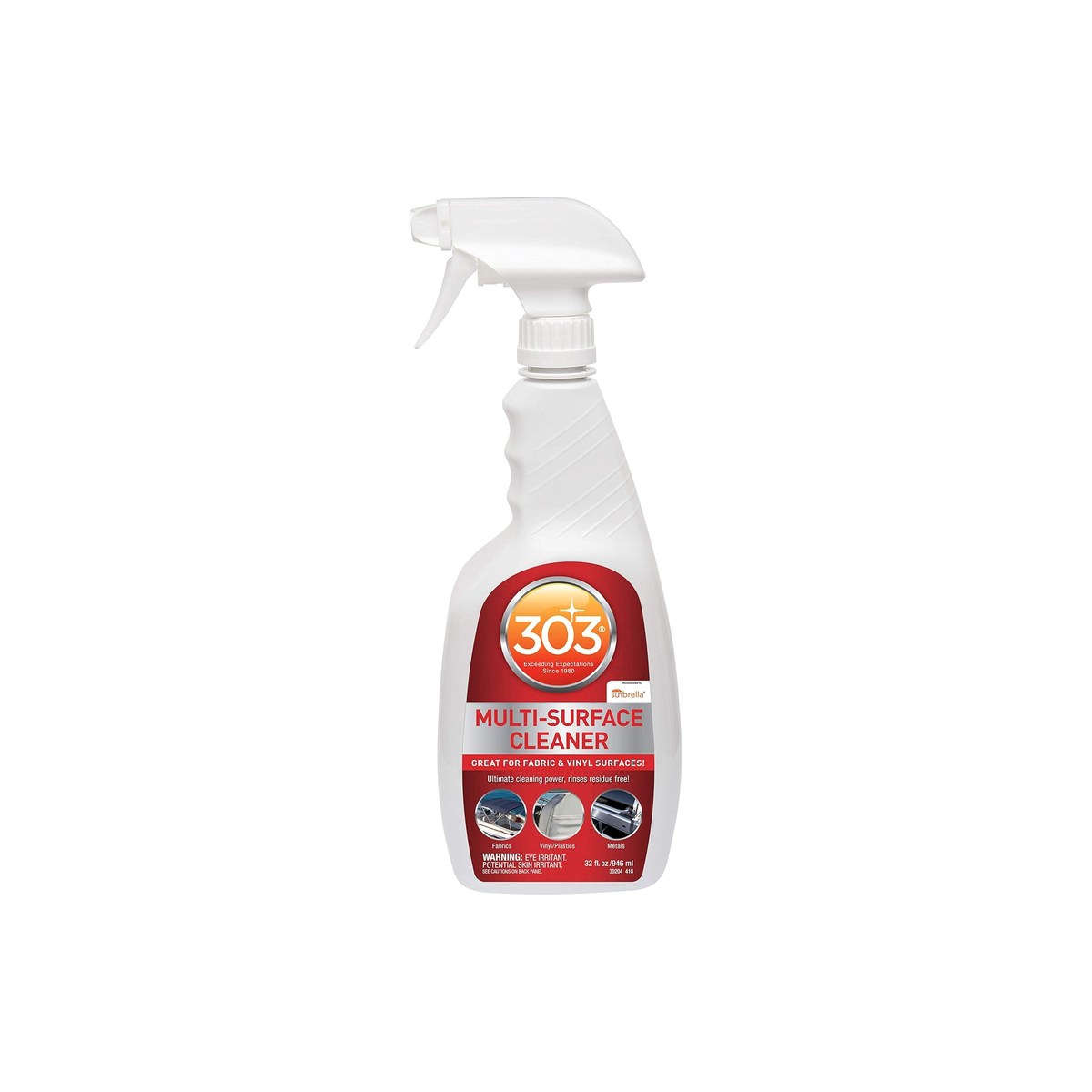
303 Products Marine Multi-Surface Cleaner, Boat Cleaner Spray for Vinyl, Canvas, Upholstery, Sunbrella Recommended, 32 oz
The Sunbrella-recommended cleaner for vinyl seats and canvas, a cleaner not a mildewcide.
The 303 Marine Multi-Surface Cleaner is the answer to every soft-surface boat cleaning question, and the budget pick at $11 because it is the second-cheapest product in this guide while covering the vinyl, canvas, and upholstery substrates that the Star brite Workhorse does not address. The single strongest credential is the Sunbrella endorsement: Sunbrella's official care guide specifies 303 Multi-Surface Cleaner as the first-step cleaning product for its solution-dyed acrylic fabric, the canvas material on most marine biminis, dodgers, and sail covers. Few other vinyl boat cleaners carry that kind of third-party manufacturer endorsement on a substrate where most boat cleaners would degrade the fluorochemical DWR (durable water repellency) treatment. The most important honesty point to surface: 303 Multi-Surface is a cleaner, not a mildewcide. It will remove dirt, sunscreen residue, food stains, and surface oils from vinyl seats and Sunbrella canvas, but it will not lift embedded mildew stains that have grown into the substrate. For mildew, the right SKU is the separate 303 Mold & Mildew Cleaner and Blocker, or the Star brite Mildew Stain Remover. The r/boats thread titled "303 Cleaner sucks for mold and mildew stains" is real and the complaint is valid; the Multi-Surface product is being asked to do a job it was not formulated for. Used for its intended job, the routine cleaning of vinyl and canvas, 303 Multi-Surface is the best vinyl boat cleaner we'd buy and the right boat cleaner for interior soft-surface work.
- + Officially recommended by Sunbrella for cleaning Sunbrella fabric, the only boat cleaner product on this list that carries a direct manufacturer endorsement from a third-party substrate maker
- + pH-neutral surfactant chemistry, the formula does not contain caustic soda, hydrochloric acid, or any other harsh component that would damage plasticizers in vinyl over time
- + Spray bottle included with the 32 oz primary listing, the sprayer is one of the better marine-rated triggers and handles continuous misting on a long surface without thumb cramp
- + Over 2,800 owner reviews on Amazon, broad social-proof on a product that has been the Sunbrella-recommended choice for over a decade
- × Does NOT lift embedded mildew stains from vinyl or canvas, the 303 Multi-Surface is a cleaner not a mildewcide, the separate 303 Mold & Mildew Cleaner and Blocker is the SKU for that job and the r/boats consensus confirms the distinction matters
- × Not effective on heavy gelcoat oxidation, deep waterline scum, or rust stains, the pH-neutral chemistry that makes it safe for soft surfaces also makes it underpowered for hard-surface stain removal
- × 303 Fabric Guard, the protective spray sold alongside this cleaner, is for fabric only and explicitly warned against vinyl and plastic on its own label, owners regularly confuse the two products and apply Fabric Guard to vinyl seats with damaging results
Also worth considering.
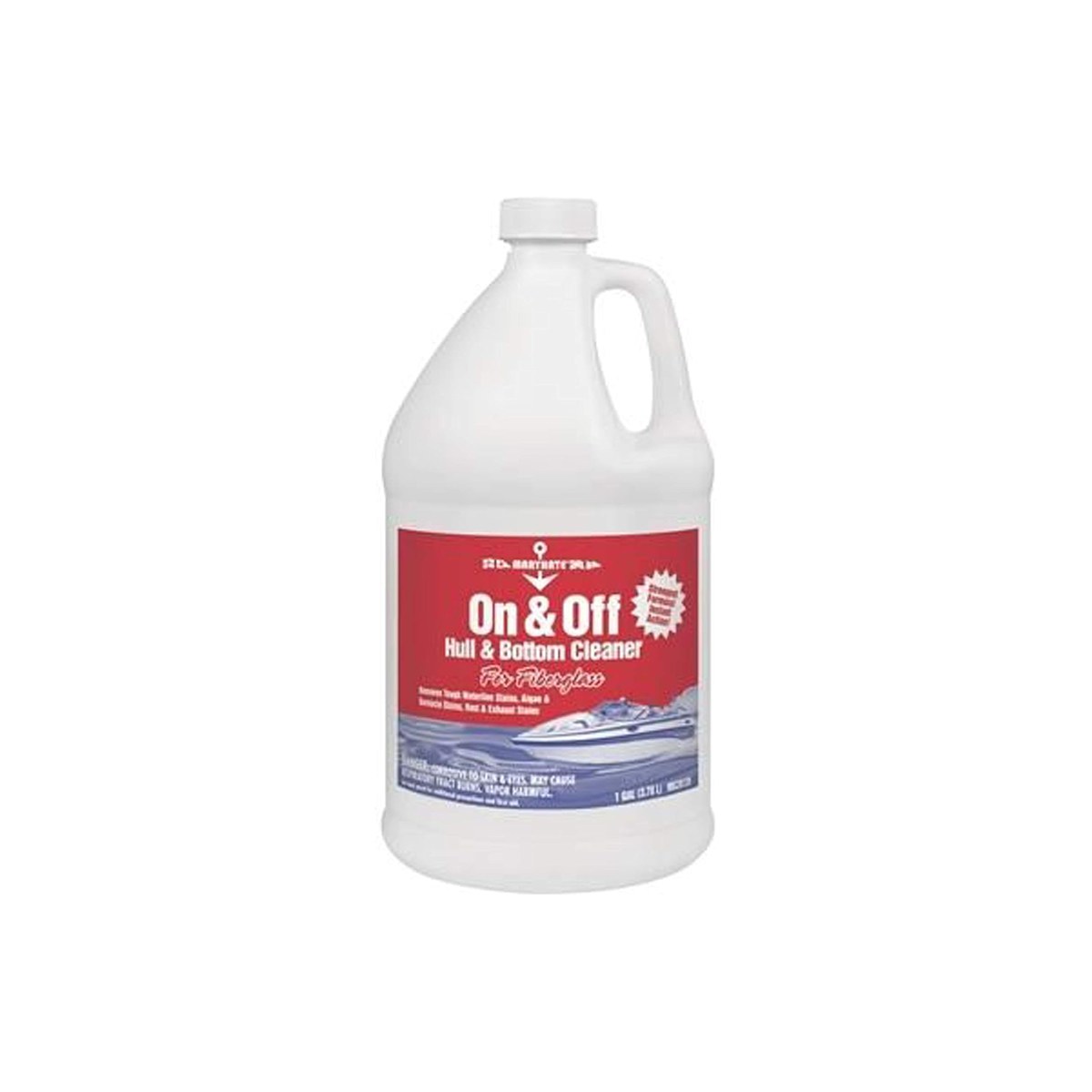
Marykate On and Off Hull and Bottom Cleaner, 1 Gallon
The pH-0.5 acid hull cleaner for waterline scum and rust, lethal to aluminum so read the contraindications.
The Marykate On and Off Hull and Bottom Cleaner is the universal answer to waterline scum and rust stain questions, and the most aggressive chemistry in this guide. The CRC technical data sheet and material safety data sheet are direct on the blend: hydrochloric acid 20 to 25 percent, phosphoric acid 5 to 10 percent, and oxalic acid 1 to 5 percent, with a pH of approximately 0.5. That is an industrial-strength acid blend, and it works exactly as expected on the stains routine boat soap cannot touch: brown waterline scum from lake water and brackish slip lines, orange rust drips from stainless deck hardware, and tannin staining from leaves and protected anchorages. The 1-gallon size is the only widely-stocked Amazon listing for this SKU, and the per-application yield varies by hull size, stain severity, and dwell-time approach, but for routine season-long use on a 25 to 35 foot fiberglass hull the gallon is meaningfully more cost-effective than buying quarts at chandlery prices. The contraindications are what every owner must internalize before using it: do NOT apply to aluminum, painted aluminum, anodized aluminum, antifouling paint, galvanized boat trailers, anodized hardware, or anything plastic adjacent to the work zone. The Aurora Marine documented case file is the most-cited cautionary example: an owner applied Marykate to clean waterline staining on a bottom-painted hull, and the HCl reacted with cupric oxide in the antifouling paint to create water-soluble copper chloride that streaked black into the gelcoat. CRC's own product page on the West Marine listing states explicitly: "Do not use on aluminum surfaces." The dwell time spec is 1 to 2 minutes per the manufacturer-endorsed Ship Shape TV demonstration, with a Practical Sailor hull-cleaner test (paywalled, relayed via the Practical Sailor blog excerpt) documenting owners stretching to 10 to 15 minutes for tougher stains, but the longer dwell only works when the product is kept wet (cover with a wet rag) and rinsed before drying. Used correctly on the right substrate, this is the on and off boat cleaner few other products can substitute for. Used carelessly, it produces some of the most-documented substrate-damage stories in the marine forum archive.
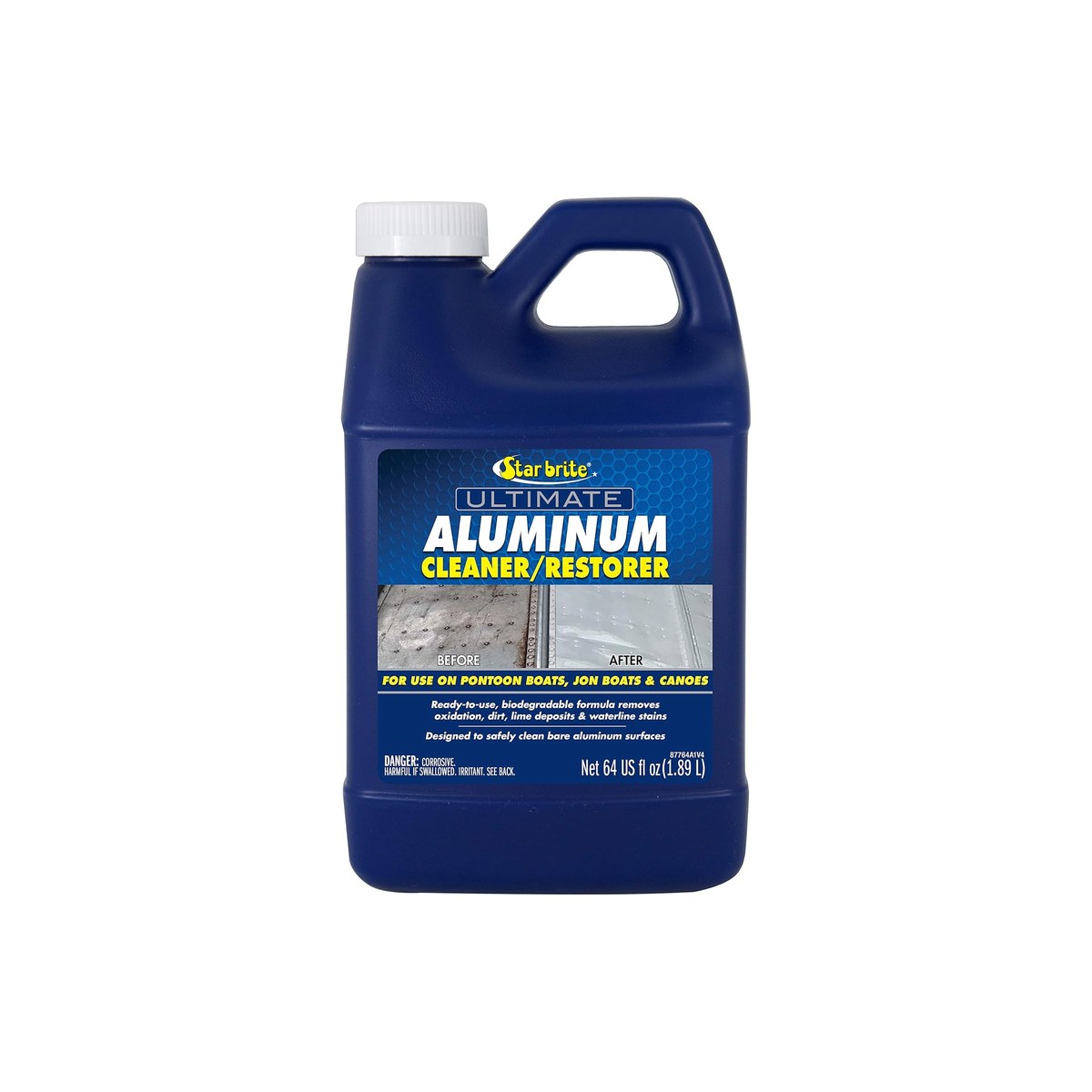
Star brite Ultimate Aluminum Cleaner and Restorer, 64 oz
The phosphoric-and-oxalic aluminum restorer for pontoon logs, the safe alternative to hardware-store muriatic.
The Star brite Ultimate Aluminum Cleaner is the specialty pick for the aluminum boat cleaner job: pontoon log oxidation, aluminum jon boat hull dulling, aluminum canoe maintenance, and the chalky white pontoon boat cleaner work that no fiberglass-cleaner can address. The single most-important property is what the formula is NOT: it is not muriatic acid, the hardware-store hydrochloric acid that the r/Pontoons community documents repeatedly as causing streaked, etched, permanently damaged aluminum hulls. The Star brite formula uses phosphoric acid and oxalic acid, calibrated to dissolve aluminum oxide (the dull chalky layer) without attacking the base aluminum underneath. The Aurora Marine technical writeup explains the differentiation: "Muriatic acid is highly corrosive to aluminum and should not be used on this metal as it can eat away the soft aluminum." The Star brite chemistry foams on contact with oxidation, the foaming is the visual confirmation that the reaction is working, and the foam stops when the oxidation has been dissolved. The protocol is the difference between restored aluminum and streaked aluminum: work bottom-up to prevent drip marks, apply to 2 to 3 foot sections at a time, scrub with a medium red scrub pad, rinse with fresh water before the cleaner dries, and follow immediately with Star brite Aluminum Polish to neutralize residual acid and seal the bright aluminum. The contraindications are critical: not for painted aluminum (strips the paint), not for anodized aluminum (dissolves the anodized layer), not for Sharkhide-coated pontoon logs (dissolves the clear coating before reaching the oxidation), and not for glass (etches), painted gelcoat, or boat trailers adjacent to the work zone. This is the aluminum pontoon boat cleaner pick we'd buy and the right aluminum boat cleaner choice for owners with the matching substrate, used per the protocol.
Skip this guide if...
You own a small jon boat, fish from it twice a season, and store it on a trailer in a covered garage. The level of maintenance covered in this guide is over-engineered for a low-use, low-exposure boat. A bottle of Star brite Concentrated Boat Wash and a hose hookup will cover everything you actually need, and the four specialty cleaners here are answers to problems your boat will not develop. Buy the Workhorse, skip the rest until you genuinely need the specialized job done.
Don't bother with.
- × Skip Dawn dish soap (or any household dish soap) for routine washes on a waxed boatDawn is a concentrated grease-cutting surfactant, the same chemistry that lifts cooking grease off pans will strip the protective wax layer off your gelcoat in a single wash. The r/boating consensus is consistent and the Boating Magazine product comparison is explicit: Dawn is acceptable as an intentional pre-wax stripper before applying new wax, but using it for routine washes systematically removes the wax that protects gelcoat from UV degradation and oxidation. The failure mode is substrate damage from wax-incompatible chemistry: the gelcoat oxidizes faster, the surface dulls, and the boat that looked good last year looks chalky this year. The cost saving versus boat soap is roughly $5 per gallon of finished wash water, and the cost of the resulting gelcoat oxidation restoration is hundreds in compound, polish, and wax (or thousands in professional detailing).
- × Skip Household bleach (or chlorine-based bathroom cleaners) for mildew removal on vinyl seats and cushionsBleach kills mildew spores effectively, that part is true. The failure mode is what bleach does to vinyl stitching: the polyester thread holding seat panels together degrades with repeated bleach exposure, and the seams fail structurally over one to three seasons of use. The r/boating documentation is direct: one owner reported losing two boats to bleach-rotted vinyl seat stitching across multiple seasons of use. The Boating Magazine vinyl-care guide confirms "virtually every vinyl manufacturer cautions against using harsh chemicals like bleach." Use 303 Mold and Mildew Cleaner and Blocker or Star brite Mildew Stain Remover for the routine mildew job, those are the products formulated to lift mildew without destroying the threads.
- × Skip Muriatic acid (hardware-store hydrochloric acid) for aluminum pontoon log cleaningMuriatic acid does not selectively attack aluminum oxide, it also attacks the base aluminum metal. The r/Pontoons documentation of DIY muriatic acid pontoon cleaning is consistent: streaked, etched, permanently dulled aluminum surfaces that look worse than the original oxidation and cannot be polished back to a uniform finish. The Aurora Marine technical reference is explicit on the failure mode: "Muriatic acid is highly corrosive to aluminum and should not be used on this metal as it can eat away the soft aluminum." Dedicated aluminum cleaners like Star brite Ultimate Aluminum use phosphoric and oxalic acid instead, calibrated to dissolve oxide without attacking the metal. The savings versus the dedicated product are real (a gallon of muriatic acid is roughly $15), but the damage from one wrong application can exceed the cost of a new set of pontoon log skins.
- × Skip Household acid bathroom cleaners (CLR, Lime-A-Way, generic lime-and-rust removers) for waterline scum and hull stainsThe acid concentrations in household bathroom cleaners are calibrated for porcelain, tile, and stainless fixtures, not for marine gelcoat or the metal hardware adjacent to a hull stain. The result of using these on a boat hull is two simultaneous failures: the gelcoat etches in micro-pits where the cleaner contacted the surface (creating new staining problems by trapping dirt in the texture), and stainless steel cleats, deck fittings, or trailer hardware in the runoff path discolor or pit from chemistry mismatch. The Charleston Fishing forum's hull-cleaner discussion captures the consensus: marine-grade acid hull cleaners (Marykate On and Off, Star brite Instant Hull Cleaner) are formulated with the right acid blend for marine substrates. Save the bathroom cleaners for the bathroom.
How we picked.
Sources we read and the methodology we used
We did not run a lab and we did not test these cleaners across a calendar season on our boat. The sites that claim they do mostly did not either. What we did is read the Star brite, Boat Bling, CRC Marykate, and 303 technical data sheets and material safety data sheets directly, the Sunbrella official care guide that specifies 303 Multi-Surface for canvas, the BoatUS Foundation 2009 and 2018 green cleaner test reports, and Boating Magazine's vinyl-care explainer. Then we cross-referenced those manufacturer claims against Cruisers Forum, Sailboat Owners Forum, Trawler Forum, BBC Boards, Club Bennington, TinBoats.net, the r/boats, r/boating, r/Pontoons, and r/Detailing subreddits, and the Aurora Marine ask-the-skipper documentation of substrate-damage failure modes. Where the manufacturer guidance and the owner consensus diverge (most notably on the Marykate dwell-time question, where the manufacturer-endorsed Ship Shape TV demo cites 1 to 2 minutes but a Practical Sailor 2022 hull-cleaner test, relayed through the Practical Sailor blog excerpt because the full article is paywalled, documents owners stretching to 10 to 15 minutes for stubborn stains), we report both with sources and flag the paywall hedge inline.
The shortlist: the five cleaners owners actually search for and buy
The shortlist started with the boat cleaner products owners actually search for and buy on Amazon. Star brite Concentrated Boat Wash and Boat Bling Hot Sauce dominate their respective categories in review count, with over 1,300 and over 5,700 reviews respectively. 303 Marine Multi-Surface had to be on the list because few other vinyl boat cleaners carry a third-party substrate-maker endorsement of the kind Sunbrella's care guide provides for the 303 product. Marykate On and Off is the hull-stain answer the marine forum world recommends most often when routine boat soap will not lift waterline scum or rust. Star brite Ultimate Aluminum is the aluminum pontoon boat cleaner pick because the aluminum search cluster is meaningful, and because the phosphoric-and-oxalic chemistry is materially safer than the muriatic acid alternative that DIY owners frequently default to.
The substrate-and-job map: every cleaner right for one job, wrong for three others
The decision framing that organizes this guide is the substrate-and-job map. Every cleaner in this guide is the right tool for exactly one job and the wrong tool for at least three others. The single most-asked alternative question, can I just use Dawn, has a clean answer: Dawn works for the routine wash on an unwaxed jon boat or as an intentional pre-wax stripper before applying new wax, and Dawn is wrong for every other use case in this guide.
Why two Star brite picks, and the $85 five-SKU kit
The five boat cleaner products we'd buy combine into a complete maintenance kit for about $85 across the five SKUs, less than the cost of a single professional detailing visit. The cost-per-job on each product is low because the specialty cleaners (Marykate, Ultimate Aluminum) are once-a-season tools, while the workhorses (Star brite Wash, 303 Multi-Surface) handle the recurring jobs. Two of the five picks are Star brite, the same two-product brand precedent we set with our Marine Sealants guide where two of the five picks were 3M. The Star brite Workhorse and the Star brite Ultimate Aluminum serve unambiguously different substrates (fiberglass routine wash vs aluminum oxidation restoration), and the alternative aluminum cleaner we considered (Socar Toonshine at $17) carries roughly one-sixteenth the review count of the Star brite product on Amazon. We name what wins by what actual buyers do, not by spreading brand variety across slots that do not deserve it.
FAQs.
Q01 Can I just use Dawn dish soap as a boat cleaner?
+
Q02 Will boat cleaner strip my wax?
+
Q03 What is the difference between a boat wash and a hull cleaner?
+
Q04 Can I use household bleach to remove mildew from boat cushions and vinyl seats?
+
Q05 How do I clean my pontoon logs without acid burns or streaking damage?
+
Q06 Is Sea Safe boat wash actually biodegradable and safe to discharge in protected waters?
+
Q07 How often should I wash my boat?
+
Q08 Do I need a separate cleaner for my canvas or Sunbrella?
+
Q09 What is the right order for cleaning and waxing a boat?
+
Q10 What is the difference between 303 Multi-Surface Cleaner and 303 Mold and Mildew Cleaner?
+
Q11 Can I use Marykate On and Off on my boat trailer or antifouling-painted bottom?
+
If you, then this.
- IF you need a routine wash on a waxed fiberglass boatGET Star brite Concentrated Boat Wash$9 →
- IF you need to remove waterline scum or rust stains from a fiberglass hullGET Marykate On and Off$53 →
- IF you need to clean vinyl seats, cushions, or Sunbrella canvasGET 303 Marine Multi-Surface Cleaner$11 →
- IF you need a between-wash quick detail or hard-water-spot removerGET Boat Bling Hot Sauce$23 →
- IF you need to restore oxidized aluminum pontoon logs or an aluminum hullGET Star brite Ultimate Aluminum Cleaner$28 →
- IF you want one single boat cleaner product that does everythingGET Star brite Concentrated Boat Wash (and accept the limits on hull stains, mildew, and aluminum)$9 →
- IF you have an aluminum jon boat with no wax to protect and only want one cleanerGET Star brite Concentrated Boat Wash (and Star brite Ultimate Aluminum once a season)$9 →
Boat Gear: The Complete Guide
The whole-boat picture →Every system on a 20 to 45 ft coastal boat, organized in one place, with the one guide we trust for each.