Raise Anchor Without the Backache: 5 Windlasses (2026)
Five anchor windlasses for a 25 to 35 ft coastal cruising sailboat or sportfish powerboat owner doing a foredeck install or upgrade, sorted by foredeck geometry, chain spec, manual-override quality, and Amazon-buyable reality. We read the Lewmar V700, Maxwell RC8, and Pro Sport 550 manuals, then cross-referenced Cruisers Forum, Trawler Forum, Practical Sailor, and MarineHowTo. Two honesty points carry the guide. The Lewmar V700 is factory-rated up to 35 ft, not the 20 to 30 ft Amazon lists, and continuous current draw runs 45 amps on the V700 and up to 83 amps on the Maxwell RC8-8, with stall draws of 90 to 135 amps; the 30 amp figure repeated across the industry is wrong and dangerous for sizing a breaker. And several look-alikes are not windlasses at all: the Powerwinch 712A and entry Trac Outdoor units are trailer or dock winches with no chain gypsy and no ABYC install path.
- 01 Lewmar V700 12V Vertical Windlass , the sailboat vertical Top Pick with Fall Safe Gypsy and 45A normal draw, factory-rated up to 35 ft, $1,043
- 02 Lewmar Pro Fish 700 Horizontal Windlass , the sportfish horizontal Runner-up with Auto Free-Fall, rated for boats up to 38 ft, $1,241
- 03 Lewmar Pro Sport 550 12V Windlass , the budget chain-windlass with Manual Freefall DEPLOY-ONLY (powered retrieval normal, driveshaft-socket emergency-only), $829
- 04 Maxwell RC8-8 (5/16 chain, 1000W, 1,320 lb pull) , the heavy-displacement offshore specialty for 35-45 ft cruisers, $1,945
- 05 Maxwell RC6 12V Vertical Windlass , the smaller-cruiser Italian-built specialty at the V700 price tier, $1,133
Working out your ground tackle? Our Anchor Size & Scope Calculator sizes the anchor for your boat and gives you the scope and rode to deploy for the conditions. →
How they compare.
| Rank | Product | Best for | Price | Our score |
|---|---|---|---|---|
| 01 | Lewmar V700 12V Vertical Windlass (factory-rated up to 35 ft, 45A normal draw)
Top Pick
| 25 to 35 ft coastal cruising sailboat vertical install | $1,043
Buy → | 9.0/10 |
| 02 | Lewmar Pro Fish 700 Horizontal Windlass (Auto Free-Fall, up to 38 ft) | 30 to 38 ft sportfish or powerboat horizontal install | $1,241
Buy → | 8.7/10 |
| 03 | Lewmar Pro Sport 550 12V Windlass (DEPLOY-ONLY Manual Freefall) | Budget 20 to 30 ft cruiser with coastal-day-use anchoring | $829
Buy → | 7.6/10 |
| 04 | Maxwell RC8-8 12V Windlass (1000W, 5/16 chain, 1,320 lb pull) | Heavy-displacement 35 to 45 ft offshore cruiser with capstan manual override | $1,945
Buy → | 9.1/10 |
| 05 | Maxwell RC6 12V Vertical Windlass (sub-1000W, Italian-built) | 25 to 32 ft cruiser wanting Maxwell gearbox at V700 price | $1,133
Buy → | 8.4/10 |
Prices are current Amazon prices at time of publication and can change. Scores reflect our editorial evaluation, not vendor input.
Our #1 pick: Lewmar V700 12V Vertical Windlass (1/4 inch G4 chain, Fall Safe Gypsy, 700 lb max pull, 320W motor, IP67 rated, factory-manual-rated up to 35 ft per Lewmar Issue 8 manual).
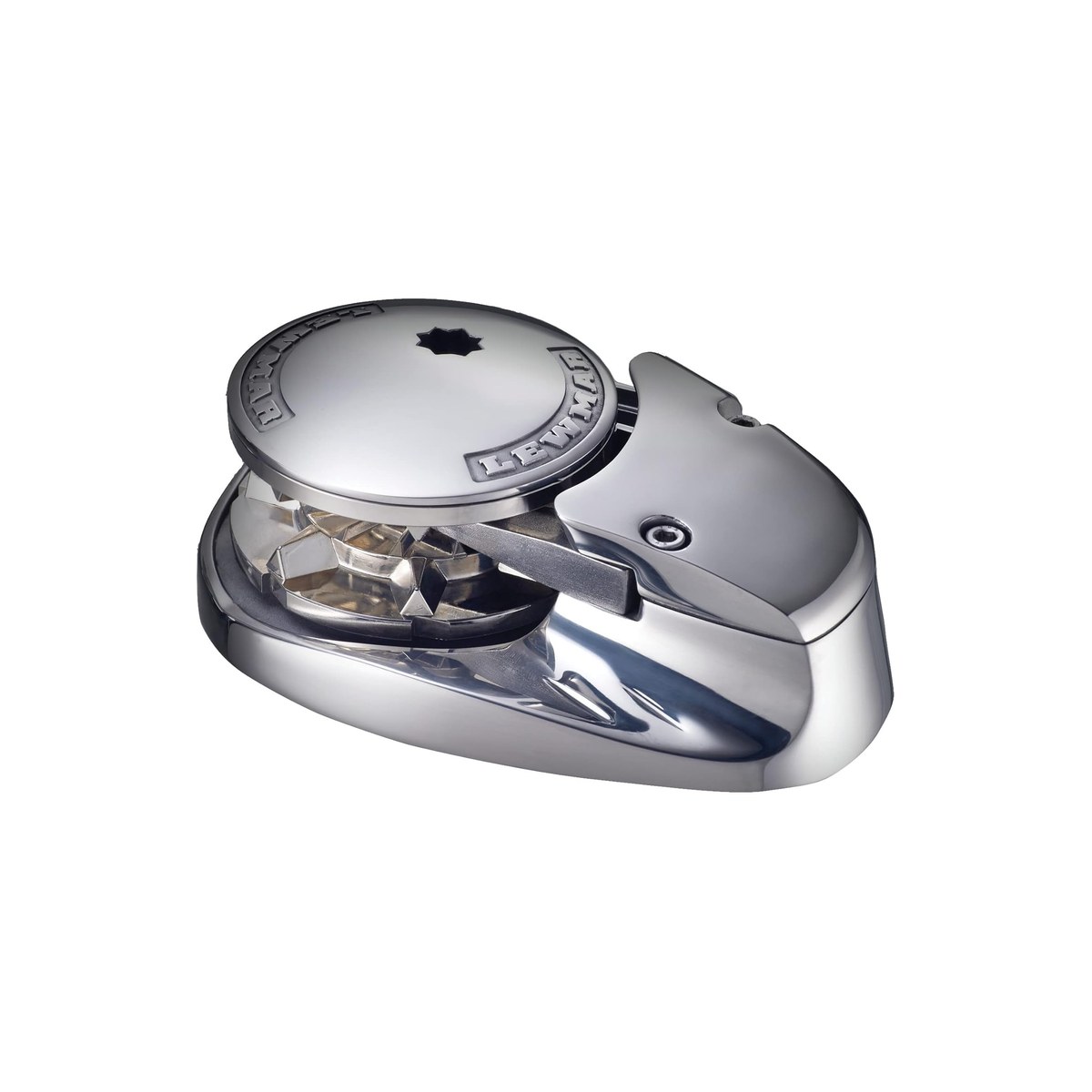
Lewmar V700 12V Vertical Windlass (1/4 inch G4 chain, Fall Safe Gypsy, 700 lb max pull, 320W motor, IP67 rated, factory-manual-rated up to 35 ft per Lewmar Issue 8 manual)
The Lewmar V700 12V Vertical Windlass is the windlass we would buy first for a 25 to 35 ft coastal cruising sailboat, and it earns the Top Pick on three concrete signals. First, 165 Amazon owner reviews at 4.6 stars is by a wide margin the strongest review-count signal of any Amazon-buyable windlass in the category. The V700 is the OEM default for new sailboat installs in this size class and the most-installed Amazon-buyable sailboat windlass on the platform. Second, the Fall Safe Gypsy is the sailboat-correct mechanism. Free-fall versus controlled-descent is a real divide in the cruising community: Cruisers Forum and Trawler Forum threads document the split, and the consensus from the cruising-sailboat side is that Fall Safe is the right call because rope-twist with 3-strand nylon, chain-pile risk in the locker, and pin-engagement failure modes all show up on free-fall units. The Lewmar Pro Fish 700 at rank 2 uses Auto Free-Fall and is the sportfish-correct alternative; here on the sailboat side, Fall Safe wins. Third, the boat-length rating: the Amazon listing for B00WIGZ4WI says boats 20 to 30 ft, but the Lewmar Issue 8 factory manual, Defender's product page, and CitiMarine all specify boats up to 35 ft. The Amazon listing reflects an older or copy-pasted spec; the factory manual is authoritative. This is meaningful because a 32 ft sailboat owner reading the Amazon listing concludes the V700 is undersized when it is not. The honest persona is 25 to 35 ft, matching the factory manual. Three honesty points on the Top Pick. First, the actual continuous current draw on the V700 is 45 amps normal per the Lewmar factory manual, with a 35 amp factory breaker, NOT the 30 amp number that gets repeated around the marine industry. Cable sizing follows the Lewmar wiring table: 8 AWG for 0 to 33 ft run from house bank to foredeck, 6 AWG for 34 to 60 ft. A buyer who sizes a 30 amp breaker based on the wrong industry figure trips the breaker under normal load; we will not propagate the wrong number. Second, the V700 has no warping drum in standard configuration; manual recovery is via the supplied clutch lever inserted into the gypsy drive cap (per Section 6.7 of the factory manual), which works but is less ergonomically effective than the Lofrans gearbox-spring-load-ratchet documented as the strongest or the Maxwell capstan-top clutch handle. For coastal cruising the V700 manual override is acceptable; for offshore use the Maxwell RC8-8 at rank 4 is the safer call. Third, some retailer listings show 500W for the V700 motor power; the Lewmar factory Issue 8 manual specifies 320W. The 500W figure is a retailer copy-paste error. Verify spec via the Lewmar factory manual before sizing wiring or breakers. For the 25 to 35 ft coastal cruising sailboat doing a vertical foredeck install with 1/4 inch G4 chain and the Fall Safe Gypsy preference, this is the sailboat windlass we would buy and the right default for the persona this guide serves. Side note for buyers considering the upper end of the persona: the Lewmar V1 is Lewmar's current-catalog vertical equivalent at the same 700 lb pull and the same 35 amp breaker spec, extending the boat-length rating to 40 ft. If your sailboat sits at 33 to 35 ft and the V1 is currently stocked on Amazon at a comparable price, the V1 is the future-proof pick. The V700's 165-review Amazon adoption keeps it as our Top Pick today; that calculus changes when the V1 hits comparable review volume.
- + 4.6 stars across 165 Amazon owner reviews, by a wide margin the strongest review-count signal of any Amazon-buyable windlass in the lineup. Lewmar V700 is the OEM default for new sailboat foredeck installs in the 25 to 35 ft class and the most-installed sailboat windlass on the platform
- + Fall Safe Gypsy is the sailboat-correct mechanism: controlled descent under power (not Auto Free-Fall), no rope-twist risk with 3-strand rode, no chain-pile risk in the locker, no pin-engagement failure mode. This is the Cruisers Forum and Trawler Forum operator-community-consensus pick for cruising sailboat use (the divide on free-fall is real, and Fall Safe is the cruising side of it)
- + 320W motor with 45 amp normal current draw and 35 amp factory breaker per the Lewmar Issue 8 manual, NOT the 30 amp draw figure that gets repeated incorrectly. Cable sizing: 8 AWG for 0 to 33 ft run, 6 AWG for 34 to 60 ft. ABYC E-11 compliant. IP67 housing rated for marine deck exposure
- + Factory-rated up to 35 ft boat length per the Lewmar Issue 8 manual, corroborated by Defender and CitiMarine retailer pages, NOT 20-30 ft as the Amazon listing says (the Amazon listing reflects an older or incorrect copy). This is meaningful: a 32 to 35 ft sailboat owner who reads the Amazon listing and concludes the V700 is not for them is making the wrong call
- × Manual override on the V700 is a clutch lever inserted into the gypsy drive cap, not a winch-handle-in-the-warping-drum operation. The V700 has no warping drum in standard configuration. The supplied clutch lever works for manual retrieval (per Section 6.7 of the factory manual) but is less ergonomically effective than the Lofrans gearbox-spring-load-ratchet documented as the strongest or the Maxwell capstan-top clutch handle. Acceptable for coastal cruising; for offshore, the Maxwell RC8-8 is the safer call
- × The Lewmar V1 is the current-catalog vertical equivalent at the same 700 lb pull and 35A breaker spec, extending the boat-length rating to 40 ft. If your sailboat is at the upper end of the persona at 33 to 35 ft and Amazon currently stocks the V1 at a comparable price, the V1 is the size-future-proof pick. As of this writing the V700 has materially stronger Amazon adoption (165 reviews vs the V1's lower count), which is why we keep the V700 as the Top Pick
- × Some retailer listings show 500W for the V700 motor power, which is incorrect; the Lewmar factory Issue 8 manual specifies 320W. The 500W figure implies a 42 amp draw at 12V at 100 percent efficiency, which is actually lower than the correct 45 amp normal draw from the factory manual (the factory figure reflects real-world motor losses and duty-cycle loading). Either way, the 500W spec is a retailer copy-paste error that misrepresents the motor class; use the factory-manual 320W and 45 amp normal draw figures for all wiring and breaker decisions
Runner-up: Lewmar Pro Fish 700 Horizontal Windlass (also written Lewmar Pro-Fish 700; 1/4 inch G4 chain, Auto Free-Fall System, 700 lb max pull, 316 stainless construction, for boats up to 38 ft per Lewmar Pro-Series page).
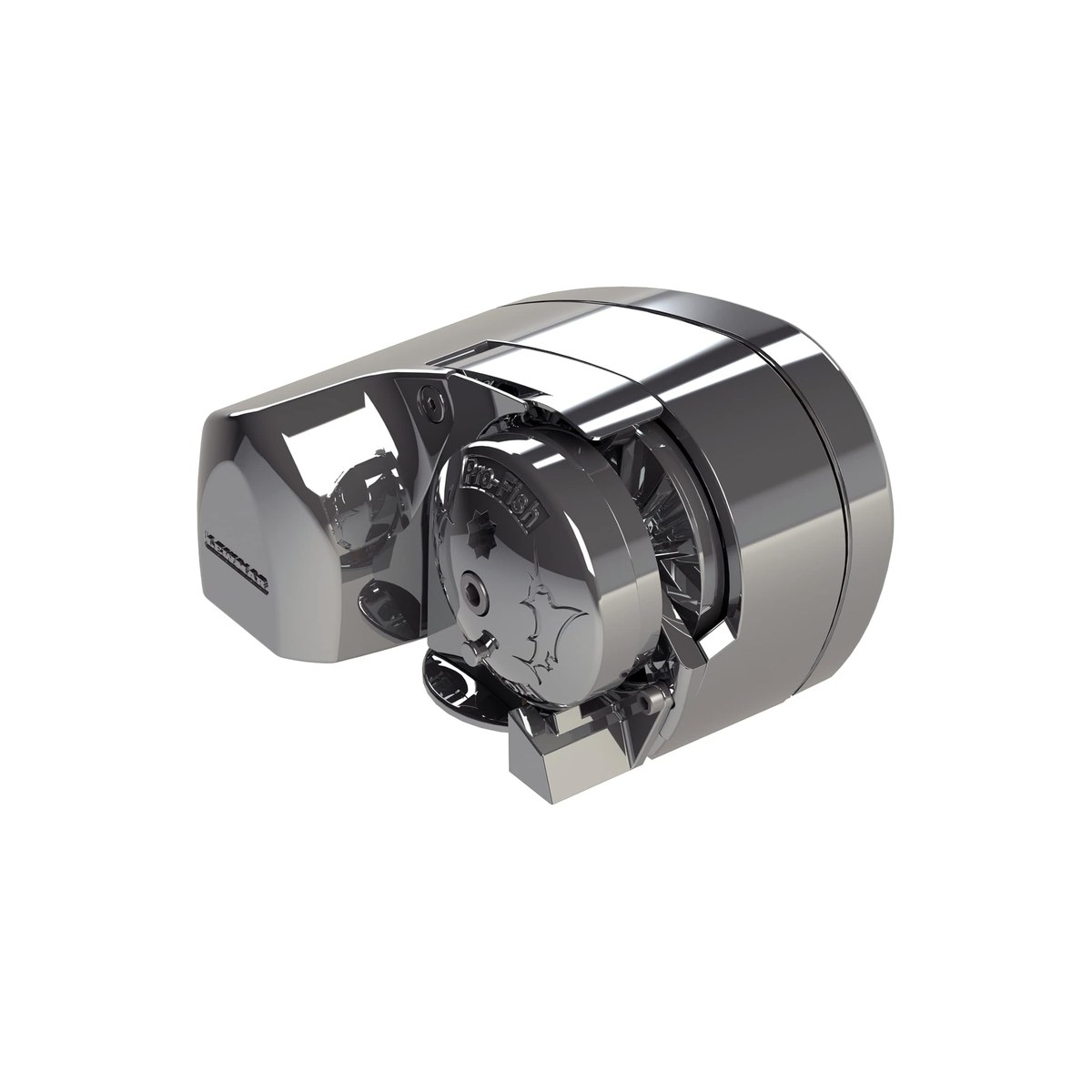
Lewmar Pro Fish 700 Horizontal Windlass (also written Lewmar Pro-Fish 700; 1/4 inch G4 chain, Auto Free-Fall System, 700 lb max pull, 316 stainless construction, for boats up to 38 ft per Lewmar Pro-Series page)
The Lewmar Pro Fish 700 is the sportfish-correct horizontal windlass and the runner-up for the 30 to 38 ft sportfish or powerboat owner doing a foredeck install. The horizontal mount geometry matches sportfish and powerboat foredecks (less vertical chain-pipe clearance, more horizontal deck real estate), and the Auto Free-Fall mechanism is the sportfish-correct deploy method for owners running repeated anchoring patterns over structure. Per Lewmar's tech video, Auto Free-Fall activates by pulling the pin and holding DOWN for no more than 2 seconds to release the cap from the shaft, then the gypsy enters free-fall; re-engagement requires pressing UP. This is not a passive system, it is a deliberate activation with a specific re-engagement step. The 700 lb pull plus 1/4 inch G4 chain math works for the persona (a 35 lb Mantus or Rocna plus 150 ft of 1/4 inch G4 chain at 0.65 lb per ft equals about 132 lb combined, times 3 safety factor equals 396 lb minimum, well inside the 700 lb max pull rating). Three honesty points on the Runner-up. First, Auto Free-Fall is divisive among the cruising-sailboat community. Cruisers Forum, Trawler Forum, and Great Grady threads document the split: free-fall introduces rope-twist with 3-strand nylon, chain-pile risk in the locker, pin-engagement steps adding failure modes, and an accidental deploy scenario underway is more dangerous than a powered descent. The Pro Fish 700 is the right answer on the sportfish side of that divide; if you have a cruising sailboat foredeck, the V700 at rank 1 is the geometry-and-mechanism-correct pick. Second, the 38 ft boat-length rating applies to sportfish boats running light-to-moderate ground tackle. A 38 ft sportfish with 200 ft of 5/16 inch chain (heavier setup) would push the Pro Fish 700 to its limits. The upgrade tier is the Pro Fish 1000 at 700W and roughly 1,000 lb pull, or the Lewmar H3 horizontal at roughly $1,600 (1,320 lb pull, 12V or 24V) which sits between the Pro Fish 700 and the Maxwell RC8-8 in both price and pull. The H3 is the legitimate step-up horizontal Amazon-available pick if you cross the 38 ft threshold. Third, the extra cost over the V700 at $1,241 versus $1,043 for the same 700 lb pull spec buys the Auto Free-Fall mechanism and the 38 ft boat-length extension; on a sailboat below 32 ft, the V700 is the better-priced and mechanism-correct pick. For the cruiser doing a horizontal install on a sportfish or powerboat in the 30 to 38 ft class with Auto Free-Fall preference, the Pro Fish 700 is the runner-up we would buy.
- + 4.5 stars across 65 Amazon owner reviews. Lewmar Pro Fish 700 is the sportfish-foredeck default in the 30 to 38 ft class. The 700 lb pull plus 1/4 inch G4 chain math (typical 35 lb anchor plus 150 ft of 1/4 inch chain at 0.65 lb per ft equals 132 lb combined, times 3 safety factor equals 396 lb, well inside the 700 lb max pull rating)
- + Auto Free-Fall is the sportfish-correct mechanism for repeated anchoring over structure: fast drop, no power consumption on deploy, efficient when you set and break anchor multiple times per session. The mechanism activates by pulling the pin and holding DOWN for no more than 2 seconds; re-engagement requires pressing UP. This is not a passive system, it is a deliberate activation, per Lewmar's tech video
- + Rated for boats up to 38 ft per the Lewmar Pro-Series landing page. This is the meaningful boat-class extension over the V700's up-to-35-ft rating, and the geometry difference (horizontal versus vertical) matches sportfish and powerboat foredecks that have less vertical chain-pipe clearance and more horizontal deck real estate
- + Galvanic isolation and IP-rated housing per the Pro-Series spec. The horizontal mount geometry also makes manual retrieval (gypsy drive cap with supplied clutch lever) more accessible than the V700's vertical configuration, because the cap sits on top of the deck rather than below a deck-clean top surface
- × Auto Free-Fall is divisive among the cruising-sailboat community. Cruisers Forum and Trawler Forum document the split: free-fall introduces rope-twist with 3-strand nylon, chain-pile risk in the locker, pin-engagement steps adding failure modes, and an accidental deploy scenario underway is more dangerous than a powered descent. The Pro Fish 700 is the sportfish answer; if you have a cruising sailboat foredeck, the V700 at rank 1 is the geometry-and-mechanism-correct pick
- × The 38 ft boat-length rating applies to sportfish boats running light-to-moderate ground tackle. A 38 ft sportfish with 200 ft of 5/16 inch chain (heavier setup) would push the Pro Fish 700 to its limits, and the upgrade tier is the Pro Fish 1000 at 700W and roughly 1,000 lb pull. The Lewmar H3 horizontal at roughly $1,600 sits between the Pro Fish 700 and the Maxwell RC8-8 in both price and pull (1,320 lb pull, 12V or 24V) and is worth a look as the step-up horizontal pick if you cross the 38 ft threshold
- × Higher price than the V700 at $1,241 versus $1,043 for the same 700 lb pull spec. The extra cost buys the Auto Free-Fall mechanism and the 38 ft boat-length extension; on a sailboat below 32 ft, the V700 is the better-priced and mechanism-correct pick
Budget pick: Lewmar Pro Sport 550 12V Windlass (1/4 inch G4 chain, Manual Freefall DEPLOY-ONLY, 550 lb max pull, port-side mounted gypsy, 150W motor, factory-rated for boats 20 to 30 ft).
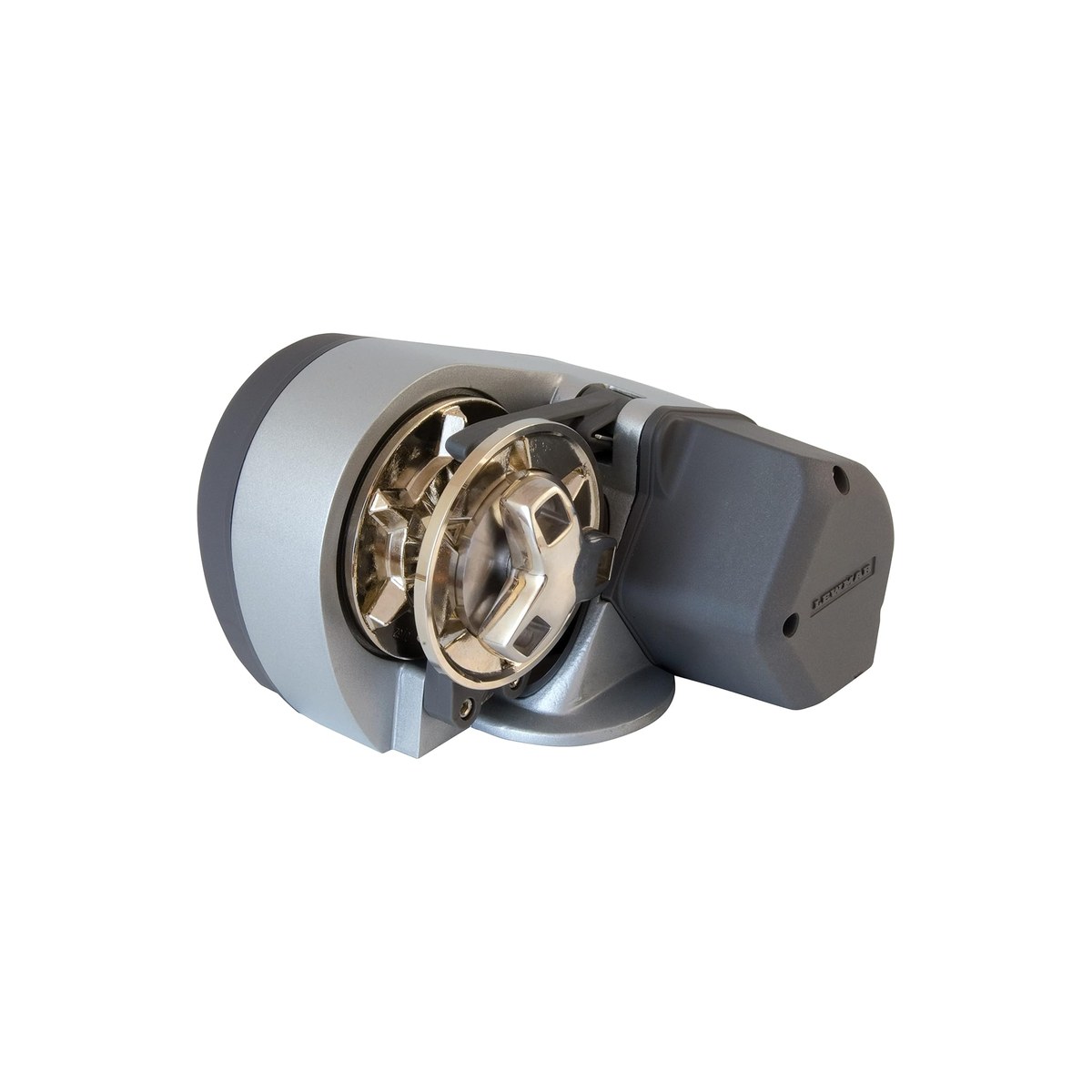
Lewmar Pro Sport 550 12V Windlass (1/4 inch G4 chain, Manual Freefall DEPLOY-ONLY, 550 lb max pull, port-side mounted gypsy, 150W motor, factory-rated for boats 20 to 30 ft)
The Lewmar Pro Sport 550 is the entry-tier chain windlass we would buy on a tight budget for a 20 to 30 ft coastal cruiser who anchors in protected water with daily marina returns. 85 Amazon owner reviews at 4.4 stars is solid for the price tier ($829 versus $1,043 for the V700), and the Pro Sport line is Lewmar's entry-tier chain windlass (NOT a rope-only anchor winch like the Trac Outdoor pontoon line or the Powerwinch 712A trailer winch, which are categorically different products covered in the Don't Bother With section). The 150W motor draws 20 amps normal per the Lewmar Pro Sport factory manual with a 25 amp factory breaker; cable sizing is 10 AWG for 0 to 33 ft run, 8 AWG for 34 to 60 ft. Light wiring profile that the small-cruiser house bank can support without a dedicated refit. Manual Freefall (insert Lewmar wrench into capstan drive cap, rotate counterclockwise) works without power on the deploy side. **HARD CALLOUT: The Pro Sport 550 Manual Freefall is DEPLOY-ONLY for the ergonomically-easy mechanism. Per Lewmar Pro Sport factory manual Sections 6.1 and 6.2, Manual Freefall (capstan drive cap with the Lewmar wrench) releases the anchor; powered retrieval is the normal way to haul it back. The Pro-Series family does document a manual anchor recovery path via a driveshaft socket on the opposite side of the windlass (insert a wrench or 12mm / 1/2 inch drive ratchet into the socket and turn clockwise), so a true emergency manual retrieval is technically possible. The catch is that the driveshaft-socket pathway has no mechanical advantage compared to the RC8-8's capstan-top crank: it requires significant continuous torque on a small ratchet, and a 3 AM breaker-trip scenario in 25 knots with 200 ft of chain out is the difference between very hard (Pro Sport 550 driveshaft socket) and manageable (RC8-8 capstan crank). The safety callout stands: do not buy the Pro Sport 550 as your only retrieval pathway for offshore use; buy it because you are coming back to a marina nightly and you can accept the driveshaft-socket workaround as the emergency-only fallback.** This is the defining limitation of budget-tier windlasses, and it is the reason the Pro Sport 550 is the coastal-day-use pick (boat returns to a marina nightly or every other night where shore power can recharge the house bank before the next anchoring cycle), not the offshore pick (where breaker failure at 3 AM in 25 knots with 200 ft of chain out is a real scenario). For offshore or extended coastal cruising on a 30-plus ft boat, the Maxwell RC8-8 at rank 4 with its capstan-top crank handle manual override is the geometry-and-safety-correct pick. The Pro Sport 550 is the budget pick we would buy for the specific persona it serves; that persona is narrow.
- + 4.4 stars across 85 Amazon owner reviews at the entry-tier chain-windlass price point ($829 versus $1,043 for the V700 and $1,241 for the Pro Fish 700). The Pro Sport 550 is Lewmar's entry-tier chain windlass and the right answer for a budget 20 to 30 ft cruiser who needs a chain windlass (not a rope-only anchor winch like the Trac Outdoor Pontoon 35 line or the Powerwinch 712A trailer winch)
- + Manual Freefall deploy mechanism: insert the Lewmar wrench into the capstan drive cap and use the same clutch-lever convention used across the Lewmar line. The deploy side works without power, which is the practical advantage at the budget tier
- + 150W motor with 20 amp normal current draw per the Lewmar Pro Sport factory manual and 25 amp factory breaker. Cable sizing: 10 AWG for 0 to 33 ft run, 8 AWG for 34 to 60 ft. The lower current draw than the V700 makes the wiring simpler and the breaker class lighter. Right install profile for the smaller-cruiser budget pick
- + Port-side mounted gypsy configuration (default in the standard kit). Standard Lewmar Pro Sport spec sheet covers configuration options for chain-up-to-the-cleat layouts on a 20 to 30 ft small-cruiser foredeck
- × BOLD CALLOUT: The Pro Sport 550 Manual Freefall (the easy capstan-drive-cap mechanism per Sections 6.1 and 6.2 of the factory manual) is DEPLOY-ONLY. Manual Freefall releases the anchor; powered retrieval is the normal way to haul it back. The Pro-Series family does document an emergency manual recovery path via a driveshaft socket on the opposite side of the windlass (insert a wrench or 12mm / 1/2 inch drive ratchet into the socket and turn clockwise), so a true zero-power retrieval is technically possible. The catch: the driveshaft-socket path has no mechanical advantage compared to the RC8-8's capstan-top crank, just significant continuous torque on a small ratchet. This is the defining limitation of budget-tier windlasses and the reason the Pro Sport 550 is the coastal-day-use pick (with marina returns), not the offshore pick
- × 550 lb max pull is materially below the V700's 700 lb and well below the Maxwell RC8-8's 1,320 lb. A 30 ft cruiser with a 25 lb anchor plus 150 ft of 1/4 inch G4 chain (combined 122 lb times 3 safety factor equals 366 lb) sits inside the 550 lb spec, but with no margin for storm tackle or oversized anchor. For anything above 30 ft or any offshore tackle profile, the V700 at rank 1 is the right call
- × 20 amp draw is the spec the smaller boats can support without a wiring refit, but it also reflects the smaller motor and shorter operational pull duration. The Pro Sport 550 is rated for shorter anchor cycles than the V700; on extended retrievals or heavy mud, expect the motor to thermal-cycle and the duty cycle to be shorter
Also worth considering.
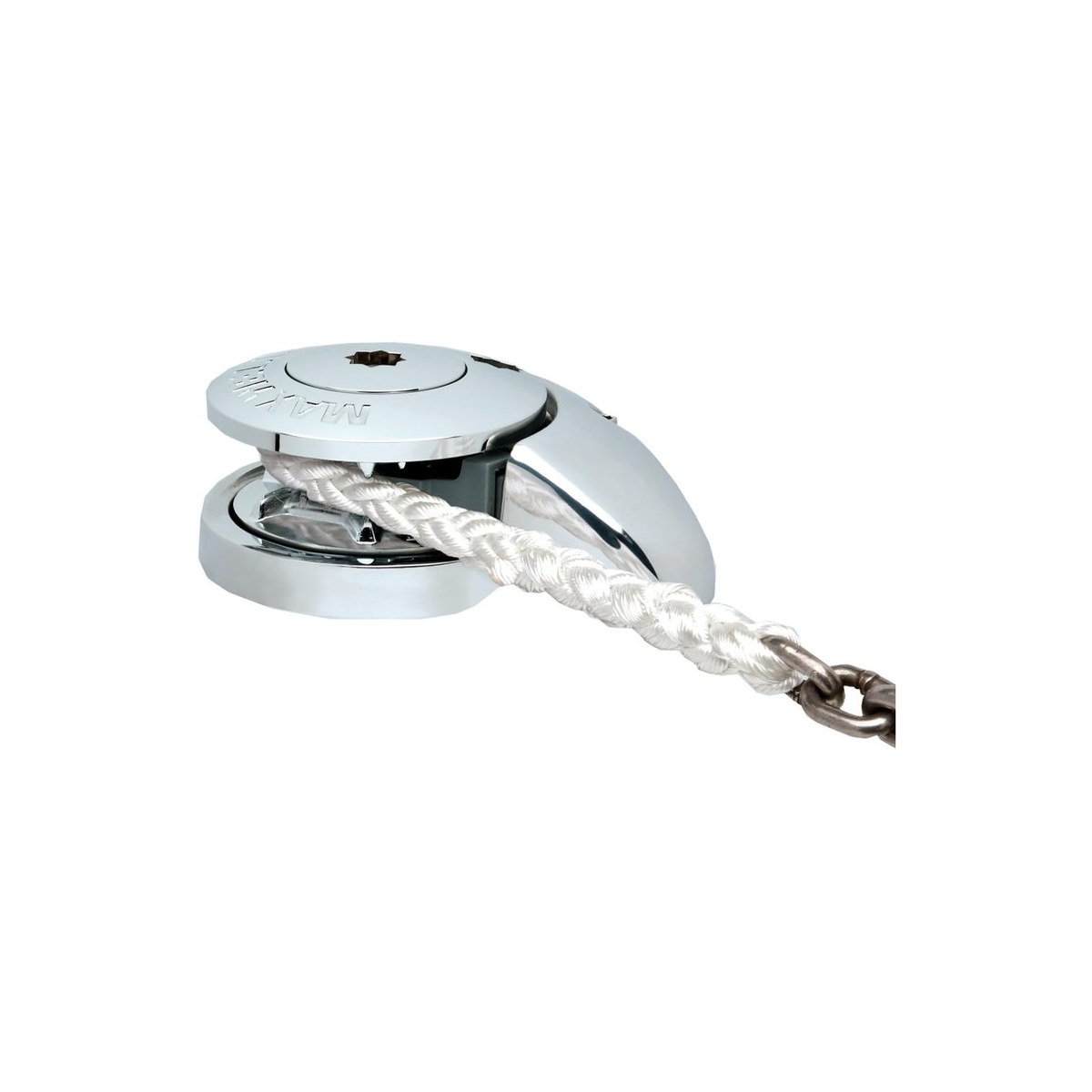
Maxwell RC8-8 12V Vertical Windlass (5/16 inch (8mm) G4 chain, 1000W motor, 1,320 lb max pull, 2,640 lb static hold, sealed oil-bath gearbox, capstan-top emergency crank handle included, ASIN B003700TTW is the 8mm variant)
The Maxwell RC8-8 is the heavy-displacement Maxwell anchor windlass we recommend as the offshore specialty pick and the right answer for the 35 to 45 ft cruising sailboat or trawler carrying 5/16 inch G4 chain. The math: a 35 ft heavy-displacement cruiser with a 35 lb anchor plus 200 ft of 5/16 inch G4 chain at 1.0 lb per ft equals 235 lb combined, times 3 safety factor equals 705 lb minimum pull. The V700 at 700 lb is at the edge; the RC8-8 at 1,320 lb is meaningfully inside spec. More importantly, the V700 gypsy does not accept 5/16 inch chain in standard configuration. If your boat carries 5/16 inch chain, the V700 is not the right pick regardless of pull rating; the RC8-8 gypsy is sized for 5/16 inch G4. Critical clarification: ASIN B003700TTW resolves to the Maxwell RC8-8 (8mm chain, 1000W, 1,320 lb pull). The Maxwell RC8 line has TWO variants sold under similar listings: the RC8-6 (6mm/1/4 inch chain, 600W, 770 lb pull) and the RC8-8 (8mm/5/16 inch chain, 1000W, 1,320 lb pull). Verify the listing matches the 8mm variant before buying; the wrong variant ships the wrong gypsy and the wrong motor for a 5/16-inch-chain refit. On the wattage rating: Maxwell engineering director Stephen Baker told Yachting Monthly directly that 'at stall load these motors can absorb 5kW. Simply comparing manufacturers stated wattage is fairly meaningless.' The 1000W RC8-8 spec is the peak/stall figure, not the continuous output. Cruisers Forum measurements show roughly 60 amp average current draw during retrieval on the RC8-series, consistent with about 720W continuous at 12V (below the nameplate). Manufacturer breaker spec is 90 to 135 amps depending on the install reference; cable sizing is 4 AWG for 0 to 33 ft run, 2 AWG for 34 to 60 ft. This is the wiring profile a 35-plus ft offshore boat is built around; the V700's 8 AWG / 6 AWG profile is materially lighter. The capstan-top emergency crank handle ships standard per the Maxwell data sheet and the RC8 manual: 'Manual override and Free Fall, using the emergency crank/clutch handle provided.' This is the operator-community-validated true manual retrieval pathway and the reason the RC8-8 is the offshore-cruiser-correct pick where the Pro Sport 550's deploy-only Manual Freefall fails. Maxwell's gearbox is sealed oil-bath marine-grade hard-anodized alloy, which gives it thermal longevity under sustained retrieval cycles that consumer-tier units cannot match. Twenty Amazon owner reviews at 4.9 stars is a low Amazon adoption signal (the Lewmar V700 has 165 reviews and the RC6 has 5), reflecting the Amazon distribution gap on Maxwell that the editorial spine names explicitly. The five-star ratings the RC8-8 does have are consistent with the operator-community-strong reputation the Maxwell line carries on Practical Sailor and the European cruising forums. For 35 to 45 ft heavy-displacement offshore cruising with 5/16 inch chain and the requirement for true manual retrieval, the Maxwell RC8-8 is the specialty pick we would buy.
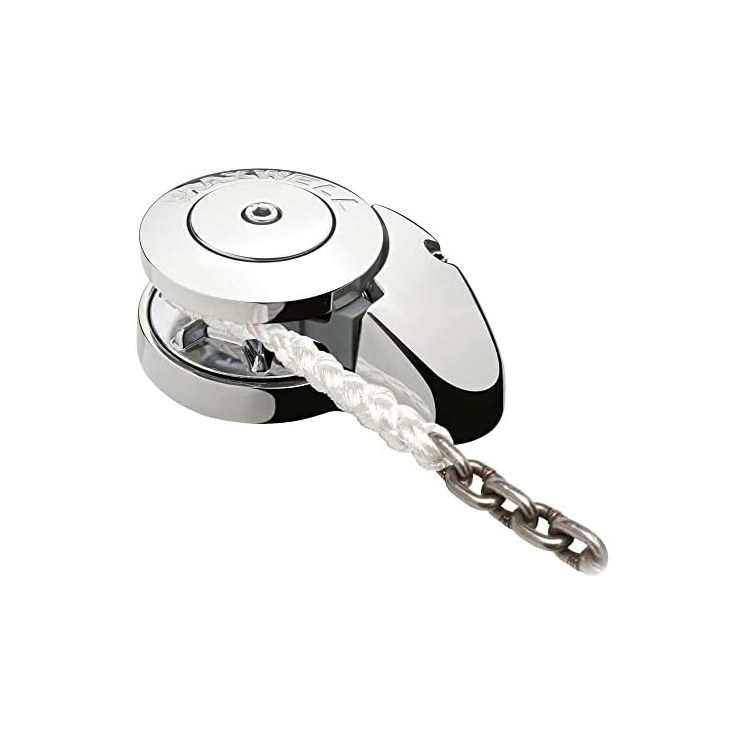
Maxwell RC6 12V Vertical Windlass (RC Series sub-1000W, marine-grade hard-anodized alloy gearbox, low-profile only, emergency free-fall activation lever standard)
The Maxwell RC6 is the smaller-cruiser Italian-built alternative pick and the right answer for the 25 to 32 ft cruiser who specifically wants the Maxwell sealed oil-bath gearbox at the V700 price tier. The RC6 sits at $1,133 (versus $1,043 V700 and $1,945 RC8-8), and the trade-off is that you get the Maxwell hard-anodized alloy sealed oil-bath gearbox and an emergency free-fall activation lever (cone-clutch release) standard, in a smaller motor and pull class. Critical clarification on manual override: the RC6 is low-profile only, with no capstan drum option (unlike the RC8-8). Manual retrieval on the RC6 requires inserting a wrench into the driveshaft socket (similar to the Pro Sport 550 mechanism), not the capstan-top crank of the RC8-8. The RC6's manual-override story is therefore meaningfully weaker than the RC8-8's: it has better gearbox longevity than the Pro Sport 550, but for true capstan manual retrieval an offshore buyer must step up to the RC8-8. The Maxwell RC6 spec runs 500W motor, roughly 42 amp normal draw, and 70 amp breaker at 12V per the Maxwell circuit breaker spec (40 amp at 24V; do not conflate with the RC8-6's 80 amp 12V spec, which the RC6 does not share); cable sizing falls between the V700's 8 AWG / 6 AWG and the RC8-8's 4 AWG / 2 AWG. The 5-star rating across only 5 Amazon owner reviews is the Amazon-thin signal that reflects the documented Maxwell distribution gap. The trade-off versus the V700 is real and asymmetric: the V700 has 33 times the Amazon adoption (165 reviews) and a lower price ($1,043 versus $1,133); the RC6 has Maxwell's gearbox build quality and the longer-term offshore upgrade pathway into the RC8 / RC10 family. For the 25 to 32 ft cruiser who values Maxwell's gearbox longevity over Lewmar's volume-seller proof point and accepts the driveshaft-socket-only manual retrieval, the RC6 is the alternative pick we would buy. For the 25 to 32 ft cruiser who values the 165-review Amazon proof point and the lower price, the V700 at rank 1 remains the right call.
Skip this guide if...
Three audiences should skip this guide. First, pontoon boat or small-bass-boat owners who anchor with rope-only systems on stub-deck installs: the Trac Outdoor Pontoon 35 line, the Trac G3 Fisherman 25 / Angler 30 / Deckboat 40, and the Camco TRAC Outdoors series are rope-only anchor winches (pre-wound double-braid rope, no chain gypsy), categorically different from the chain windlasses in this guide. For pontoon and bass-boat anchoring, those products are the right call; for coastal-cruiser foredeck installs they are not. Second, owners of 40 to 60 ft cruising sailboats or sportfish boats running 3/8 inch G4 chain or larger: the lineup tops out at the Maxwell RC8-8 for 5/16 inch chain on 35 to 45 ft boats; for serious offshore tackle (3/8 inch chain on 50 ft cruisers), the Lewmar V2 / V3 or the Maxwell RC10 / RC12 or the Lofrans Tigres 1500W are the right size class, and those product families need a separate guide focused on the heavy-displacement offshore market. Third, owners of any boat doing a trailer-winch (loading the boat onto a trailer at the launch ramp) install: trailer winches are categorically not anchor windlasses; the Powerwinch 712A is the most-mislabeled product in this category and is not in our lineup because it is not a windlass.
Don't bother with.
- × Skip Powerwinch 712A and similar 'anchor winches' that are actually trailer winchesThe Powerwinch 712A is listed on the manufacturer's own website as a boat trailer winch, not an anchor windlass. It has a 712 lb capacity for trailer hauling, with power-in and free-wheel-out action. It has NO chain gypsy, NO ABYC-compliant installation pathway for marine foredeck anchor duty, and NO certification for the duty cycle that anchor cycling requires (a windlass deploys and retrieves chain repeatedly under load; a trailer winch loads a boat onto a trailer once per trip). Some Amazon sellers mislabel the 712A as an anchor windlass; that mislabeling is a category error. The reported 'sizing trap' where owners install the 712A on 5,000-plus lb boats and shatter the gears is real in the sense that the wrong-class product was bought; the underlying issue is that the 712A was never the right product for anchor duty. Buy a chain windlass with a chain gypsy. The Pro Sport 550 at rank 3 is the budget chain-windlass entry tier.
- × Skip Trac Outdoor Pontoon 35, Camco TRAC Pontoon, Trac G3 Fisherman / Angler / Deckboat lines, and similar rope-only anchor winchesAll Trac Outdoor 'Pontoon 35', 'Deckboat 40', 'Angler 30', 'Fisherman 25-G3' units are rope-only anchor winches with pre-wound double-braid anchor rope, NO chain gypsy. They are categorically different from chain windlasses and serve a different audience (pontoon boats, small fishing boats, and stub-deck installs that cannot accommodate a chain locker). For a pontoon boat with a 10 lb mushroom anchor and 100 ft of pre-wound rope, the Trac Pontoon 35 is the right product; for a 25 to 35 ft coastal cruiser doing a chain-gypsy foredeck install, it is the wrong product class. The two product categories are not interchangeable.
- × Skip Wattage as the primary windlass-buying specMaxwell engineering director Stephen Baker stated in Yachting Monthly: 'At stall load these motors can absorb 5kW. Simply comparing manufacturers stated wattage is fairly meaningless.' Manufacturer wattage ratings are peak or stall figures, not continuous output. Cruisers Forum measurements on the Maxwell RC8 series show real-world continuous current draw around 60 amps (roughly 720W at 12V) versus the 1000W nameplate. The Lewmar V700 specs at 320W (per the factory manual), but some retailer listings show 500W (a copy-paste error). Buy based on max pull rating, gypsy chain class, manual override quality, and motor cooling design, NOT motor wattage in isolation.
- × Skip Generic Asian-sourced 'G4' anchor chain at hardware-store or anonymous Amazon pricesThe Lewmar V700 gypsy (part number 603, with replacement service kits 66000603 for 1/4 inch G4 and 7mm DIN 766, or 66000604 for 6mm DIN 766) is factory-cut to accept BOTH DIN 766 AND ISO 4565 standards at the 1/4 inch / 6-7mm size class; the V700 gypsy is dimensionally tolerant at this chain size. Verify the current Lewmar service kit part number against the parts catalog before ordering a replacement, since catalog numbers update. The 2mm pitch difference between DIN 766 and ISO 4565 that gets discussed in the cruising-community vernacular becomes a real jamming hazard at 10mm and larger chain sizes (where the V2 and V3 use separate gypsy part numbers for DIN versus ISO compatibility), not at the 1/4 inch chain this guide covers. The actual trap for 1/4 inch G4 buyers is generic Asian-sourced chain marketed as 'G4' but not properly calibrated to ISO 4565 tolerances; the inconsistent link pitch jams any gypsy unpredictably. Buy name-brand calibrated chain (ACCO, Peerless, ISO-marked) from a marine chandlery, not generic hardware-store or anonymous Amazon chain.
- × Skip Buying a windlass before sizing the chain, the house bank, and the foredeck geometryThe right windlass for your boat is a function of four things, in order: (1) the chain class you will actually carry (1/4 inch G4 needs a 1/4 inch gypsy like the V700; 5/16 inch G4 needs the RC8-8 gypsy; the gypsies are not interchangeable across these chain sizes), (2) the foredeck geometry (vertical for sailboat foredecks where deck-clean is preferred; horizontal for sportfish foredecks where deck access is preferred), (3) the house bank capacity and the cable run from house bank to foredeck (V700's 45 amp draw needs 8 AWG for 0-33 ft and 6 AWG for 34-60 ft; the RC8-8's 83 amp normal draw needs 4 AWG and 2 AWG), and (4) the use pattern (coastal day-use can accept the Pro Sport 550's deploy-only Manual Freefall; offshore requires true manual retrieval like the Maxwell RC8-8's capstan-top crank). Buying a windlass before answering these four questions produces a unit that either jams on the wrong chain, fits the wrong foredeck, or fails the wrong way at 3 AM in 25 knots.
- × Skip Lofrans, Muir, and Quick windlasses via Amazon (Amazon distribution gap)Lofrans (Italian, dominant on Practical Sailor's tech rankings), Muir (Australian, Italian gearboxes, the Practical Sailor service-tech favorite), and Quick (Italian, wireless key-fob remotes and NMEA integration) have minimal Amazon US distribution as of 2026. Lofrans Tigres is stocked through Defender ($2,259 to $3,247), CitiMarine, and YachtAid Marine. Muir HR/C 950 starts at $1,359 through Mantus Marine (the correct US source per the Imtra Marine distribution channel). Quick distributes through quickusastore.com. If you want any of these brands, buy direct from those channels, NOT Amazon. These brands' competitive differentiation (Lofrans stainless build, Muir Italian gearboxes, Quick wireless integration) appeals to buyers who research carefully and source through marine specialty channels; Amazon does not stock them in volume because their fulfillment model disfavors heavy, low-volume marine hardware that requires technical support. Our 3 Lewmar plus 2 Maxwell Amazon-buyable lineup reflects Amazon distribution reality.
How we picked.
Sources we read and the methodology we used
We did not test these windlasses across a season on our boat. The sites that claim they did mostly did not either; the closest thing to authoritative independent test data is the Practical Sailor archive, the Maxwell engineering director's Yachting Monthly interview on wattage ratings, and the cruising-community forum threads that document real-world install patterns and failure modes. What we did is read the Lewmar V700 Issue 8 factory manual, the Pro Sport 550 factory manual, the Maxwell RC8 data sheet, the Lewmar Pro-Series landing pages, the Dark Horse Marine gypsy compatibility guide, and the Jimmy Green Marine gypsy specification table directly, then cross-referenced against Cruisers Forum, Trawler Forum, Great Grady, Practical Sailor service-tech threads, MarineHowTo (Compass Marine on windlass install patterns), and the operator-vernacular harvest covering Lewmar, Maxwell, Lofrans, Muir, Quick, and the Powerwinch / Trac Outdoor product-class boundary. We discarded sources that could not be attributed to a named owner, a dated publication, or a specific test methodology, and we report both sides where manufacturer guidance and owner consensus diverge.
The V700 boat-length rating: factory manual vs Amazon listing copy
The single most-important piece of forum-cited honesty in this guide is the boat-length rating: the Lewmar V700 Amazon listing says 20-30 ft, the Lewmar Issue 8 factory manual and Defender and CitiMarine all say up to 35 ft. The factory manual is authoritative; the Amazon listing is copy-paste-incorrect. If your sailboat is in the 30 to 35 ft range, the V700 is the right size class even though the Amazon listing suggests it falls short. The honest persona is 25 to 35 ft (the lower bound is set by sub-25 ft boats typically not needing a chain windlass; the upper bound is the factory manual's 35 ft).
Current draw and breaker sizing: why the 30A industry figure is wrong on the V700
The second most-important honesty point is the actual current draw and wiring: the V700 draws 45 amps normal per the factory manual (NOT the 30 amps that gets repeated in the marine industry), and the Maxwell RC8-8 draws roughly 83 amps normal. A buyer sizing a 30 amp breaker on the wrong industry figure trips it under normal load. The Lewmar V700 ships with a 35 amp factory breaker and a stall draw up to 80-90 amps; cable sizing per the Lewmar wiring table is 8 AWG for 0-33 ft run from house bank to foredeck, 6 AWG for 34-60 ft, 4 AWG for 61-80 ft. The Maxwell RC8-8 requires a 90 to 135 amp breaker; cable sizing is 4 AWG for 0-33 ft run, 2 AWG for 34-60 ft. The Lewmar Pro Sport 550 draws 20 amps normal with a 25 amp factory breaker; cable sizing is 10 AWG for 0-33 ft, 8 AWG for 34-60 ft. Always verify breaker spec against the factory manual, not against generic industry copy.
The Pro Sport 550's Manual Freefall is deploy-only, with no real manual retrieval
The third honesty point is the Pro Sport 550's Manual Freefall being deploy-only; the factory manual Sections 6.1 and 6.2 are explicit, and a buyer who expects manual retrieval at 3 AM after a breaker trip will be disappointed. There IS an emergency-only zero-power retrieval pathway: insert a wrench or 12mm (1/2 inch) drive ratchet into the driveshaft socket on the opposite side of the windlass from the gypsy, then turn clockwise. The catch is that this socket has no mechanical advantage compared to the RC8-8's capstan-top crank: it requires significant continuous torque on a small ratchet. The Pro Sport 550 is the coastal-day-use pick (boat returns to a marina nightly, shore-power recharge before the next anchoring cycle); it is NOT the offshore pick (where a 3 AM breaker trip in 25 knots makes the driveshaft-socket workaround genuinely punishing). For offshore use the Maxwell RC8-8 with the capstan-top crank handle is the safer call, because the capstan crank provides true manual retrieval with mechanical advantage.
The shortlist: five design families for a coastal-cruiser foredeck install
The shortlist started with the design families that working marine electricians on Cruisers Forum, Trawler Forum, Practical Sailor, and the Lewmar factory-tech videos actually recommend for a 25 to 38 ft coastal cruising sailboat or sportfish powerboat doing a foredeck install: vertical-install sailboat default at sub-$1,100 (the Lewmar V700 at $1,043 with 165 Amazon reviews, the Amazon volume leader by a wide margin); horizontal-install sportfish at sub-$1,300 (the Lewmar Pro Fish 700 at $1,241 for the up-to-38 ft sportfish geometry); budget chain windlass with the deploy-only Manual Freefall limitation (the Lewmar Pro Sport 550 at $829 for the 20-30 ft coastal-day-use cruiser); heavy-displacement offshore at sub-$2,000 (the Maxwell RC8-8 at $1,945 for 5/16 inch G4 chain on 35-45 ft cruisers, with capstan-top manual override standard); and the smaller-cruiser Italian-built alternative at the V700 price tier (the Maxwell RC6 at $1,133 with 5 Amazon reviews and Maxwell gearbox build quality; low-profile only with no capstan-drum option, so manual retrieval is driveshaft-socket only).
Five alternatives we considered: V1, H3, Lofrans Tigres, Muir HR/C, V2/V3
We considered five additional picks worth knowing about. First, the Lewmar V1 (current-catalog vertical equivalent of the V700 with the same 700 lb pull but extended boat-length rating to 40 ft); if your sailboat sits at 33-35 ft and the V1 is currently stocked on Amazon at comparable price, the V1 is the future-proof pick. Second, the Lewmar H3 horizontal at roughly $1,600 (1,320 lb pull, 12V or 24V, mid-size yachts); legitimate step-up horizontal between the Pro Fish 700 and the Maxwell RC8-8 in both price and pull, and the right answer for 38-45 ft sportfish boats running heavier ground tackle. Third, the Lofrans Tigres at Defender's $2,259 (the Italian Practical Sailor favorite with the gearbox-spring-load-ratchet documented as the strongest manual override); not Amazon-buyable, the editorial-favorite-by-tech-rankings. Fourth, the Muir HR/C 950 via Mantus Marine at $1,359 (Italian gearboxes, the Practical Sailor service-tech favorite). Fifth, the Lewmar V2 / V3 family (1,874 lb and 2,260 lb pull respectively for 40 to 50 ft heavy cruisers); above the 25-38 ft persona this guide serves and outside the entry-tier-to-mid-tier price profile.
How the lineup is defended: three Lewmar plus two Maxwell (and why no Lofrans, Muir, or Quick)
The lineup is three Lewmar plus two Maxwell. Three-Lewmar (V700 vertical Top Pick at $1,043, Pro Fish 700 horizontal Runner-up at $1,241, Pro Sport 550 budget at $829) is defended by role separation: V700 is the sailboat-vertical Fall Safe Gypsy default, Pro Fish 700 is the sportfish-horizontal Auto Free-Fall default, Pro Sport 550 is the budget entry-tier with the documented deploy-only Manual Freefall limitation. Same parent company, three distinct product lines, three distinct foredeck-geometry-and-mechanism decisions. Same defensibility shape we used for three-price-tier picks on Marine Battery Chargers (three Victron variants serving shore charger, DC-DC, and Bluetooth-app-configurable parameter slots) and two-3M-picks on Marine Sealants and two-Star-brite-picks on Boat Cleaners. Two-Maxwell (RC8-8 1000W heavy-displacement specialty at $1,945, RC6 sub-1000W smaller-cruiser specialty at $1,133) is defended by output-class separation: RC8-8 is the 5/16 inch chain offshore unit, RC6 is the 1/4 inch chain coastal alternative; different chain class, different motor class, different price tier.
The single most-important honesty point this guide makes is on Amazon distribution reality: Lofrans + Muir + Quick dominate Practical Sailor tech rankings and European cruising markets, but Amazon coverage is thin (zero Prime listings, sourcing channels are Defender / CitiMarine / Hodges Marine / Mantus Marine). Our 3 Lewmar + 2 Maxwell Amazon-buyable lineup reflects that reality without papering over the gap. If you want Lofrans Tigres or Muir HR/C 950 or Quick Genius, the guide names the right sourcing channels and recommends them explicitly; we will not pretend Amazon is the right channel when it is not. One final methodology note on marine anchor chain: the gypsy is the windlass component that determines which marine anchor chain spec the unit will accept (DIN 766 or ISO 4565 calibrated, G4 grade, 1/4 inch or 5/16 inch). Buy ISO-calibrated brand-name marine anchor chain (ACCO, Peerless, ISO-marked) from a marine chandlery rather than generic Asian-sourced chain marketed as G4; the link-pitch inconsistency on cheap chain will jam any gypsy and there is no recovery from a jammed retrieval mid-anchorage. We cover marine anchor chain sourcing in more depth in our Marine Anchor Chain guide.
FAQs.
Q01 How do I know if my boat needs a vertical or a horizontal windlass?
+
Q02 What is the right boat length range for the Lewmar V700?
+
Q03 What is the actual current draw on the V700 and the Maxwell RC8-8?
+
Q04 Does the Lewmar Pro Sport 550 have manual override?
+
Q05 How do I size the breaker and cable for a windlass install?
+
Q06 Should I buy 1/4 inch G4 chain or 5/16 inch G4 chain for my windlass?
+
Q07 Why is the Powerwinch 712A not in this guide?
+
Q08 Why are there no Lofrans or Muir picks in this guide?
+
If you, then this.
- IF you have a 25 to 35 ft coastal cruising sailboat doing a vertical foredeck install with 1/4 inch G4 chain, want the Amazon volume-seller-with-165-reviews proof point, and prefer Fall Safe Gypsy over Auto Free-FallGET Lewmar V700 12V Vertical Windlass$1,043 →
- IF you have a 30 to 38 ft sportfish or powerboat doing a horizontal foredeck install with 1/4 inch G4 chain, want Auto Free-Fall for repeated anchoring over structure, and need the up-to-38 ft boat-length ratingGET Lewmar Pro Fish 700 Horizontal Windlass$1,241 →
- IF you are budget-tight on a 20 to 30 ft coastal cruiser, accept the deploy-only Manual Freefall limitation (powered retrieval normal, driveshaft-socket emergency-only with no mechanical advantage), and use the boat for coastal-day-anchoring with daily marina returnsGET Lewmar Pro Sport 550 12V Windlass$829 →
- IF you have a 35 to 45 ft heavy-displacement offshore cruising sailboat or trawler carrying 5/16 inch G4 chain, need true manual retrieval (capstan-top crank handle ships standard), and want the meaningfully stronger 1,320 lb pullGET Maxwell RC8-8 12V Windlass (8mm / 5/16 inch chain variant; verify ASIN resolves to RC8-8)$1,945 →
- IF you have a 25 to 32 ft coastal cruiser, want the Maxwell sealed oil-bath gearbox build quality at the V700 price tier, accept that the RC6 is low-profile only (driveshaft-socket manual retrieval, no capstan crank), and accept the very low Amazon adoption signal (5 reviews) in exchange for Italian-built reliability and the longer-term offshore upgrade pathwayGET Maxwell RC6 12V Vertical Windlass$1,133 →
- IF your boat is 33-35 ft and you want the current-catalog vertical equivalent of the V700 with extended boat-length rating to 40 ftGET Lewmar V1 (current-catalog equivalent; check Amazon for stock; same 700 lb pull, 35A breaker spec, extends to 40 ft)varies →
- IF your boat is 38 to 45 ft sportfish running 1/4 inch chain and you want a horizontal step-up between the Pro Fish 700 and the Maxwell RC8-8GET Lewmar H3 horizontal (~1,320 lb pull, 12V/24V, mid-size yachts; the legitimate step-up horizontal Amazon-available pick)~$1,600 →
Boat Gear: The Complete Guide
The whole-boat picture →Every system on a 20 to 45 ft coastal boat, organized in one place, with the one guide we trust for each.
- ABYC H-40: the windlass is not a designated strong point · American Boat & Yacht Council
- Windlass range, pull ratings, and gypsy matching · Lewmar
- Windlass selection by ground-tackle weight · Maxwell Marine