Best RV Cell Signal Boosters: 5 Picks, and What a Booster Can't Do (2026)
A cell signal booster pulls a weak outside signal off a roof antenna, amplifies it, and rebroadcasts it inside your rig, turning one or two bars into a usable call or connection. It cannot create signal where there is none, and in 2026 every honest booster review starts there. The category rates 3.5 to 4.0 stars on Amazon because buyers expect magic and get amplification. We read the FCC rules and the RV mobile-internet authorities, then verified every listing live on Amazon on June 16, 2026. The headlines: mobile boosters are capped at 50 dB of gain by the FCC while a parked rig can legally run 65; a roof MIMO antenna beats a booster for raw data most of the time; and the carrier registration the law requires takes five minutes and almost nobody does it.
- 01 weBoost Drive Reach RV II (B0DC7Q4XW1) , top pick, the mobile flagship, strongest uplink, all US carriers, 50 dB, 3.8/83, ~$550
- 02 weBoost Destination RV (B08WTRVG61) , best for staying put: 65 dB stationary gain, directional antenna, 4.0/339, ~$650
- 03 weBoost Drive X RV (B07TYGJ9TV) , the value weBoost, most-reviewed here at 1,011, same 50 dB for less, 4.0, ~$450
- 04 HiBoost Travel 2.0 RV (B0DF7SYLWS) , the budget pick, name-brand 50 dB with a signal app, 3.9/220, ~$400
- 05 SureCall Fusion2Go 3.0 RV (B079TKZN1B) , the alternative, 3-year warranty, lowest-rated here at 3.5/154, ~$450
How they compare.
| Rank | Product | Best for | Price | Our score |
|---|---|---|---|---|
| 01 | weBoost Drive Reach RV II (B0DC7Q4XW1)
Top Pick
| best overall mobile booster: strongest uplink for fringe one-bar areas, all US carriers, one-time install | $549.99
Buy → | 8.6/10 |
| 02 | weBoost Destination RV (B08WTRVG61) | best for a parked rig: 65 dB of gain, fifteen more than any mobile booster, if you stay put | $649.99
Buy → | 8.5/10 |
| 03 | weBoost Drive X RV (B07TYGJ9TV) | the value weBoost: same 50 dB mobile gain and the deepest review base here, for $100 less | $449.99
Buy → | 8.3/10 |
| 04 | HiBoost Travel 2.0 RV (B0DF7SYLWS) | the budget name-brand pick: full 50 dB with a signal-monitoring app, lower uplink than weBoost | $399.99
Buy → | 7.7/10 |
| 05 | SureCall Fusion2Go 3.0 RV (B079TKZN1B) | the weBoost alternative: longer warranty and return window, the lowest rating in the guide | $449.99
Buy → | 7.1/10 |
Prices are current Amazon prices at time of publication and can change. Scores reflect our editorial evaluation, not vendor input.
Our #1 pick: weBoost Drive Reach RV II Cell Phone Signal Booster Kit, Boosts 4G LTE and 5G for All US Carriers, FCC Approved, Made in USA (model 474061, ASIN B0DC7Q4XW1).
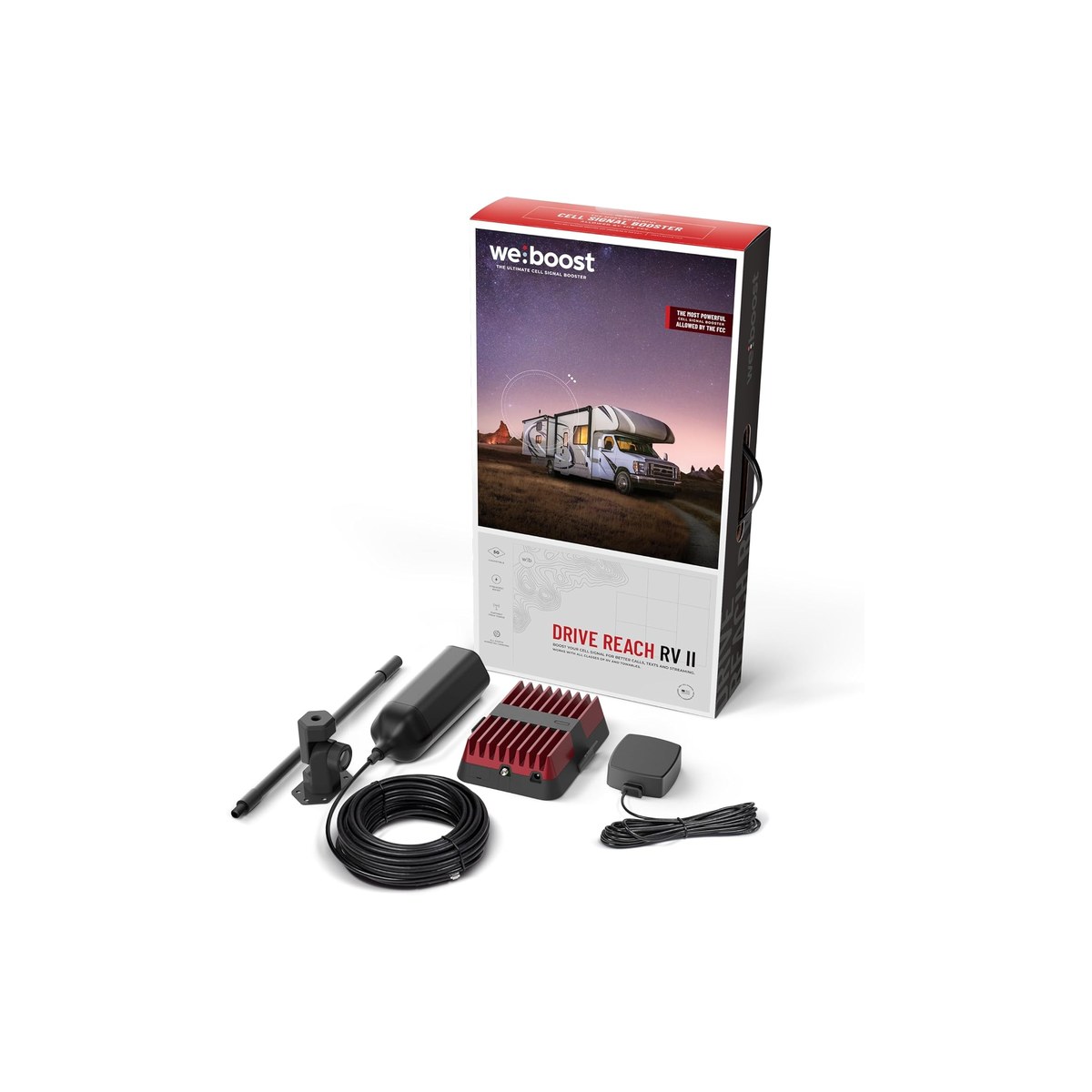
weBoost Drive Reach RV II Cell Phone Signal Booster Kit, Boosts 4G LTE and 5G for All US Carriers, FCC Approved, Made in USA (model 474061, ASIN B0DC7Q4XW1)
The strongest mobile booster we tested, if you travel and park.
Who it's for: The RVer who moves often and wants a stronger signal both while driving and parked at camp, without setting anything up at each stop. The weBoost Drive Reach RV II is the current flagship mobile booster, an omni roof antenna stays mounted permanently, it works with every US carrier at once, and it carries the highest uplink power of any weBoost mobile kit, the spec that matters most when the nearest tower is miles away.
What we found: It boosts 4G LTE and 5G for all US carriers in an FCC-approved, US-made kit, and at 3.8 stars across 83 reviews it is the newest weBoost RV booster, replacing the older 470354 model. The 29.5 dBm uplink, more than double the older Drive 4G-X's, is the real upgrade: uplink is your phone talking back to the tower, and a strong one turns a dropped call into a held one at the fringe. The honest cap is the FCC limit of 50 dB that every mobile booster shares, and the $550 price.
Bottom line: Buy the Drive Reach RV II if you travel regularly into one-bar country and want the strongest mobile booster available, on all carriers, with a one-time install. If you mostly park in one spot for days at a time, the stationary Destination RV below buys more gain for less hassle. And if your budget is tighter, the Drive X RV does the same job with less uplink for $100 less. It does nothing in a true dead zone.
- + Highest uplink power of any weBoost mobile booster at 29.5 dBm, more than double the uplink of the older Drive 4G-X, the spec that holds a call when the tower is miles away
- + Boosts 4G LTE and low-band 5G for all US carriers at once in an FCC-approved, US-made kit, with a permanently mounted omni roof antenna
- + The current flagship mobile booster, and the unit the RV mobile-internet authorities keep naming their top pick for travelers
- × Held to the FCC mobile cap of 50 dB of gain, so a parked rig can do better with the stationary Destination RV below
- × At about $550 it is the priciest mobile booster here, $100 over the Drive X that shares its 50 dB ceiling
- × Newer model, so its 3.8-star rating rests on just 83 reviews, far fewer than the Drive X's thousand-plus
Runner-up: weBoost Destination RV Cell Phone Signal Booster for Stationary Use, Boosts 5G and 4G LTE for All US and Canadian Carriers, FCC Approved (model 470159, ASIN B08WTRVG61).
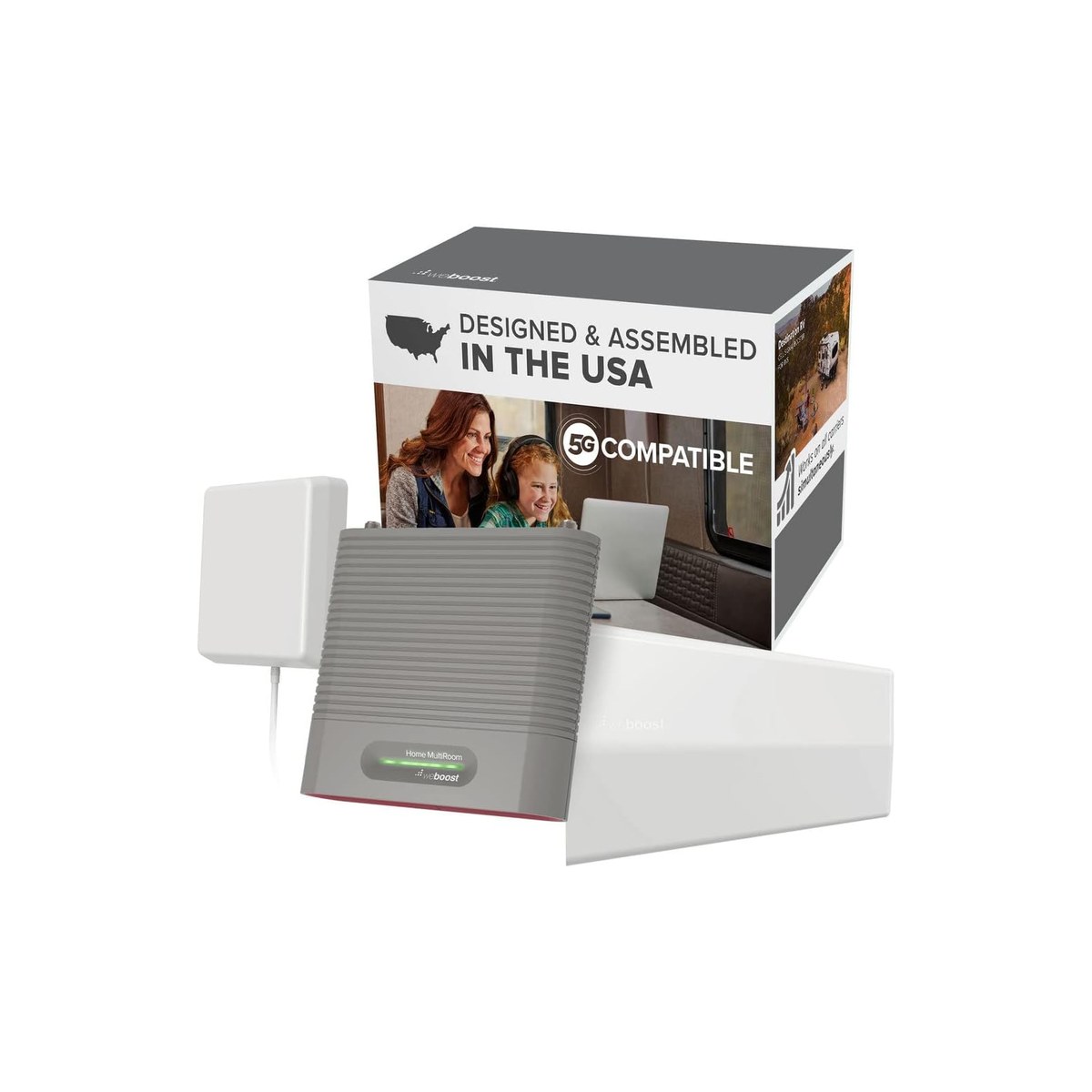
weBoost Destination RV Cell Phone Signal Booster for Stationary Use, Boosts 5G and 4G LTE for All US and Canadian Carriers, FCC Approved (model 470159, ASIN B08WTRVG61)
More gain than any mobile booster, for a rig that stays parked.
Who it's for: The snowbird, the seasonal camper, and the full-timer who parks in one place for days or weeks and wants the strongest possible signal while stationary. The weBoost Destination RV is built for exactly that: it trades the omni antenna for a directional one you aim at the nearest tower, and because the FCC allows parked boosters more power, it reaches 65 dB of gain, fifteen more than any mobile booster can legally run.
What we found: At 4.0 stars across 339 reviews it ties for the best-rated booster here, and the 65 dB ceiling is a real step up, fifteen decibels is roughly thirty times more signal power at the amplifier output, though the felt gain still depends on your distance to the tower and the terrain. That extra reach is what pulls a workable connection into a campsite tucked behind a ridge. The trade-offs are honest: it cannot be used while driving, the directional antenna has to be set up and aimed at each new site, a five-to-ten-minute job, and at $650 it is the priciest pick in this guide.
Bottom line: Buy the Destination RV if you stay put long enough that aiming an antenna once is worth a clearly stronger signal, snowbirds and seasonal campers are the perfect fit. If you move every day or two, the setup and teardown becomes a chore and a mobile booster like the Drive Reach is the better tool. And like every booster, it amplifies an existing signal, so it still needs at least a faint one to work with.
- + Reaches 65 dB of gain, fifteen more than any mobile booster can legally run, roughly thirty times more signal power for a parked rig
- + Rated 4.0 stars across 339 reviews, with a directional antenna that reaches farther toward a distant tower than an omni
- + Boosts 5G and 4G LTE for all US and Canadian carriers, FCC-approved, with a telescoping pole included for setup
- × Cannot be used while driving, the directional antenna must be set up and aimed at the nearest tower at each new site
- × At $650 it is the priciest pick in this guide, and the aiming adds a five-to-ten-minute job per stop
- × Overkill for anyone who moves every day or two, where a mobile booster is the simpler tool
Budget pick: HiBoost RV Cell Phone Signal Booster, Travel 2.0 RV Booster Kit, Boosts 4G and 5G LTE for All US Carriers, FCC Approved (ASIN B0DF7SYLWS).
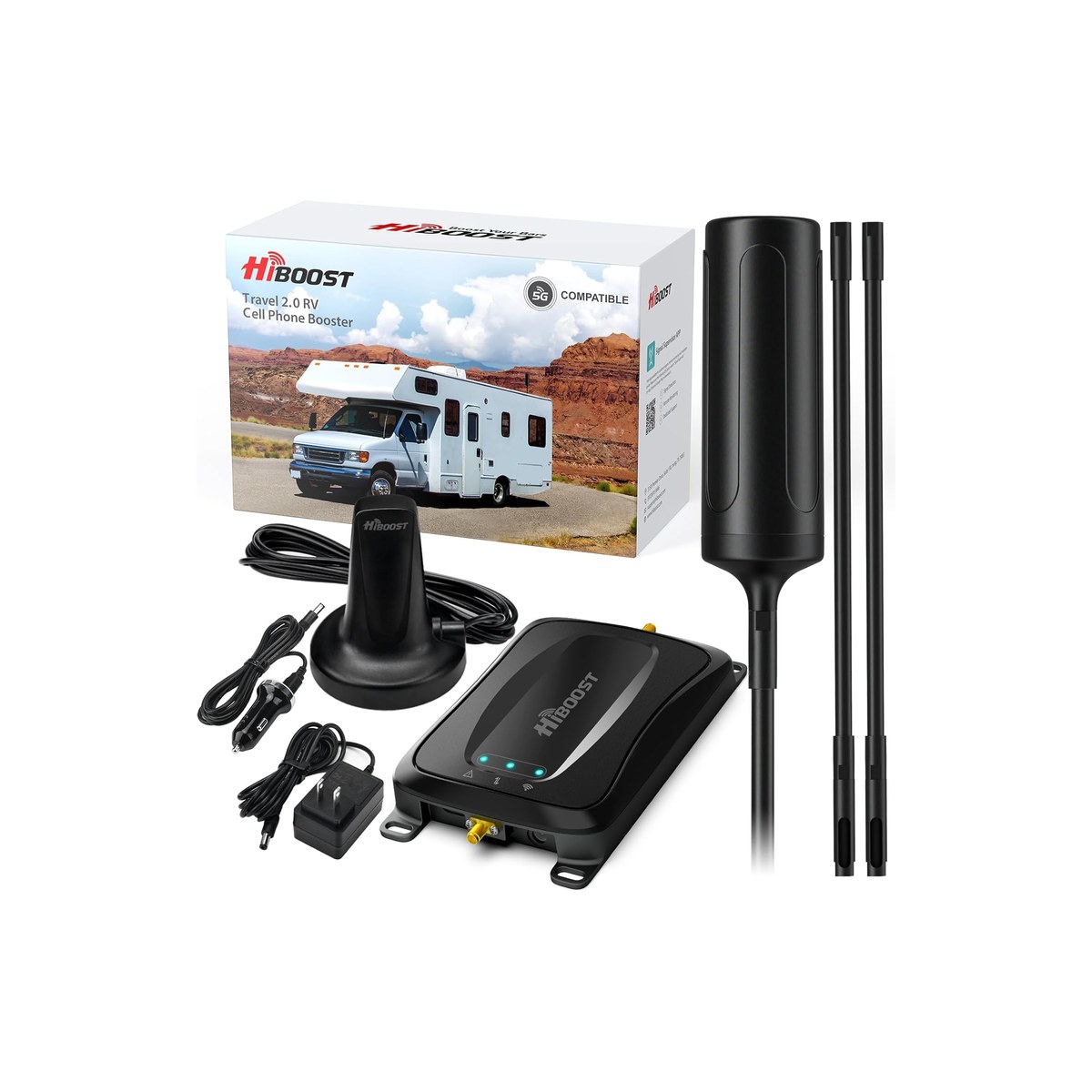
HiBoost RV Cell Phone Signal Booster, Travel 2.0 RV Booster Kit, Boosts 4G and 5G LTE for All US Carriers, FCC Approved (ASIN B0DF7SYLWS)
The cheapest name-brand RV booster here, with a signal-monitoring app.
Who it's for: The budget-conscious traveler who wants a real, FCC-certified RV booster from a known brand without paying weBoost flagship money, and who likes the idea of a phone app that shows signal strength while aiming the antenna. The HiBoost Travel 2.0 RV is the value entry point, a full 50 dB mobile kit at $400, $150 under the Drive Reach, with a three-year warranty behind it.
What we found: It delivers the same 50 dB mobile gain and all-carrier support as the pricier kits, at 3.9 stars across 220 reviews, and its Signal Supervisor app is a genuinely useful touch, it reads signal in real time over Bluetooth so you can position the outside antenna for the best result instead of guessing. The honest gap is uplink power: at roughly 24 dBm it trails the 29.5 dBm weBoost Drive Reach and the SureCall, which shows at campsites where the tower is five to ten miles out. For moderate fringe it holds its own.
Bottom line: Buy the HiBoost Travel 2.0 RV if you want a legitimate, warrantied RV booster at the lowest name-brand price and you mostly travel where signal is weak rather than nearly gone. If you regularly camp at the deep fringe, the extra uplink of the Drive Reach or the Drive X is worth the step up. Skip the no-name sub-$200 boosters entirely, the savings are not real once the FCC gets involved.
- + The cheapest name-brand RV booster here at $400, $150 under the Drive Reach, with a three-year warranty behind it
- + Full 50 dB mobile gain and all-carrier support, the same ceiling as the pricier mobile kits, at 3.9 stars across 220 reviews
- + A Signal Supervisor app reads signal strength in real time over Bluetooth, so you position the outside antenna by data instead of guessing
- × Uplink power is about 24 dBm, below the 29.5 dBm weBoost Drive Reach and the SureCall, which shows when the tower is far out
- × Made by Huaptec, a less familiar name than weBoost in the US, with a thinner field-test record among the RV authorities
- × A mid-tier choice, not the strongest puller of fringe signal, where the extra weBoost uplink earns its premium
Also worth considering.
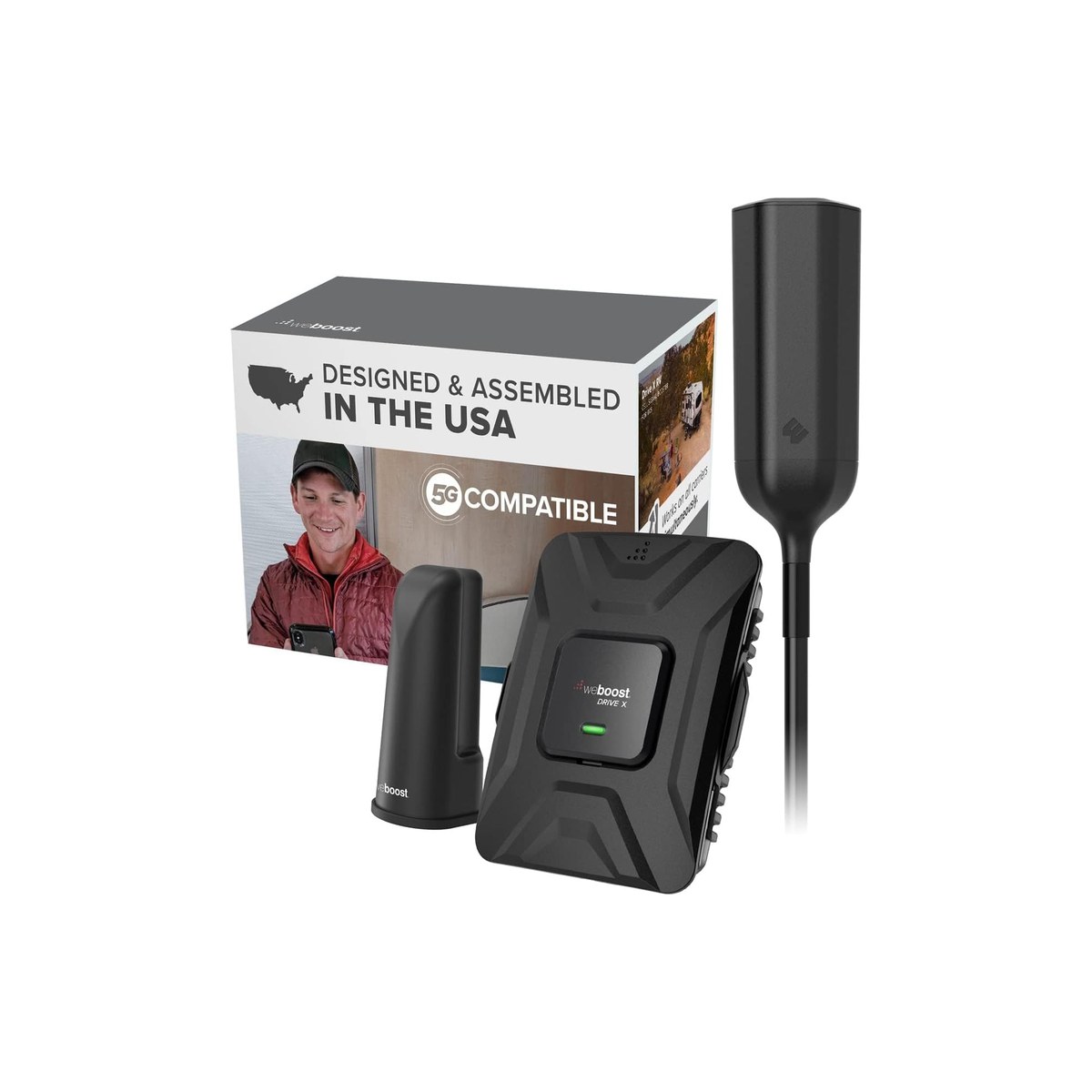
weBoost Drive X RV Cell Phone Signal Booster Kit, Boosts 5G and 4G LTE for All US and Canadian Carriers, FCC Approved, Made in USA (model 471410, ASIN B07TYGJ9TV)
The most-reviewed booster here: weBoost quality for a hundred less.
Who it's for: The mobile RVer who wants a weBoost but not the flagship's price, and values a long track record over the last few decibels of uplink. The weBoost Drive X RV is the value workhorse, the same 50 dB mobile gain and all-carrier, all-Canadian support as the Drive Reach, in the most-reviewed booster in this guide by a wide margin.
What we found: It is the proven volume seller, 4.0 stars across more than 1,000 reviews at $450, the deepest record here and a higher rating than the newer Drive Reach RV II has yet earned. It gives up uplink power to the Reach, weBoost rates the Reach's uplink meaningfully higher, which is the one reason to pay up if you live at the fringe. For most travelers in ordinary weak-signal areas the Drive X does the same job and costs $100 less.
Bottom line: Buy the Drive X RV if you want weBoost's reliability and the reassurance of a thousand-plus reviews, and your travels are mostly in moderate rather than extreme fringe. Step up to the Drive Reach only if you regularly push into one-bar country where its stronger uplink earns the extra $100. It is the value pick of the mobile boosters here.
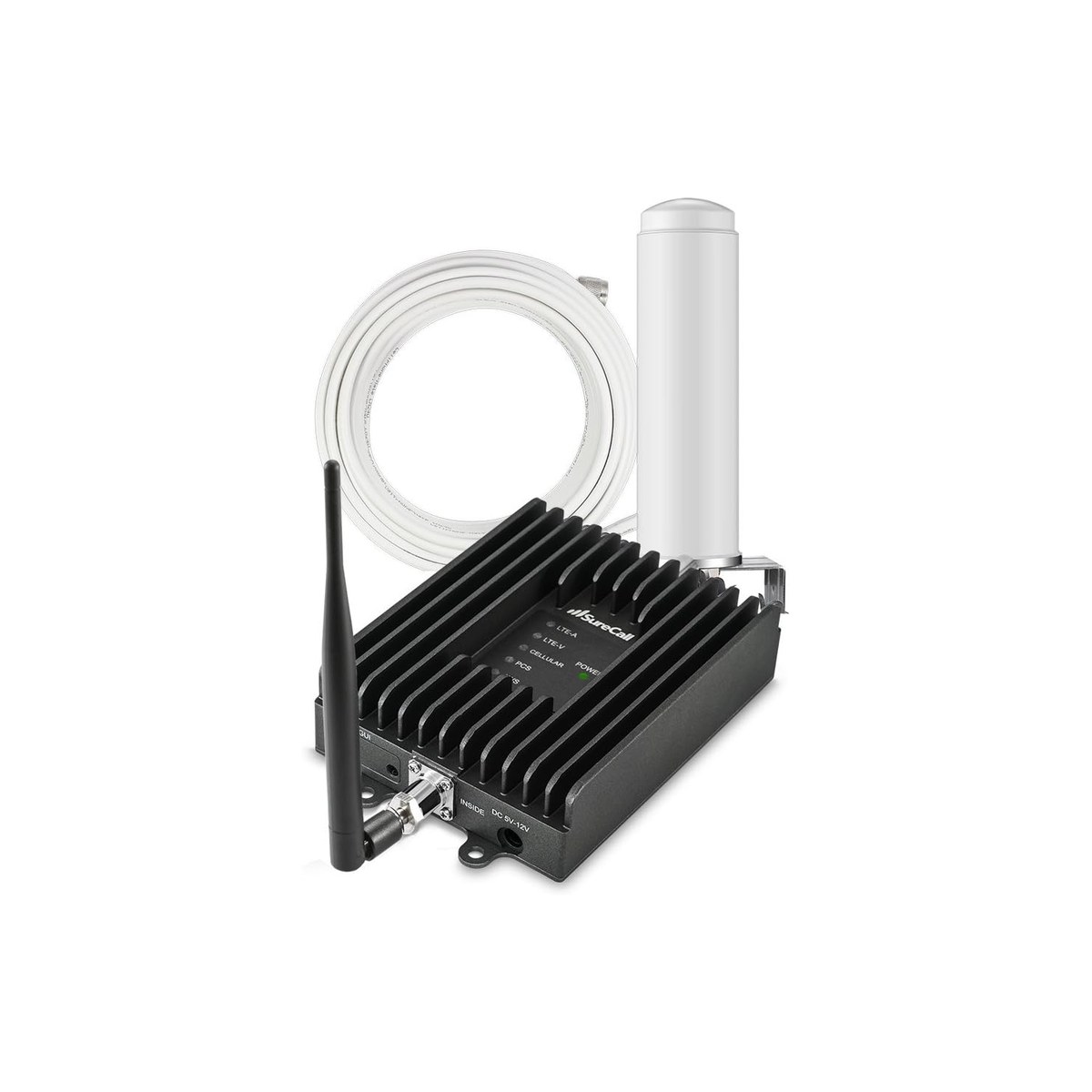
SureCall Fusion2Go 3.0 RV Cell Signal Booster for Motorhome, 5G and 4G LTE, Permanent Omni Antenna, All Carriers, FCC Approved (ASIN B079TKZN1B)
The weBoost alternative, with a longer warranty and return window.
Who it's for: The RVer who wants an alternative to weBoost's near-monopoly and values a longer warranty and return window over the category leader's deeper reviews. The SureCall Fusion2Go 3.0 RV is the main competitor, a 50 dB all-carrier mobile kit with a permanent omni antenna built for motorhomes, backed by SureCall's three-year warranty and sixty-day returns, both longer than weBoost's.
What we found: It matches the mobile picks on the spec sheet, 50 dB gain, all carriers, 5G and 4G LTE, but at 3.5 stars across 154 reviews it is the lowest-rated booster in this guide, and the RV-internet authorities we read described its 3.0 generation as a touch underwhelming next to weBoost. The warranty and return window are the real reasons to choose it: three years and sixty days, against weBoost's two years and thirty days. The newer Fusion2Go XR exists but is vehicle-framed and barely reviewed.
Bottom line: Buy the Fusion2Go 3.0 RV if you specifically want a non-weBoost booster and the longer warranty and return window matter more to you than the rating gap. For most buyers the weBoost Drive X RV is the safer call at the same price, with far more reviews and a higher score. Treat the 3.5-star rating as the category's honest baseline, not a defect unique to SureCall.
Skip this guide if...
Skip a cell booster entirely if you camp where coverage is already solid, it does nothing useful when you already have three or four bars, and it can even slow your data by collapsing a multi-path signal into one amplified channel. Skip it too if your goal is faster internet rather than a more reliable connection, because a roof-mounted MIMO antenna on a cellular router beats a booster for raw data most of the time. And no booster of any kind helps in a true dead zone with zero signal, that is a job for Starlink, covered in our RV internet guide.
Don't bother with.
- × Skip No-name boosters under $200 that claim FCC certificationThe cheapest 'cell boosters' on Amazon, a rotating cast of unknown brands, list themselves as FCC-certified while cross-referencing as unauthorized. An uncertified booster can interfere with the cell network, a carrier can force it off, and FCC fines for serious violations run past $100,000. The FCC has separately gone after Amazon over illegal signal jammers, a different and entirely banned device, not the same thing as a booster. The tell is simple: a legitimate booster from weBoost, SureCall, HiBoost, or Nextivity costs $400 or more, and anything far under that from an unfamiliar brand is the one to avoid.
- × Skip Signal booster 'stickers' and stick-on antennasThe little adhesive films sold as cell signal boosters do absolutely nothing, they are a decades-old scam that predates smartphones, and no version of them has ever worked. A real booster is an amplifier with an outside antenna, a powered box, and an inside antenna, it cannot be a passive sticker behind your phone case. If a product promises more bars for under $20 with no antenna and no power supply, it is selling you a sticker, not a signal, keep scrolling.
- × Skip Expecting a booster to create signal in a dead zoneA booster amplifies an existing signal, it does not generate one, so in a true dead zone with no measurable signal outside the rig it has nothing to work with and delivers nothing. This is the single biggest source of buyer disappointment and one-star reviews across the whole category. Boosters shine at the fringe, turning a flickering one or two bars into a usable connection, not in the deep backcountry. Where there is genuinely no cell signal, satellite, meaning Starlink, is the only answer, and our RV internet guide covers that route.
- × Skip Buying a booster to make your internet fasterBoosters are marketed for speed, but they help most with voice calls and pulling a usable connection out of a marginal signal, not with raw throughput. Modern 4G and 5G use MIMO, multiple simultaneous data streams, and a booster collapses those into a single amplified channel, so in moderate signal it can actually lower your data speed. The RV mobile-internet authorities found a roof-mounted MIMO antenna on a cellular router beats a booster for data 80 to 90 percent of the time. If speed is the goal and you run a router, price a MIMO antenna first.
- × Skip Counting on a booster for T-Mobile in the deep backcountryT-Mobile's longest-range rural band is Band 71 at 600 MHz, the one that reaches deepest into remote country, and as of 2026 no consumer booster can legally amplify it, only industrial units with carrier pre-approval can. A T-Mobile user buying any consumer booster gets help on their other bands but misses the one giving them coverage at extreme range. If you boondock far out on T-Mobile, do not expect a booster to rescue Band 71, and weigh a Verizon or AT&T line, or Starlink, for those trips.
How we picked.
Sources we read and how we picked
We started from what an RV booster can and cannot do, because half the buying mistake in this category is expecting the wrong thing. We read the FCC's consumer signal booster rules, the RV mobile-internet authorities who test this gear in the field, the manufacturer spec sheets from weBoost, SureCall, and HiBoost, and the owner forums where real fringe-camping results show up. Then we verified every booster live on Amazon on June 16, 2026, price, rating, review count, and whether it is actually in stock and buyable.
Our filter, in order: match the booster to how you camp, mobile if you move, stationary if you park, then weigh gain, uplink power, proof, and price. That order is why the mobile Drive Reach RV II leads for most travelers while the higher-gain Destination RV wins for a parked rig, and why we score on fit rather than raw specs. We state every rating plainly, including the soft ones, because this whole category rates 3.5 to 4.0 stars, the honest reflection of a tool that helps at the fringe and disappoints anyone expecting it to manufacture coverage.
How a cell booster actually works, and when it helps
Every booster is three parts: an outside antenna that captures the weak signal, a powered amplifier box, and an inside antenna that rebroadcasts the boosted signal in the rig. It works in both directions, strengthening what the tower sends you and what your phone sends back, which is why a good one improves calls and uploads as much as downloads. Any device on a supported carrier benefits automatically, no pairing, and the outside and inside antennas must sit far enough apart, usually a foot or two, or the booster detects feedback and shuts itself off, behavior owners sometimes mistake for a defect.
Gain, measured in decibels, is the amplification: 50 dB is a hundred-thousandfold boost on paper, but real-world gains are modest and logarithmic, the felt result is one bar becoming three, or data that finally loads. The sweet spot is the fringe, one or two existing bars turned usable. The honest counterpoint, repeated by every authority we read, is that for raw data a roof MIMO antenna on a cellular router usually beats a booster, because it preserves the multiple signal paths 4G and 5G rely on while a booster funnels everything through one. Many serious boondockers eventually run both.
Mobile versus stationary: the call that picks your booster
The first real fork is whether you boost on the move or only when parked. Mobile boosters, the Drive Reach, Drive X, HiBoost, and SureCall here, use an omnidirectional roof antenna that works at any heading, so they boost while you drive and while you camp, with a one-time install. The FCC caps them at 50 dB of gain because a moving vehicle creates dynamic interference risk. For the majority of RVers who travel and want signal everywhere, a mobile booster is the right tool, and the differences among them come down to uplink power, price, and proof.
Stationary boosters, the Destination RV here, are legal up to 65 dB because a parked rig is predictable, and that extra fifteen decibels is roughly thirty times more signal power, a real difference when the tower is far. The cost is a directional antenna you aim at the nearest tower and set up at each site, so it only suits rigs that stay put for days or weeks. The high-end single-carrier option, Cel-Fi's GO X, uses a smart digital design to push past 50 dB in motion, but it boosts one carrier at a time and is intermittently stocked on Amazon, so we left it off the scored list.
The FCC rules, carrier registration, and what makes a booster legal
Consumer signal boosters are governed by FCC Part 20, Subpart O, in force since 2014. A legal booster must be FCC-certified, must include automatic features that detect feedback and back off near strong towers, and must respect the gain caps, 50 dB mobile, up to 65 to 72 dB fixed depending on the band. Every booster in this guide meets that bar. The uncertified no-name units flooding Amazon do not, and a sub-$200 mystery brand is a false economy: it can interfere with the network, a carrier can force it off, and FCC fines for serious violations run past $100,000. The FCC has also gone after Amazon over illegal signal jammers, a separate and entirely banned device, not to be confused with a certified booster.
The step almost nobody takes is registration. The law requires you to register a consumer booster with your carrier before use, but it is free, takes about five minutes online, and the carriers have given blanket consent, it is a notification, not an approval. AT&T, Verizon, T-Mobile, and US Cellular all have registration pages. One more limit worth knowing: consumer boosters cover 4G and 5G only on the legacy certified bands, the 700 MHz, 850, AWS, and 1900 ranges, and they do not reach mid-band C-band 5G or T-Mobile's Band 71 at 600 MHz, which sits below the certified band floor. Band 71 is T-Mobile's main rural band, so a T-Mobile user in the deep backcountry should plan around that gap.
FAQs.
Q01 Do cell phone boosters actually work for an RV?
+
Q02 What is the difference between a mobile and a stationary RV booster?
+
Q03 Do I have to register my cell booster, and is it legal?
+
Q04 Will a booster work where I have no signal at all?
+
Q05 weBoost or SureCall for an RV?
+
Q06 How much gain (dB) do I need for an RV cell booster?
+
If you, then this.
- IF you move often and want signal both driving and parkedGET weBoost Drive Reach RV II (B0DC7Q4XW1; mobile flagship, strongest uplink, all US carriers)$549.99 →
- IF you want a proven weBoost for a hundred dollars lessGET weBoost Drive X RV (B07TYGJ9TV; same 50 dB, most-reviewed booster here at 1,011)$449.99 →
- IF you park in one place for days or weeks at a timeGET weBoost Destination RV (B08WTRVG61; 65 dB stationary gain, directional antenna)$649.99 →
- IF you want the cheapest name-brand booster with a signal appGET HiBoost Travel 2.0 RV (B0DF7SYLWS; full 50 dB, Signal Supervisor app, 3-year warranty)$399.99 →
- IF you want a longer warranty and a non-weBoost optionGET SureCall Fusion2Go 3.0 RV (B079TKZN1B; 3-year warranty, 60-day returns, all carriers)$449.99 →
- IF you stick to one carrier and camp at the extreme fringeGET Cel-Fi GO X (single-carrier smart booster, 65 dB in motion; stock on Amazon is intermittent, see the rules above)varies →
- IF your spots have no cell signal at allGET not a booster: Starlink is the only thing that reaches a true dead zone, see our RV internet guidevaries →
RV & Van Gear: The Complete Guide
The whole-rig picture →Every system in a van, RV, or camper, organized in one place, with the safety and weight floor and the one guide we trust for each.
- Consumer Signal Boosters: rules, gain limits, and the carrier registration requirement · FCC
- 47 CFR 20.21: the statutory text governing signal boosters · eCFR
- Mobile Cellular Boosters Guide: MIMO-vs-booster testing and the T-Mobile Band 71 limit · Mobile Internet Resource Center
- weBoost Destination RV vs Drive Reach RV: gain and installation compared · WilsonAmplifiers
- Illegal boosters on Amazon put customers and networks at risk · Waveform