Best RV Inverters: 5 Pure Sine Wave Picks, Sized and Wired Right (2026)
An RV inverter turns your 12-volt battery bank into household power, and the wattage on the box is only half the decision. A microwave that says 1000 watts on the door draws about 1,550 watts from the wall, so 2000 watts is the van default. The other half is the wiring: a 2000-watt inverter at 12 volts pulls around 200 amps, finger-thick cable, with a fuse that exists to protect the wire, not the inverter. We read the manufacturer datasheets and install manuals, the engineering guides van builders actually wire from, and the owner forums, then verified every price and listing claim live on Amazon on June 12, 2026. The honest headlines: pure sine wave is the floor in 2026, idle draw can eat half a 100Ah battery in a day, and the spec sheets that publish the fewest numbers belong to the brands the forums trust least.
- 01 Renogy P2 2000W (B07H9SXV61) , top pick, the van-default size, UL 458 on the listing, ~$286
- 02 Giandel 2000W (B0DPLWKS7L) , best value 2000W, GFCI outlets, stated surge duration, ~$269
- 03 Renogy P2 3000W (B096MKPQ1M) , best 3000W, needs a 400Ah-class bank and 4/0-class cable, ~$360
- 04 Renogy 1000W (B07JMQ27WJ) , best small rig, CPAP and laptops, ~$176
- 05 Victron MultiPlus-II 12/3000 (B0BZV91KW4) , the inverter-charger gold standard, ~$890, thin Amazon listing
How they compare.
| Rank | Product | Best for | Price | Our score |
|---|---|---|---|---|
| 01 | Renogy P2 2000W (B07H9SXV61)
Top Pick
| best overall, the van-default 2000W, UL 458 claim on the listing | $285.99
Buy → | 9.0/10 |
| 02 | Giandel 2000W (B0DPLWKS7L) | best value 2000W, battery-monitor remote, the only on-listing surge duration | $268.82
Buy → | 8.7/10 |
| 03 | Renogy P2 3000W (B096MKPQ1M) | best 3000W, for 400Ah-plus banks and hardwired panels | $359.99
Buy → | 8.6/10 |
| 04 | Renogy 1000W (B07JMQ27WJ) | best small rig, CPAP and laptop loads, smaller fuse and idle draw | $175.99
Buy → | 8.5/10 |
| 05 | Victron MultiPlus-II 12/3000 (B0BZV91KW4) | best inverter-charger, shore-power rigs, dealer-channel reality | $890.35
Buy → | 8.4/10 |
Prices are current Amazon prices at time of publication and can change. Scores reflect our editorial evaluation, not vendor input.
Our #1 pick: Renogy Inverter P2 2000W Pure Sine Wave, 12V DC to 120V AC, UL 458 and CSA Certified per Listing, Hardwire Port, 16.4-ft Wired Remote (ASIN B07H9SXV61).
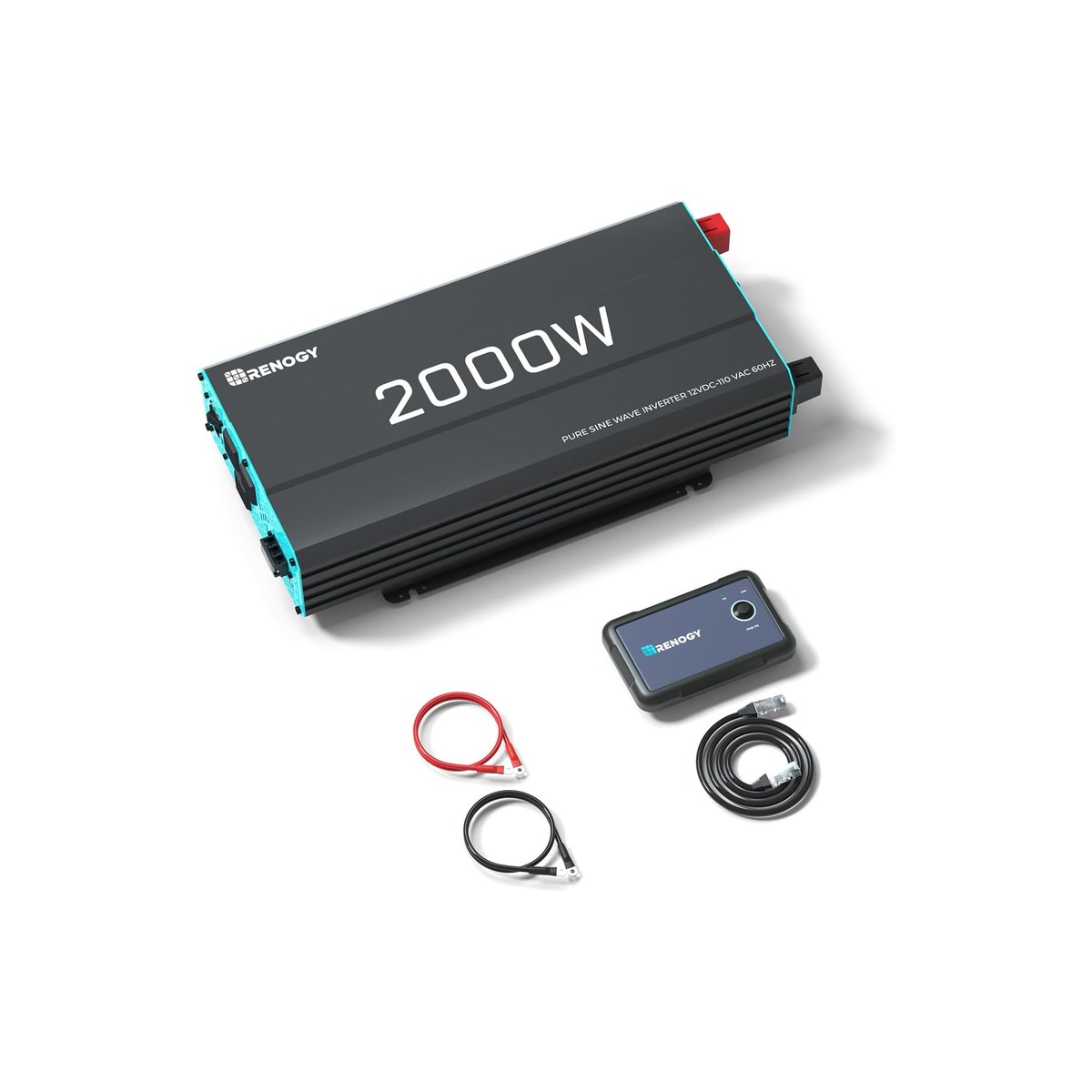
Renogy Inverter P2 2000W Pure Sine Wave, 12V DC to 120V AC, UL 458 and CSA Certified per Listing, Hardwire Port, 16.4-ft Wired Remote (ASIN B07H9SXV61)
The van-default 2000 watts, with the deepest proof in class.
Who it's for: The van or trailer owner whose 120-volt life is the 2000-watt class: a countertop microwave, a single induction burner, a coffee maker, one at a time, on a 200Ah or larger lithium bank. This is the default inverter size for a reason, and the Renogy P2 is the default unit: UL 458 certified per its listing and supported by the deepest review history in the class.
What we found: The P2 2000W is the most-proven pure sine wave inverter in the lineup, 4.4 stars across more than 2,000 ratings, Amazon-fulfilled, and its UL 458 and CSA certification claim sits right on the listing, which is rarer than it should be. It ships with a 16-foot wired remote, a hardwire port, and a built-in GFCI, and Renogy's credibility here is structural: its inverter manuals are hosted on Forest River's own site as factory component documents. The honest catches: no-load draw is specced under 2 amps, roughly 25 watts, the listing prints no surge duration, and owners report failed remotes with no replacements sold.
Bottom line: Buy the Renogy P2 2000W as the van-default inverter and wire it right: 2/0 cable, a 300-amp class fuse, mounted close to the battery, with the manual's own table as the final word. Use the remote to kill it when you are not drawing, because idle draw is the silent battery killer. Step down to the Giandel to save a little and gain GFCI outlets, or up only if your bank can feed 3000 watts.
- + UL 458 and CSA certification claim sits right on the listing, with 4.4 stars across more than 2,000 ratings, Amazon-fulfilled
- + Renogy's credibility is structural: its inverter manuals ship as factory component documents in Forest River rigs
- + Hardwire port plus a 16-foot wired remote, so it installs clean under a bed or seat base and shuts off from the cab
- × No-load draw is specced under 2 amps, roughly 25 watts, enough to eat half a 100Ah battery in a day, so use the remote
- × Owners report failed remotes and Renogy does not sell replacements, the recurring complaint in the review history
- × The listing prints no surge duration, the manual is where the spec lives (4000 watts at two seconds), a pattern across the Renogy line
Runner-up: Giandel 2000W Pure Sine Wave Power Inverter, 12V DC to 120V AC, GFCI Outlets, USB-C, 15-ft Remote with Battery Monitor, 4100W Surge for 2 Seconds (ASIN B0DPLWKS7L).
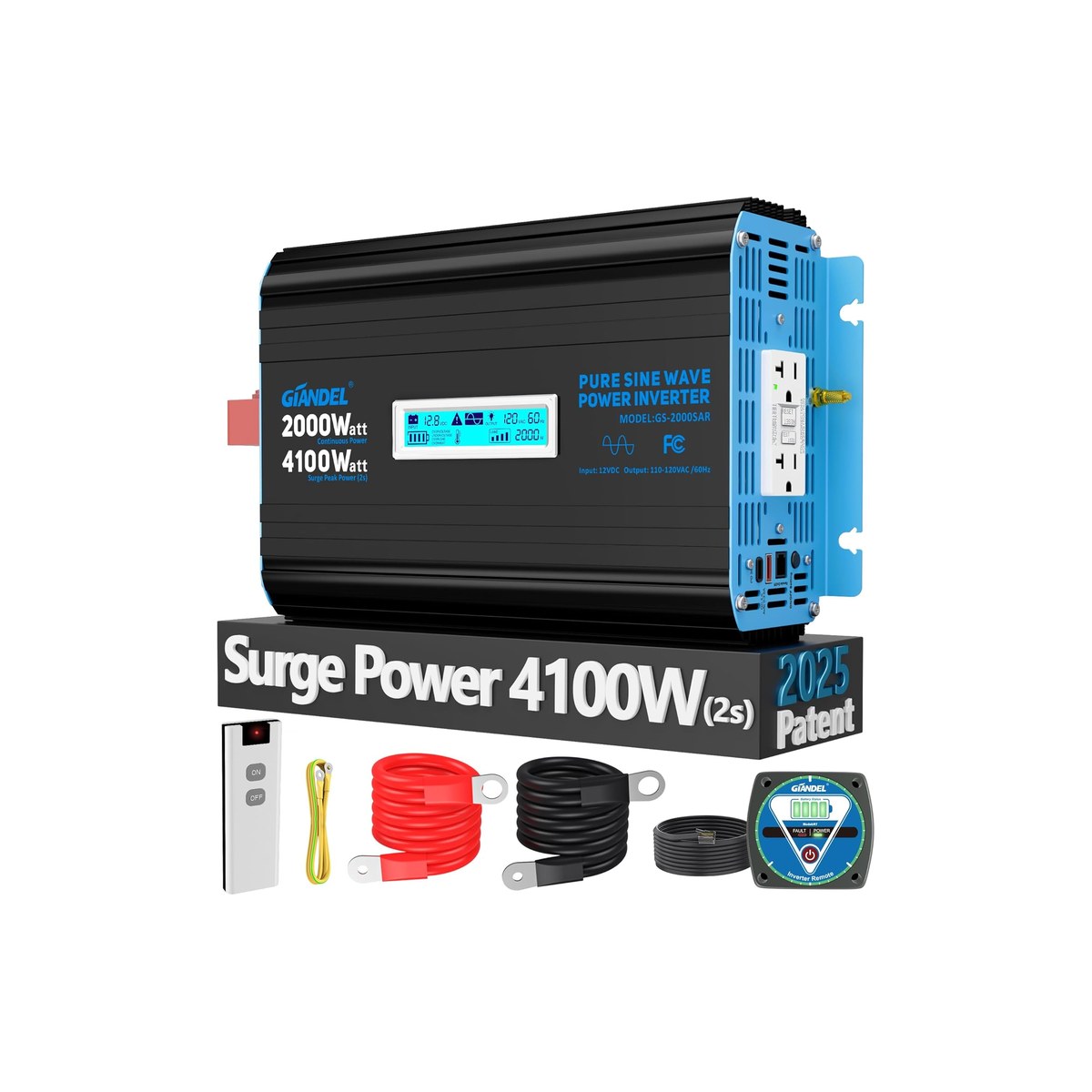
Giandel 2000W Pure Sine Wave Power Inverter, 12V DC to 120V AC, GFCI Outlets, USB-C, 15-ft Remote with Battery Monitor, 4100W Surge for 2 Seconds (ASIN B0DPLWKS7L)
GFCI outlets and the only surge rating with a stated duration.
Who it's for: The budget-conscious builder who wants the 2000-watt class for less and likes specs you can read before buying: the Giandel listing states its surge rating with a duration, 4100 watts for two seconds, where most listings print a bare peak number. This is the DIY solar forum's budget consensus pick, and it suits the owner who plugs loads into outlets rather than hardwiring a distribution panel, and who likes a battery voltage readout on the remote.
What we found: The Giandel 2000W is the honest-spec budget unit: 4.5 stars across 735 ratings at about $269, sold by Giandel and shipped from Amazon, with a 15-foot wired remote that doubles as a battery monitor and a USB-C port. It is the only listing in this guide that states a surge duration, and its GFCI outlets carry the UL 458 reference. Read that claim precisely, though: the listing certifies components, the GFCI outlets and internal parts, to UL standards, not the whole unit the way Renogy's listing does. For an outlet-fed rig that distinction is modest; for a hardwired build, it tips the scale to Renogy.
Bottom line: Choose the Giandel if your loads plug into outlets and you want GFCI protection, a real surge spec, and a battery readout for about $17 less than the Renogy. It is the best value in the 2000-watt class and the unit we would put in an outlet-fed weekender. Choose the Renogy for a hardwired build, the whole-unit certification claim, and the deeper track record. Either way, the wiring budget is the same: 2/0 cable and a 300-amp class fuse, per your unit's manual.
- + The only listing in this guide that states a surge duration: 4100 watts for two seconds, an honesty signal in a category of bare peak numbers
- + GFCI-protected outlets plus a USB-C port, and a 15-foot wired remote that doubles as a battery voltage monitor
- + 4.5 stars across 735 ratings at about $269, the DIY solar forum's budget consensus pick
- × The UL 458 reference on the listing covers components, the GFCI outlets and internal parts, not the whole unit the way Renogy's claim reads
- × No published no-load draw on the listing; owners report around 2 amps, so the same leave-it-off discipline applies
- × Outlet-first design: fine for plug-in loads, less tidy than the Renogy for a hardwired distribution panel
Budget pick: Renogy Inverter P2 3000W Pure Sine Wave, 12V DC to 120V AC, UL 458 and CSA Certified per Listing, Wired Remote, for 400Ah-Plus Banks (ASIN B096MKPQ1M).
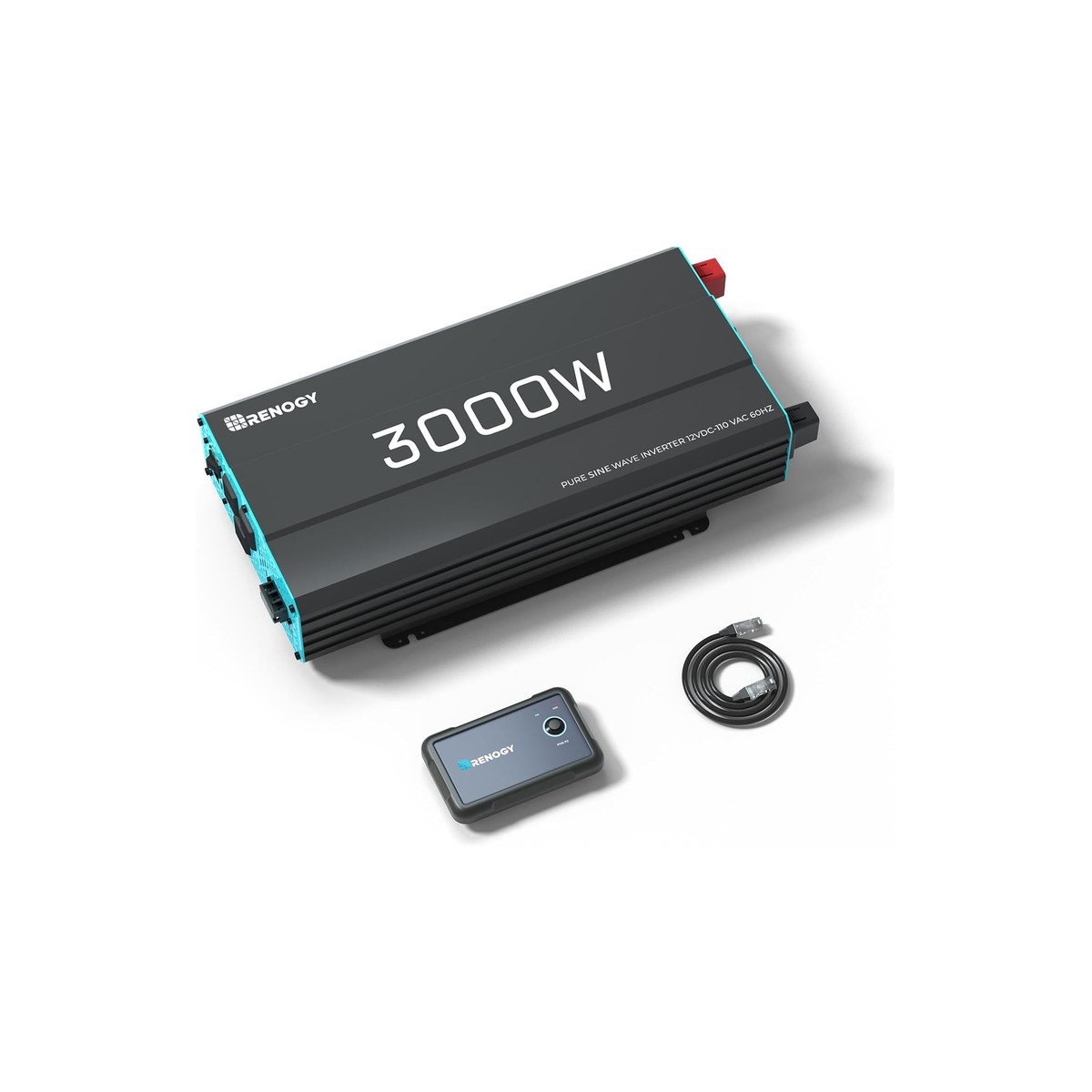
Renogy Inverter P2 3000W Pure Sine Wave, 12V DC to 120V AC, UL 458 and CSA Certified per Listing, Wired Remote, for 400Ah-Plus Banks (ASIN B096MKPQ1M)
Real 3000-watt capacity, if your battery bank can feed it.
Who it's for: The bigger rig that genuinely needs more than 2000 watts, two significant loads at once, or a hardwired panel feeding several circuits, and that has the battery bank to back it: think 400Ah of lithium and up. At 12 volts a 3000-watt inverter pulls roughly 250 amps, so this pick is for the builder ready to buy 4/0-class cable and a 400-amp fuse, not for upgrading a single-battery weekender.
What we found: The Renogy P2 3000W carries the same on-listing UL 458 and CSA certification as its 2000-watt sibling, with 4.3 stars across more than 1,000 ratings at about $360, the cheapest credible 3000-watt unit we verified. The 6000-watt peak surge has no stated duration, the no-load draw is specced under 2.5 amps, roughly 32 watts, and the wired remote is the same failure-prone design. The bigger truth is around the unit: at this size, 12 volts is the ceiling, and a bank under 400Ah will hit its BMS limit before the inverter breaks a sweat. A single 100Ah lithium with a 100-amp BMS tops out near 1,280 watts at the battery terminals, whatever the inverter promises.
Bottom line: Buy the P2 3000W only when your loads and your bank both justify it, and budget the wiring like the safety system it is: the cable and fuse for 250 amps cost real money, and your inverter manual's table overrides any chart on the internet, including ours. If you are sizing up just for the rooftop air conditioner, read our methodology first, a soft start changes that math. Otherwise the 2000-watt picks serve most rigs better for less.
- + The cheapest credible 3000-watt unit we verified, with the same on-listing UL 458 and CSA certification claim as its 2000-watt sibling
- + 4.3 stars across more than 1,000 ratings, Amazon-fulfilled, with the hardwire port and wired remote of the P2 platform
- + Real headroom for a microwave plus a second load, or a small hardwired 120-volt distribution panel
- × The battery bank gates everything: under roughly 400Ah of lithium, the BMS quits before the inverter does
- × Roughly 250 amps at full load means 4/0-class cable and a 400-amp-class fuse, a wiring bill that surprises people
- × 6000-watt peak surge with no stated duration, no-load draw specced under 2.5 amps, and the same failure-prone remote design
Also worth considering.
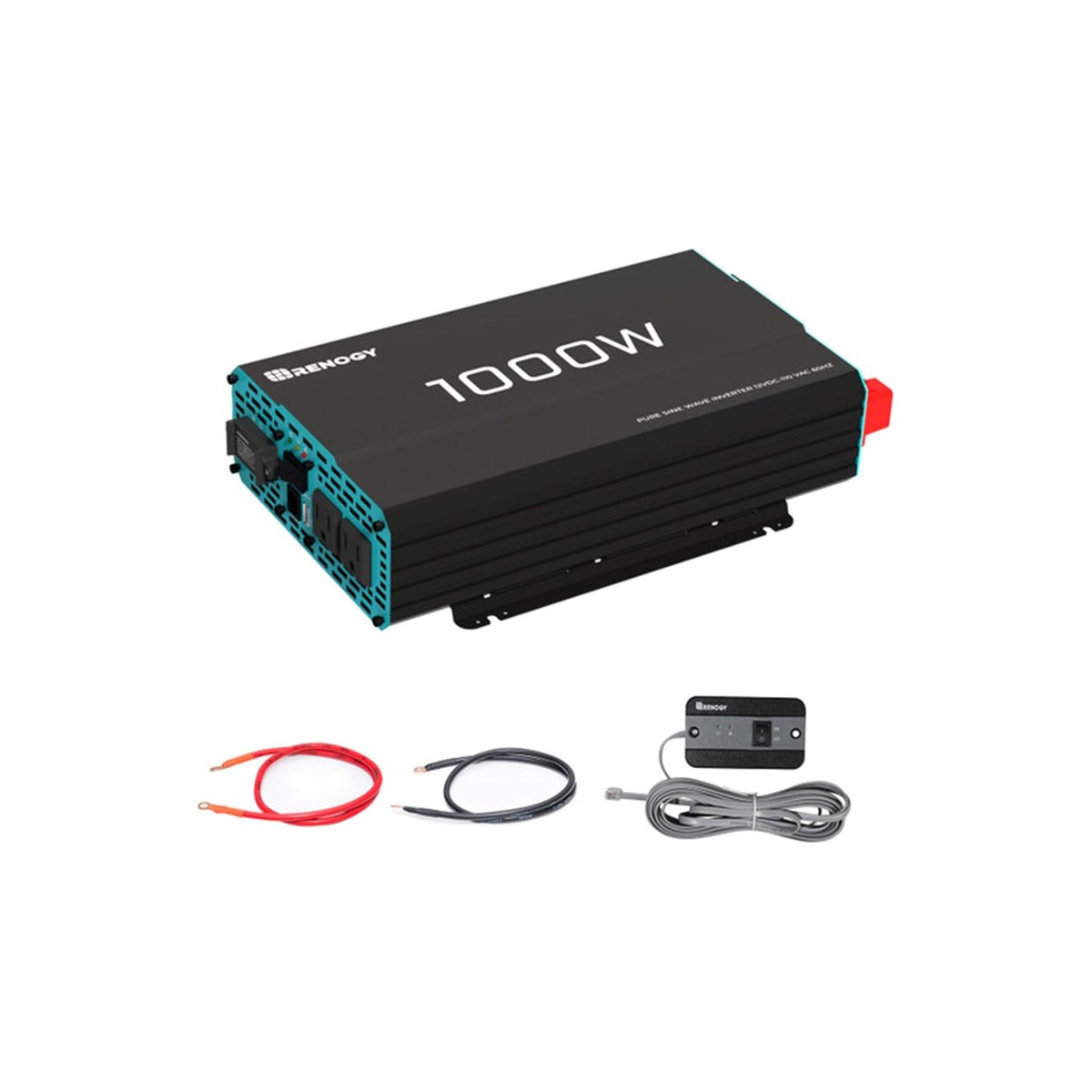
Renogy 1000W Pure Sine Wave Inverter, 12V DC to 120V AC, UL 458 and CSA Certified per Listing, Hardwire Port, Wired Remote (ASIN B07JMQ27WJ)
The right size for CPAP, laptops, and small rigs.
Who it's for: The small rig or weekender whose 120-volt needs are honest: a CPAP, laptop bricks, a blender, camera batteries, nothing with a heating element. A 1000-watt pure sine wave inverter covers all of that with margin, weighs about half of what the 2000-watt class does, and costs about $110 less. It is also the right answer for the buyer tempted to oversize, because idle draw and fuse sizing scale with the inverter, not with your actual loads.
What we found: The Renogy 1000W is the same P2 platform scaled down: pure sine wave, the UL 458 and CSA claim on the listing, the 16-foot wired remote, a hardwire port, and 4.5 stars across more than 1,000 ratings at about $176, Amazon-fulfilled. For CPAP users it clears ResMed's pure sine guidance with room to spare, though heated humidifiers deserve a check against your machine's battery guide first. The 2000-watt peak surge carries no stated duration, and the remote caveat applies across the Renogy line. Wiring is only slightly friendlier: AltE's table still calls for 2/0 cable at 12 volts, with the fuse dropping to 200 amps, so do not assume savings on copper.
Bottom line: Buy the 1000-watt Renogy if your loads list has no heating elements on it, and enjoy the savings in price, weight, and idle draw. It is the honest size for a CPAP-and-laptops rig, and undersizing on purpose is the cheapest reliability upgrade in this category. Step up to the 2000-watt class the day a microwave or induction burner joins the build, because no 1000-watt unit starts those.
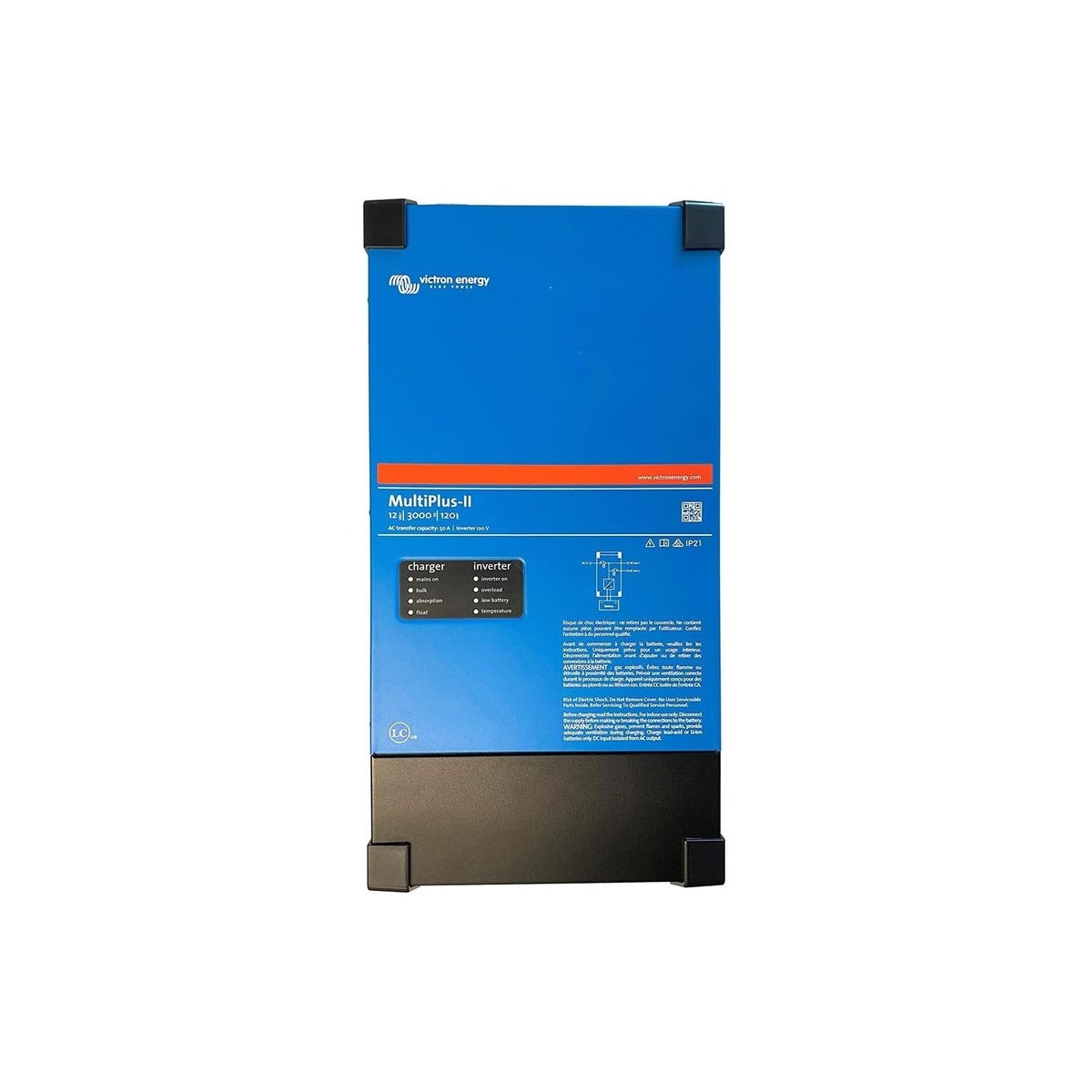
Victron Energy MultiPlus-II 12/3000/120-50 Inverter-Charger, UL-Certified, 50A Transfer Switch, 120A Charger, Single 120V (ASIN B0BZV91KW4)
The forum gold standard, if you see shore power regularly.
Who it's for: The rig that sees shore power regularly and wants one box to do three jobs: a true sine inverter, a 120-amp charger, and a 50-amp transfer switch that flips between shore and battery in under 20 milliseconds. This is the unit van-build engineering guides design whole systems around, for the owner who values configurability and a support ecosystem over the lowest price, and who accepts dealer-channel buying as part of the deal.
What we found: The MultiPlus-II 12/3000 is the forum gold standard: Victron publishes the numbers others hide, 2400 watts continuous at 25 degrees Celsius with honest derating curves, a 5500-watt peak, and idle figures the budget brands never print. The $890 Amazon listing is sold by Inverters-R-US, an authorized Victron distributor, credible, but it carries just 30 ratings, and this is the single-120-volt model: it feeds one 120-volt leg and cannot power both sides of a 50-amp rig's 120/240-volt panel. Its manual is equally direct about what it expects: a recommended 400 to 1200Ah bank, doubled 1/0 AWG cable per polarity on short runs, and a 400-amp fuse. Configuration lives in VictronConnect; the remote panel costs extra.
Bottom line: Buy the MultiPlus-II if your rig lives part-time on shore power and you want the charger, transfer switch, and inverter engineered as one system. The thin Amazon review count reflects where Victron actually sells, through dealers, and the dealer network is the normal buying path if the listing runs dry. Skip it for pure boondocking: our DC-DC and solar guides cover that charging path, and a $286 inverter does the rest for two-thirds less.
Skip this guide if...
Skip this guide if your rig lives on shore power and your factory converter already covers you, or if every load you own runs on 12 volts and USB, in which case you need a bigger battery, not an inverter. Skip it too if you do not want to run 200-amp cable at all: a portable power station is an inverter, battery, and wiring in one sealed box, and our power station guide covers that path. An inverter earns its place when you have a house bank, real 120-volt loads, and the willingness to wire it like the 200-amp circuit it is.
Don't bother with.
- × Skip A modified sine wave inverter in 2026Modified sine units are cheap and often carry legitimate-looking safety stamps, the Krieger KR2000 is ETL approved and clearly labeled modified sine wave, but the waveform is the problem, not the safety testing. Induction cooktops simply will not run on modified sine, microwaves run weak and erratic on it, and ResMed's guidance for CPAP humidifiers requires pure sine wave. A certification stamp does not mean pure sine: read the waveform line on the listing before anything else, because for a 2026 rig full of electronics, pure sine is the floor.
- × Skip A 3000-watt inverter on a single 100Ah batteryThe battery bank gates the inverter, not the other way around. A single 100Ah lithium with a 100-amp BMS can deliver roughly 1,280 watts before the BMS disconnects, no matter what the inverter is rated for, which is exactly the new-inverter-keeps-shutting-off complaint that fills the forums. Victron's own manual recommends a 400 to 1200Ah bank for its 3000VA unit. Size the bank first, then the inverter: a 2000-watt unit on 200Ah-plus is the balanced default, and our RV lithium battery guide covers the bank side.
- × Skip Trusting a surge rating with no durationEvery spec sheet brags about peak watts, but a surge number without a stated duration is marketing, not engineering. Victron publishes continuous ratings at three temperatures plus a peak; Giandel states 4100 watts for two seconds; most budget listings print a doubled number and go quiet. The pattern we kept finding: the brands that publish the fewest numbers, no surge duration, no idle draw, no temperature derating, are the same ones the forums report failing under motor loads. Treat missing numbers as the spec, because in this category, silence is data.
- × Skip Skipping or undersizing the wiringAt 12 volts, a 2000-watt inverter pulls around 200 amps, which means 2/0 cable and a 300-amp-class fuse per the published van-wiring diagrams, and a 3000-watt unit steps up to 4/0-class cable and a 400-amp fuse per Victron's manual. That kit costs real money, and it is not optional: the fuse exists to protect the cable from overheating, not to protect the inverter. Undersized cable does not trip anything, it just gets hot. Mount the inverter close to the battery, run the 120-volt side long, and follow your manual's table over any chart online.
- × Skip Leaving the inverter on around the clockNo-load draw is the silent battery killer: a unit idling at roughly 25 watts burns around 600 watt-hours a day, half a 100Ah battery, powering nothing. Eco and search modes help less than they promise, because their wake thresholds sit above small loads, a CPAP or a fridge thermostat can fail to wake the inverter at all, which is why owners famously defeat eco modes with a light bulb on a timer. The boring fix is the wired remote: switch the inverter off when you are not drawing, and treat published idle numbers as a buying criterion.
How we picked.
Sources we read and how we picked
This category is electrical, so we weighted primary sources: manufacturer datasheets and install manuals from Victron, Renogy, and Xantrex, the published van-wiring diagrams and fuse-sizing guides at EXPLORIST.life, AltE's inverter cable and fuse table, and ResMed's battery and inverter guidance for CPAP loads. We layered the DIY Solar Power Forum and RV owner threads over that for failure patterns, then verified every price, rating, and certification claim live on Amazon on June 12, 2026.
Our filter, in order: pure sine wave only, then certification claims as actually written on the listing, UL 458 is the vehicle standard that matters, then spec-sheet honesty, published idle draw and surge duration, then review depth and seller credibility. That is why three Renogy units anchor the lineup: they are the rare inverters that are Amazon-fulfilled with the UL 458 and CSA claim on the listing and four-digit review counts, and Renogy's inverter manuals are hosted by Forest River as factory component documents. One transparency note: Victron and Xantrex sell mostly through dealers, so their thin Amazon listings understate hardware that engineering guides rate as the class of the field.
Watts, surge, and what your loads actually draw
Size the inverter to input watts, not the number on the appliance. A microwave sold as 1000 watts is rated by cooking power and draws roughly 1,550 watts from the wall, which is why the 2000-watt class is the van default and the 1000-watt class is for rigs with no heating elements: no microwave, no induction, no coffee maker, no hair dryer. A pod machine is in this club too, a Keurig pulls about 1,470 watts on its heating cycle and needs the 2000-watt class, not a 12V socket, which is the inverter our 12V coffee makers guide points pod drinkers back to. Add up your real simultaneous loads, then leave headroom, because continuous ratings themselves shrink with heat: Victron rates its 3000VA unit at 2400 watts continuous at 25 degrees Celsius and less when the install bay runs hot.
Surge is where marketing lives. Motors and compressors draw a multiple of their running watts at startup, and a rooftop RV air conditioner that runs near 1,500 watts can demand several times that for an instant, which is why a bare inverter that should handle it on paper trips instead. A soft-start device cuts that starting demand sharply, by about 70 percent per SoftStartRV, and is the difference between a 3000-watt inverter starting a 13,500 BTU unit or not. For everything else, prefer the spec sheet that states a surge duration over the one that just prints a big number.
The wiring layer: cable, fuse, and the 12-volt ceiling
The inverter is the easy purchase; the wiring is the safety system. At 12 volts, 2000 watts means roughly 200 amps, and the wire gauge follows from that current: the published van-wiring diagrams at EXPLORIST.life spec 2/0 cable with a 300-amp ANL main fuse and a 300-amp MEGA branch fuse for exactly this build. Those gauges assume quality 105-degree-rated marine cable on a short run; cheaper 75-degree cable needs to be heavier still. At 3000 watts, roughly 250 amps, Victron's manual specifies doubled 1/0 AWG cable per polarity, stepping to 2/0 on longer runs, and a 400-amp fuse. The principle underneath, straight from AltE's sizing table: the fuse protects the wire from overheating, not the inverter. Undersized cable does not trip anything. It heats. The same goes for connections: a loose or badly crimped lug is a heater bolted to your battery, so torque every termination to the manual's spec and re-check after the first few hundred miles. Work it all de-energized, pull the main fuse or open the battery switch before touching cables, and keep metal tools clear of the posts, because a wrench across a lithium bank's terminals is a welding event. Check polarity twice before the final connection, reversed cables kill most inverters instantly and the damage is rarely warrantied. Mount the inverter as close to the battery as ventilation allows, off carpet and away from anything that burns, run the 120-volt side long instead, and treat your unit's manual as the final authority over every chart, including this one. If any of this paragraph is unfamiliar, have the install done, or at least inspected, by someone who does it for a living.
Two more gates before you buy big. First, the battery bank: BMS current limits cap what an inverter can pull, a single 100Ah lithium with a 100-amp BMS tops out near 1,280 watts at the battery terminals, closer to 1,100 usable after inverter losses, and Victron's 3000VA manual recommends a 400 to 1200Ah bank, which is why our RV lithium battery guide is the prerequisite read. Second, the 12-volt ceiling: at 3000 watts and 250 amps, cable economics start arguing for 24 volts, where the same power halves the current. If your bank is heading past 400Ah and your loads past 3000 watts, consider the system voltage before buying a bigger 12-volt inverter. And look for UL 458 on the listing: it is the standard written for power inverters in vehicles, and a generic safety stamp is not the same thing.
Pure sine versus modified sine, without the scare-mongering
Pure sine wave inverters produce power like the grid; modified sine wave units produce a stepped approximation that some loads tolerate and some do not. The clear cases: induction cooktops will not run on modified sine at all, ResMed requires a pure sine wave inverter for CPAP machines using heated humidifiers, with 300 watts continuous and 500 surge as its stated floor, and microwaves run on modified sine but cook slower, behave erratically, and age their electronics faster. Resistive loads, a simple kettle, a work light, genuinely do not care.
The price gap that once justified the gamble is gone: every pick in this guide is pure sine for under $900, and the 2000-watt class starts around $269. The trap that remains is labeling, because a modified sine unit can carry a legitimate ETL stamp, the certification covers safety, not waveform, and a busy listing page buries the word modified. Check the waveform line first on any inverter listing, then the certification. For a 2026 rig running electronics, chargers, and possibly medical gear, pure sine wave is the floor, and that is why nothing modified is scored here.
Idle draw, eco modes, and the inverter-charger fork
Idle draw is the spec that quietly empties batteries. A unit that burns roughly 25 watts doing nothing consumes around 600 watt-hours a day, half a 100Ah battery, and owners have measured close to that on popular 2000-watt units left on around the clock. Victron's MultiPlus-II idles near 13 watts and drops to about 3 in search mode, which is the honest version of eco. But eco modes carry their own trap: wake thresholds sit high enough that a CPAP or a fridge thermostat may never wake the inverter, the classic fix owners use is a light bulb on a timer, so for small overnight loads, resize the thresholds if your unit allows it, Victron's are adjustable in VictronConnect and most budget units' are not, or just switch the inverter with its remote. Brands that publish no idle figure at all are telling you something.
The last fork is the inverter-charger. One box combines the inverter, a high-amp charger, and a transfer switch that flips between shore and battery in milliseconds, which is exactly right for rigs that see campground pedestals or a generator regularly: a 30-amp rig pairs naturally with a 30-amp transfer unit, and 50-amp rigs usually run a subpanel for the loads the inverter should never carry. For pure boondockers the combo is mostly money spent on a charger you rarely use, since solar and DC-DC charging, covered in our other Power guides, already do that job. Buy the combo for shore-power life, the bare inverter for off-grid life, and the wiring discipline either way. One last non-optional read: grounding and neutral bonding rules differ between bare inverters and inverter-chargers, so follow your manual's grounding section exactly.
FAQs.
Q01 What size inverter do I need for my RV?
+
Q02 What is the best RV inverter?
+
Q03 Do I really need a pure sine wave inverter?
+
Q04 What size cable and fuse does an inverter need?
+
Q05 Why is my inverter draining my battery overnight?
+
Q06 Can an inverter run my RV air conditioner?
+
Q07 Should I get an inverter or an inverter-charger?
+
If you, then this.
- IF you run a microwave or induction one-at-a-time on a 200Ah-plus bankGET Renogy P2 2000W (B07H9SXV61; UL 458 claim on the listing; wire per its manual, 2/0-class cable and a 300A-class fuse)$285.99 →
- IF you want the 2000W class for less, with an on-listing surge specGET Giandel 2000W (B0DPLWKS7L; 4100W for 2 stated seconds, battery-monitor remote; same 2/0-class wiring per its manual)$268.82 →
- IF you have a 400Ah-class bank and genuinely need two big loads at onceGET Renogy P2 3000W (B096MKPQ1M; budget 4/0-class cable and a 400A fuse with it)$359.99 →
- IF your loads are CPAP, laptops, and small kitchen gear, no heating elementsGET Renogy 1000W (B07JMQ27WJ; same platform, about $110 less and a fraction of the idle draw)$175.99 →
- IF you see shore power regularly and want charger plus transfer switch in one boxGET Victron MultiPlus-II 12/3000 (B0BZV91KW4; authorized-dealer listing, thin reviews, gold-standard hardware)$890.35 →
- IF you do not want to run 200-amp cable at allGET a portable power station instead: inverter, battery, and wiring in one sealed box, covered in our power station guidevaries →
RV & Van Gear: The Complete Guide
The whole-rig picture →Every system in a van, RV, or camper, organized in one place, with the safety and weight floor and the one guide we trust for each.
- MultiPlus-II 120V datasheet: continuous ratings by temperature, peak, transfer, and idle draw · Victron Energy
- What size fuses to use for a DIY camper electrical setup · EXPLORIST.life
- Recommended inverter cable, breaker, and fuse sizing · altE Store
- ResMed battery and inverter guide for CPAP devices · ResMed