Best DC-DC Chargers: 5 We'd Trust to Charge While You Drive (2026)
A DC-DC charger is the box that lets the engine actually fill your lithium house bank while you drive. A stock converter and alternator leave lithium at roughly 60 to 80 percent; a DC-DC charger holds the 14.4 to 14.6 volts lithium needs, limits current so it cannot cook the alternator, and runs only when the engine does. Buyers get three things wrong: they size the charger bigger than the alternator can feed, they ignore the smart-alternator problem, and they assume buy-amps equal real amps. We cross-read owner threads on the DIY Solar boards, the Promaster and Transit forums, and r/vandwellers against Victron, Renogy, and Redarc spec sheets, then verified every price and review count live on Amazon on June 9, 2026. The headline: Victron's 98.5 percent efficient Orion XS reset this category in the last two years, and the best-selling 'charger' Amazon suggests first is not an alternator charger at all.
- 01 Victron Orion XS 12/12-50 (B0CWYWQGBF) , top pick, the charger that reset the category, ~$296
- 02 Renogy DCC50S 50A with MPPT (B093BB5JKF) , best with solar input, one box for alternator and panels, ~$297
- 03 Victron Orion-Tr Smart 12/12-30 (B086Q8YNJZ) , best value, the most-reviewed charger in the category, ~$191
- 04 Redarc BCDC Dual Input 25A (B077JPHCRV) , best for overland rigs and smart alternators, ~$519
- 05 Renogy 40A DC-DC (B0D78W7CSV) , best budget, the most amps per dollar from a known brand, ~$187
How they compare.
| Rank | Product | Best for | Price | Our score |
|---|---|---|---|---|
| 01 | Victron Orion XS 12/12-50 (B0CWYWQGBF)
Top Pick
| best overall, 98.5% efficient, configurable 10 to 50A | $295.98
Buy → | 9.1/10 |
| 02 | Renogy DCC50S 50A w/ MPPT (B093BB5JKF) | best value solar+alternator combo, both inputs in one box | $296.99
Buy → | 8.4/10 |
| 03 | Victron Orion-Tr Smart 12/12-30 (B086Q8YNJZ) | best value, the proven default for van builds | $190.96
Buy → | 8.7/10 |
| 04 | Redarc BCDC Dual Input 25A (B077JPHCRV) | rugged dual-input (solar+alt) for overland / smart alternators | $518.95
Buy → | 8.8/10 |
| 05 | Renogy 40A DC-DC (B0D78W7CSV) | best budget, most amps per dollar, dial-down 20A port | $186.99
Buy → | 7.9/10 |
Prices are current Amazon prices at time of publication and can change. Scores reflect our editorial evaluation, not vendor input.
Our #1 pick: Victron Energy Orion XS 12/12-50 Smart DC-DC Battery Charger (Bluetooth, fully configurable 10 to 50A output, IP65 sealed, 700W, ASIN B0CWYWQGBF).
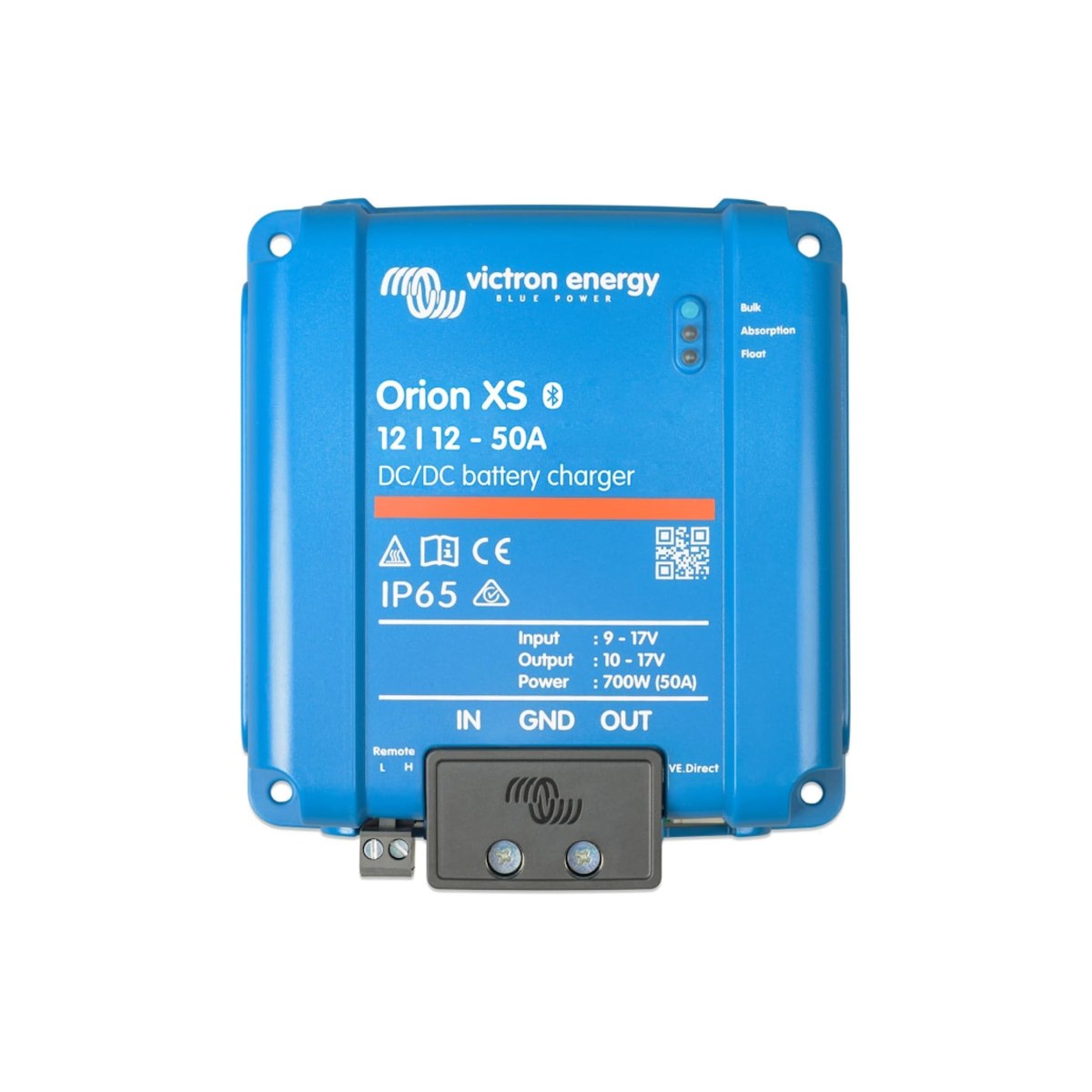
Victron Energy Orion XS 12/12-50 Smart DC-DC Battery Charger (Bluetooth, fully configurable 10 to 50A output, IP65 sealed, 700W, ASIN B0CWYWQGBF)
The charger that reset the category: cool, sealed, fully configurable.
Who it's for: The van or RV builder with a 12V lithium house bank who wants the engine to charge it properly and plans to keep the rig. This is the buyer who already has solar handled by a separate controller, or no solar at all, and wants the cleanest, coolest-running alternator charger on the market, with output they can dial to whatever their alternator can actually feed, from 10 amps up to the full 50.
What we found: This is the unit that reset the category. The Orion XS runs at 98.5 percent efficiency against roughly 87 for the older Orion-Tr line, which is the difference between a charger that needs no fan and one that folds back its output in a hot van. It is sealed to IP65, half the size of what it replaces, and fully configurable over Bluetooth, so the same box runs at 30 amps on a stock alternator and 50 on an upgraded one. At 4.6 stars across 479 ratings it is also the best-reviewed current-generation charger here, and the engine-detection logic handles smart alternators once you wire the ignition trigger.
Bottom line: Buy the Orion XS if you want the best alternator charger on Amazon and your solar, if any, lives on its own controller. At about $296 it costs within a dollar of the Renogy combo below, so you are choosing architecture, not price: this is the cleaner, cooler, more configurable box. Dial it down to 30 amps or less on a stock alternator, and wire the ignition trigger on any modern vehicle.
- + 98.5 percent efficient against roughly 87 for the older Orion-Tr line: fan-free, full 50 amps to 104 degrees ambient, then a gentle 1.5 percent per degree derate against the Orion-Tr's 3
- + Fully configurable 10 to 50 amp output over Bluetooth, the same box serves a stock alternator at 30A and an upgraded one at 50A
- + Sealed to IP65 and about half the size of what it replaces, with a VE.Direct port for Victron system integration
- + Best-reviewed current-generation charger here, 4.6 stars across 479 ratings
- × No solar input, pair it with a separate MPPT controller if you have panels
- × At about $296 it costs the same as the Renogy combo that does include solar input
- × On a smart alternator you must wire the ignition trigger, engine detection by voltage alone is not reliable on modern vehicles
- × Early-2026 firmware (1.12 and earlier) had reported brief-dropout and display bugs, so update the firmware in VictronConnect at install
- × A 70-amp Orion XS reaches US retail in mid-to-late 2026; a very large bank on an upgraded alternator may want to wait or plan to parallel two units
Prices were accurate when we last checked and change often. The eBay figure is the lowest new listing we found, and its search can include newer or older models. We may earn a commission from these links, at no extra cost to you.
Runner-up: Renogy DCC50S 12V 50A DC-DC Battery Charger with built-in MPPT solar controller (dual input, starter-battery trickle charge, ASIN B093BB5JKF).
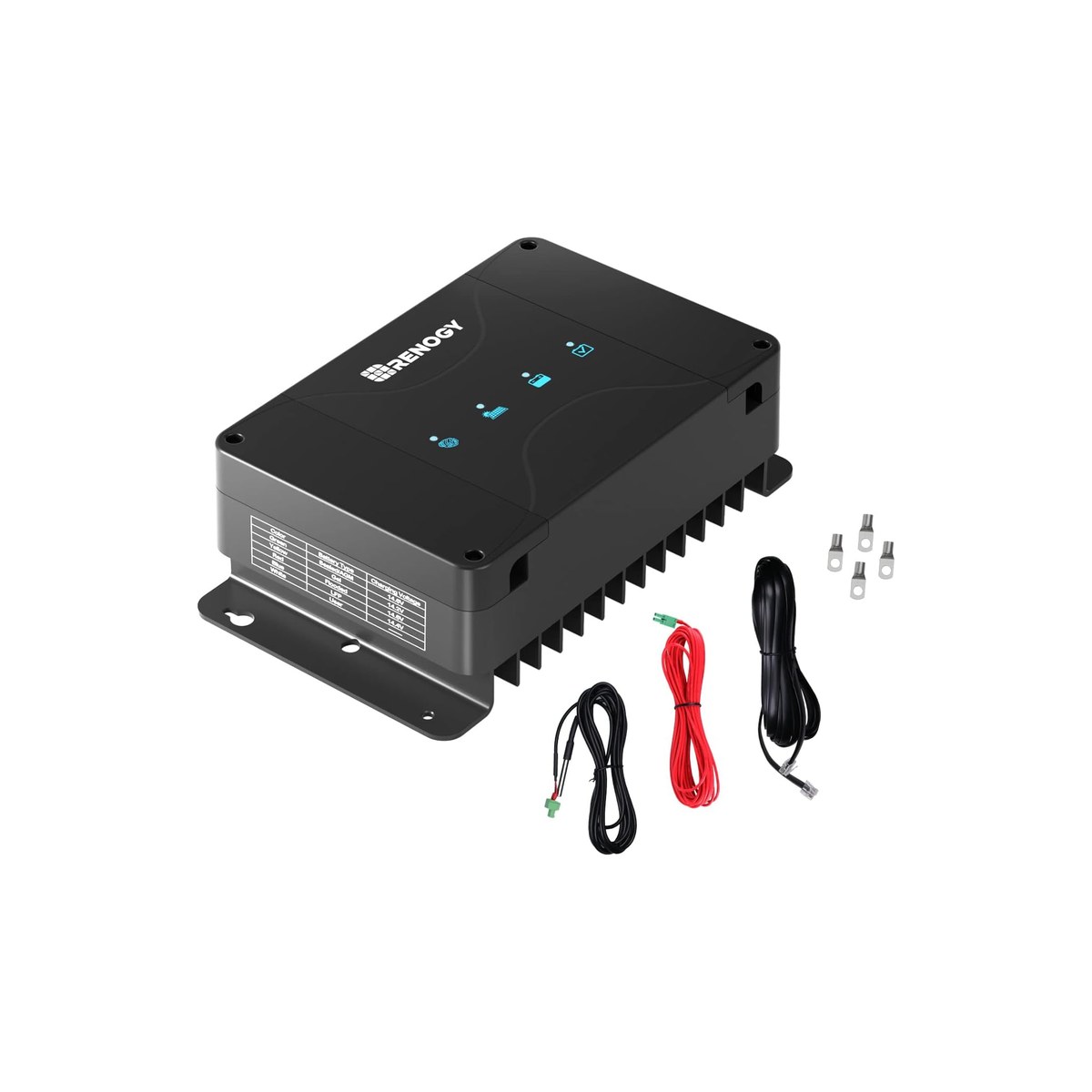
Renogy DCC50S 12V 50A DC-DC Battery Charger with built-in MPPT solar controller (dual input, starter-battery trickle charge, ASIN B093BB5JKF)
One box for alternator and solar, if you know the catch.
Who it's for: The from-scratch van builder who wants one box to handle both charging sources: the alternator while driving and the rooftop panels while parked. This is the buyer wiring a new system who would rather mount, fuse, and learn a single unit than pair a dedicated alternator charger with a separate solar controller, and whose rooftop array is modest, about 400 watts or less, so the combo's limits never really bite.
What we found: The DCC50S is the most popular combo unit in the category, 543 ratings, because the idea is genuinely good: a 50-amp alternator charger and an MPPT solar controller in one housing, plus a trickle feed that keeps the starter battery topped. The catch owners discover later is that with both inputs live it caps each side at 25 amps, never more than 50 total, so a weak solar input still halves the alternator's share and a big array never stacks on top of it. At 4.1 stars it also reviews below the Victrons, with stripped terminal screws the recurring complaint, and it runs hotter than the XS.
Bottom line: At about $297 it costs the same as the Orion XS, so be clear about what you are buying: the built-in solar input, not a saving. For a modest array and a simpler install, that trade is worth it and this is the right box. If your panels are 400 watts and growing, run the math the other way: a dedicated MPPT plus the XS charges faster and runs cooler for about $90 more.
- + Alternator charger and MPPT solar controller in one housing, one mount, one fuse plan, one manual
- + The most popular combo unit in the category at 543 ratings, with a trickle feed that keeps the starter battery topped
- + 50 amps of alternator charging when driving, solar when parked, the right two sources for most van builds
- × With both inputs live it caps each at 25 amps (25 alternator plus 25 solar, never more than 50 total), so a weak solar input still halves the alternator side and cloudy-day charging can drop below alternator-only
- × Solar input tops out around 25 volts on current hardware (check your version's manual), one parallel panel string only; series strings need a separate controller or the Kisae DMT1250
- × 4.1 stars, below the Victrons, with stripped terminal screws the recurring owner complaint
- × Runs hotter and less efficient than the Orion XS at the same price
Budget pick: Victron Energy Orion-Tr Smart 12/12-30 DC-DC Battery Charger (Bluetooth, 360W, isolated and non-isolated versions, ASIN B086Q8YNJZ).
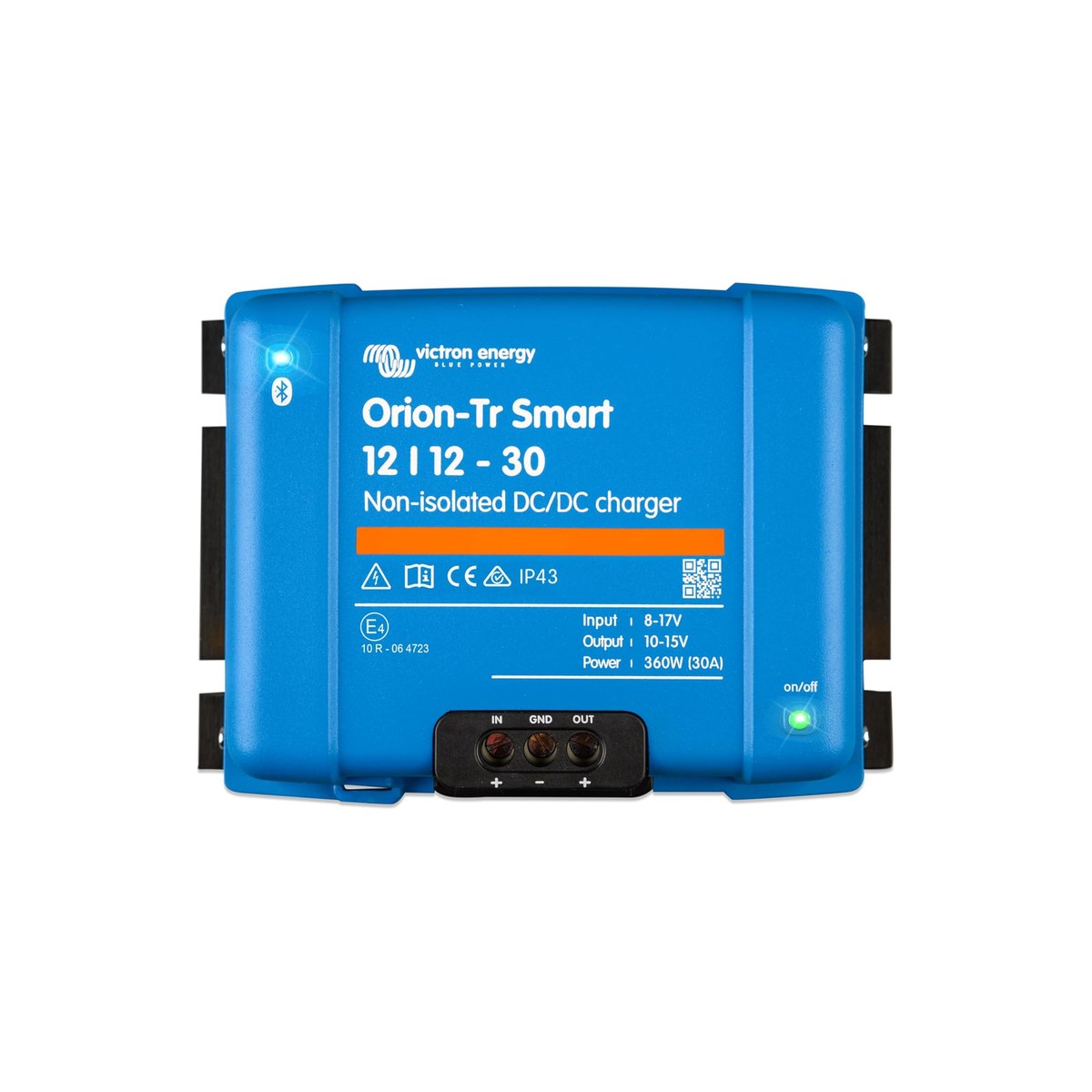
Victron Energy Orion-Tr Smart 12/12-30 DC-DC Battery Charger (Bluetooth, 360W, isolated and non-isolated versions, ASIN B086Q8YNJZ)
The most-reviewed charger in the category, at the best price.
Who it's for: The buyer with a 100 to 200Ah bank and a stock alternator who wants the proven name at the lowest sensible price. This is the weekender or part-timer who drives often enough that 30 amps refills the bank between stops, does not need IP-rated sealing or 50-amp output, and would rather buy the unit with the longest review record in the category than gamble on a no-name box to save forty dollars.
What we found: This is the most-reviewed DC-DC charger on Amazon, 901 ratings at 4.6 stars, and the long record is the point: the Orion-Tr Smart line has been the default van-build charger for years. It has Bluetooth setup, engine detection by voltage or ignition wire, and both isolated and non-isolated versions. The honesty point is heat: it is rated 30 amps continuous only to 104 degrees ambient, and at roughly 87 percent efficiency owners in warm installs watch real output sag into the mid-20s, so treat it as a high-20s charger in a hot van, not a true continuous 30.
Bottom line: At about $191 this is the best value in the lineup: the proven box, a hundred dollars under the XS, and right-sized for a stock alternator. Mount it somewhere with airflow and the derating rarely matters. Two flags before you buy: stock ran thin at the time of writing, so confirm availability, and if your budget stretches another hundred dollars the XS runs cooler and gives you headroom to 50 amps.
- + The most-reviewed DC-DC charger on Amazon, 901 ratings at 4.6 stars, the default van-build charger for years
- + Bluetooth setup, engine detection by voltage or ignition wire, and both isolated and non-isolated versions
- + At about $191 it is a hundred dollars under the Orion XS and right-sized for a stock alternator
- × Roughly 87 percent efficient, so it runs hot: rated 30 amps continuous only to 104 degrees ambient, and owners in warm installs see output sag into the mid-20s
- × No solar input, and no IP rating, it needs a dry spot with airflow
- × Stock ran thin at the time of writing, confirm availability before planning the install around it
Prices were accurate when we last checked and change often. The eBay figure is the lowest new listing we found, and its search can include newer or older models. We may earn a commission from these links, at no extra cost to you.
Also worth considering.
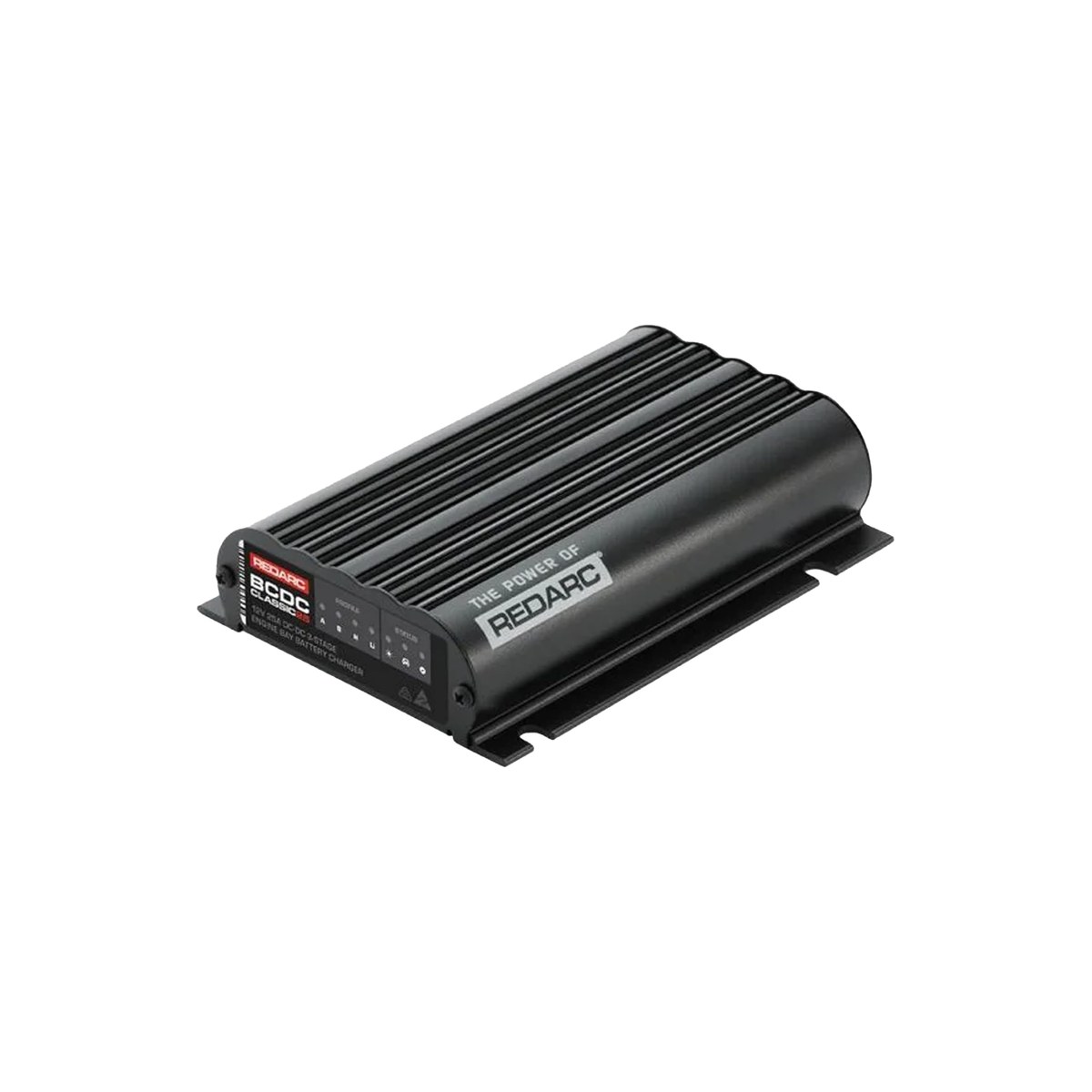
REDARC BCDC Dual Input 25A In-Vehicle DC-DC Battery Charger (built-in MPPT solar regulator, Green Power Priority, smart-alternator ready, ASIN B077JPHCRV)
The overland tank: dual input, smart-alternator ready, survives real abuse.
Who it's for: The overlander, truck camper, or four-wheel-drive owner whose charger lives in heat, dust, vibration, and the occasional water crossing, and whose modern vehicle runs a smart alternator. This is the buyer who treats the electrical system as expedition equipment, wants solar and alternator inputs in one sealed unit, and will pay roughly double for the one brand with a genuine reputation for surviving conditions that kill cheaper boxes.
What we found: Redarc is the overland gold standard and the highest-rated pick here, 4.8 stars across 138 ratings. The BCDC line is built for exactly this duty: it keeps working at ambient temperatures up to 176 degrees Fahrenheit, shrugs off vibration and water crossings, and its Green Power Priority logic charges from solar first and tops up from the alternator, which is the right order for fuel and alternator life. It is also engineered around smart alternators, with proper ignition wiring documented rather than an afterthought. One label note: this is the older BCDC Classic generation; Redarc's newer Alpha series adds Bluetooth but is not sold through Amazon.
Bottom line: At about $519 for 25 amps it is by far the most expensive charger per amp in this guide, and that is the honest trade: you are paying for survivability and engineering, not output. A street-parked camper van does not need it; the Victrons do that job for less. A vehicle that earns its keep off-pavement does, and owners who run them for years report exactly zero drama.
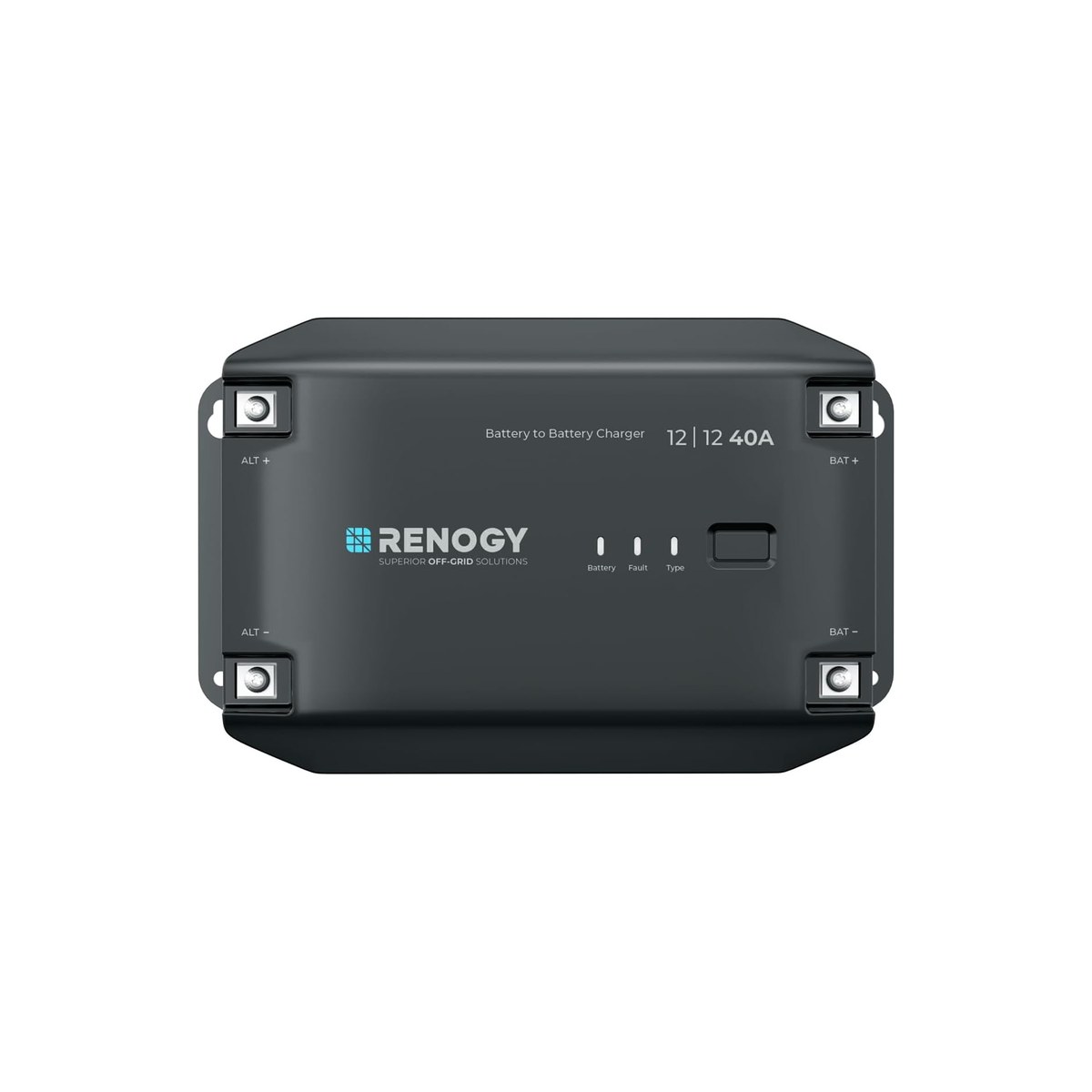
Renogy 12V 40A DC-DC Battery Charger (multi-stage for LiFePO4, AGM, gel, and flooded, low-current 20A mode, ASIN B0D78W7CSV)
The most amps per dollar, with one honest asterisk on quality.
Who it's for: The budget-first builder with a bigger bank, 200Ah and up, who needs real charging current under $200 and is upgrading the alternator or confident theirs can feed it. This is the buyer who wants the most amps per dollar from a brand with actual support, not a no-name listing, and who does not need solar input, an app, or a sealed case to justify the price.
What we found: At about $187 for 40 amps this is the cheapest real charging current here, just over $4.50 per amp against the XS at nearly $6. It is also, honestly, the lowest-rated pick at 3.9 stars across 52 ratings, with the quality-control complaints the Victrons avoid and one recurring fault to know: on voltage-only detection or a miswired ignition lead it can keep charging after shutdown and drain the starter battery, so wire the ignition trigger. The saving grace is the low-current port: flip it to 20 amps and it is safe on a stock alternator. No solar input, and Bluetooth only via Renogy's separate BT-2 dongle at about $40.
Bottom line: Buy it when the 40 amps is the point and the budget is fixed; it does the job, and the price is genuinely good. But if you are choosing between this and quality at fewer amps, the smaller Orion-Tr Smart 18A runs about $155 with 4.6 stars across 841 ratings, and for most stock-alternator rigs fewer, better amps is the smarter trade.
Skip this guide if...
Skip this guide if the engine is not really part of your charging plan. If the rig sits parked for weeks and solar or shore power covers the bank, a DC-DC charger is a box that mostly sleeps; put the money into panels via our RV solar kits guide instead. If you are still on a lead-acid house battery with an older fixed-voltage alternator, a simple battery isolator may genuinely be enough, that is the one setup where the old cheap way still works. If what you actually want is faster charging from a wall outlet or campground pedestal, that is a converter or shore charger, a different product entirely. And if your power lives in a portable power station, use the maker's own car-charging cable or alternator kit rather than wiring in a charger meant for a fixed bank.
Don't bother with.
- × Skip A NOCO Genius as your alternator chargerThe NOCO Genius line is the best-selling '12V charger' on Amazon, and as of mid-2026 it is not this product. It is an AC shore charger and maintainer: it plugs into a wall outlet and charges a battery. It does not take alternator input, does not current-limit a charging run while you drive, and will not charge your house bank from the engine, full stop. It is a fine garage maintainer. If a listing does not say DC-DC or battery-to-battery with an ignition or D+ terminal, it is not an alternator charger.
- × Skip A voltage-sensing relay (VSR) or battery isolator on a lithium bank or smart alternatorThe old way to charge a second battery was a relay that closes when it sees alternator voltage. Two things killed it: lithium banks pull unlimited current through a dumb relay, which is exactly the alternator-cooking problem a DC-DC charger exists to prevent, and modern smart alternators sit at low voltage for fuel economy, so the relay never reliably sees the trigger voltage and never closes. On lead-acid with an old alternator a VSR still works. On lithium or anything built in the last decade, it is the wrong tool.
- × Skip Generic 'DC-DC converter' modules sold as chargersA buck-boost converter board holds an output voltage, and that is all it does. No multi-stage charge profile, no current limiting matched to an alternator, no engine detection, no temperature compensation, usually no enclosure rated for a vehicle. Plenty of Amazon listings blur the words converter and charger. The picks in this guide are chargers: they manage a battery, not just a voltage. If the listing has no battery-chemistry setting, walk away.
- × Skip A 50 or 60 amp charger on a stock alternatorA DC-DC charger draws roughly 15 to 30 percent more than it outputs, briefly up to 50 percent at start-up, so a 50-amp unit can pull 60-plus amps from an alternator that is also running the vehicle, 15 to 40 amps of load depending on what is on, and that was never rated for continuous maximum output. Owners who oversize cook alternators. The working rule, and Redarc's own published guidance: size at no more than half the alternator's rating. On a typical 90 to 150 amp stock alternator that caps you around 40 amps; the 180 to 250 amp units in many late-model vans support more. Check your alternator's rating before you buy the big charger.
- × Skip No-name 40 and 50 amp units with no published derating or temperature specEvery DC-DC charger makes less than its rated amps once it gets hot; the honest brands publish the curve and the cutoff. The bargain listings do not, and the review patterns show why: outputs that sag far below rating, units that shut down in summer, and no support when they do. Heat handling is most of what you are paying for in this category. A charger that will not tell you its derating behavior is telling you anyway.
How we picked.
Sources we read and how we picked
We did not bench-test ten chargers, and most sites claiming they did are reworking spec sheets. What we did was read the owners who live with these boxes: install threads and failure reports on the DIY Solar boards, the Promaster, Transit, and Sprinter forums, and r/vandwellers, plus Victron, Renogy, and Redarc's own engineering documentation, which is unusually frank about limits like derating and alternator load. Then we verified every price, rating, and review count live on Amazon on June 9, 2026.
Our filter was Amazon-buyable 12V chargers from brands with a real support path, sorted into the roles van and RV builders actually shop. That filter is why three brands cover all five slots: Victron owns the quality end, Renogy owns the value and combo end, and Redarc owns the overland end. Sterling Power, the smart-alternator specialist, has only thin third-party Amazon stock with a weak review record there (3.8 stars across 28 ratings on the BB1260 at the time of writing), and the no-name budget tier reviews too poorly to recommend. We would rather say that plainly than pad the lineup to five brands. One housekeeping note on the Victrons: Victron routes warranty through the selling dealer, so on Amazon check who the seller is and keep the invoice and serial number.
Do you actually need a DC-DC charger?
Usually, for a lithium bank, yes, and here is the honest version of why. A vehicle alternator and a stock RV converter were tuned for lead-acid: they push a voltage that leaves a lithium bank at roughly 60 to 80 percent, and the wiring run to the back of a trailer drops the voltage further, so the bank you paid for never quite fills. A DC-DC charger takes whatever the alternator gives and holds the proper 14.4 to 14.6 volt multi-stage profile at the battery.
There is a second reason that has nothing to do with charge quality: protection. A lithium bank's low resistance will pull every amp an alternator can make, continuously, through a direct connection. Some owners do run direct-connected lithium without drama, and the debunk camp is right that alternators fail less often than the marketing implies. But the failure mode is real, it is expensive, and there is a second one the debunkers skip: if the battery's BMS disconnects mid-charge, the sudden load loss spikes the voltage and can take out the alternator's diodes. A current-limited charger removes both risks entirely. For a DC-to-DC charger for lithium batteries in RV or van use, that insurance plus a genuinely full battery is the case in one sentence.
What size DC-DC charger does your alternator support?
Size to the alternator, not to the battery bank, because the alternator is the component you can cook. Two numbers matter. First, a charger draws more than it outputs: roughly 15 to 30 percent more depending on efficiency, briefly up to 50 percent at start-up, so a 40-amp charger can pull 50-plus from the alternator and a 50-amp unit 60-plus. The 98.5 percent efficient Orion XS sits at the gentle end, closer to 10 to 15 percent over. Second, the vehicle itself is already using 15 to 40 amps depending on what is running, and alternators are cooled by engine airflow, not rated for continuous maximum output.
The working rule, which is also Redarc's published guidance, holds up: size the charger at no more than half the alternator's rated output. A 100-amp alternator supports a 20 to 30 amp charger comfortably; a typical 90 to 150 amp stock unit caps you around 40; the 180 to 250 amp alternators in many late-model vans genuinely support 50 or more. Bank size and drive time then set whether bigger is worth it: 30 amps adds roughly 30Ah per driving hour, which refills a weekend's use on a 100Ah bank in about three hours of road time. And whatever the size, fuse both ends of the run, both batteries are energy sources, with the manual's wire gauge: Victron specifies 60 to 70 amp fuses and 6 AWG or heavier for its 50-amp unit.
Smart alternators and the ignition wire, the modern gotcha
Most vehicles built in roughly the last decade run a smart alternator: the computer varies its voltage for fuel economy, letting it idle low and spiking it on deceleration. That breaks every charging trick that watches for voltage, which is why old split-charge relays die on new vans, and why a DC-DC charger is now the only reliable way to charge a house bank from the engine.
It adds one install step that catches people. A charger detecting the engine by voltage alone can false-trigger or never trigger on a smart alternator, so you run one thin wire from an ignition-switched circuit, often called the D plus signal, to the charger's remote terminal. Then it runs exactly when the engine does. Every pick in this guide supports ignition-wire triggering; finding the right circuit in your fuse box is the actual work, and the forums for your specific van are the best map.
Isolated vs non-isolated, settled in two sentences
A non-isolated charger shares a ground path between the vehicle and the house bank, which is correct for almost every van and RV build, since everything bolts to the same chassis. An isolated charger keeps the two sides electrically separate, which you pay for in price, size, and a little efficiency, and need only when the two batteries do not share a clean common ground: boats, truck-and-trailer setups where the bank rides the trailer, or installs fighting electrical noise.
The practical rule: buy non-isolated unless you can name your reason. If the battery being charged lives on the same chassis as the engine, that is a non-isolated install. Victron sells the Orion-Tr Smart both ways, which is why the spec matters when you click; the listing variants look nearly identical.
Buy-amps are not real amps: the heat derating truth
Every charger in this category outputs its rated amps on a bench and fewer in a hot van wall. The physics is fixed: whatever the unit wastes as inefficiency becomes heat, the electronics protect themselves by folding output back as temperature climbs, and a summer install cavity can sit 30 degrees above ambient. The older 30-amp Orion-Tr is rated for its full 30 only to 104 degrees ambient, and owners in warm installs watch output sag into the mid-20s and below; Redarc documents derating starting around 131 degrees internal temperature and shutdown at 176.
This is also the quiet argument for efficiency as a buying spec. At 98.5 percent, the Orion XS turns almost nothing into heat, which is why it holds rated output without a fan while less efficient units sag. The practical moves: mount any charger low, in moving air, never in a sealed cabinet with the batteries, and if your math says you need a true continuous 30 amps, buy the 50 and run it derated rather than buying a 30 and hoping.
FAQs.
Q01 What is a DC-DC charger, and how is it different from my RV's converter?
+
Q02 What size DC-DC charger do I need?
+
Q03 Do I need an isolated or non-isolated DC-DC charger?
+
Q04 Will a DC-DC charger drain my starting battery?
+
Q05 Can I charge from solar and the alternator at the same time?
+
Q06 Why does my DC-DC charger put out fewer amps than its rating?
+
Q07 Will a DC-DC charger work with my vehicle's smart alternator?
+
Q08 Is the NOCO Genius a DC-DC charger?
+
If you, then this.
- IF you want the best alternator charger available and your solar, if any, runs on its own controllerGET Victron Orion XS 12/12-50 (B0CWYWQGBF; 98.5% efficient, IP65, configurable 10 to 50A)$295.98 →
- IF you want alternator and rooftop solar charging in one box, and your array is about 400 watts or lessGET Renogy DCC50S 50A with MPPT (B093BB5JKF; one install, knows the one-source-at-a-time catch)$296.99 →
- IF you want the proven default at the best price for a 100 to 200Ah bank on a stock alternatorGET Victron Orion-Tr Smart 12/12-30 (B086Q8YNJZ; 901 ratings, give it airflow, confirm stock)$190.96 →
- IF your rig lives off-pavement in heat, dust, and water crossings, on a modern smart alternatorGET Redarc BCDC Dual Input 25A (B077JPHCRV; solar + alternator inputs, survives what kills cheaper boxes)$518.95 →
- IF you need maximum amps per dollar for a 200Ah-plus bank and the budget stops under $200GET Renogy 40A DC-DC (B0D78W7CSV; use the 20A mode on a stock alternator; 3.9 stars, know the trade)$186.99 →
- IF the rig mostly sits parked and solar already covers the bank, or you charge on hookupsGET panels and a controller (our RV solar kits guide) or a lithium-aware converter, not a DC-DC chargervaries →
RV & Van Gear: The Complete Guide
The whole-rig picture →Every system in a van, RV, or camper, organized in one place, with the safety and weight floor and the one guide we trust for each.