Best RV Fire Extinguishers: 4 That Meet the Code, 1 Honest Supplement (2026)
An RV fire can give you only a couple of minutes, and the industry standard is specific about what belongs by your door: NFPA 1192 requires a UL-listed extinguisher rated at least 1-A:10-B:C located within 24 inches of the primary exit. The dusty unit your rig shipped with may not clear that bar: RV makers filed companion recalls covering nearly 2 million rigs with Kidde extinguishers recalled for failing to discharge, and the old 5-B:C and 10-B:C ratings many guides still quote were superseded. We read the standard's own text, the recall filings, and the RV owners who live with these, then verified every price live on Amazon on June 11, 2026. The honest headline: the popular no-mess sticks and sprays cannot be your required extinguisher, no extinguisher answers a lithium battery fire, and a small bottle buys roughly ten to fifteen seconds of agent. The first rule of any RV fire is people out, then decide.
- 01 First Alert MARINE1 (B0045PS1DO) , top pick, the required 1-A:10-B:C with vehicle bracket and strap, ~$30
- 02 First Alert PRO5 (B000M2QR8U) , best step-up, 3-A:40-B:C for the kitchen end of the rig, ~$58
- 03 First Alert HOME1 (B01LTICQYE) , best budget, the required rating at $27, no bracket included
- 04 Kidde Pro 210 (B000VBGG5Q) , the recalled-Kidde replacement, 2-A:10-B:C, ~$55
- 05 First Alert EZ Fire Spray AF400 (B001229JCU) , galley supplement only, $14, not UL-rated
How they compare.
| Rank | Product | Best for | Price | Our score |
|---|---|---|---|---|
| 01 | First Alert MARINE1 (B0045PS1DO)
Top Pick
| best overall, the required 1-A:10-B:C with vehicle bracket and strap | $29.98
Buy → | 9.0/10 |
| 02 | First Alert PRO5 (B000M2QR8U) | best step-up, 3-A:40-B:C, the kitchen-end unit for bigger rigs | $58.19
Buy → | 8.7/10 |
| 03 | First Alert HOME1 (B01LTICQYE) | best budget, the required rating, 39,000+ reviews, add a bracket | $26.98
Buy → | 8.6/10 |
| 04 | Kidde Pro 210 (B000VBGG5Q) | best recalled-Kidde replacement, 2-A:10-B:C, current metal-valve line | $54.97
Buy → | 8.4/10 |
| 05 | First Alert EZ Fire Spray AF400 (B001229JCU) | best galley supplement, point-and-spray, not UL-rated | $13.98
Buy → | 8.0/10 |
Prices are current Amazon prices at time of publication and can change. Scores reflect our editorial evaluation, not vendor input.
Our #1 pick: First Alert MARINE1 Fire Extinguisher, UL Rated 1-A:10-B:C, All-Metal Valve, Marine Bracket and Strap Included, USCG-Approved with Bracket (FE1A10GR, ASIN B0045PS1DO).
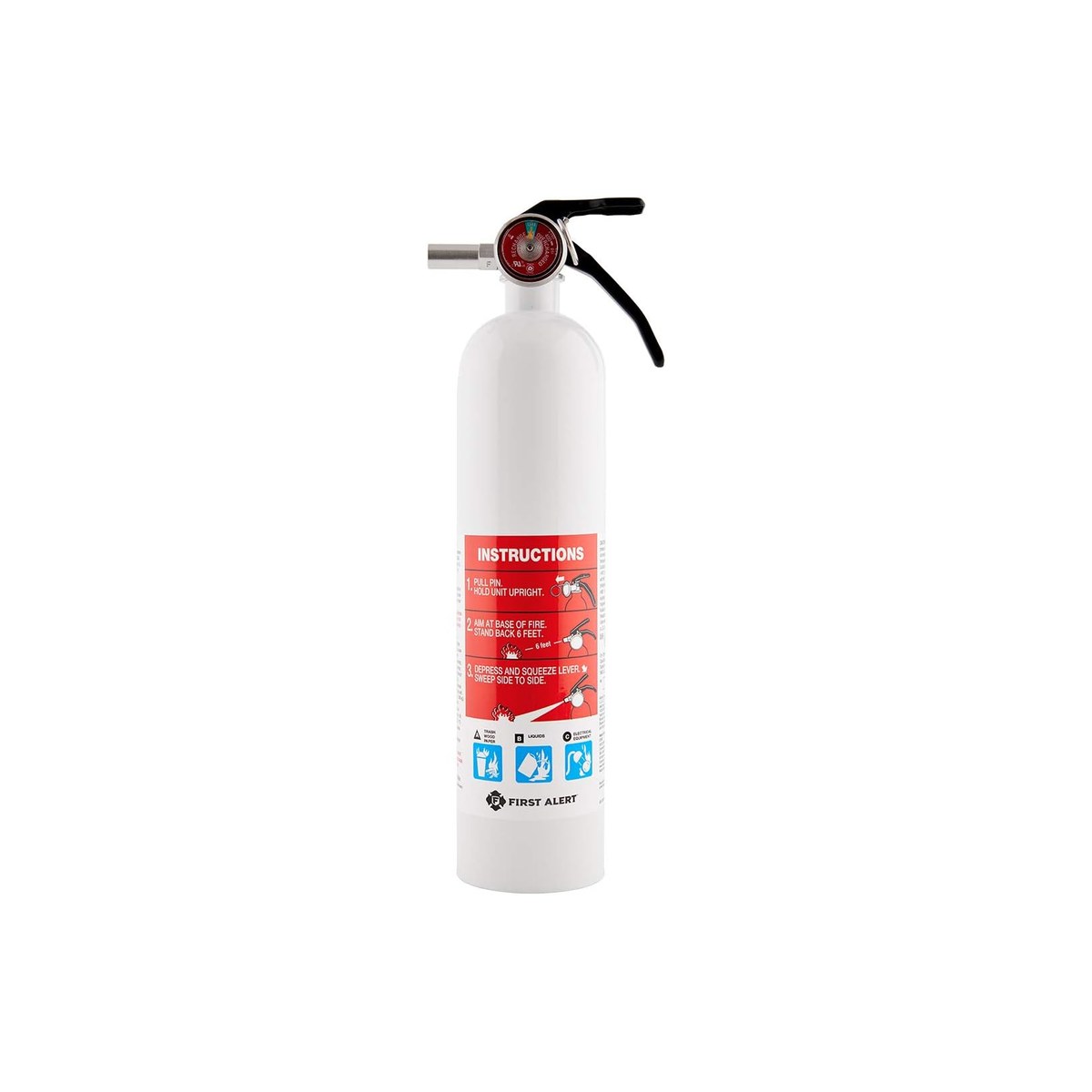
First Alert MARINE1 Fire Extinguisher, UL Rated 1-A:10-B:C, All-Metal Valve, Marine Bracket and Strap Included, USCG-Approved with Bracket (FE1A10GR, ASIN B0045PS1DO)
The required rating, the vehicle mount, and marine-grade build for $30.
Who it's for: The RV owner who wants the required extinguisher handled correctly in one purchase. NFPA 1192, the standard RVs are built and certified to, calls for a listed extinguisher rated at least 1-A:10-B:C within 24 inches of the primary exit, and the MARINE1 is exactly that rating with the vehicle hardware included. It suits anyone replacing the dusty original unit, and anyone who just learned theirs was part of the Kidde recall.
What we found: The MARINE1 is the cleanest compliance buy in the category. It is UL-rated 1-A:10-B:C, the exact floor the RV standard sets, with an all-metal valve and trigger, and it ships with a secure mount, bracket, and strap, the hardware that keeps an extinguisher seated through thousands of miles of washboard road. It is Coast Guard approved when used with that bracket, a useful proxy for vibration and damp-bay duty, and it holds 4.8 stars across more than 2,700 ratings at about $30. The honest limits: 1-A is the minimum Class A capacity, and like every dry chemical unit, using it indoors means a serious cleanup.
Bottom line: If you want one purchase that puts the required extinguisher by your door, mounted properly, buy the MARINE1 and be done. It is the right rating, the right hardware, and the right price. Pair it with a bigger PRO5 at the kitchen end of a larger rig, and check the recall list before you trust whatever your RV came with. The white casing is the only quirk, so label its spot.
- + Exactly the required rating: UL-listed 1-A:10-B:C, the minimum NFPA 1192 specifies for RVs with propane or shore power
- + Ships with the bracket and strap, and it is Coast Guard approved when used with that bracket, so it is built to stay put in a moving vehicle
- + All-metal valve and trigger at 4.8 stars across more than 2,700 ratings, for about $30
- × The floor, not the ceiling: 1-A is the minimum Class A capacity, and a larger rig benefits from a bigger second unit like the PRO5
- × Dry chemical, so a discharge inside the rig means a corrosive cleanup job on everything it touches
- × White marine casing rather than safety red, worth labeling its spot so guests can find it fast
Runner-up: First Alert PRO5 Rechargeable Heavy Duty Fire Extinguisher, UL Rated 3-A:40-B:C, Commercial-Grade Metal Valve, Mounting Bracket Included (ASIN B000M2QR8U).
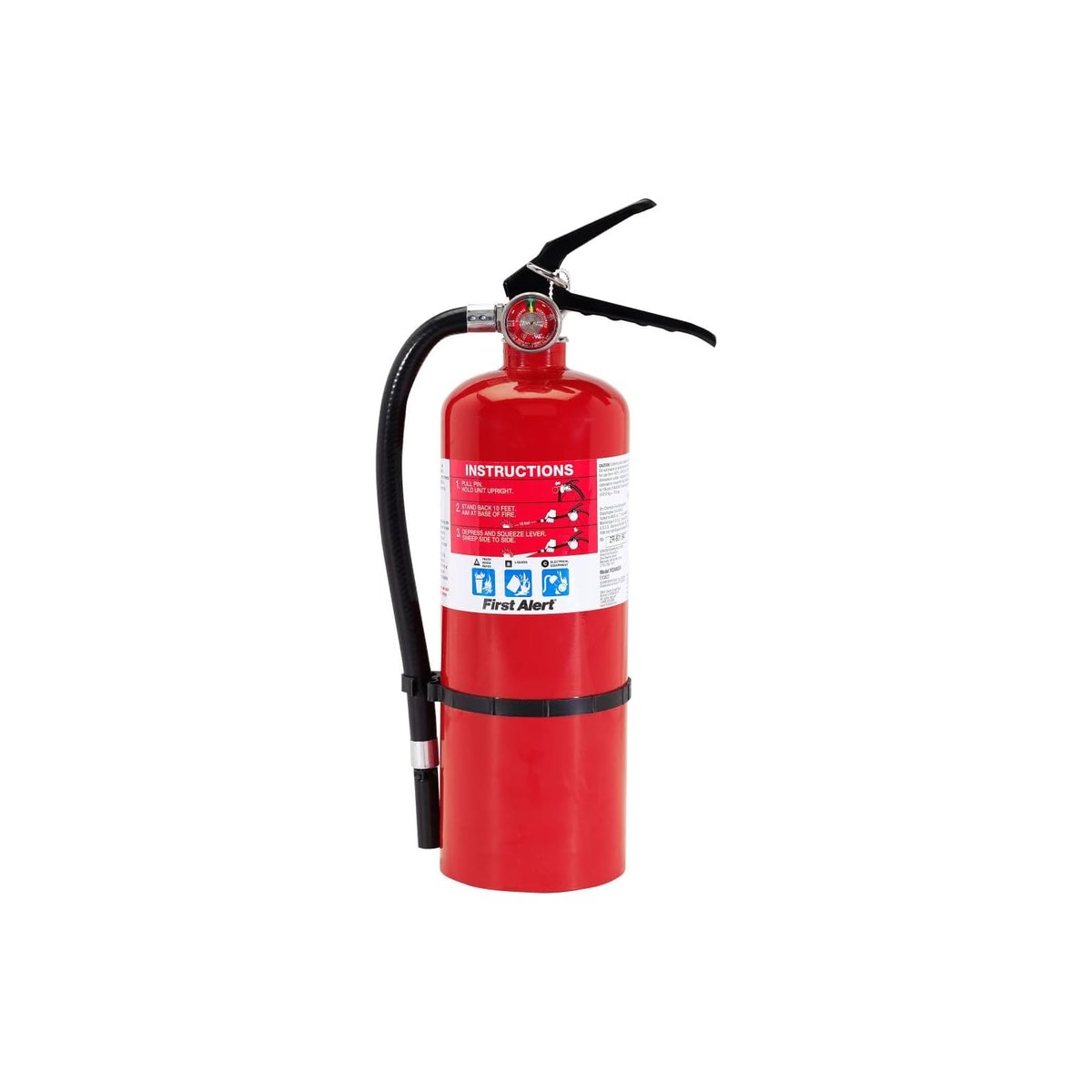
First Alert PRO5 Rechargeable Heavy Duty Fire Extinguisher, UL Rated 3-A:40-B:C, Commercial-Grade Metal Valve, Mounting Bracket Included (ASIN B000M2QR8U)
Several times the required capacity for the kitchen end of the rig.
Who it's for: The owner of a larger rig who understands the door unit is a minimum, not a strategy. Fire officials recommend more than one extinguisher in an RV, one by the exit as required, plus units within reach of the kitchen and bedroom, and the PRO5 is the one you place at the kitchen end, where a grease flare or a 120-volt appliance fault is most likely to start. It suits fifth wheels, larger travel trailers, and motorhomes with real distance between door and galley.
What we found: The PRO5 is the capacity play: UL-rated 3-A:40-B:C, triple the Class A water-equivalence and four times the Class B square footage of the required floor. In practice that means more agent and a few extra seconds of discharge, units this size empty in roughly ten to fifteen seconds, so the capacity is margin on the same small, contained stove-top fire, not a license to fight a bigger one. It is rechargeable, built around a commercial-grade metal valve and head, ships with its bracket, and holds 4.8 stars across more than 3,500 ratings at about $58, at about 9 pounds mounted.
Bottom line: Buy the PRO5 as the second unit in any rig with a real kitchen, or as the primary in a big coach. It does not replace the door unit, and if a fire is bigger than the pan it started in or spreading, no bottle on this page is the answer: you are out the door. Skip it in a tiny camper where a second MARINE1 covers the bases.
- + UL-rated 3-A:40-B:C: triple the Class A capacity and four times the Class B coverage of the required minimum
- + Rechargeable with a commercial-grade metal valve and head, so it is serviceable rather than disposable
- + Mounting bracket included, at 4.8 stars across more than 3,500 ratings
- × About 9 pounds mounted (a 5-pound-agent unit), bigger and heavier than the door unit, so plan a real mounting spot
- × About $58, twice the price of the compliance picks, fair for the capacity but not pocket change
- × Still dry chemical, with the same corrosive-mess cleanup if you discharge it inside
Budget pick: First Alert HOME1 Rechargeable Fire Extinguisher, UL Rated 1-A:10-B:C, All-Metal Construction, US Coast Guard Approved for Marine Use (ASIN B01LTICQYE).
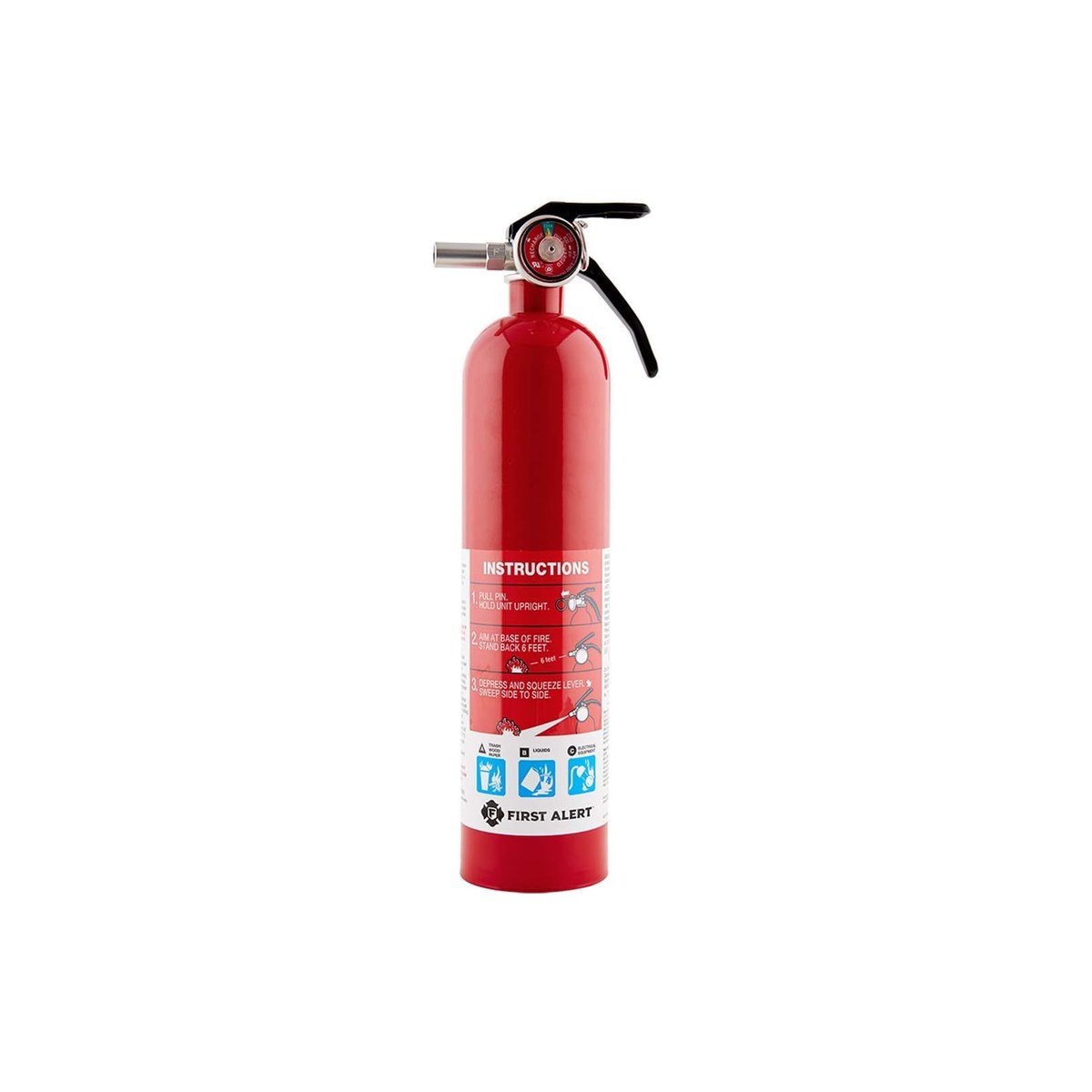
First Alert HOME1 Rechargeable Fire Extinguisher, UL Rated 1-A:10-B:C, All-Metal Construction, US Coast Guard Approved for Marine Use (ASIN B01LTICQYE)
The required rating for $27, if you add your own bracket.
Who it's for: The buyer outfitting a whole rig on a budget. Fire officials recommend an extinguisher by the door, near the kitchen and bedroom, in an outside bay, and in the tow vehicle, and at $27 each the HOME1 is how you actually do that without spending $200. It is also the right pick for anyone who already has a mounted door unit and wants proven, compliant-rated backups distributed through the rig and truck.
What we found: The HOME1 is the most-proven extinguisher in this guide and it is not close: nearly 40,000 ratings at 4.8 stars, with the same UL 1-A:10-B:C rating as the MARINE1, all-metal construction, a commercial-grade metal valve, and a rechargeable body, for $27. It is even Coast Guard approved for marine use. The one real catch is the missing hardware: it ships with no bracket of any kind, and an unsecured steel bottle in a vehicle that brakes hard is a projectile. Budget a few dollars for a strap-style marine bracket and mount it properly, which still lands you under the MARINE1's price.
Bottom line: Buy the HOME1 to put the required rating in every spot that should have one, and accept the bracket errand as the cost of the discount. For the single by-the-door unit, the MARINE1 is the cleaner buy because the vehicle hardware is in the box. For everything after that first unit, the HOME1's price and its 40,000-review track record make it the easy multiplier.
- + The required UL 1-A:10-B:C rating at $27, the cheapest compliant unit we verified
- + Nearly 40,000 ratings at 4.8 stars, the most-proven extinguisher in this guide by an order of magnitude
- + All-metal construction with a commercial-grade metal valve, rechargeable, and Coast Guard approved for marine use
- × Ships with no bracket at all, and a loose extinguisher in a moving RV is a projectile, so add a strap mount
- × Same 1-A floor capacity as the MARINE1, it is a compliance unit, not a big-fire unit
- × Red household styling and no marine packaging, fine inside, less ideal in a damp exterior bay
Also worth considering.
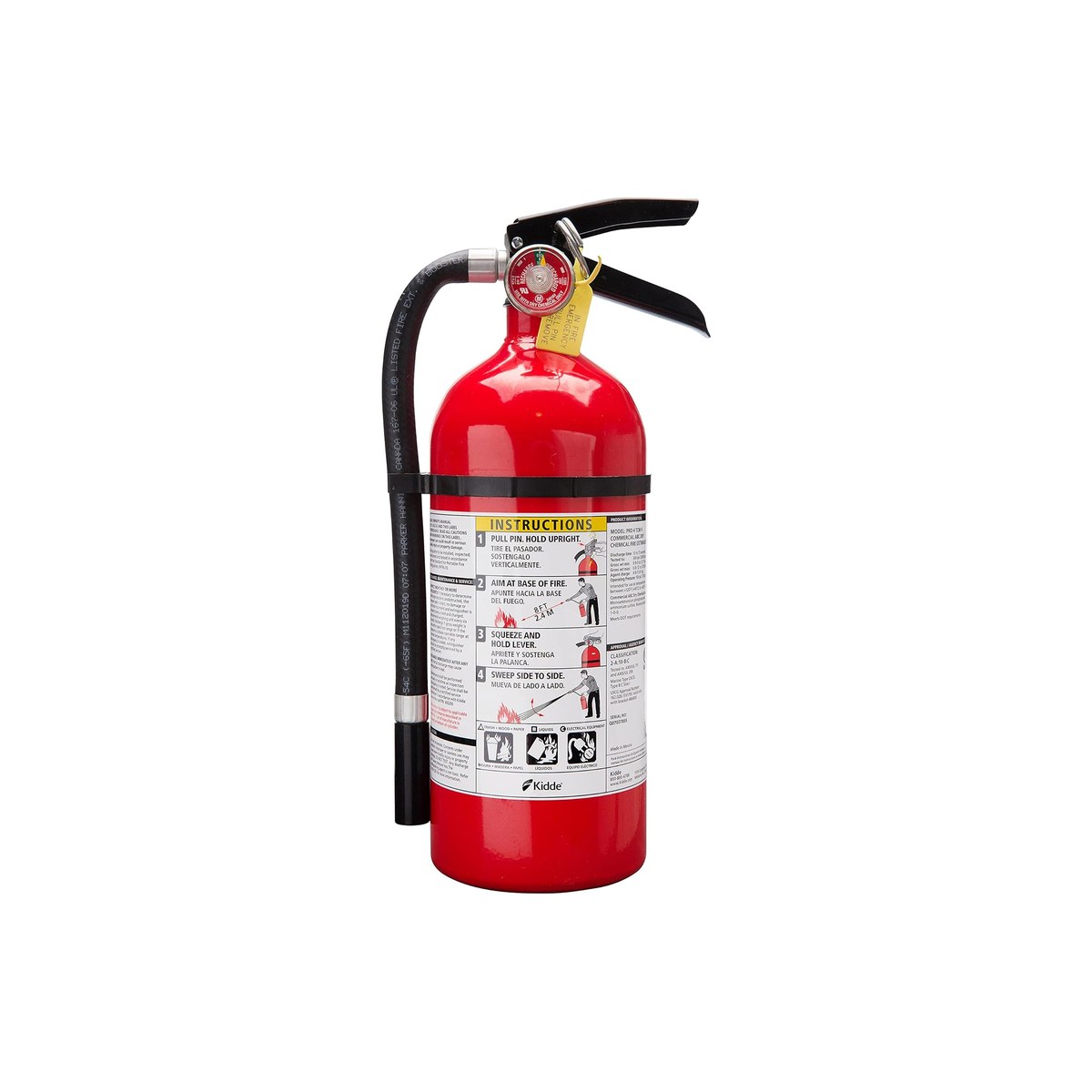
Kidde Pro 210 Fire Extinguisher, UL Rated 2-A:10-B:C, Rechargeable, Aluminum Valve, Mounting Bracket Included (ASIN B000VBGG5Q)
The straight swap for a recalled plastic-handle Kidde.
Who it's for: The owner who pulled the extinguisher out of the cabinet, saw a straight plastic handle with a vertical pin, and realized it might be one of the roughly 38 million Kidde units recalled in 2017 for failing to discharge. Kidde still replaces those free, and this Pro 210 is the current line you replace it with if you would rather just buy once: an aluminum-valve, rechargeable unit rated above the RV minimum.
What we found: The Pro 210 is Kidde's current metal-valve line, UL-rated 2-A:10-B:C, double the Class A capacity of the required floor, rechargeable, with a bracket in the box and 4.7 stars across more than 5,100 ratings at about $55. The valve assembly is aluminum, which matters here: the 2017 recall was specifically the old plastic-handle and push-button models, and any Kidde with a metal handle and pin is not affected. The bracket is a wall-hanger style rather than a marine strap, so for a rattly cabinet or exterior bay, add a strap bracket the way you would for the HOME1.
Bottom line: Choose the Pro 210 if you are replacing a recalled or aged Kidde and want the familiar brand with a capacity bump, or if you simply want 2-A:10-B:C at the door instead of the floor rating. Register for Kidde's free replacement first if yours is affected, then decide whether the free metal-handle swap or this upgrade suits you. Keep the old unit mounted until its replacement is in hand, then retire it.
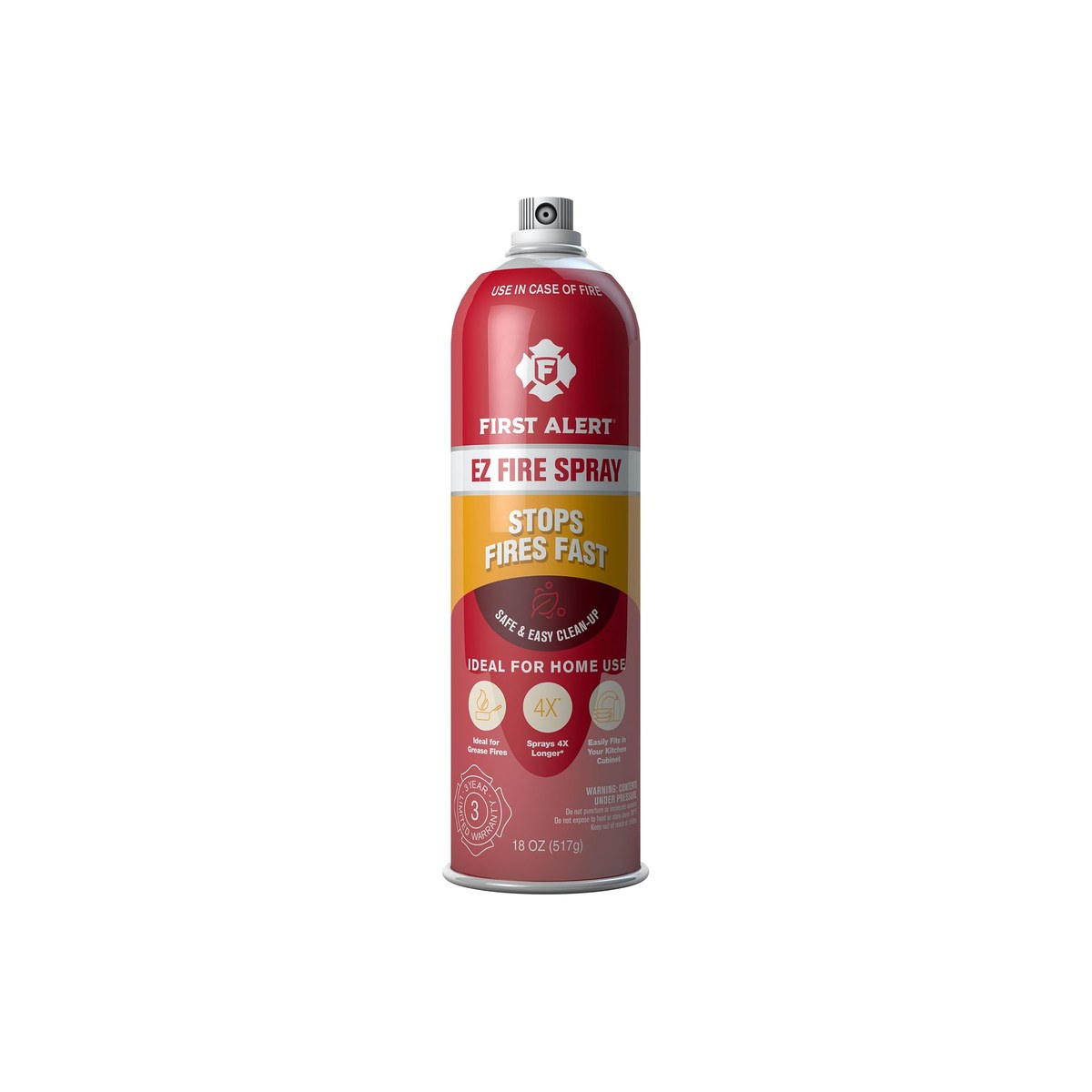
First Alert EZ Fire Spray AF400, 18-Ounce Extinguishing Aerosol for Grease and Small Fires (supplement only, not UL-rated, ASIN B001229JCU)
A $14 galley grab-can, as a supplement, never the required unit.
Who it's for: Every rig's galley, as the second layer. A pan flare on a two-burner in a 200-square-foot home is the everyday fire scenario, and the EZ Fire Spray is simple enough for any adult guest: point and spray, no pin, no lever, no technique. A kid's only job in an RV fire is to get out. It is for the owner who already has the required UL-rated unit by the door and wants cheap, easy redundancy at the stove or in the truck.
What we found: The AF400 is a $14, 18-ounce aerosol with 4.8 stars across more than 12,000 ratings, and its honesty profile is exactly why it sits last: it is not a UL-rated extinguisher. It is ETL-rated and tested to UL 711 performance criteria by an independent lab, which is real testing but not a UL listing, so it cannot be the extinguisher the RV standard requires. It offers ease and a long, controllable discharge on small grease and fabric flares, with rinse-away residue. And for a pan fire, the lid and the burner knob beat any product; never put water on grease.
Bottom line: Add the AF400 to the galley and the tow vehicle for what it is, the easiest first response to a tiny flare, and never let it stand in for the required unit. The same goes for every no-mess product in this category, including the Element stick RVers love: useful supplements, none of them UL-rated, none of them compliant alone. People and the door always come first; the rated unit covers a small flare on the way out; the spray is the convenience layer on top.
Skip this guide if...
Skip this guide if your rig already carries a current, in-date, UL-rated 1-A:10-B:C or better, mounted by the door, with a metal handle (not a recalled plastic-handle or push-button Kidde) and a gauge in the green: you are equipped, and your money is better spent confirming your smoke and CO alarms work. Skip it too if what you are really shopping for is a CO or propane detector, which is a different life-safety product this guide does not cover. And nothing here is a lithium-battery solution: if a battery fire is your worry, the answer is prevention, charging habits, and an exit plan, not a different bottle by the door.
Don't bother with.
- × Skip Fire extinguisher balls, full stopThe CPSC issued a 2023 warning telling consumers to immediately stop using fire extinguisher balls sold online, citing failure to extinguish fires and risk of serious injury or death, and noting the products fail to meet UL 299, UL 711, and NFPA 10 requirements. A product whose sales pitch is that you throw it at a fire, and which the federal safety agency says may not put that fire out, has no place in a 200-square-foot home you sleep in. Buy a UL-rated extinguisher and skip the novelty.
- × Skip Letting a no-mess stick or spray be your only extinguisherThe Element stick and aerosol sprays are genuinely useful supplements, and genuinely not compliant primaries. Element's own FAQ concedes it cannot substitute for extinguishers where a UL certification is required and positions it as a supplement; the sprays are NRTL-tested but carry no UL rating. NFPA 1192 requires a listed extinguisher rated at least 1-A:10-B:C, and none of the no-mess products are listed at any rating. Buy the rated unit first; add the convenient layer second.
- × Skip Trusting the dusty unit your RV came withRV manufacturers filed companion recalls covering nearly 2 million rigs that shipped with Kidde extinguishers later recalled for failing to discharge, part of a recall spanning roughly 38 million units across 134 plastic-handle and 8 push-button models made between 1973 and 2017, with one death attributed. The check takes ten seconds: a straight plastic handle with a vertical pull pin means it is likely affected, the push-button style is too; any metal handle means it is not. Kidde's free replacement program is still running in 2026. While you are at it, check the gauge and the date, because dry chem units age out too.
- × Skip Buying a 10-B:C unit because an older guide said that was the ruleThe old RV requirement was a 5-B:C for towables and a 10-B:C for motorhomes, and that split still circulates in widely shared club documents. The current NFPA 1192 minimum is 1-A:10-B:C for any RV with propane or a 120-volt system, and the A matters: it is the rating for ordinary combustibles, the wood, fabric, and paper your RV is mostly made of. A B:C-only unit also satisfies nothing if a cushion or paneling is what catches. Buy to the current floor, not the superseded one.
- × Skip Planning to be a hero instead of getting outThe U.S. Fire Administration's guidance is blunt: if you are unsure whether it is safe to use an extinguisher, alert others, leave, and call 911. An extinguisher is for a small, contained fire between you and the exit, in a box this small and this flammable. And for lithium battery fires, the NFPA's own RV committee says occupants should leave the RV because lithium fires move very fast. No purchase on this page changes the first rule of an RV fire: people out, then decide.
How we picked.
Sources we read and how we picked
This guide leans on primary sources, because the category is life-safety: the NFPA 1192 revision-cycle documents that contain the RV extinguisher provisions, the CPSC and NHTSA filings on the Kidde recall, U.S. Fire Administration guidance, and UL-rating explainers from fire-protection trade sources. We layered RV-owner experience over that, the iRV2 and club threads on what actually gets mounted and used, then verified every price, rating, and review count live on Amazon on June 11, 2026.
Our filter was the requirement first: only UL-listed extinguishers rated 1-A:10-B:C or better were scored as primary units, because that is the floor the RV standard sets. Then mounting hardware, because an unsecured bottle in a vehicle is a hazard of its own, then capacity per dollar. Supplements appear only with their limits stated. That is why a $30 marine unit outranks fancier hardware: in this category, the boring rated bottle by the door is the whole game. One transparency note: four of the five picks are First Alert because that is what is reliably buyable at sane prices on Amazon right now. Element's official listing has collapsed as of June 2026 (it remains a fine supplement if you find it at list price), clean agents start north of $450, and rated units from Amerex and Buckeye are every bit as good but sell mostly through fire-equipment suppliers.
What your RV is actually required to carry
NFPA 1192, the standard RVs are built and certified to, requires a listed portable fire extinguisher with a minimum rating of 1-A:10-B:C, located inside within 24 inches of the primary means of escape, for any RV with fuel-burning equipment or a 120/240-volt system, which in practice means any camper with propane or shore power. Listed means UL-certified and rated under UL 711, which is the hook that disqualifies the no-mess sticks, sprays, and balls: they are not listed at any rating. Toy haulers with a separated cargo area call for an additional rated unit at the cargo door. The rating decodes simply: each A is about 1.25 gallons of water-equivalence against ordinary combustibles, each B is about a square foot of flammable-liquid fire a non-expert can put out, and C just means the agent will not conduct electricity, so C never carries a number.
Two corrections to what you may have read elsewhere. First, the old split, a 5-B:C for towables and a 10-B:C for motorhomes, was superseded; the widely shared club PDFs still teaching it are out of date, and the current floor includes that Class A rating for a reason, because an RV is mostly Class A fuel. Second, this is a manufacturing standard enforced through industry certification, not a law that polices owners; no federal rule requires a private RV operator to maintain an extinguisher, the way 49 CFR 393.95 does for commercial vehicles. Your rig was built and certified assuming a rated unit hangs by the door. Keeping one there is your end of that bargain, and the RV fire extinguisher requirements are worth memorizing: 1-A:10-B:C, listed, within 24 inches of the exit.
Check your current unit against the Kidde recall first
Before buying anything, pull your current extinguisher and look at the handle. In November 2017, roughly 38 million Kidde extinguishers across 134 plastic-handle models made between 1973 and August 2017, plus 8 push-button models, were recalled because they can clog, require excessive force, or fail to discharge entirely, with one death attributed to a unit that failed during a car fire. RV manufacturers filed companion recalls covering nearly 2 million rigs that shipped with these units installed at the factory, which is why the dusty bottle in your cabinet deserves suspicion.
The check is fast: a straight plastic handle with a vertical pull pin means your unit is likely affected, the push-button Pindicator style is recalled too, and any metal handle and pin, in any style, is not part of the recall. Kidde's replacement program is still active in 2026 and the replacement is free, through the recall portal or at 855-271-0773. Register for the free swap even if you also upgrade, and keep the old unit mounted until its replacement is in hand, then retire it. While you are checking, confirm the gauge is in the green and the body free of corrosion, and treat a decade-old disposable as expired regardless of what the gauge claims.
Sticks, sprays, clean agents, and what doesn't count
The no-mess products are the category's biggest temptation and its biggest compliance trap. The Element stick, beloved by RVers for its no-pressure, no-expiry, glovebox-sized format, is not UL-rated, and Element's own FAQ says it cannot substitute where UL certification is required, positioning it as a supplement. Aerosol sprays like the EZ Fire Spray are NRTL-tested to UL 711 criteria but carry no UL listing or numeric rating. Clean-agent extinguishers solve dry chemical's corrosive-mess problem, but the small Halotron and Halon units rate 2-B:C to 5-B:C, below the 1-A:10-B:C floor, and current US listings start north of $450, so they are a specialty buy for electronics-heavy coaches, not a primary. And fire extinguisher balls carry an active CPSC stop-use warning. None of these can be your required unit.
Two lanes are worth knowing about editorially. Automatic suppression tubes, BlazeCut's T-series and the dealer-installed Proteng THIA, mount inside an engine bay and discharge on heat without anyone present, addressing the fire you cannot fight from the driver's seat; motorhome owners increasingly add them, though US listings are thin and the dealer channel dominates, and they are not a lithium-battery answer either. And if dry chemical mess is your worry, the honest answer is placement and technique, not an unrated product: the rated unit stops the fire that would have taken the rig, and the cleanup is the price of still having a rig to clean.
Placement, temperature, the shake myth, and lithium reality
The standard puts one extinguisher within 24 inches of the primary exit, and fire officials recommend more: one on the approach to the galley, never directly above or beside the stove you cannot reach through flames, one in the bedroom, one in an outside bay, and one in the tow vehicle, because a fire between you and the door unit makes the door unit useless. Mount them on real brackets, a loose bottle is a projectile under braking. Mind temperature too: Kidde rates vehicle storage from minus 40 to 120 degrees Fahrenheit, and a closed RV in summer sun can exceed that inside, so favor shaded, ventilated spots over the dashboard. And the monthly ritual that matters is a ten-second gauge check, not shaking: the manufacturer Amerex calls the shake-or-invert ritual a myth that appears nowhere in NFPA 10, and inverting the bottle can damage the gauge.
On lithium batteries, the honest answer is the one the standard-setting body gives. The NFPA's RV technical committee, asked to require lithium-specific extinguishers, declined, and said plainly that extinguishers are for small fires and occupants should leave the RV if there is a lithium-ion fire, because lithium fires move very fast. No consumer portable carries a UL rating class for lithium-ion fires, whatever the marketing says. Practitioner consensus adds a nuance: the LiFePO4 chemistry in most RV house banks tolerates far more heat before runaway than the NMC packs in e-bikes and scooters, lower risk, not zero, so the higher-probability lithium fire in an RV is the e-bike charging on the dinette. Charge those packs outside where possible, never unattended overnight, and never between you and the door, and if a battery fire starts, get everyone out and call 911. That is thermal runaway reality: no bottle on this page fights it.
FAQs.
Q01 What fire extinguisher is required in an RV?
+
Q02 What does 1-A:10-B:C actually mean?
+
Q03 Is the fire extinguisher that came with my RV still good?
+
Q04 How many fire extinguishers should an RV have, and where?
+
Q05 Do Element sticks or aerosol fire sprays meet the RV requirement?
+
Q06 What about lithium battery fires in an RV?
+
Q07 Do I need to shake my fire extinguisher every month?
+
Q08 When should I fight an RV fire, and when should I just get out?
+
If you, then this.
- IF you want one purchase that puts the required unit by the door, mounted rightGET First Alert MARINE1 (B0045PS1DO; UL 1-A:10-B:C, bracket and strap included)$29.98 →
- IF you have a bigger rig and want real capacity at the kitchen endGET First Alert PRO5 (B000M2QR8U; UL 3-A:40-B:C, rechargeable, bracket included)$58.19 →
- IF you are outfitting bedroom, bay, and tow vehicle on a budgetGET First Alert HOME1 (B01LTICQYE; UL 1-A:10-B:C, 39,000+ reviews, add a strap bracket)$26.98 →
- IF you found a recalled plastic-handle Kidde in your rigGET Kidde's free replacement first (855-271-0773), then the Kidde Pro 210 (B000VBGG5Q; UL 2-A:10-B:C) if you would rather upgrade than wait$54.97 →
- IF you already have the rated unit by the door and want a galley grab-canGET First Alert EZ Fire Spray AF400 (B001229JCU; supplement only, not UL-rated)$13.98 →
- IF your worry is the lithium house bank or an e-bike packGET no extinguisher is that answer: charge NMC packs outside, plan the exit, and see our RV lithium battery guide for safe bank setupvaries →
RV & Van Gear: The Complete Guide
The whole-rig picture →Every system in a van, RV, or camper, organized in one place, with the safety and weight floor and the one guide we trust for each.
- NFPA 1192 revision-cycle documents (RV fire extinguisher provisions) · NFPA
- Fire extinguisher guidance: when to fight, when to leave · U.S. Fire Administration
- Kidde fire extinguisher recall: identification guide and free replacement · Kidde
- Kidde recalls fire extinguishers with plastic handles (recall 18-022) · CPSC
- CPSC warning: stop using fire extinguisher balls (2023) · CPSC
- Common myth: shaking or fluffing dry chemical extinguishers (Myth #33) · Amerex