Best RV Backup Cameras: 5 for Furrion-Prep, Wired, and Wireless Rigs (2026)
The first question about an RV backup camera is not which brand, it is whether your rig has Furrion or Voyager camera prep. Pop the cover plate on the rear cap, and if it is branded, buy the matching camera, not a generic kit: about $350 for the genuine Furrion or about $90 for a 1080p Furrion-adapter cam. If there is no prep, the real choice is wired versus wireless. We read the RV owners who live with these cameras and verified every price live on Amazon on June 11, 2026. The honest headline: wired has no lag and is what you want if you will actually back into tight sites, while wireless installs in an hour but freezes and drops out on a long rig, where a $15 antenna extension fixes most of it. And 'wireless' still means running 12 volts to the camera, because only the video is wireless.
- 01 Furrion Vision S 7" (B07CZ268GT) , top pick, the Furrion-prep match and most-proven camera, ~$350
- 02 Rear View Safety RVS-770613 (B07K37MFRC) , best for real backing, wired and no-lag, ~$320
- 03 Yakry Y27-N (B07H3PGBYB) , best value, 1080p Furrion-adapter for ~$92
- 04 Haloview MC7108 (B07GKXPKRS) , best wireless system for long rigs, DVR, ~$250
- 05 AMTIFO 2-Camera (B07F8Q4NHY) , best multi-camera, rear plus side or hitch, ~$160
How they compare.
| Rank | Product | Best for | Price | Our score |
|---|---|---|---|---|
| 01 | Furrion Vision S 7" (B07CZ268GT)
Top Pick
| best overall, the Furrion-prep match, most-proven (wireless) | $349.99
Buy → | 9.0/10 |
| 02 | Rear View Safety RVS-770613 (B07K37MFRC) | best for actually backing up, wired, zero lag | $320.00
Buy → | 8.4/10 |
| 03 | Yakry Y27-N (B07H3PGBYB) | best value, 1080p Furrion-adapter, 5,400+ reviews | $91.99
Buy → | 8.7/10 |
| 04 | Haloview MC7108 (B07GKXPKRS) | best wireless system, long rigs, DVR, expandable | $249.99
Buy → | 8.5/10 |
| 05 | AMTIFO 2-Camera (B07F8Q4NHY) | best multi-camera, rear plus side or hitch | $159.99
Buy → | 8.3/10 |
Prices are current Amazon prices at time of publication and can change. Scores reflect our editorial evaluation, not vendor input.
Our #1 pick: Furrion Vision S Wireless RV Backup Camera System, 7-inch Monitor, Rear Sharkfin, IR Night Vision, IP65 (the Furrion-prep match, FOS07TASF, ASIN B07CZ268GT).
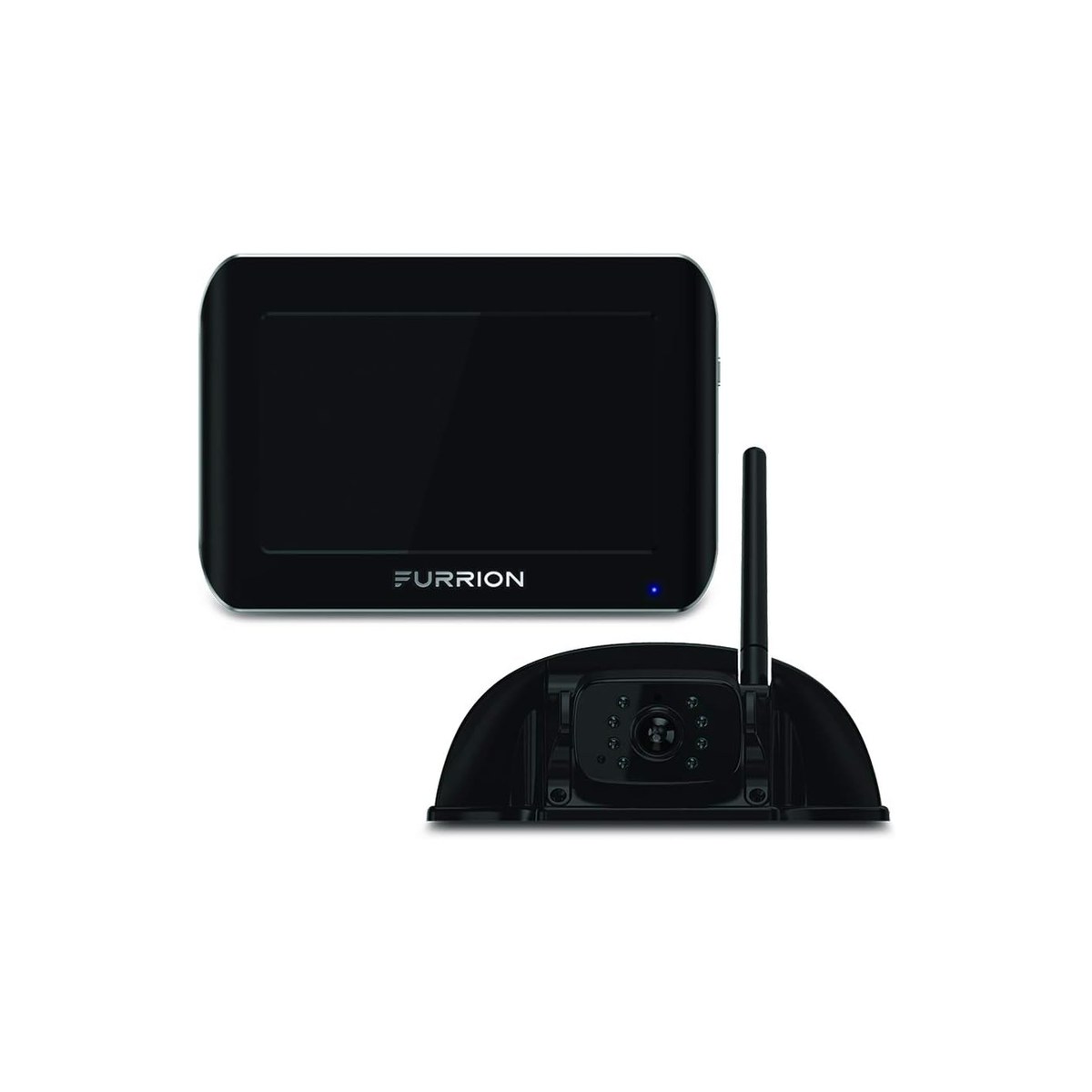
Furrion Vision S Wireless RV Backup Camera System, 7-inch Monitor, Rear Sharkfin, IR Night Vision, IP65 (the Furrion-prep match, FOS07TASF, ASIN B07CZ268GT)
The prep-match most RV owners should buy, and the proven default.
Who it's for: The RV owner whose rig has Furrion camera prep, which is most newer travel trailers and fifth wheels from Forest River, Keystone, Grand Design, Jayco, and Dutchmen. Pop the cover plate on the rear cap; if it says Furrion, this sharkfin camera drops onto the existing bracket and pairs with the monitor, with no new wiring or sealing. It is also the safe default for anyone who just wants the most-proven RV backup camera, prep or not.
What we found: The Furrion Vision S is the camera the whole category is measured against, with more than 6,400 ratings at 4.4 stars, far more real-world proof than anything else here. For a Furrion-prep rig it is the no-brainer: the sharkfin mounts on the factory bracket and pairs in minutes. It is a wireless 2.4 GHz system with infrared night vision, a wide view, IP65 weatherproofing, and a microphone. The honest catch is the wireless catch: on a long rig the signal can lag or drop, and at about $350 it is the priciest wireless pick here. It still needs 12-volt power run to the camera.
Bottom line: If your rig has Furrion prep, buy the Furrion Vision S and be done: it is the matching camera, it installs in minutes, and it is the most-proven system in the category. If you do not have prep, it is still a strong, well-supported wireless pick, just not the cheapest. Step down to the Yakry for a Furrion-adapter cam at a quarter the price, or up to a wired system if lag-free backing matters more than an easy install.
- + The Furrion-prep match: the sharkfin clicks onto the existing factory bracket and pairs with the monitor, no new wiring or roof sealing
- + The most-proven camera in the category by far: over 6,400 ratings at 4.4 stars, more real-world data than anything else here
- + Wireless 2.4 GHz with infrared night vision, a wide view, IP65 weatherproofing, and a microphone, on a 7-inch monitor
- × Wireless, so on a long rig the signal can lag or drop, the recurring owner complaint
- × Standard-definition picture (720 by 480), not HD: at about $350 you pay for the prep-match and the proven track record, not sharpness, and the cheaper Yakry shoots 1080p
- × Like every 'wireless' camera, it still needs 12-volt power run to the camera (only the video is wireless)
Runner-up: Rear View Safety RVS-770613 Wired RV Backup Camera System, 7-inch Auto-Dimming Monitor, 130-degree IR Camera (commercial-grade, no-lag, ASIN B07K37MFRC).
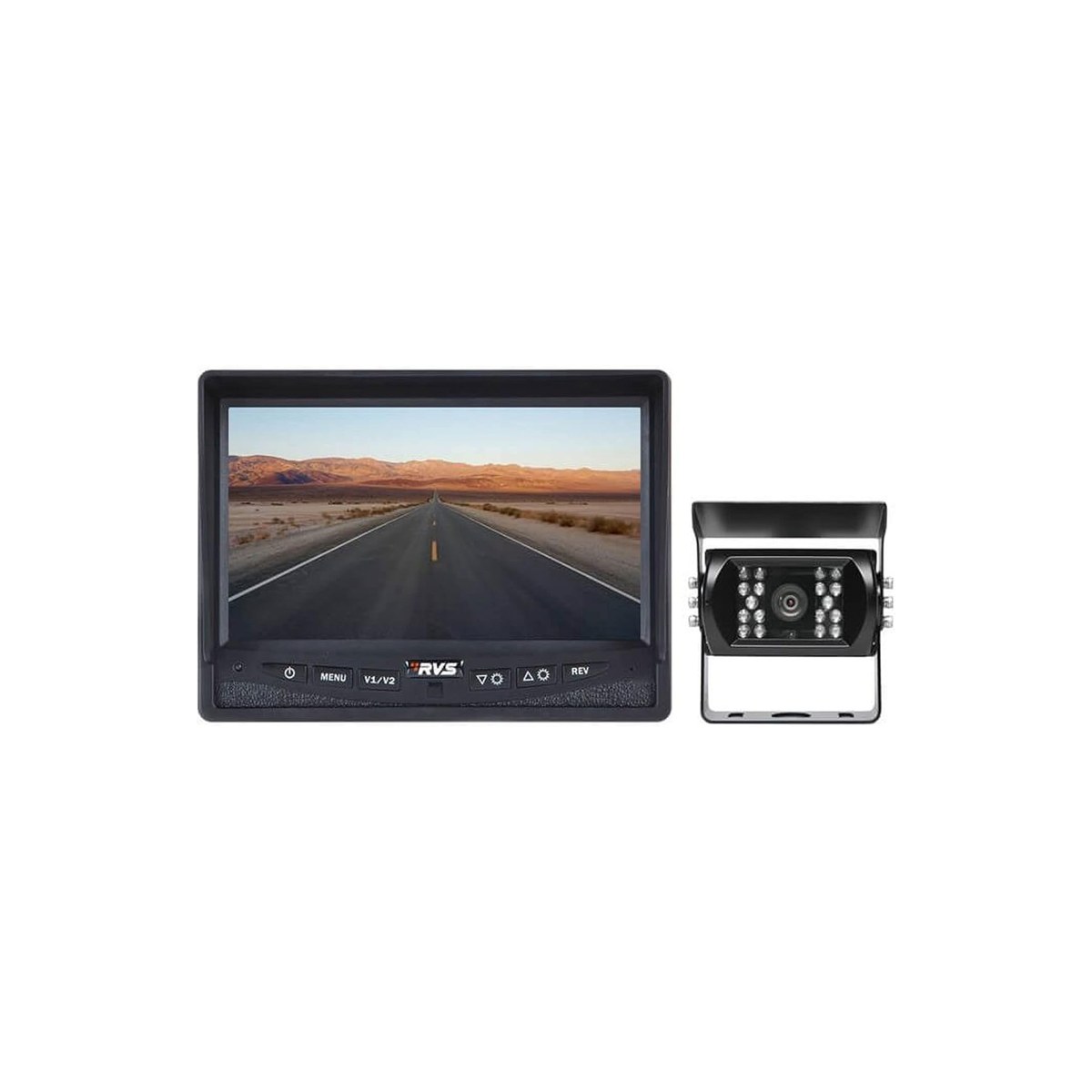
Rear View Safety RVS-770613 Wired RV Backup Camera System, 7-inch Auto-Dimming Monitor, 130-degree IR Camera (commercial-grade, no-lag, ASIN B07K37MFRC)
The wired, no-lag pick if you will really back into sites.
Who it's for: The owner who will actually use the camera to maneuver, backing a big rig into a tight, tree-lined site solo, and who refuses to gamble on a wireless image that might freeze at the worst moment. This is the buyer who will run a cable bow to stern for a picture that is simply there, instantly, every time, and who values commercial-grade hardware over consumer convenience. It is the wired rv backup camera for people who back up for real.
What we found: The Rear View Safety RVS-770613 is a commercial-grade wired system built for RVs, trucks, and buses, with a 7-inch auto-dimming monitor, a 130-degree IR camera, and a wired harness that means zero lag and zero dropout. That reliability is the whole point: the image is there the instant you shift to reverse. The honest catches are real. At about $320 it costs as much as the priciest wireless units, the wired install is a genuine job, and it has only 53 Amazon ratings at 4.2 stars, far fewer than the wireless leaders, because the market overwhelmingly buys wireless, not because it is worse.
Bottom line: Choose the RVS-770613 if lag-free reliability matters more than an easy install, which it should if you regularly back a large rig into tight spots. It is the no-compromise wired pick, and the commercial-grade build outlasts cheap consumer cams. Skip it if you want plug-and-play (go wireless) or the lowest price (the Yakry). Go in knowing the trade: you run a cable and pay more, and you get a picture you can actually trust the moment you need it.
- + Wired, so zero lag and zero dropout: the image is there the instant you shift to reverse, which is exactly when it matters
- + Commercial-grade hardware (RV, truck, and bus duty) with a 7-inch auto-dimming monitor and a 130-degree infrared camera
- + No wireless interference, no pairing, no antenna fiddling on a long rig: a wired feed just works
- × The hardest install here: you fish a roughly 66-foot cable the length of the rig from the rear cap to the dash, so budget the time or a shop
- × Standard-definition analog image (about 620 TVL), so you buy zero lag and durability, not sharpness; the 1080p Yakry and AMTIFO are sharper; and about $320, as much as the priciest wireless units
- × Only 53 Amazon ratings at 4.2 stars, far fewer than the wireless leaders, because the consumer market overwhelmingly buys wireless (not because it is worse)
Budget pick: Yakry Y27-N RV Backup Camera, 1080p, 7-inch Touch Monitor, Pre-Wired for Furrion (Furrion-adapter, wireless, ASIN B07H3PGBYB).
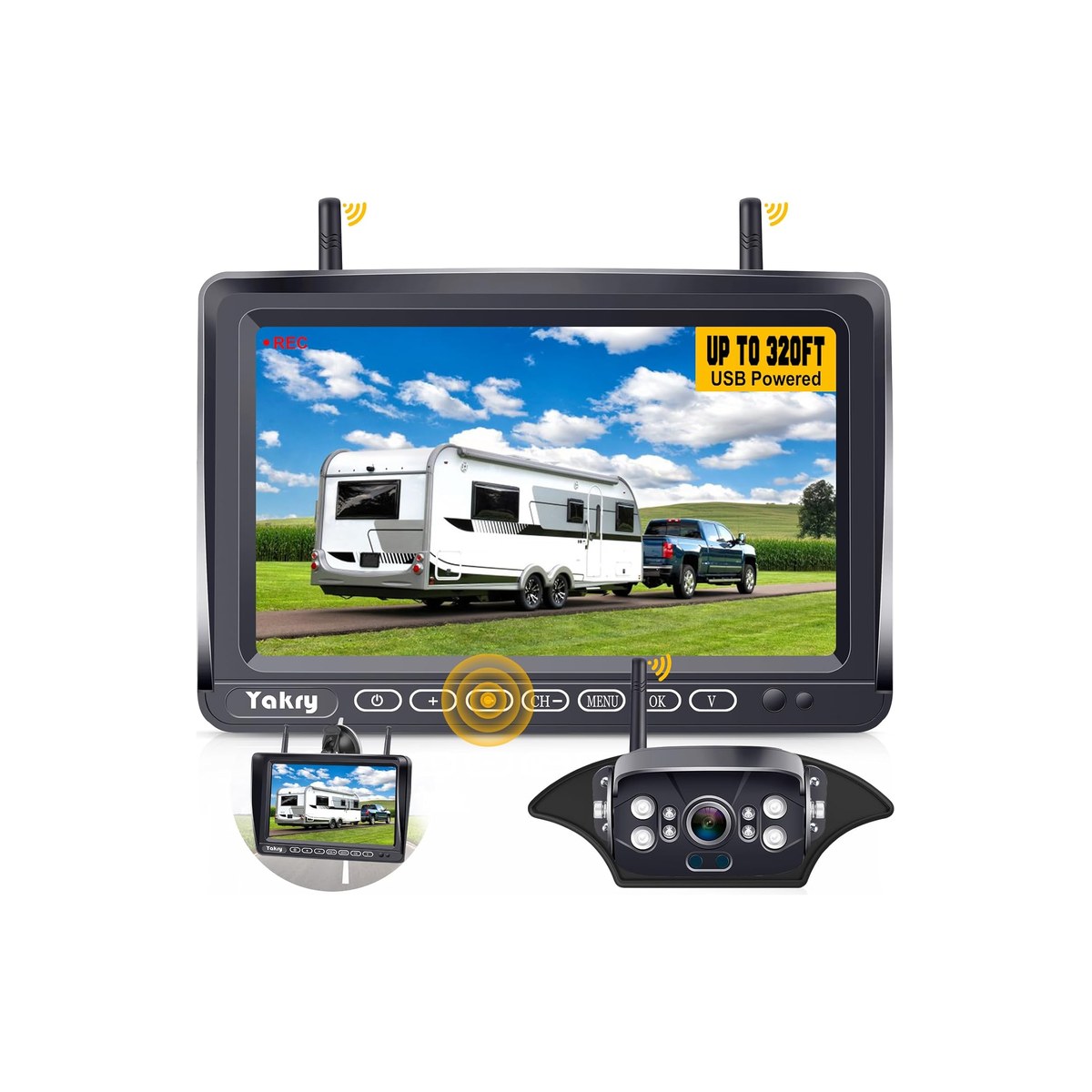
Yakry Y27-N RV Backup Camera, 1080p, 7-inch Touch Monitor, Pre-Wired for Furrion (Furrion-adapter, wireless, ASIN B07H3PGBYB)
A 1080p Furrion-adapter cam for a quarter the genuine price.
Who it's for: The Furrion-prep rig owner who wants the matching-bracket convenience without paying genuine-Furrion money, and any budget buyer who wants a proven 1080p system for under $100. This is the buyer who pops the cover plate, sees Furrion, and realizes they can get a sharper 1080p, 7-inch touch system that plugs into the same Furrion prep harness for about $92 instead of $350, and who is fine with an aftermarket brand that has thousands of happy reviews behind it.
What we found: The Yakry Y27-N is the value revelation of this category: a 1080p, 7-inch touch-monitor system that ships with a Furrion-prep adapter, so it clicks onto the same factory bracket as the genuine Furrion for about $92, a quarter of the price. At 4.4 stars across more than 5,400 ratings it is as proven as the Furrion itself. It is wireless, so the usual caveats apply: lag or dropout possible on a long rig, and you still run 12-volt power to the camera. But for a prep rig on a budget, it is hard to argue with 1080p and 5,400 reviews at under $100.
Bottom line: For a Furrion-prep rig, the Yakry Y27-N is the smart-money buy: the same bracket fit and a sharper 1080p picture than the genuine Furrion, for a quarter of the cost, with thousands of reviews behind it. Buy the genuine Furrion instead only if you want the brand's support and longest track record; step up to a wired system if you need zero lag. For most prep owners watching their wallet, this is the one.
- + Ships with a Furrion-prep adapter: plugs into the same prep harness as the genuine Furrion, for about $92 instead of $350
- + Sharper 1080p picture on a 7-inch touch monitor, and over 5,400 ratings at 4.4 stars, as proven as the Furrion itself
- + The smart-money pick for a Furrion-prep rig on a budget: a quarter of the genuine price
- × Wireless, so the usual lag-or-dropout caveat applies on a long rig
- × Still needs 12-volt power run to the camera
- × An aftermarket brand rather than the OEM, if that matters to you for support
Also worth considering.
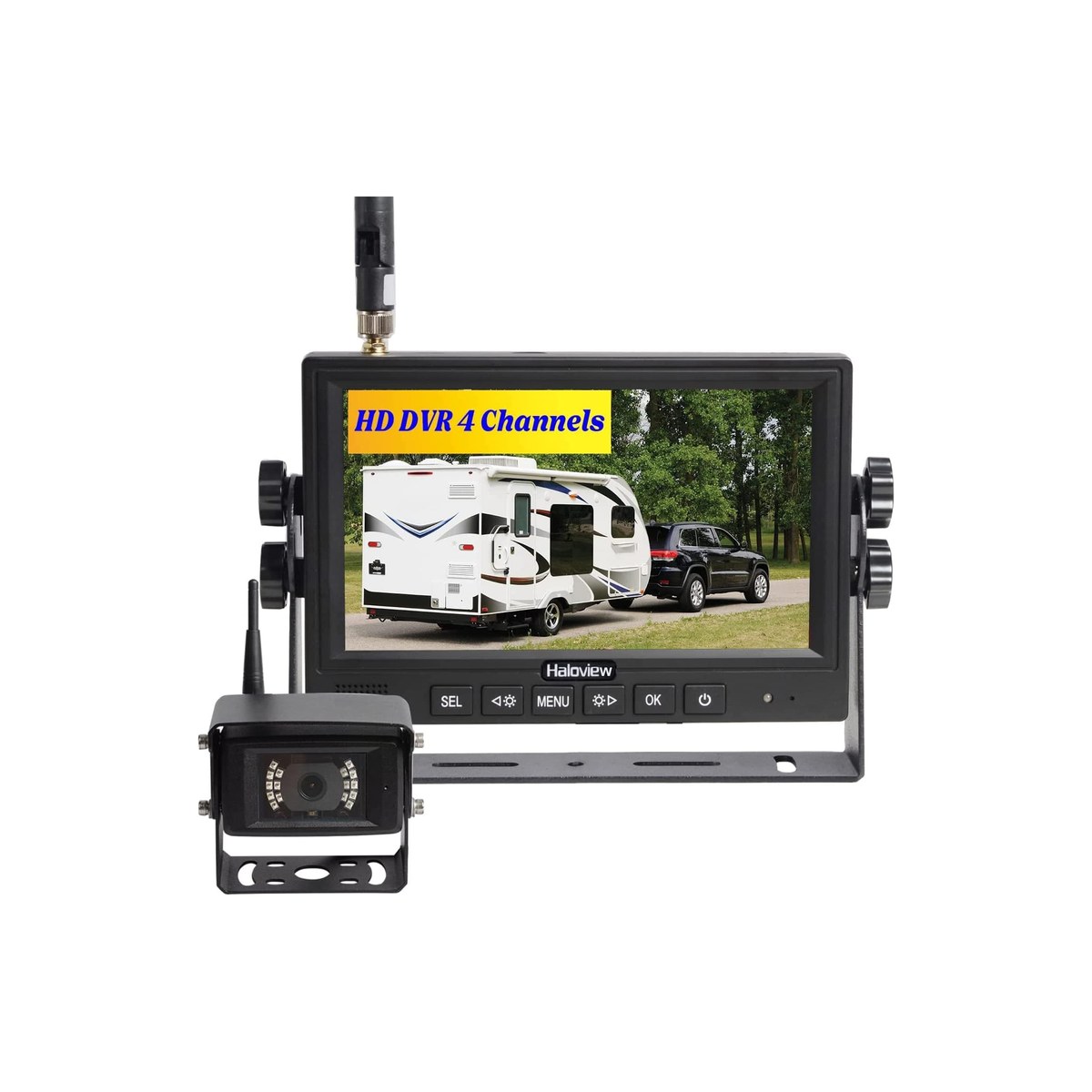
Haloview MC7108 Wireless RV Backup Camera System, 7-inch Monitor, Built-in DVR, IR Night Vision, up to 4 Cameras (ASIN B07GKXPKRS)
The best wireless system for a long rig, with a booster path.
Who it's for: The owner of a no-prep rig, especially a long fifth wheel or Class A, who wants a capable wireless system and is willing to add an extension antenna if the signal needs help. This is the buyer who wants a 7-inch monitor with a built-in DVR, room to add side and hitch cameras later, and the established Haloview booster-antenna ecosystem that solves the long-rig dropout problem the cheap wireless cams cannot.
What we found: The Haloview MC7108 is the enthusiast's wireless pick, a 7-inch system with a built-in DVR, infrared night vision, and support for up to four cameras, at about $250 with 4.4 stars across nearly 1,300 ratings. Its real advantage on a long rig is the ecosystem: Haloview sells extension antennas (33, 42, and 49 feet), and the owner fix for lag and dropout on a big trailer is exactly that, add or reposition the antenna. It is still wireless, so it still needs 12-volt power to the camera, and the base range struggles on a 40-footer until you boost it.
Bottom line: Buy the Haloview MC7108 if you have a no-prep rig and want a serious, expandable wireless system, and you are willing to add a booster antenna on a long trailer. It is the best wireless system here for big rigs and multi-camera setups. Skip it if your rig has Furrion prep (buy the matching cam) or if you want zero lag (go wired). For a Class A or long fifth wheel without prep, this plus an extension antenna is the wireless answer.
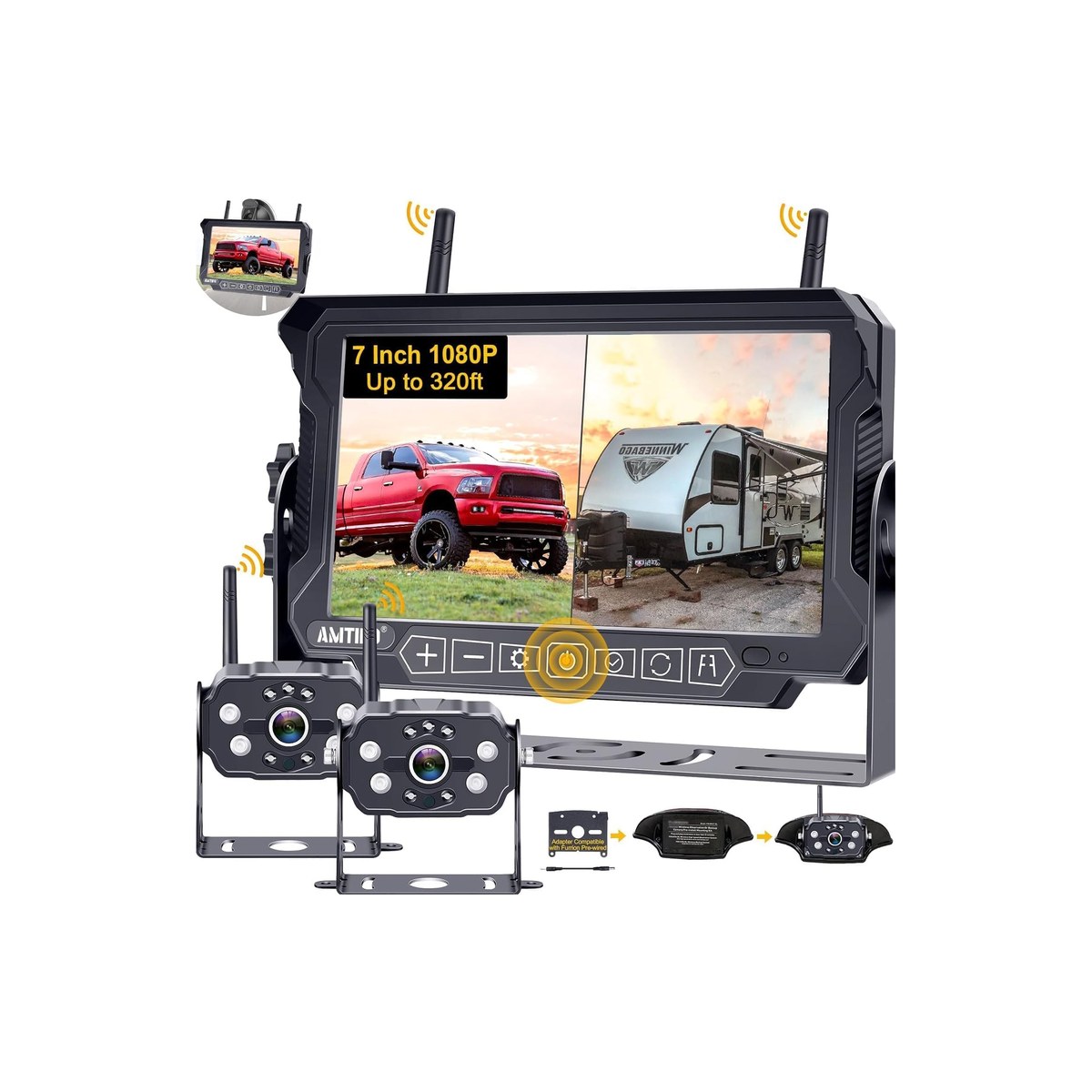
AMTIFO Wireless RV Backup Camera System, 2 HD 1080p Cameras, 7-inch Split-Screen Monitor, Furrion-Compatible, Loop Recording (ASIN B07F8Q4NHY)
Two 1080p cameras and a split screen for sides or a hitch.
Who it's for: The owner who wants more than a rear view, a side camera for lane changes and blind spots, or a hitch camera for coupling a fifth wheel solo. This is the buyer who values seeing two angles at once on a split-screen monitor, and who has either a Furrion-prep rig (the AMTIFO ships a Furrion adapter) or no prep at all. It suits anyone who has had a close call changing lanes blind in a long rig.
What we found: The AMTIFO 2-camera system is the multi-camera value pick: two 1080p cameras and a 7-inch split-screen monitor for about $160, with loop recording, night vision, and Furrion-prep compatibility, at 4.4 stars across more than 700 ratings. Run the second camera on a side for lane changes or on the hitch for coupling. It is wireless, with the usual caveats, lag or dropout possible on a long rig and 12-volt power run to each camera. For the price, two angles is a lot of capability.
Bottom line: Choose the AMTIFO 2-camera if you want a rear plus a side or hitch view without paying for a pricey multi-camera rig. The split screen and the second camera genuinely help on lane changes and solo hitching, and it works on Furrion-prep or no-prep rigs. Skip it if you only need a rear view (the others are simpler and cheaper for that) or if you want zero lag (go wired). As an affordable two-angle system, it earns its spot.
Skip this guide if...
Skip this guide if you do not actually need a camera, or already have one you trust. If you tow a short trailer you can see over, or you always travel with a spotter, you may not need a backup camera at all. If your rig came with a working factory camera you are happy with, there is no reason to replace it. And if you only want a camera to watch a parked rig for security, that is a different product, our sibling Best RV Security Cameras guide, not a backup camera. A backup camera earns its place when you back a rig you cannot see behind, especially solo, into tight or unfamiliar sites.
Don't bother with.
- × Skip Buying a generic kit when your rig has Furrion or Voyager prepThis is the single most common mistake in the category. A prep'd rig has a factory bracket and power already on the rear cap behind a branded cover plate; the right buy is the matching camera (or a Furrion-adapter cam), which clicks on and pairs in minutes. Buyers who read a generic 'best RV backup camera' list and grab a no-adapter kit end up removing the factory bracket and hardwiring a new one, sealing the rear cap themselves. Pop the cover plate first, read the brand, and buy to match.
- × Skip Assuming 'wireless' means no wiring at allNearly every 'wireless' RV backup camera still needs 12-volt power physically run to the camera, usually a tap off a rear taillight or marker light. Only the video signal is wireless. Buyers expecting a peel-and-stick, no-wires install are surprised. The only truly wire-free options are solar or battery magnetic cameras, a small niche with their own trade-offs. Plan to run power to the camera regardless of what 'wireless' implies.
- × Skip Trusting the marketing range number on a long rigWireless cameras advertise huge open-air ranges (often hundreds of feet), but real-world range collapses on a long rig, behind a metal or aluminum frame, at highway speed, and near cell towers, which is the number-one owner complaint: lag, freezing, and dropout. The fix is cheap and well-documented: add a $15 to $30 extension antenna or reposition the monitor higher and away from the cab electronics. Budget for the antenna on a 40-footer, or go wired.
- × Skip A car license-plate backup camera on a tall RVA car-market license-plate camera is mounted low and aimed for a sedan's bumper; on a tall RV or fifth wheel it sits too low, vibrates loose over time, and gives you a view of the road right behind the bumper rather than the wide, elevated angle you need to back a big rig. Buy a camera built and mounted for an RV (sharkfin or roof-line bracket), not a repurposed car cam, unless you specifically want a low hitch-coupling view.
- × Skip Skipping night vision and weatherproofing to save a few dollarsThe cheapest cameras cut the things that make a camera last and work when you need it: real infrared night vision (you back into sites at dusk) and genuine weatherproofing (a roof-mounted camera lives in UV, rain, and constant vibration). Owners report bargain cams dying within a season from heat and water intrusion, or washing out at night. Pay for IR night vision and an IP-rated housing; a backup camera you cannot see through at dusk in the rain is not a bargain.
How we picked.
Sources we read and how we picked
We did not bolt cameras to ten rigs in a lab. We read the RV owners who live with these systems: the long range-and-dropout threads on Forest River, Grand Design, and iRV2 forums, the prep-camera and wireless write-ups on The Camping Nerd and Camp Addict, and the durability reviews from owners who actually backed into sites with them. Then we verified every price, rating, and review count live on Amazon on June 11, 2026.
Our filter was the decision RV owners actually face, in order: do you have Furrion or Voyager prep, then wired versus wireless, then range, cameras, and budget. That is why the lineup leads with the Furrion-prep match and a wired no-lag pick, then covers the best wireless system, the value Furrion-adapter, and a multi-camera option. Every spec here was checked against the live listing, because vendor range and resolution claims are the least reliable numbers in this category.
First, check for Furrion or Voyager prep
The single most important step happens before you shop: pop the cover plate on the rear cap of your rig and look for a brand name. Most newer travel trailers and fifth wheels (Forest River, Keystone, Grand Design, Jayco, Dutchmen) ship with Furrion prep, a factory bracket and power already wired to a Furrion cover plate. Airstream, Winnebago, and Lance tend to use Voyager prep instead. If your rig is prepped, the bracket and power are done for you.
For a prepped rig the right buy is the matching camera, not a generic kit. A Furrion-prep rig takes the genuine Furrion Vision S, or a 1080p Furrion-adapter cam like the Yakry Y27-N that plugs into the same prep harness for a quarter of the price. A Voyager-prep rig (Airstream, Winnebago, Lance) needs the Voyager match, the Voyager WiSight system; we do not score Voyager here because this guide covers Furrion-prep and no-prep rigs, but the Furrion-bracket picks below will not seat in a Voyager mount, so a Voyager owner buys the WiSight, not a Furrion-adapter cam. The classic, costly mistake is a prepped-rig owner buying a no-adapter generic kit, then having to strip the factory bracket and hardwire a new one. Check the plate first; it decides everything downstream.
Wired vs wireless: the real choice for a no-prep rig
If your rig has no prep, the decision is wired versus wireless, and the owner consensus inverts the marketing. Wireless wins the install: most are a taillight power tap plus a pairing step, an hour's job. But wired wins the use. A wired rv backup camera has no lag and no dropout, so the image is there the instant you shift to reverse, which is the exact moment it matters when you are easing a big rig between two trees.
Wireless cameras lag, freeze, and drop out, and it gets worse with rig length, metal frames, highway speed, and interference, the number-one complaint in every owner thread. For most weekend backing, modern digital wireless is fine, and it is sharper than the standard-definition wired unit here. But for repeated tight-site backing on a long rig, especially solo, wired's zero lag and zero dropout matter more than picture sharpness, and a booster antenna is only a wireless half-measure. Match the choice to how you actually back up.
Range, power, and mounting reality
Two install truths catch buyers out. First, 'wireless' is only the video: you still run 12-volt power to the camera, usually a tap off a rear taillight or marker light. Second, the marketing range is open-air best case; on a 40-foot rig with an aluminum frame the real range is far shorter, and the proven fix for lag and dropout is a $15 to $30 extension antenna or repositioning the monitor higher, away from the cab electronics. Budget for the antenna on a long trailer.
On mounting, an RV camera belongs high on the rear cap (a sharkfin or roof-line bracket) for the wide, elevated view you need to back a big rig, not a low car-style license-plate mount that sits too low and vibrates loose. Match the camera to your rig: a tall Class A or fifth wheel wants a roof-line mount and, if wireless, a booster; a van build can run a cleaner wired install into an existing screen.
One camera or several, and the monitor
A rear camera is the baseline, but many RV owners add more. A side camera turns blind lane changes in a long rig into a glance at a split screen; a hitch camera makes coupling a fifth wheel a solo job. Systems like the AMTIFO 2-camera ship two 1080p cameras and a split-screen monitor for that reason, and the better wireless systems (Haloview) support up to four. If you have ever had a close call merging blind, the second camera is worth more than another megapixel.
On the monitor, 7 inches is the RV standard and the right call for anyone running a split screen; owners on big rigs find a 5-inch screen genuinely too small. Look for an auto-dimming or anti-glare display so a sun-washed dash does not wash out the image, and infrared night vision so you can back into a site at dusk. The monitor is what you actually look at, so do not undersize it to save twenty dollars.
FAQs.
Q01 What is the best RV backup camera?
+
Q02 How do I know if my RV has backup camera prep?
+
Q03 Wired vs wireless RV backup camera: which is better?
+
Q04 Do wireless RV backup cameras lag, and how do I fix it?
+
Q05 Does a wireless RV backup camera still need power wired to it?
+
Q06 Can I use a car backup camera on my RV?
+
Q07 How do I install an RV backup camera?
+
Q08 Can I add a side or hitch camera?
+
If you, then this.
- IF your rig has Furrion camera prep (check the rear-cap cover plate)GET Furrion Vision S 7" (B07CZ268GT; the matching cam, clicks on the factory bracket) or the Yakry adapter cam to save money$349.99 →
- IF you will actually back a big rig into tight sites and want zero lagGET Rear View Safety RVS-770613 (B07K37MFRC; commercial-grade wired, no dropout)$320.00 →
- IF you have Furrion prep but want 1080p for a quarter the priceGET Yakry Y27-N (B07H3PGBYB; 1080p Furrion-adapter, 5,400+ reviews)$91.99 →
- IF you have a no-prep long rig and want the best expandable wireless systemGET Haloview MC7108 (B07GKXPKRS; 7" DVR, up to 4 cameras, add the booster antenna)$249.99 →
- IF you want a rear plus a side or hitch viewGET AMTIFO 2-Camera (B07F8Q4NHY; two 1080p cams, 7" split screen, Furrion-compatible)$159.99 →
- IF you tow a short trailer you can see over, or always have a spotterGET possibly nothing, or a cheap wireless cam for peace of mind; do not over-buyvaries →
RV & Van Gear: The Complete Guide
The whole-rig picture →Every system in a van, RV, or camper, organized in one place, with the safety and weight floor and the one guide we trust for each.
- Furrion vs Voyager RV backup cameras: prep and compatibility · RV Upgrade Store
- Best backup cameras for RVs, tested by rig type · Camp Addict