Best Starlink for RVs: Which Dish, Which Plan, and the 3 Mounts Worth Buying (2026)
Starlink is the only internet that reaches the off-grid spots no cell plan covers, and for RVers it comes down to three decisions: which dish, which Roam plan, and how to mount it. The dish and the plan you buy direct from Starlink, not Amazon. The mount is what you buy on Amazon, and it matters more than people expect, because a dish that can't see open sky is a dead dish. We checked Starlink's live Roam pricing on June 16, 2026, read the RV-internet authorities, and verified every mount on Amazon. The honest headlines: the Mini at about $249 is lighter but actually worse in trees than the $349 Standard; Roam runs $55, $80, or $175 a month depending on data; and the real cost is the battery and solar to feed its continuous draw, which can double the first-year total.
- 01 FlagPole Buddy Ladder Mount (B0DK28P4TC) , top pick, the community-standard RV ladder mount, Gen 3 compatible, 4.7/61, ~$210
- 02 NovaKits Ground Pole Mount (B0DF5DWS3Q) , best for treed sites, a 10ft no-dig pole that walks the dish to open sky, 4.4/37, ~$90
- 03 wuutyty Ladder/Pole Mount (B0CS3CFVDG) , the budget mount, plain aluminum clamp + pipe adapter, 200lb, 4.0/82, ~$40
How they compare.
| Rank | Product | Best for | Price | Our score |
|---|---|---|---|---|
| 01 | FlagPole Buddy Ladder Mount (B0DK28P4TC)
Top Pick
| best overall: the community-standard ladder mount, sturdy and quick to raise and stow, lifts the dish above the roofline; needs a rear ladder | $209.95
Buy → | 8.6/10 |
| 02 | NovaKits Ground Pole Mount (B0DF5DWS3Q) | best for obstructed sites: a 10ft no-dig pole that decouples the dish from the rig so you can chase open sky away from trees | $89.99
Buy → | 8.2/10 |
| 03 | wuutyty Ladder/Pole Mount (B0CS3CFVDG) | best budget: a $40 aluminum clamp-and-pipe bracket that does the basic mounting job; check your ladder rail diameter first | $39.99
Buy → | 7.6/10 |
Prices are current Amazon prices at time of publication and can change. Scores reflect our editorial evaluation, not vendor input.
Our #1 pick: FlagPole Buddy Starlink Gen 3 Compatible Mounting Kit for RV Ladder Mount (ASIN B0DK28P4TC).
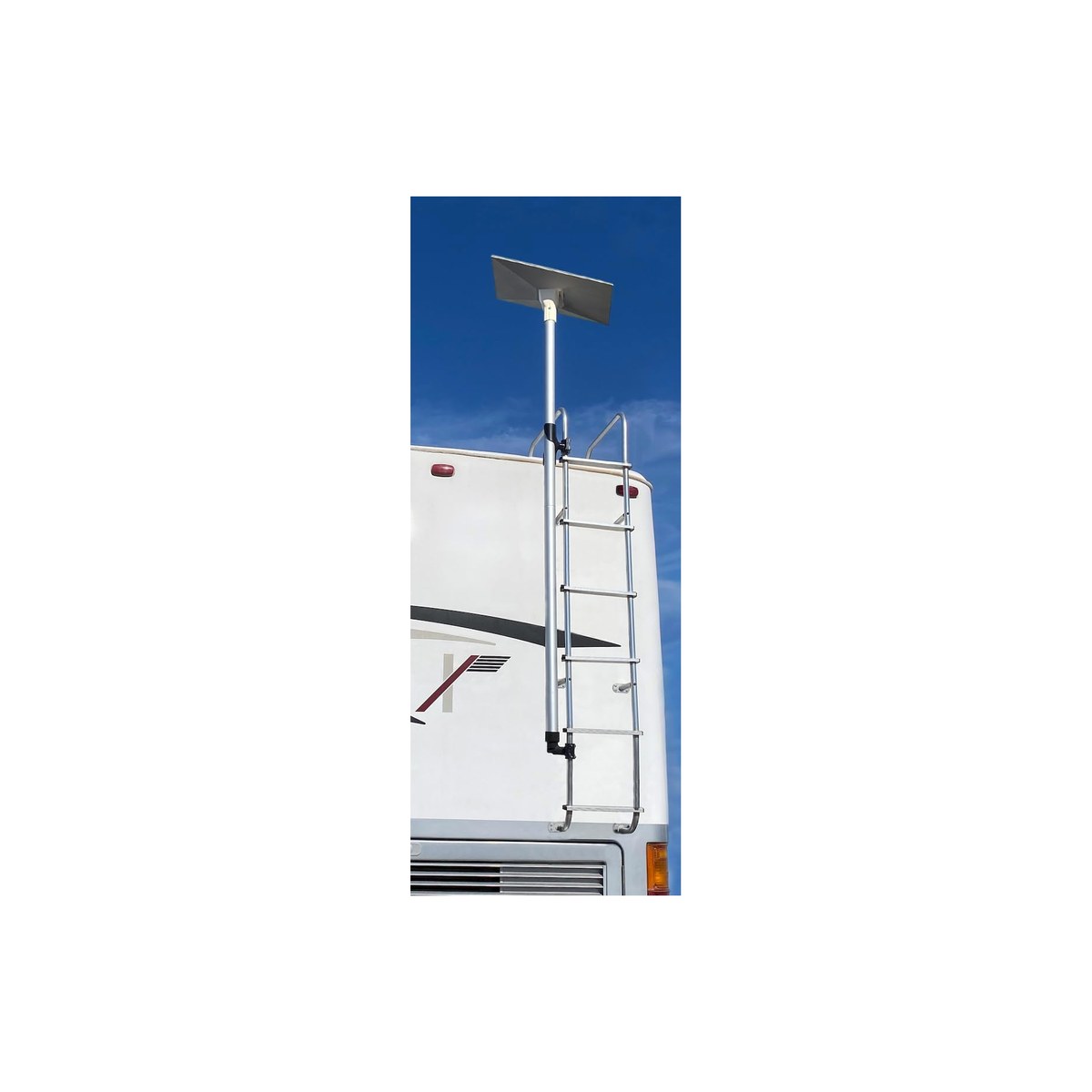
FlagPole Buddy Starlink Gen 3 Compatible Mounting Kit for RV Ladder Mount (ASIN B0DK28P4TC)
The community-standard RV ladder mount, on and off in seconds.
Who it's for: The RVer who wants the most trusted way to mount a Starlink without drilling the roof, clamping it to the rear ladder so it sets up in seconds and stows for travel. The FlagPole Buddy is the mount the RV-internet community keeps landing on, a Gen 3 compatible kit built for the rear ladder, sturdy enough to hold the dish steady in wind yet quick to raise and lower at each site.
What we found: At 4.7 stars it is the best-rated mount here, and it earns the reputation, heavy-gauge aluminum, a proper Gen 3 dish adapter, and a design that lets you lift the dish above the roofline for a cleaner view of the sky than a roof mount gives. The catch is price: at about $210 it costs more than the dish-to-ladder brackets below, and stock runs thin. It mounts to a standard RV rear ladder, so confirm you have one before buying.
Bottom line: Buy the FlagPole Buddy if you have a rear ladder and want the sturdiest, best-proven mount that still sets up and stows fast, it is the one most full-timers settle on. If your site is buried in trees, you will still want the ground pole below to walk the dish out to open sky. And if $210 is more than you want to spend on a bracket, the budget mount does the basic job.
- + The best-rated mount here at 4.7 stars, heavy-gauge aluminum with a proper Gen 3 dish adapter, the mount the RV-internet community keeps recommending
- + Clamps to a standard RV rear ladder, no roof holes, and lifts the dish above the roofline for a cleaner view of the sky than a roof mount
- + Raises and lowers in seconds, so it sets up at camp and stows for travel without a project each time
- × At about $210 it is the priciest mount here, several times the cost of a basic ladder bracket
- × Requires a standard RV rear ladder, confirm you have one and its rail diameter before buying
- × Stock runs thin (often a few units), and it does not solve a treed site, you still need a ground pole for that
Runner-up: NovaKits 10FT Starlink Standard Gen 3 Ground Pole Mount Kit, No-Dig Ground Anchor, Gen 3 Pipe Adapter (ASIN B0DF5DWS3Q).
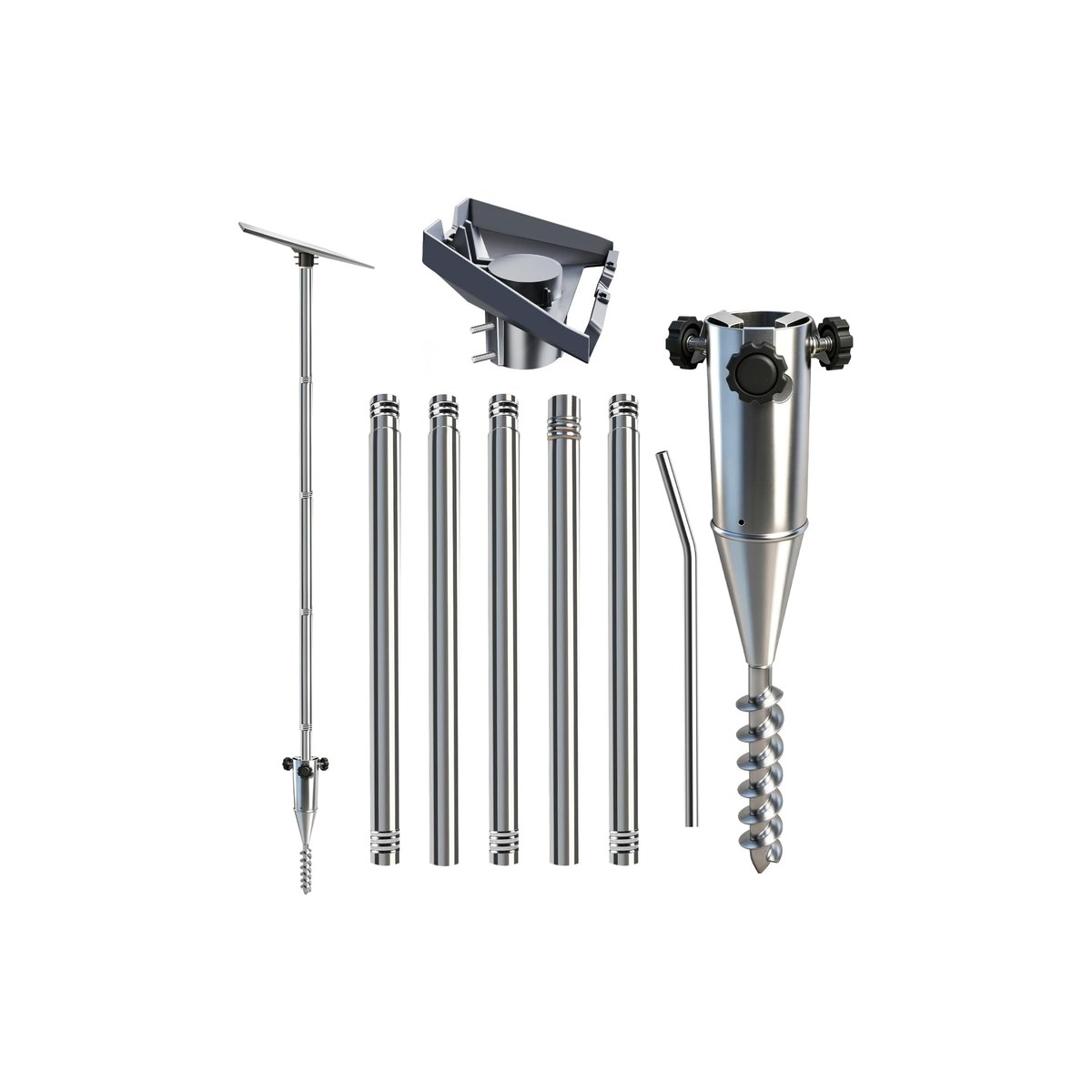
NovaKits 10FT Starlink Standard Gen 3 Ground Pole Mount Kit, No-Dig Ground Anchor, Gen 3 Pipe Adapter (ASIN B0DF5DWS3Q)
Walks the dish out to open sky when trees block your site.
Who it's for: The boondocker whose favorite sites sit under trees, where a roof or ladder mount leaves the dish staring into branches. The NovaKits ground pole is the fix: a 10-foot pole with a no-dig ground anchor that lets you set the dish wherever the sky is clear, twenty or fifty feet from the rig if that is where the opening is, then run the cable back. It turns a treed site from unusable to online.
What we found: It directly solves the single biggest reason Starlink fails for RVers, obstructions, by decoupling the dish from the rig so you can chase open sky. At 4.4 stars across 37 reviews and about $90 it is well-built, the no-dig anchor means no tools and no holes, and the included pipe adapter fits the Standard dish, Mini owners need a Mini-specific adapter. The trade-offs: it is one more bulky thing to carry and set up, and it only helps if there is a clear patch of sky somewhere within cable reach, which dense forest may not offer.
Bottom line: Buy the NovaKits pole if you camp in the trees and need to move the dish to the light, it is the difference between Starlink working and not at a shaded site. If you mostly park in the open, you do not need it, a ladder mount is simpler. Pair it with a longer Starlink cable if your clear sky tends to be far from where you park.
- + Directly solves obstructions, the single biggest reason Starlink fails for RVers, by decoupling the dish from the rig
- + A 10-foot pole with a no-dig ground anchor, no tools and no holes, with a Gen 3 pipe adapter that fits the Standard dish
- + Lets you set the dish 20 or 50 feet from the rig where the sky opens up, then run the cable back
- × One more bulky item to carry and set up at each site
- × Only helps if there is a clear patch of sky within cable reach, dense forest may not offer one
- × You may need a longer Starlink cable if your clear sky tends to be far from where you park
Budget pick: wuutyty Starlink RV Ladder Mount / Pole Mount, All-Aluminum Pipe Adapter, 200lb Load, 0.8-1.17in Rail Range (ASIN B0CS3CFVDG).
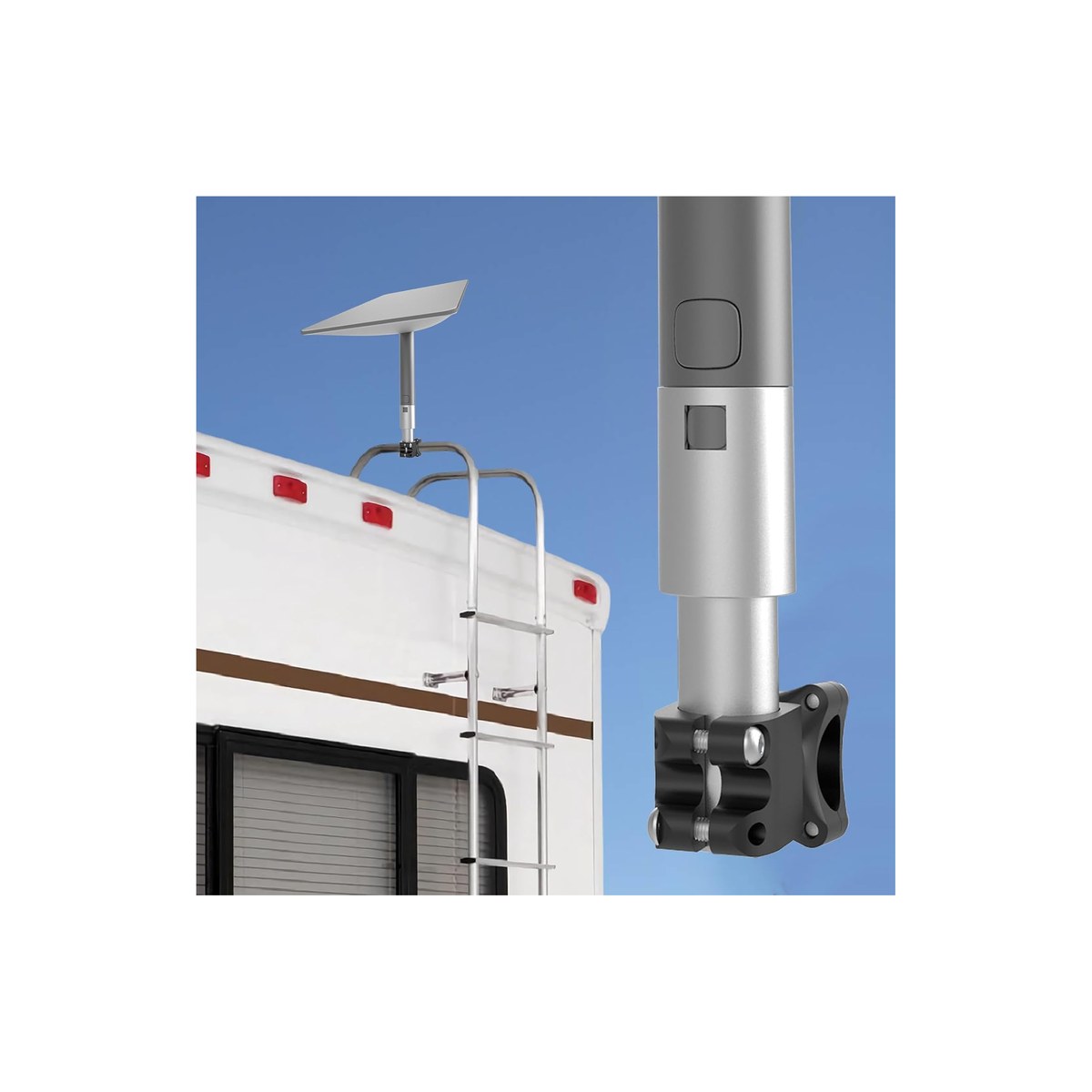
wuutyty Starlink RV Ladder Mount / Pole Mount, All-Aluminum Pipe Adapter, 200lb Load, 0.8-1.17in Rail Range (ASIN B0CS3CFVDG)
The $40 aluminum bracket that does the basic mounting job.
Who it's for: The budget-minded RVer who wants to get the dish mounted to a ladder or pole without spending more on the bracket than a month of service. The wuutyty mount is a plain aluminum clamp-and-pipe adapter that attaches the Starlink to a rear ladder rail or a pole, rated to 200 pounds, for about $40, a fraction of the FlagPole Buddy's price.
What we found: It does the one job it claims, a sturdy aluminum bracket with a pipe adapter that clamps to a rail from 0.8 to 1.17 inches, and at 4.0 stars across 82 reviews it has more buyer history than the premium mount. What you give up is the FlagPole Buddy's polish and reach: it does not lift the dish as high or stow as elegantly, and a few reviewers note the fit is fussier on odd-diameter rails. For a simple, cheap, functional mount it holds up.
Bottom line: Buy the wuutyty mount if you want the cheapest legitimate way to clamp a Starlink to your ladder and you do not need the premium mount's finish or extra height. Measure your ladder rail's diameter against its 0.8-to-1.17-inch range first. If you fight obstructions this does not solve that, the ground pole does; and if you want set-and-forget sturdiness, the FlagPole Buddy is worth the step up.
- + About $40, a fraction of the FlagPole Buddy, the cheapest legitimate way to mount the dish to a ladder or pole
- + All-aluminum clamp with a pipe adapter rated to 200 pounds, with more buyer history (82 reviews) than the premium mount
- + Fits ladder or pole rails from 0.8 to 1.17 inches, so it works on a range of RV ladders
- × Does not lift the dish as high or stow as cleanly as the FlagPole Buddy, it is a plain bracket
- × A few reviewers note the fit is fussier on odd-diameter rails, measure yours first
- × At 4.0 stars it is the lowest-rated mount here, and like all of these it does nothing about obstructions
Skip this guide if...
Skip a Starlink setup entirely if you mostly camp where you already have cell coverage, a cellular hotspot or router is cheaper to buy and run, see our RV internet guide, and Starlink only earns its cost off-grid. Skip it too if your sites sit under dense canopy with no clear patch of sky within cable reach, a ground pole solves partial tree cover but cannot replace open sky that isn't there. And do not buy any mount until you have the dish and know whether you have a rear ladder, a roof you will drill, or a need to set the dish on the ground.
Don't bother with.
- × Skip Buying the Starlink dish on AmazonThere are Starlink Mini and Standard listings on Amazon, but Starlink sells the hardware directly at Starlink.com, and the Amazon listings are third-party resellers charging a markup, sometimes hundreds over retail, often with no warranty support since the kit has to be registered to an account. The dish is the one part of this guide you should not buy on Amazon. Order it from Starlink.com, then buy the mount and accessories, the parts Starlink does not sell, here.
- × Skip Magnetic roof mounts on a typical RVMagnetic Starlink mounts are everywhere on Amazon and they look easy, but they only hold on a steel roof, and almost no RV has one, RV roofs are rubber membrane, fiberglass, or aluminum, none of which a magnet grips. On a van or truck with a steel roof they can work; on a motorhome or travel trailer they will slide or fly off at highway speed. Use a ladder mount, a ground pole, or a proper bolt-down roof mount instead.
- × Skip Assuming the Mini is the better RV dish because it's smallerThe Starlink Mini is lighter, cheaper, lower-power, and has built-in WiFi, so it is the right pick for most RVers, but the portable framing hides a real trade-off: its smaller antenna is actually less tolerant of obstructions than the larger Standard. Under partial tree cover or at the edge of a clearing, the Standard holds a connection the Mini drops. If you mostly camp in the deep woods, the bigger dish is the more capable one, not the cute one.
- × Skip Forgetting that the power system is the real costThe dish is a few hundred dollars and the mount is less, but running Starlink off-grid is where the money goes. It draws a continuous 20 to 100 watts depending on the dish, all day, every day you want internet, which a small battery cannot sustain. A realistic off-grid setup needs a lithium battery and solar, roughly $600 to $1,500 for the low-draw Mini and $1,500 to $3,000 for the power-hungry Standard, to keep the dish fed. Budget the power system before the dish, see our RV lithium battery and solar guides.
- × Skip Expecting Roam to perform like home internet at a busy parkRoam is Starlink's lowest-priority tier, so when a satellite beam is congested, Roam users are throttled behind Residential and Priority customers. In the open you may see 50 to 100-plus megabits; at a packed campground on a holiday weekend it can drop to 5 to 25. It is still usually better than campground WiFi, but plan for variable speeds, not a fixed home connection, and keep a cellular backup for the times Starlink slows or the sky is blocked.
How we picked.
How we decoded this and picked the gear
Starlink for an RV is really three decisions stacked together, which dish, which Roam plan, and how to mount it, and only the last one is something you buy on Amazon. So we split the work: we decoded the dish and plan choices from Starlink's own pages and the RV-internet authorities, and we treated the mounts and accessories as the buyable gear to test. We checked Starlink's live Roam pricing on June 16, 2026, and verified every mount on Amazon for price, rating, and stock.
Our filter for the gear was fit and proof: the mount that solves the most common problem leads, the one that solves the hardest problem, obstructions, comes next, and the cheapest functional option anchors the budget. We rank on what actually keeps a dish online and steady, not on spec-sheet extras. The dish itself we leave editorial, because you cannot buy it here, and the Amazon listings that say you can are resellers to avoid.
Mini vs Standard: which dish for an RV
For most RVers the Starlink Mini is the right dish. At about $249 it is the cheaper, lighter option, it runs on a wide 12-to-48-volt DC input through Starlink's car adapter so it draws far less power, and it has a WiFi router built in, no separate equipment to wire up. It packs into a backpack, sets up in a minute, and for open-sky camping it is all the dish you need. It is the reason most new RV Starlink setups are Minis.
The Standard, or Gen 3, dish at about $349 is bigger, heavier, and draws more power, 75 to 100 watts versus the Mini's 20 to 45, and needs a separate router and an AC power brick. But its larger antenna is more tolerant of obstructions, so under partial tree cover it holds a connection the Mini loses. Buy the Standard if you regularly camp at the wooded edge of clearings and can feed its power draw; buy the Mini otherwise. The old motorized Gen 2 dish, the original Starlink for RVs, is discontinued, so ignore it on the used market unless it is nearly free.
What can't Starlink do on an RV?
Three honest limits decide whether Starlink works for you, and the gear can only address one of them. First, obstructions: Starlink needs a clear view of the sky, and trees, not distance, are its kryptonite, a leafy canopy drops the signal where weak cell service would just slow down. A ground pole that walks the dish to a clear patch is the only fix, which is why it is one of our three picks. Second, power: the dish draws a continuous 20 to 100 watts, so off-grid it demands real battery and solar, the true hidden cost of a Starlink RV setup.
Third, priority: Roam is Starlink's bottom service tier, so on a congested beam, at a packed holiday-weekend campground, Roam users are throttled behind Residential and Priority customers and can drop from 50-to-100-plus megabits in the open to as little as 5 to 25. None of this makes Starlink a bad choice, it is still the only thing that reaches true off-grid country, but it makes it a situational one. The RVers happiest with Starlink treat it as the off-grid tool and keep a cellular plan for everywhere cell service already reaches, which our RV internet guide lays out.
Mounting it, and the real first-year cost
There are three sane ways to mount a Starlink on an RV. A ladder mount, like the FlagPole Buddy, clamps to the rear ladder and is the most popular, quick to set up and stow, no holes drilled. A ground pole, like the NovaKits, decouples the dish from the rig so you can move it to open sky, the answer for treed sites. And a permanent bolt-down roof mount is the cleanest look but means drilling and sealing your roof, an advanced job we would only do on a full-time rig. Skip the magnetic mounts unless your roof is steel, which almost no RV's is.
Add it all up and the real first-year cost is bigger than the headline. The Mini is about $249 and a mount $40 to $210, but the Roam plan runs $660 to $2,100 a year, and the off-grid power system, battery and solar to feed the continuous draw, can add $600 to $1,500 for the Mini or $1,500 to $3,000 for the Standard. A weekend camper who pauses service between trips with Standby Mode (about $10 a month) keeps it cheap; a full-timer running Unlimited with a solar setup is in deep. Decide which you are before you buy, and price the power, not just the dish.
FAQs.
Q01 Which Starlink is best for an RV, the Mini or the Standard?
+
Q02 How much does Starlink for an RV cost per month?
+
Q03 Do I need a special mount for Starlink on an RV?
+
Q04 Does Starlink work while driving in an RV?
+
Q05 Why does my Starlink keep dropping at the campground?
+
Q06 Can I run Starlink off my RV battery?
+
If you, then this.
- IF you have a rear ladder and want the sturdiest, most popular no-drill mountGET FlagPole Buddy Ladder Mount (B0DK28P4TC; Gen 3 compatible, lifts above the roofline)$209.95 →
- IF your sites are treed and you need to move the dish to open skyGET NovaKits 10FT Ground Pole Mount (B0DF5DWS3Q; no-dig anchor, Gen 3 adapter)$89.99 →
- IF you want the cheapest functional ladder or pole bracketGET wuutyty Ladder/Pole Mount (B0CS3CFVDG; all-aluminum, 200lb, measure your rail first)$39.99 →
- IF you are choosing the dish itselfGET the Mini (about $249) for most, the Standard (about $349) only if you camp in tree cover, bought direct from Starlink.comvaries →
- IF you mostly camp where you already have cell coverageGET not Starlink: a cellular hotspot is cheaper to buy and run, see our RV internet guidevaries →
- IF you want to run it off-gridGET price the lithium battery and solar to feed the continuous draw first, see our RV power guidesvaries →
RV & Van Gear: The Complete Guide
The whole-rig picture →Every system in a van, RV, or camper, organized in one place, with the safety and weight floor and the one guide we trust for each.
- Starlink Roam plans and pricing (100GB $55 / 300GB $80 / Unlimited $175), in-motion and marine notes · Starlink
- Starlink Satellite Internet for Mobile RV and Boat Use: dish comparison and real-world performance · Mobile Internet Resource Center
- Starlink Adds a 300GB Plan for RVs: Roam tier breakdown and deprioritization · SatelliteInternet.com
- Starlink Internet Review for RV use: power draw and off-grid setup · EcoFlow
- Choosing the Best Starlink Dish for RV Travel: Gen 3 vs Mini (owner discussion) · Forest River Forums