Best RV Water Softeners: 5 Picks, Re-Rated at Real Hardness (2026)
An RV water softener is a portable tank of ion-exchange resin that trades the calcium and magnesium in campground water, the scale-formers, for sodium, and regenerates with two boxes of grocery-store table salt. The spec-sheet trap: identical 16,000 grain tanks advertise 1,600, 2,000, and 2,461 gallons, because each brand assumes a different water hardness, usually in the fine print, never in the headline. One formula cuts through all of it: grains divided by hardness equals gallons. We pulled the manufacturers' own numbers, ran the math at the 20 grains-per-gallon water the Southwest actually serves, and verified every listing live on Amazon on June 12, 2026. The honest headlines: every 16,000 grain tank on this page becomes the same 800 gallons in the hard-water belt, the regeneration ritual costs about two dollars of salt and half an hour, and the resin inside is a five-to-nine-year part depending on whose rating you read.
- 01 On The Go OTG4-DBLSOFT (B00KVPNVJ6) , top pick, the 16,000 grain category default, 4.7 across 1,880, ~$207
- 02 Pro+Aqua 16,000 Grain (B079N2L7L6) , the shorter tank for tight bays, cover and splitter included, ~$252
- 03 On The Go OTG3NTP3M 8K Standard (B001FCE0MQ) , the compact weekender pick, one-box 15-to-19 minute regen, ~$165
- 04 VEVOR RWS16000 (B0CJ9DK4T2) , budget 16K with brass fittings, eyes open, ~$113
- 05 Watts RV PRO-1000 M7002 (B0050EITTK) , the in-line regen trick, no hose disconnection, 10,000 grains, ~$200
How they compare.
| Rank | Product | Best for | Price | Our score |
|---|---|---|---|---|
| 01 | On The Go OTG4-DBLSOFT (B00KVPNVJ6)
Top Pick
| best overall, the proven 16,000 grain default with the deepest review base here | $207.00
Buy → | 9.0/10 |
| 02 | Pro+Aqua 16,000 Grain (B079N2L7L6) | the shorter, fatter tank that fits low bays, accessories included | $251.96
Buy → | 8.7/10 |
| 03 | On The Go OTG3NTP3M 8K (B001FCE0MQ) | the compact: 18 pounds, one box of salt, 15-to-19 minute regeneration | $165.00
Buy → | 8.6/10 |
| 04 | VEVOR RWS16000 (B0CJ9DK4T2) | budget 16,000 grains with brass fittings, sized by the formula like the rest | $112.99
Buy → | 8.4/10 |
| 05 | Watts RV PRO-1000 M7002 (B0050EITTK) | regenerates in-line without disconnecting hoses, 10,000 grains, low stock when we checked | $199.91
Buy → | 8.3/10 |
Prices are current Amazon prices at time of publication and can change. Scores reflect our editorial evaluation, not vendor input.
Our #1 pick: On The Go OTG4-DBLSOFT Portable 16,000 Grain RV Water Softener, Double Standard Size, Assembled in Indiana (ASIN B00KVPNVJ6).
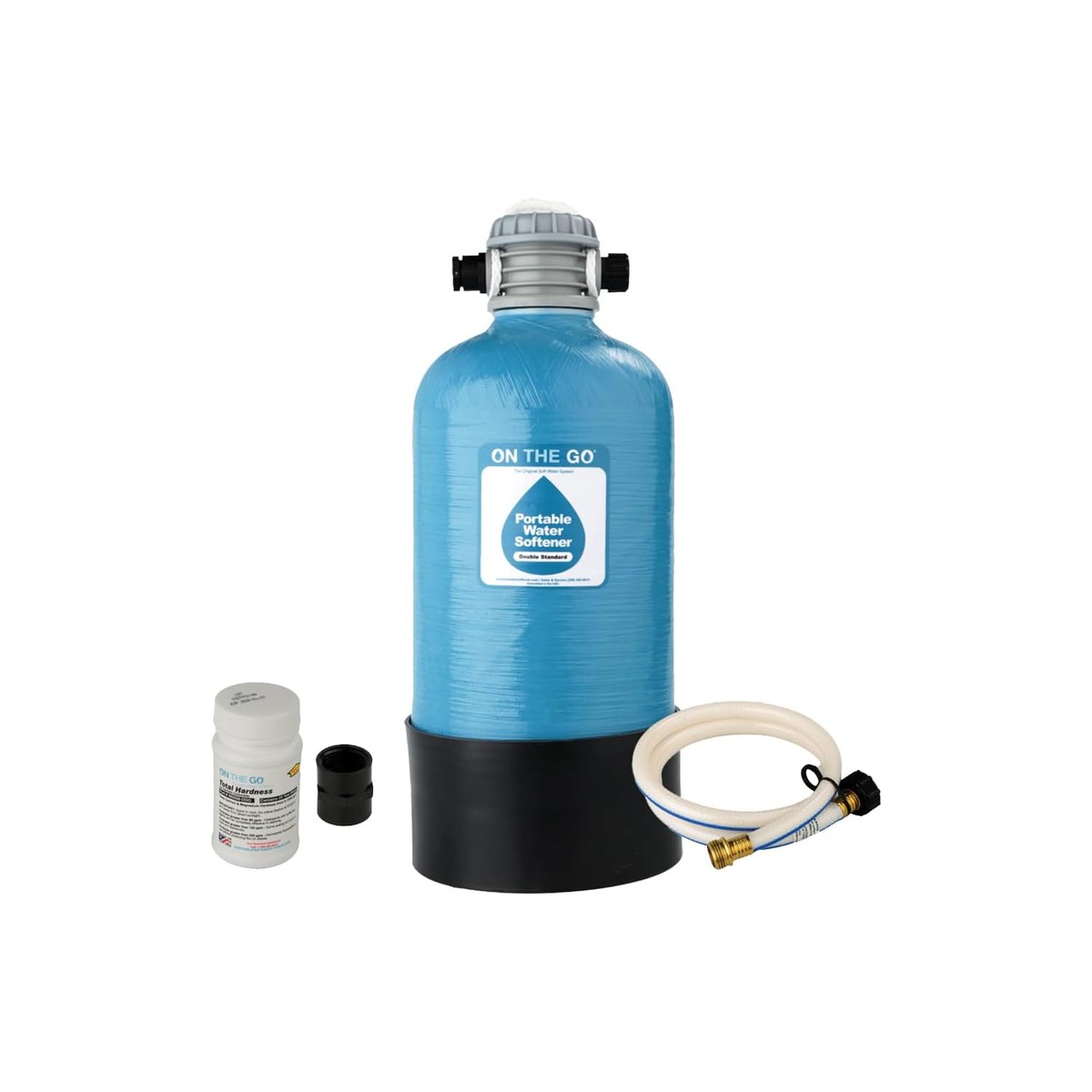
On The Go OTG4-DBLSOFT Portable 16,000 Grain RV Water Softener, Double Standard Size, Assembled in Indiana (ASIN B00KVPNVJ6)
The category default, sized by the formula, not the box.
Who it's for: The rig that keeps finding white scale on its fixtures, soap that will not lather, and a water heater aging fast: hard-water country. The On The Go OTG4-DBLSOFT is the portable softener the category formed around, 16,000 grains of resin, no electricity, no drain hookup, regenerated by hand with grocery-store salt, and the unit the category's marketing measures itself against.
What we found: The capacity math is the whole purchase: 16,000 grains divided by your water's hardness in grains per gallon equals gallons between regenerations, so the listing's 'up to 1,600 gallons' is true at 10 gpg and becomes 800 gallons in the 20 gpg hard-water belt. On The Go publishes the bookends itself, 3,200 gallons at 5 gpg, 640 at 25, the same formula. Regeneration per the official instructions: two 26-ounce boxes of table salt, a pencil-thin slow rinse of 24 to 30 minutes, a 6-to-8 minute fast rinse, then verify 0-to-3 gpg with the included strips. At $207.00 with 4.7 stars across 1,880 ratings, it is the proven version of the whole idea.
Bottom line: Buy the OTG4-DBLSOFT if you camp the Southwest, Texas, or Florida circuits and size your expectations with the formula. Plan the regen as a monthly half-hour ritual in hard country, use plain or iodized table salt, On The Go says either works, never sea salt, and put a sediment filter ahead of it so the resin stays clean. The resin itself is a seven-to-nine-year part per On The Go, and replaceable when it fades.
- + The deepest review base in the category, 4.7 stars across 1,880 ratings, on the brand that has defined portable softening since the 2000s
- + 16,000 grains is the real spec: 800 honest gallons even in brutal 20 gpg water, 1,600 in the 10 gpg water the box assumes
- + Regeneration is two 26-ounce boxes of plain table salt and about half an hour, with hardness test strips included to verify the job
- × The box's 'up to 1,600 gallons or 40 days' assumes 10 gpg water, in the Southwest belt where you most need it, halve both numbers
- × 22 inches tall and 32 pounds dry, heavier wet, measure the bay before buying, the Pro+Aqua is the shorter option
- × Sold through a third-party RV dealer under the On The Go brand, and the 'less than 30 minutes' regen claim runs 30-to-38 by the manual's own step times
Runner-up: Pro+Aqua 16,000 Grain Portable RV Water Softener, 20 Inch Tank with Cover, Y-Splitter, and Shut-Off Valve (ASIN B079N2L7L6).
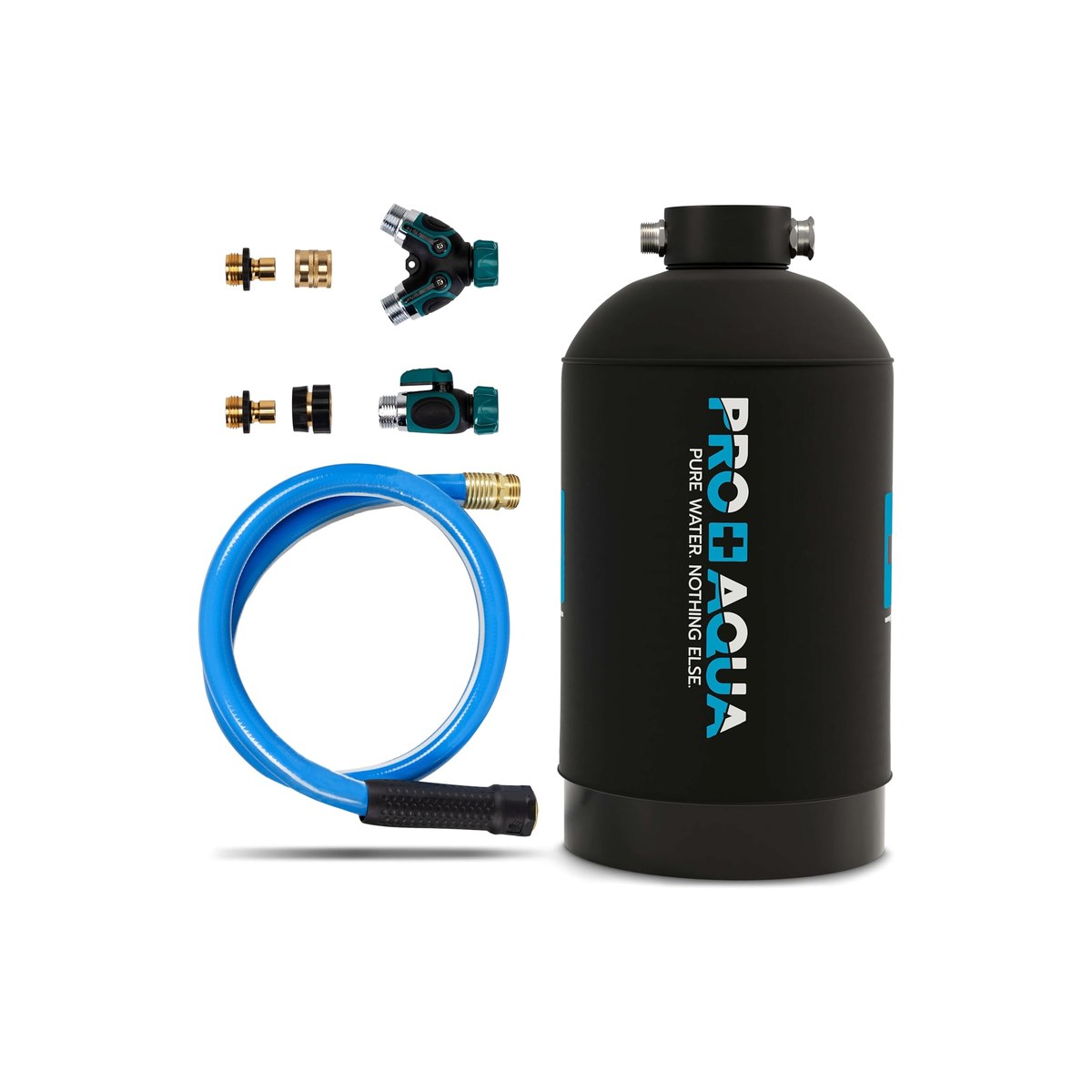
Pro+Aqua 16,000 Grain Portable RV Water Softener, 20 Inch Tank with Cover, Y-Splitter, and Shut-Off Valve (ASIN B079N2L7L6)
Same sixteen thousand grains, two fewer inches of tank.
Who it's for: The owner who measured the pass-through bay first. Portable softeners are tall, the On The Go tanks run 22 inches, and the Pro+Aqua's 20 inch by 10 inch shape is the shortest 16,000 grain tank among the dimensions the makers publish. It comes dressed for the job too: neoprene cover against the sun, Y-splitter, and a shut-off valve in the box.
What we found: The resin charge is the same 16,000 grain class as our top pick, and the marketing is a textbook shell-game exhibit: the spec field says 2,000 gallons, an 8 grains-per-gallon assumption stated on Pro+Aqua's own site, and the brand claims 40 percent more soft water than any other unit, from a resin charge rated identically to our top pick's, the same 800 gallons in 20 gpg water. Pro+Aqua's own materials also disagree on regeneration details across pages, time and salt quantity both, so treat the printed manual as the procedure. At $251.96 with 4.5 stars across 1,245 ratings, you are paying about $45 over the default for the shape and the accessory kit.
Bottom line: Buy the Pro+Aqua when the bay measurement decides for you, or when the included cover and splitter close the price gap on accessories you would buy anyway. Run it by the same rules as every ion-exchange tank here: sediment filter upstream, table salt regens verified with test strips, and the formula, not the box, setting your expectations between regenerations.
- + Two inches shorter than the On The Go tanks at 20 inches, the difference between fits-the-bay and rides-in-the-shower
- + The accessory kit is the most complete here: neoprene cover, Y-splitter, and shut-off valve included
- + 4.5 stars across 1,245 ratings under the Pro+Aqua brand, the credible second name in the category
- × The spec sheet's 2,000 gallons assumes 8 gpg water, by the formula it is the same 800 gallons at 20 gpg as every 16,000 grain tank
- × At 35 pounds dry it is the heaviest published weight here, shorter does not mean lighter
- × Its own regeneration guidance disagrees with itself across pages, under 30 minutes with two boxes in one place, slower with different salt advice in another, follow the manual in the box
Budget pick: On The Go OTG3NTP3M Standard 8,000 Grain Portable Water Softener, 18 Pounds, One-Box Regeneration (ASIN B001FCE0MQ).
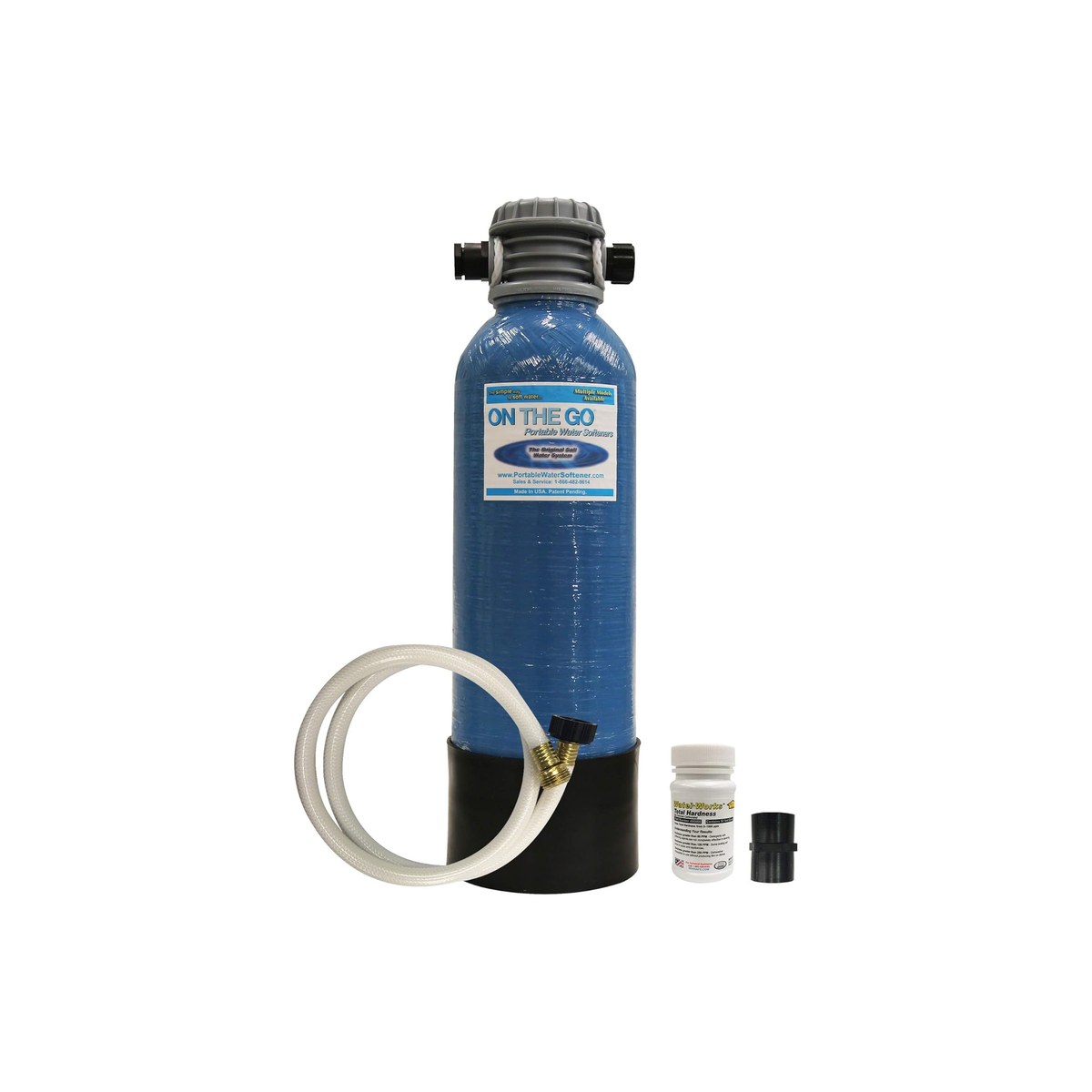
On The Go OTG3NTP3M Standard 8,000 Grain Portable Water Softener, 18 Pounds, One-Box Regeneration (ASIN B001FCE0MQ)
Half the grains, half the weight, the weekender's ritual.
Who it's for: The weekend and shoulder-season camper for whom the 32 pound tank is the reason a softener never gets used. The On The Go Standard runs the same resin chemistry at 8,000 grains in an 18 pound, 6.75 inch diameter tank, light enough to actually deploy every trip, and its regeneration is the lineup's easiest: one box of salt, a quarter hour or so.
What we found: The formula keeps the sizing honest: 8,000 grains is 800 gallons at 10 grains per gallon and 400 gallons at 20, which for a couple's ballpark use is a comfortable month of weekends in moderate water or a week-plus of full-timing in the hard-water belt, this is the right tank for the first pattern, not the second. It shares the top pick's 22 inch height, so the bay question does not change, but at 4.7 stars across 590 ratings and $165.00 under the On The Go brand, it is the proven light option in a category that mostly sells bulk.
Bottom line: Buy the Standard if your camping is measured in weekends and your water in single-digit grains, and step up to the 16K the season your travel turns toward Texas or Arizona. The half-hour-versus-quarter-hour regen difference matters less than the lifting difference, and an unused 16K softens nothing. Same rules as its big brother: strips to verify, table salt only, sediment filter first.
- + 18 pounds dry and a slim 6.75 inch diameter, the easiest tank here to lift, stow, and live with
- + One box of table salt and 15 to 19 minutes per regeneration by the manual's own steps, the gentlest ritual in the lineup
- + Same On The Go brand and quality as the top pick, 4.7 stars across 590 ratings
- × 8,000 grains halves the math: 800 gallons at 10 gpg, just 400 in 20 gpg water, roughly a week-plus for a couple in hard country
- × Same 22 inch height as the 16K, the saving is width and weight, not bay clearance
- × Costs about 80 percent of the 16K's price for half the capacity, you pay for portability, not gallons
Also worth considering.
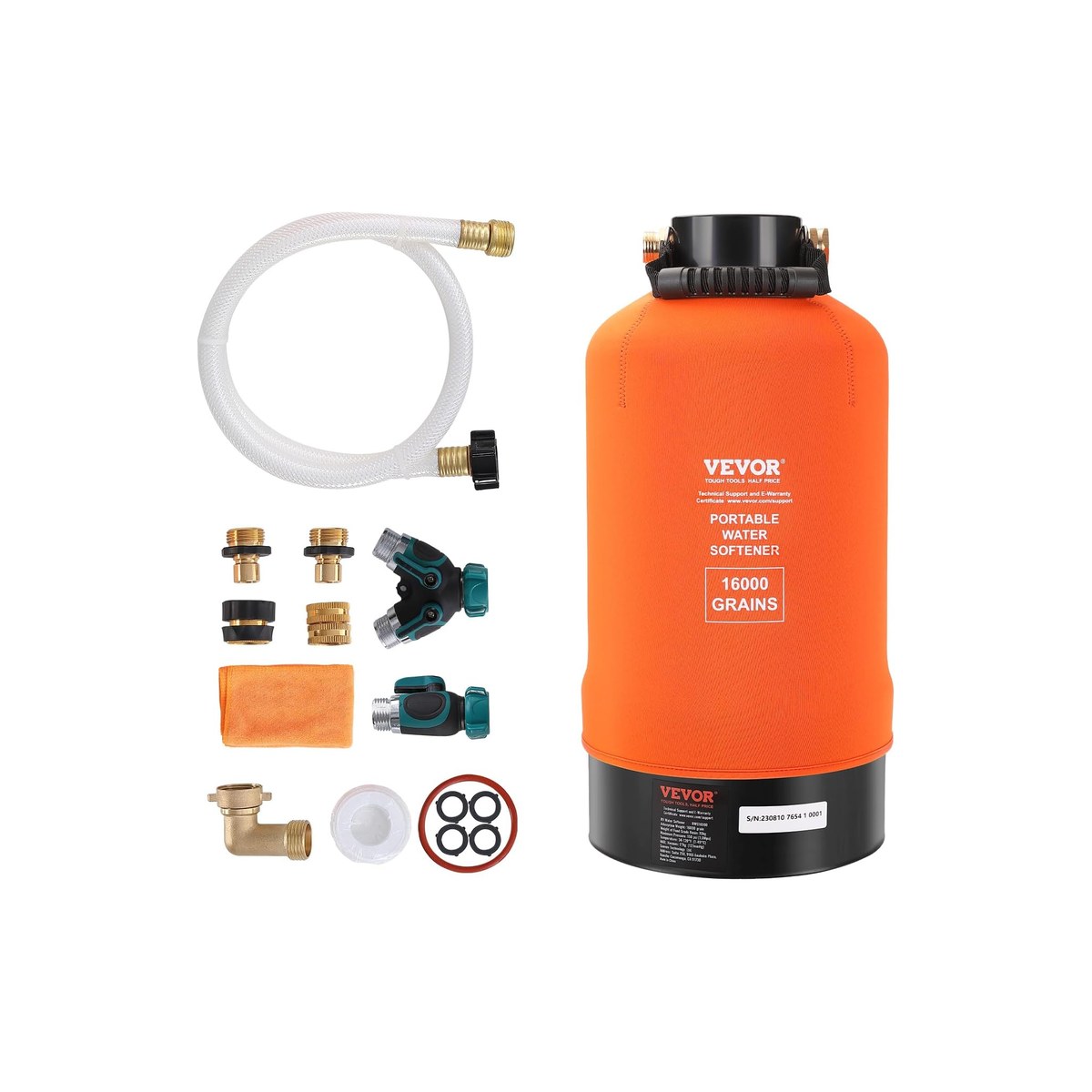
VEVOR RWS16000 16,000 Grain Portable RV Water Softener, 3/4 Inch Brass Fittings, 42 Inch Hose (ASIN B0CJ9DK4T2)
Sixteen thousand grains at $113, read by the formula.
Who it's for: The budget buyer who ran the math and noticed resin is resin. The VEVOR RWS16000 sells the same 16,000 grain class as tanks costing nearly twice as much, with 3/4 inch brass fittings and a 42 inch hose in the box, and a 4.3 star average across 415 ratings that is real, if young, proof. It suits the experimenter and the once-a-year hard-water tripper.
What we found: The listing makes the boldest assumption on the page, and at least prints it: 2,461 gallons and up to 50 days at a stated 6.5 grains per gallon, gentle water few buyers of this product actually camp in, the same tank delivers 800 gallons at 20 gpg like every 16,000 grain unit here. VEVOR claims roughly five years of resin life against On The Go's seven-to-nine, and the brand's support and parts trail is thin next to the legacy names. The hardware itself, brass fittings, 150 PSI rating, reads better than the price suggests.
Bottom line: Buy the VEVOR when the $94 saved against the default matters more than brand history, and run it exactly like the expensive tanks: formula sizing, table salt, strips, sediment filter upstream. Treat the five-year resin claim as the honest service life and the 50-day box claim as marketing weather. If it earns its keep for a season, you got the category's function at half price.
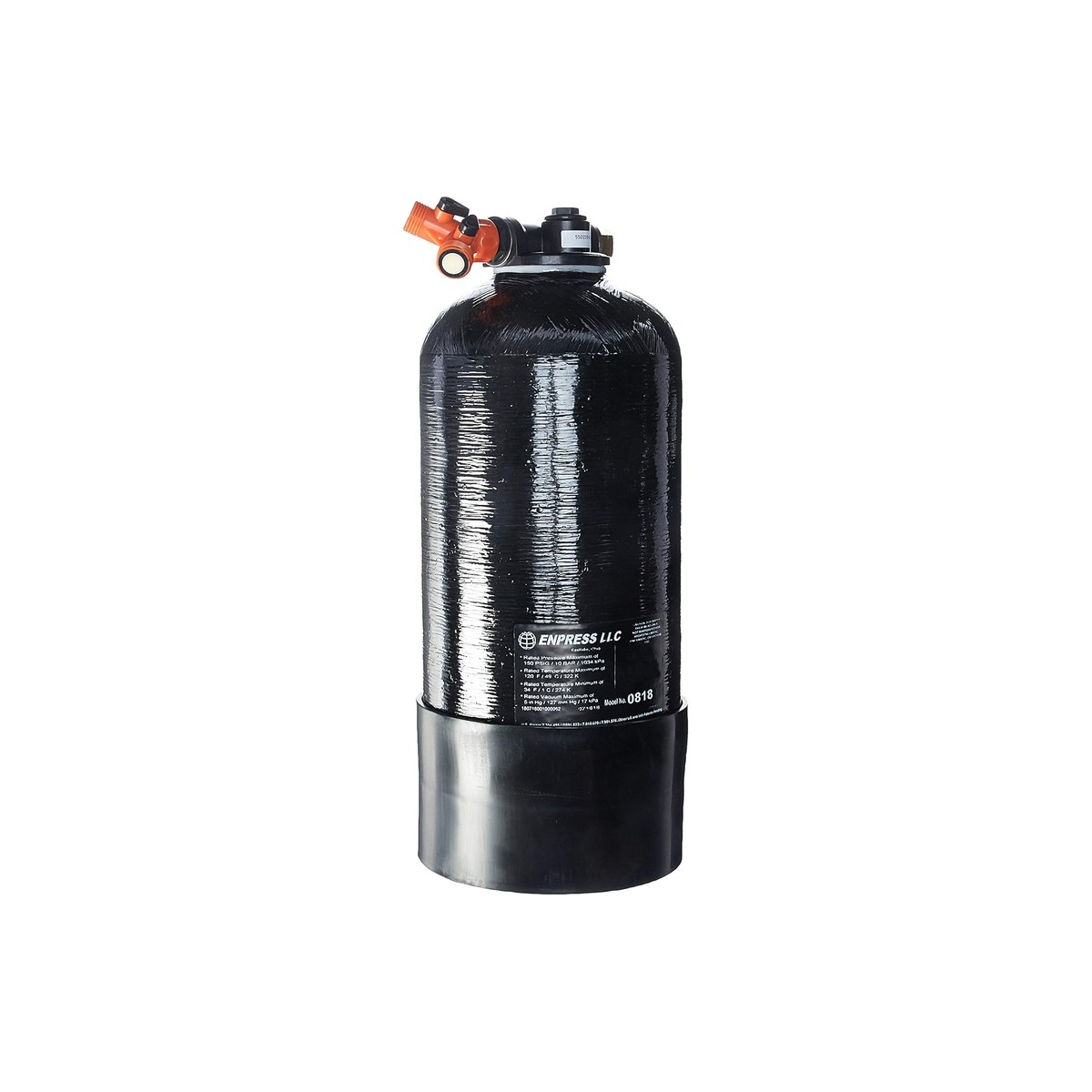
Watts RV PRO-1000 / M7002 Portable Water Softener, 10,000 Grain, In-Line Regeneration Valve (ASIN B0050EITTK)
The only tank here that regenerates without touching a hose.
Who it's for: The owner who knows the honest failure mode of portable softeners: the ritual gets skipped. The Watts M7002's custom flow valve lets you pour salt and regenerate in place, hoses connected, the convenience trick none of our other picks has, and Watts claims its drain restrictor stretches effective capacity substantially. If regeneration friction is what kills your soft water, this is the fix.
What we found: The trade is capacity: 10,000 grains sits between our 8K and 16K picks, 1,000 gallons at 10 gpg and 500 at 20 by the formula, and the four-gallon-per-minute flow claim with low pressure drop is the best in the lineup on paper. The listing we verified is the genuine Watts brand store at $199.91 with 4.3 stars across 330 ratings, which also retires a persistent discontinuation rumor, though stock read only five units with more on the way. The 20.5 inch height splits the difference between the Pro+Aqua and the On The Go tanks.
Bottom line: Buy the Watts if in-place regeneration is the feature that makes you actually use a softener, and accept the middle capacity as the price of the valve. Verify with your own strips since the in-line process hides the work. At this stock level order when ready rather than next season, and if it is gone, the fallback is the default On The Go and the discipline to do the ritual.
Skip this guide if...
Skip this guide if your water is already soft: spend $10 on hardness test strips before $200 on a tank, and if the campgrounds you frequent read under about 4 grains per gallon, scale is not your problem. Skip it too if your complaints are taste, smell, grit, or safety, those are our water filter guide's territory, a softener removes none of them. And skip the whole category on a rented or borrowed rig for one trip: scale damage is a years-scale problem, and the ritual only pays off as a routine.
Don't bother with.
- × Skip Electronic and magnetic 'descalers'Plug-in coils and clamp-on magnets sell for ion-exchange prices, one electronic unit ranks in the softener search results at $295 to $495, while changing nothing you can measure in the water. We found no credible independent evidence that magnetic or electronic gadgets soften water, hardness strips read identical before and after, because the calcium and magnesium are still there. A device that cannot change a test strip is not competing with a tank of resin. If the budget is tight, the $113 VEVOR is real softening for a quarter of the $495 version's price.
- × Skip Buying a 'salt-free softener' expecting soft waterTemplate-assisted crystallization units, the legitimate end of the salt-free aisle, are conditioners, not softeners: they aim to convert hardness minerals into crystals that stick to plumbing less, and the published evidence is genuinely split, one university study measured strong scale reduction while another found essentially no change. What is not in dispute: the minerals stay in the water, strips read just as hard, soap behaves no differently, and there is nothing to regenerate. If reduced scale buildup is all you want, a TAC unit is a defensible bet; if you want what this guide is about, soft water you can verify, only ion exchange does that.
- × Skip Trusting the gallons on the boxEvery 16,000 grain tank on this page advertises a different capacity, 1,600, 2,000, and 2,461 gallons, and all three are the same tank: the difference is each brand's assumed water hardness, 10, 8, and 6.5 grains per gallon respectively. Divide grains by your actual hardness and the marketing evaporates: at the 20 gpg water of the Southwest hard-water belt, all of them deliver about 800 gallons between regenerations. The formula is the only spec that travels with you, and the brands' own bookend numbers confirm it is the model they use themselves.
- × Skip Regenerating with whatever salt is aroundThe manufacturers disagree about salt enough that it is worth one paragraph: On The Go says plain or iodized table salt, either, in its words it does not matter; Pro+Aqua's own testing ranked softener pellets highest but found they took over an hour to dissolve in a portable tank, scored plain table salt nearly as well, and flunked sea salt, whose own minerals can cling to the resin. The practical rule: cheap plain table salt per your manual, pellets only if you enjoy waiting, and never sea salt or rock salt in a portable. The whole consumable costs about two dollars a regen, this is not the place to improvise.
- × Skip Shopping from recycled roundupsThe softener listicles in the search results are running 2019-era lineups: one current 'best portable softeners' page still headlines a brand with no findable manufacturer presence or live listing anywhere we checked, and includes a product that is actually a water filter. The category moved, legacy names shipped new variants, a budget wave arrived, and a zombie brand persists in copy-paste roundups. Check that a recommended unit has a live, stocked, brand-bylined listing before you chase it, the same verification we ran on every pick above.
How we picked.
Sources we read and how we picked
We started from the manufacturers' own documentation, On The Go's published instructions and FAQ, Pro+Aqua's product pages and testing notes, Watts' product literature, ran every capacity claim through the grains-divided-by-hardness formula the manufacturers' own bookend numbers confirm, and verified every listing live on Amazon on June 12, 2026: price, rating, stock, brand byline, what ships in the box. The sodium and hardness-classification numbers come from water-treatment references, not from us.
Our filter, in order: honest capacity at real hardness, then the regeneration ritual's actual cost in time and salt, then review scale on a genuine brand listing. The ladder ranks by buyer served: the On The Go default wins on proof and parts trail, the Pro+Aqua buys bay fit, the 8K buys liftability, the VEVOR buys price with a young brand's risk, and the Watts buys regen convenience and sits last on proof: 4.3 across 330 against the 8K's 4.7 across 590, with five units of stock the day we checked. Where a maker's claims disagree across its own pages, we say so and defer to the printed manual.
The capacity math: grains, hardness, and honest gallons
One formula sizes this entire category: grains of capacity divided by water hardness in grains per gallon equals gallons of soft water between regenerations. The manufacturers use it themselves, On The Go's published bookends, 3,200 gallons at 5 gpg and 640 at 25, are exactly 16,000 divided by each number. Water hardness runs roughly from soft below 3.5 gpg through hard at 7-to-10 to very hard above 10.5, and the US camping map is unkind: the Midwest, Texas, the desert Southwest, and Florida's limestone aquifers, the snowbird circuit itself, run hard to very hard, with 15-to-20 gpg common. Strips tell you your number in thirty seconds.
Worked examples beat spec sheets: a 16,000 grain tank in 20 gpg San Antonio-class water delivers 16,000 divided by 20, 800 gallons, which at a couple's ballpark daily use is roughly two-and-a-half weeks between regenerations; the same tank in 8 gpg Midwest city water runs about six weeks. An 8,000 grain compact halves both. That is why the box claims differ while the tanks do not: 1,600 gallons at an assumed 10 gpg, 2,000 at 8, and 2,461 at 6.5 are one identical 16,000 grain resin charge wearing three marketing outfits. Published capacity also assumes a full, unhurried regeneration, treat every number as a ceiling, and let your test strips referee.
Ion exchange and the regeneration ritual
The tank is full of cation-exchange resin beads charged with sodium. Hard water flows through, the resin swaps its sodium for the water's calcium and magnesium, the minerals that build scale, stop soap from lathering, and coat water-heater elements, and soft water comes out the other side. When the sodium runs out, you regenerate: salt water poured through the tank mass-displaces the captured minerals and reloads the resin. No electricity, no drain plumbing, no control valve, the portable in portable softener means you are the regeneration mechanism.
The ritual, per On The Go's official instructions for the 16K: disconnect and drain the tank, pour in two 26-ounce boxes of table salt, reconnect the inlet, run a pencil-thin slow rinse for 24 to 30 minutes, then a full-stream rinse for 6 to 8 more, and verify the output reads 0-to-3 grains per gallon on a test strip, soft, and not salty to taste. The 8K halves everything: one box, 15 to 19 minutes. Budget 30 to 40 minutes and about two dollars of salt per cycle on a 16K and the claims of under-30-minute regens stop mattering, the cost is a podcast episode, monthly in hard country, less often elsewhere.
Where it goes in the hookup chain, and what it costs in flow
The forum consensus and our editorial chain agree: campground spigot, then the 45 PSI pressure regulator from our regulator guide, then a sediment filter, then the softener, then the hose to the rig. The sediment stage matters most, softener internals have small passages and the resin bed itself fouls on grit, so the cheap filter protects the expensive resin, and the carbon stage is a real fork: placed ahead of the softener it strips chlorine, a resin-killer, before the resin ever sees it, placed after it polishes taste, the sediment stage before the softener is the non-negotiable either way. Our water filter guide covers that whole side of the chain, contaminants are its job, hardness is this guide's.
Flow is the quiet spec: the 8K class moves about 2 gallons per minute, the 16K class about 3, and the Watts claims 4 with low pressure drop, and after the regulator and a filter stack every restriction shows up in the shower. The other physical spec that decides purchases is bay fit: these tanks are 20 to 22 inches tall and 18 to 35 pounds dry, heavier soaked, so measure the pass-through before ordering and plan where 30 pounds of wet tank rides on travel days. And the payoff for the plumbing: scale is what kills tankless water heater heat exchangers, our heaters guide hands every tankless pick an annual descaling chore, and a portable water softener system upstream is the prevention that makes that chore rare. One honest scope note: the protection covers water arriving through the spigot chain, so if you boondock on the pump, fill the fresh tank through the softener too, or the heater still sees hard water.
Resin life, storage, winterizing, and the sodium question
The resin is the part that ages: On The Go rates it at seven to nine years depending on water quality and regeneration frequency, VEVOR claims about five, and replacement resin kits exist, so a faded tank is a rebuild, not a landfill trip. The accelerants to avoid are chlorine, iron, and heat, one more argument for the filter-first chain, and the failure tells are capacity collapsing, hardness reading high right after a regen, and sand-like grit in the water, which is broken beads. Between trips, do not let the tank sit weeks in a hot bay with stagnant water: backflush a few minutes if it has been idle, and for winter, drain it and protect it from freezing, a freeze-cracked tank or valve head is the category's one fatal storage mistake. Published storage guidance genuinely varies between dry-storage and keep-wet schools, follow your own manual's section.
The drinking question has a number: softening adds about 1.9 milligrams of sodium per eight-ounce glass for every grain of hardness removed, per Pure Water Products, so even brutal 20 gpg water picks up roughly 38 milligrams a glass, more than typical bottled water but a fraction of a slice of bread. For most people that is a non-issue; on a strict low-sodium diet, tee an unsoftened line to the drinking tap or drink and cook from reverse-osmosis water, and water potted plants from the unsoftened side too, sodium builds up in their soil. And the slick shower feel that prompts warranty returns is the product working: hard water's squeaky skin is soap scum that never rinsed, soft water lets soap actually leave.
FAQs.
Q01 What is the best RV water softener?
+
Q02 How do you regenerate an RV water softener?
+
Q03 What kind of salt should I use in a portable water softener?
+
Q04 How long does an RV water softener last between regenerations?
+
Q05 Is softened water safe to drink in an RV?
+
Q06 Do I need a water softener or a water filter for my RV?
+
Q07 How do you store and winterize a portable water softener?
+
If you, then this.
- IF you camp the hard-water belt and want the proven defaultGET On The Go OTG4-DBLSOFT (B00KVPNVJ6; size it by the formula, 800 gallons at 20 gpg)$207.00 →
- IF your storage bay is too short for a 22 inch tankGET Pro+Aqua 16,000 Grain (B079N2L7L6; 20 inches, cover and splitter included)$251.96 →
- IF you weekend-camp and 32 pounds is the dealbreakerGET On The Go 8K Standard (B001FCE0MQ; 18 pounds, one-box 15-to-19 minute regen)$165.00 →
- IF the budget is firm and you accept a young brandGET VEVOR RWS16000 (B0CJ9DK4T2; same 16,000 grains, read the box math our way)$112.99 →
- IF you will only regenerate if it is genuinely easyGET Watts RV PRO-1000 M7002 (B0050EITTK; in-line regen, no hose disconnection, low stock when we checked)$199.91 →
- IF you are not sure you have hard water at allGET JNW Direct hardness test strips (B07B31M49N; the $10 answer before any $200 tank)$9.99 →
- IF your tankless water heater needs descaling every seasonGET A softener upstream is the prevention that makes the descale rare, the tankless picks it protects are in our RV water heaters guide$0 →
RV & Van Gear: The Complete Guide
The whole-rig picture →Every system in a van, RV, or camper, organized in one place, with the safety and weight floor and the one guide we trust for each.
- On The Go portable softener instructions and FAQ (regeneration steps, salt guidance, resin life) · On The Go
- Pro+Aqua portable softener product pages and salt testing notes · Pro+Aqua
- Water hardness classification (grains per gallon, regional hardness) · USGS
- Sodium added by water softening (mg/L per grain of hardness removed) · Pure Water Products