Best RV Water Hoses: 5 Drinking-Water Picks, and the Garden-Hose Mistake (2026)
A campground spigot fills whatever hose you connect, and a $6 green garden hose is the mistake that taints the water you drink, cook with, and brush your teeth in. Garden hoses are exempt from the federal lead-free rule, and lab testing has found lead, antimony, and phthalates leaching out of them; a proper RV drinking-water hose is the $14 fix. The real decision is small: a white potable hose, the right length, and one honest question, does the label name a standard or just say drinking-water-safe? We read the NSF standards, the lead-free law, and the owner forums where rubber-tasting water and split hoses get diagnosed, then verified every price live on Amazon on June 18, 2026. The headlines: drinking-water-safe means little alone, the 5/8-inch hose you are told to buy often changes nothing, and a heated hose only matters below freezing, where one model sips 10 watts a foot and a clone pulls ten times that.
- 01 Camco TastePURE 25-ft (B004ME11FS) , top pick, the safe $14 default, 17,000+ ratings
- 02 Camco 25-ft Heated (B01ABONB0A) , best for winter, freeze protection to -20F, ~$105
- 03 Valterra AquaFresh (B000BGODPQ) , best high-pressure, all-NSF-listed materials, ~$21
- 04 Camco EvoFlex2 (B09Z6X4RVV) , the ultralight, no-memory anti-kink hose, ~$27
- 05 RVGUARD 25-ft (B0BXWRW4P5) , budget kink-resistant newcomer, thin reviews, ~$18
How they compare.
| Rank | Product | Best for | Price | Our score |
|---|---|---|---|---|
| 01 | Camco TastePURE 25-ft (B004ME11FS)
Top Pick
| best overall and best value, the safe drinking-water default for almost every hookup | $13.78
Buy → | 9.0/10 |
| 02 | Camco 25-ft Heated (B01ABONB0A) | best for freezing weather, the proven heated line with a self-regulating low-draw cable | $104.53
Buy → | 8.5/10 |
| 03 | Valterra AquaFresh W01-6300 (B000BGODPQ) | best high-pressure hookup, all-NSF-listed materials and a no-taste liner | $21.17
Buy → | 8.6/10 |
| 04 | Camco EvoFlex2 (B09Z6X4RVV) | the ultralight, fabric-reinforced hose that coils without a fight | $26.97
Buy → | 8.6/10 |
| 05 | RVGUARD 25-ft (B0BXWRW4P5) | the budget kink-resistant pick, with a thin review history | $17.99
Buy → | 8.0/10 |
Prices are current Amazon prices at time of publication and can change. Scores reflect our editorial evaluation, not vendor input.
Our #1 pick: Camco TastePURE 25-Ft RV Drinking Water Hose, No Lead, No BPA, No Phthalate, Diamond-Hatch Reinforced PVC, 5/8-Inch Inside Diameter, Made in USA (ASIN B004ME11FS).
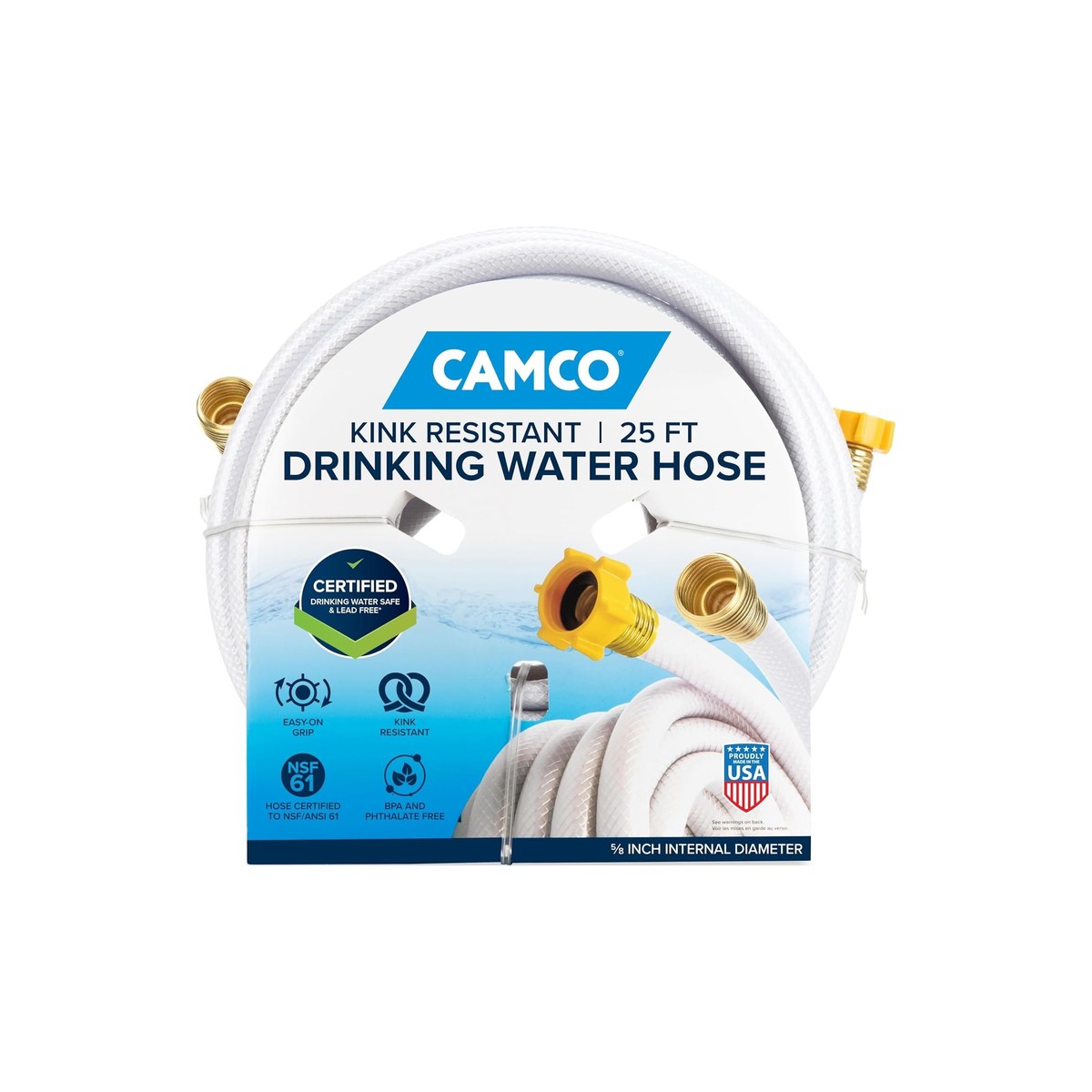
Camco TastePURE 25-Ft RV Drinking Water Hose, No Lead, No BPA, No Phthalate, Diamond-Hatch Reinforced PVC, 5/8-Inch Inside Diameter, Made in USA (ASIN B004ME11FS)
The safe, proven, $14 default that fits almost every hookup.
Who it's for: The RVer who wants the question settled cheaply and safely. The Camco TastePURE is the white drinking-water hose most rigs run: no lead, no BPA, no phthalates, the contaminants a plain garden hose is legally free to leach, at 4.5 stars across more than 17,000 ratings. At about $14 it is also the cheapest pick in this guide, so the value answer and the best answer turn out to be the same hose.
What we found: The TastePURE is reinforced diamond-hatch PVC with a 5/8-inch inside diameter, made in the USA, sold in 10, 25, and 50-foot lengths so you carry only the run you need. Its drinking-water construction is the brand's own statement rather than a listed NSF certification number, but the no-lead, no-BPA, no-phthalate spec is exactly what separates a potable hose from the garden hose it should replace. The honest catches are minor: new PVC tastes faintly of plastic until you flush it, and the hose holds coil memory, so it can kink at the spigot unless you loop the connection.
Bottom line: Buy the TastePURE, flush it once before the first drink, and keep it as your dedicated fresh-water hose, never the green garden hose. We rank it over the NSF-listed Valterra because for almost every hookup its no-lead construction plus 17,000 ratings is enough, and the Valterra earns its extra $7 only on a big rig where flow matters. For freezing nights, add the heated hose below.
- + Drinking-water construction with no lead, BPA, or phthalates, the things a garden hose is legally allowed to leach, at 4.5 stars across more than 17,000 ratings
- + About $14 and made in the USA, the cheapest pick in this guide and the hose most RVers quietly run for years
- + Reinforced diamond-hatch PVC in a 5/8-inch bore, sold in 10, 25, and 50-foot lengths so you carry only the run you need
- × New PVC has a faint plastic taste, run it a few minutes before the first fill and it fades
- × The listing carries no NSF certification number, the no-lead and no-BPA construction is the brand's own claim, not a database-verified mark
- × Stiffer than the woven or polyurethane hoses, it holds coil memory and can kink at the spigot if you do not loop it
Runner-up: Camco 25-Ft Heated Drinking Water Hose for RV, Freeze Protection Down to -20F, Self-Regulating Energy-Saving Thermostat, Dual-End Adapter, 120 VAC (ASIN B01ABONB0A).
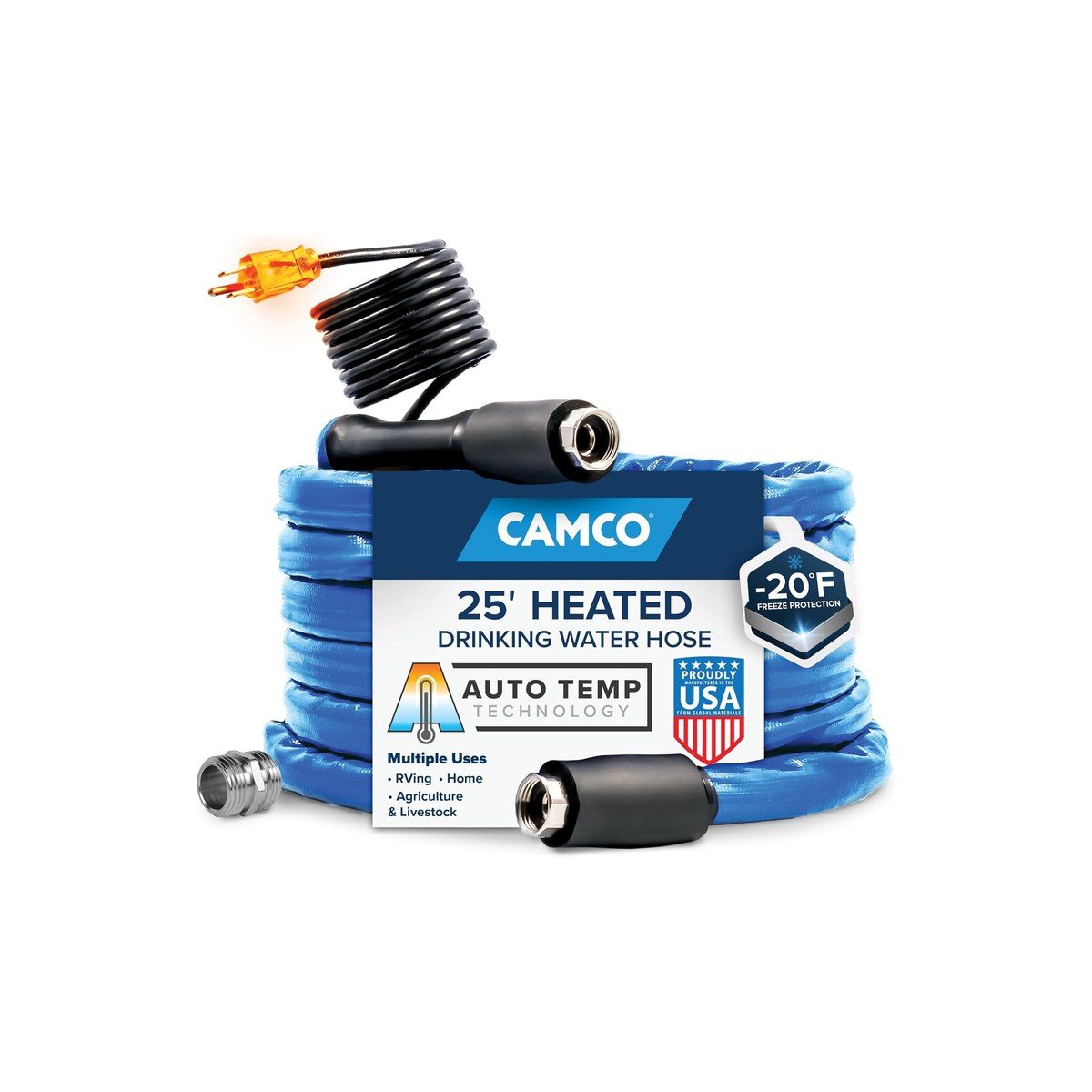
Camco 25-Ft Heated Drinking Water Hose for RV, Freeze Protection Down to -20F, Self-Regulating Energy-Saving Thermostat, Dual-End Adapter, 120 VAC (ASIN B01ABONB0A)
Running water at the tap when the overnight low says no.
Who it's for: The RVer who camps where the overnight low drops below freezing. A standard hose left on the spigot turns to ice and can split; a heated hose keeps the water line liquid down to -20F. The Camco 22911 is the proven version of this part, 4.3 stars across more than 15,000 ratings, and its water path carries the same no-lead, no-BPA, no-phthalate construction as the regular TastePURE, not a compromise on water quality for the sake of the heat cable.
What we found: The honest story on heated hoses is the power draw, and it is where this Camco earns its place. Its cable is self-regulating: it only warms as the temperature falls and shuts off once the line is safe, so a 25-foot hose pulls roughly 10 watts a foot, about 250 watts, not the constant load some buyers fear. Several cheap heated hoses pull closer to 2,500 watts, a real consideration on a shared 30-amp pedestal. The dual-end adapter lets you power the cable from whichever end reaches your outlet. The catch is simple: it needs a 120-volt hookup running the whole time, so it is for shore power, not off-grid.
Bottom line: Buy the heated hose if you winter-camp or shoulder-season in the mountains, and run your cheap TastePURE the rest of the year. If your nights never reach freezing, skip it, this is the one pick here you buy for a condition, not for every trip. Heat tape on a regular hose is the cheaper half-measure, but a built-in self-regulating cable is the version that does not cook the hose.
- + Freeze protection down to -20F with a self-regulating, energy-saving cable that only heats when it needs to, at 4.3 stars across more than 15,000 ratings
- + The same no-lead, no-BPA, no-phthalate drinking-water construction as the standard TastePURE, with a dual-end adapter so you can plug the heat cable in at either end
- + Draws roughly 10 watts per foot, about 250 watts for the 25-foot hose, where some cheap heated hoses pull closer to 2,500
- × At about $105 it is the most expensive hose here, and it is only worth it if you actually camp in the cold
- × It needs a 120-volt outlet at the pedestal the whole time, so it is shore-power gear, not a boondocking solution
- × Heated hoses run lower star ratings as a class, the cable and connections are simply more to go wrong than a plain hose
Budget pick: Valterra W01-6300 AquaFresh High-Pressure Drinking Water Hose, 5/8-Inch x 25-Ft, All NSF-Listed Materials, Lead-Free, Smooth Liner, White (ASIN B000BGODPQ).
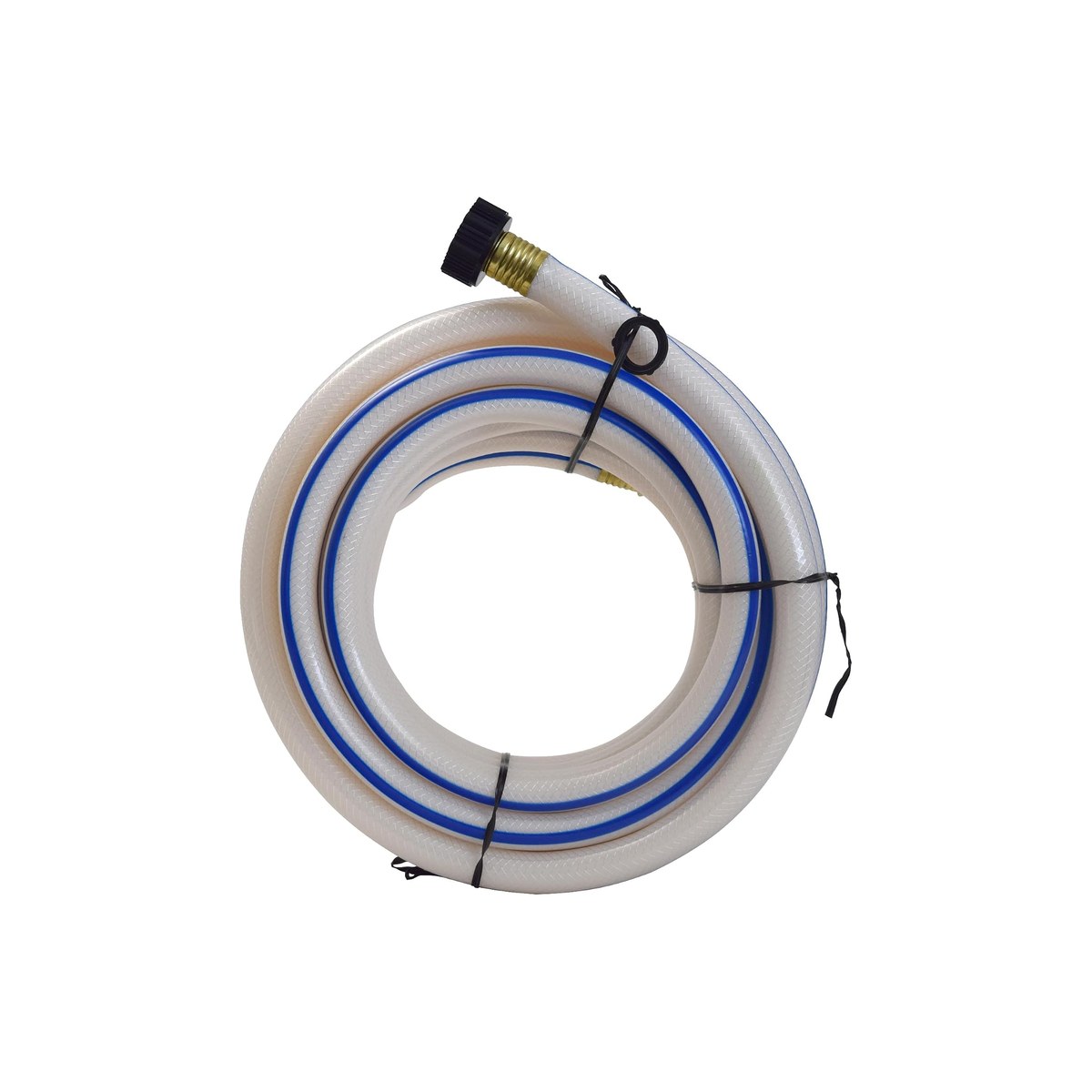
Valterra W01-6300 AquaFresh High-Pressure Drinking Water Hose, 5/8-Inch x 25-Ft, All NSF-Listed Materials, Lead-Free, Smooth Liner, White (ASIN B000BGODPQ)
The heavier potable hose for big rigs and weak showers.
Who it's for: The big rig or full-hookup family whose shower goes weak on a cheap hose. Where a thin hose restricts flow, the Valterra AquaFresh is the heavier-duty answer: a 5/8-inch potable hose rated to 120 PSI, built from all-NSF-listed materials, at 4.5 stars across more than 4,600 ratings. It suits travelers who run long hose runs or shower on full hookups and want volume, not just safe water.
What we found: The AquaFresh is the durability-and-flow pick of the group. Its materials are all NSF-listed, its pressure rating is a genuine 120 PSI, and the feature owners single out is the smooth interior liner: it is the hose that does not leave a rubber taste, the most common gripe about budget PVC. Valterra backs it with a 10-year warranty. The honest framing is about who needs it: on a small trailer with a short run, the extra flow over the $14 TastePURE is largely unfelt, and all-NSF-listed materials describes the components, it is not the same as a single NSF 61 end-product certification number printed on the listing.
Bottom line: Buy the Valterra when flow and durability are the problem you are solving, a large rig, long runs, or a family showering at once, and you want a hose built to last seasons. Skip the upcharge if a $14 TastePURE already keeps everyone happy. And remember the real shower-pressure fix is often the pressure regulator, not the hose, which is why we cross-link that guide below.
- + Built from all-NSF-listed materials and rated to 120 PSI, the heavier-duty potable hose in this guide, at 4.5 stars across more than 4,600 ratings
- + A smooth interior liner that owners credit for no hose taste, the common complaint about cheaper PVC
- + 5/8-inch bore and a 10-year warranty, the hose to buy when flow and durability matter more than saving $7
- × About $21, half again the TastePURE, for a difference most small rigs on short runs will not feel
- × Heavier and stiffer than the woven hoses, it stores like a traditional garden hose, not a compact coil
- × All-NSF-listed materials is a materials statement, not a single NSF 61 end-product certification number
Also worth considering.
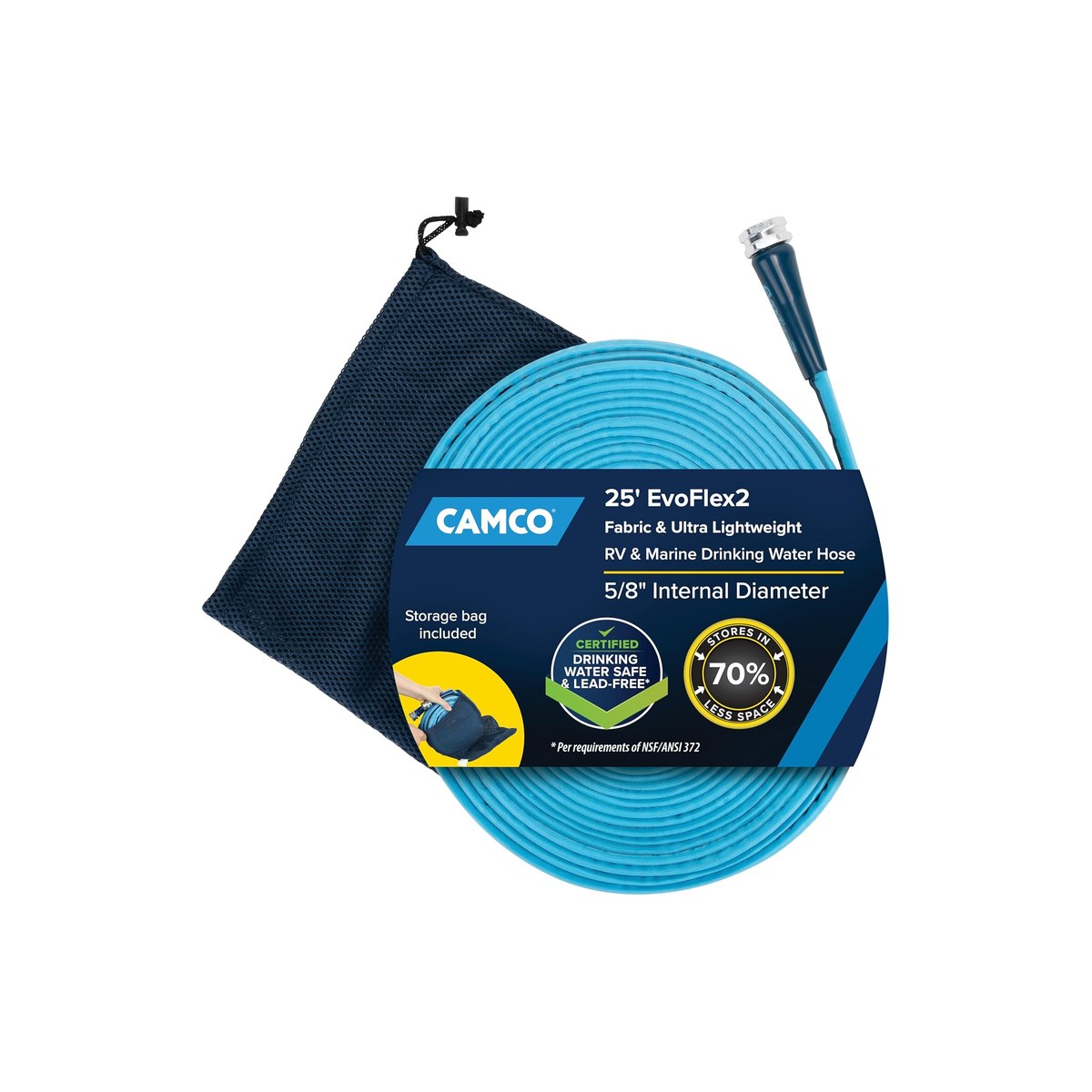
Camco EvoFlex2 25-Ft Drinking Water Hose for RV, Fabric-Reinforced, Ultra Lightweight, No Lead, No BPA, No Phthalate, Abrasion-Resistant (ASIN B09Z6X4RVV)
The ultralight hose that coils without a fight.
Who it's for: The RVer whose actual complaint is handling, not safety or pressure. The Camco EvoFlex2 is the fabric-reinforced, ultra-lightweight hose in the lineup, built to coil and store without the memory and kinks of stiff PVC, at 4.6 stars across more than 1,400 ratings. It keeps the same no-lead, no-BPA, no-phthalate drinking-water construction as the cheaper TastePURE, so you give up nothing at all on water safety.
What we found: The EvoFlex2 trades the rigid PVC wall for a woven, fabric-reinforced jacket, which is where the weight savings and the no-memory flexibility come from, and it adds abrasion resistance for dragging across gravel. It is the nicest hose here to handle and the one most likely to make you stop swearing at the wet bay. The trade-offs are price and a narrower point: at about $27 it is roughly double the TastePURE, and the upgrade is purely ergonomic, it carries no more pressure rating or certification than the cheap hose, so you are paying for how it feels, not for safer or higher-flow water.
Bottom line: Buy the EvoFlex2 if coil memory and weight are your real frustration and the few extra dollars are worth a hose you do not fight. If you do not care how the hose stores, the TastePURE does the same job on water quality for less. The famous Teknor Apex Zero-G is the other lightweight name here, lighter still, but it sits at a lower 4.0-star average, with owners flagging fitting leaks and durability, which is why the EvoFlex2 takes this slot.
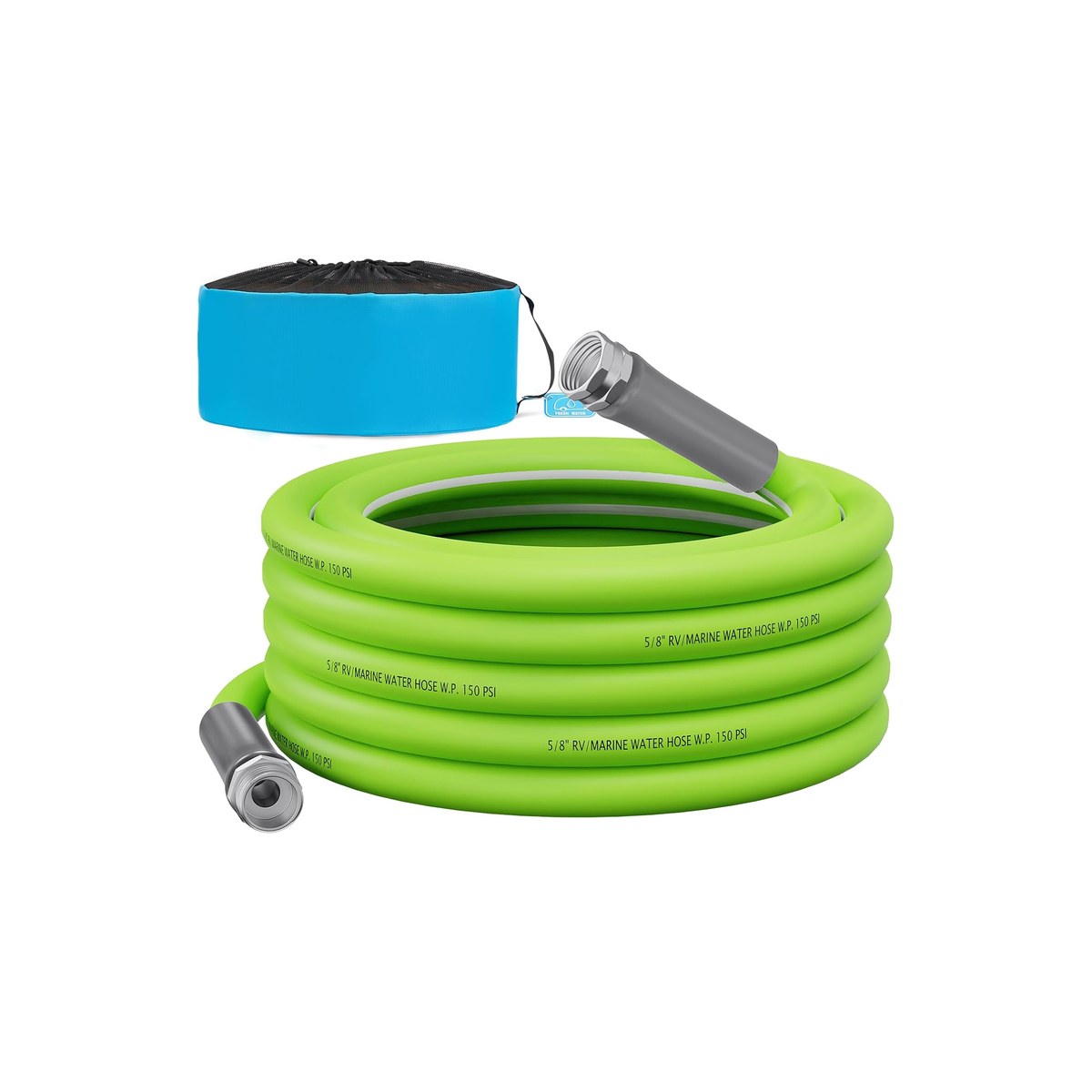
RVGUARD RV Water Hose 25 Ft, 5/8-Inch Inside Diameter Drinking Water Hose, Lead-Free, Kink-Resistant, Hydraulic-Assembled Fittings (ASIN B0BXWRW4P5)
A budget kink-resistant hose, bought with eyes open.
Who it's for: The buyer who wants kink-resistance on a budget and does not need a decade of reviews behind the purchase. The RVGUARD is a lead-free 5/8-inch drinking-water hose with a kink-resistant build and hydraulic-assembled fittings, at 4.6 stars but across only about 156 ratings, a fraction of the Camco and Valterra histories. It suits the value hunter willing to be an early adopter.
What we found: The RVGUARD reads well on paper: lead-free and phthalate-free construction, a kink-resistant hose body, no-leak machined fittings, and a 4.6-star average for about $18. The honest catch is confidence, not specs: at roughly 156 ratings the sample is thin next to the TastePURE's 17,000, so the long-term durability and the quality consistency are not yet proven at scale, and stock ran low when we checked, only about 15 units. It is a credible budget hose, but it is a newer brand asking for a little more trust than the established picks.
Bottom line: Buy the RVGUARD if you want a kink-resistant hose at a budget price and you are comfortable as an early adopter on a thin review history. If you would rather buy the most-proven hose for even less money, the $14 TastePURE is the safer call, and it is cheaper. Check stock before you count on it; this is the one pick here most likely to be out when you look.
Skip this guide if...
Skip this guide only if you never connect to city water and never refill from a potable spigot: a rig that runs entirely off its fresh tank still needs a safe hose to fill that tank, so almost no one is truly exempt. You can also stop reading early if you already own a white, no-lead, no-BPA drinking-water hose in good shape, it does not expire, and a hose that is intact and stored clean is doing its job. The one thing that does not count as covered: the green garden hose in the bay. That is the exact hose this guide exists to replace.
Don't bother with.
- × Skip Drinking from a regular garden hoseThis is the mistake the whole guide is built around. Ordinary garden hoses are legally exempt from the federal Safe Drinking Water Act lead-free rule, so there is no lead ceiling on them at all, and independent lab testing by the Ecology Center found hoses leaching lead, antimony, bromine, and phthalates into the water sitting in them. They are also commonly labeled not safe for drinking in the fine print. A green hose is fine for the black-tank rinse or washing the rig; it is not fine for the water you drink, and a $14 white potable hose removes the question entirely.
- × Skip Trusting a drinking-water-safe label by itselfThe phrase drinking-water-safe has no defined legal meaning, and a study found hoses wearing that exact label still testing positive for phthalates. The signals that actually mean something are concrete: no lead, no BPA, no phthalates in the construction, and, at the strongest tier, a named standard, NSF/ANSI 61 for what leaches out or NSF/ANSI 372 for lead content. Buy on the specific construction claims and the white potable color, not on a vague reassuring sticker.
- × Skip A 2,500-watt cheap heated hose to save moneyHeated hoses are not interchangeable. The self-regulating cable on the Camco draws roughly 10 watts a foot and only when it is cold; some budget heated hoses run a constant element that pulls far more, several hundred watts and up, the worst around 2,500, which is a real load to add to a shared 30-amp campground pedestal and a faster way to trip a breaker or cook the hose. If you need heat, pay for the self-regulating version; the cheap one can cost more in power and grief than it saves up front.
- × Skip Buying 5/8-inch over 1/2-inch expecting more shower pressureThe common advice to always buy the 5/8-inch hose oversells it. A bigger bore does pass more water on paper, but the bottleneck on most rigs is the internal 1/2-inch plumbing and the city-water inlet, not the supply hose, so on a short run the upgrade is often unfelt. Buy 5/8-inch for long runs and big rigs where it genuinely helps; on a small trailer with a 15-foot hookup, do not expect a thicker hose to fix a weak shower. The real pressure fixes are the regulator and your plumbing, not the hose diameter.
- × Skip One hose for both fresh water and the tank rinseUsing your drinking-water hose to rinse the black tank is how you contaminate the hose you fill from. The settled RV practice is two hoses: a white potable hose for fresh water only, and a separate, clearly different hose, often a cheap colored one, dedicated to the sewer rinse and never connected to your fresh inlet. It is a few dollars of insurance against a genuinely unpleasant cross-contamination, and the reason potable hoses are sold in white in the first place.
How we picked.
Sources we read and how we picked
We read the NSF/ANSI standards that govern drinking-water components, the EPA's lead-free requirements under the Safe Drinking Water Act, the Ecology Center's lab testing of garden hoses, manufacturer specifications for each hose, and the owner forums where rubber-tasting water, split hoses, and heated-hose power draw get diagnosed, then verified every price, rating, and availability live on Amazon on June 18, 2026.
Our filter, in order: drinking-water safety first, then the honesty of the safety claim, then handling, flow, and price. One note on ranking: the picks are ordered by the role they fill for the most RVers, not by raw star average, which is why the heated hose ranks second despite a lower star rating, the cold-weather need is the second most common reason people shop for an RV hose after a plain fresh-water hookup. The whole category shares a simple truth: the hose is cheap, and the only expensive mistake is drinking through the wrong one.
Why a garden hose is the wrong hose
The core of this guide is one regulatory fact: garden hoses are exempt from the federal lead-free law. The 2011 Reduction of Lead in Drinking Water Act, which amended the Safe Drinking Water Act, caps lead in the wetted surfaces of drinking-water components at a weighted average of 0.25 percent, but it applies to pipes, fittings, and fixtures for human consumption, not to garden hoses, which sit entirely outside it. That is why a plain garden hose can legally contain leaded brass fittings and PVC additives a potable hose cannot.
The consequence is measurable, not theoretical. Independent testing by the Ecology Center's HealthyStuff project found garden hoses leaching lead, antimony, bromine, and phthalates into the water standing inside them, especially after sitting in the sun, and many garden hoses carry a fine-print warning that they are not for drinking. An RV drinking-water hose is built to the opposite spec: no lead, no BPA, no phthalates, and at the top tier a named NSF standard. It is white precisely so you never confuse it with the green hose you use for the dirty jobs. For about $14, the safe hose costs less than the unsafe habit is worth risking.
Reading the label: NSF 61 versus 372 versus drinking-water-safe
Three claims show up on these hoses and they do not mean the same thing. NSF/ANSI 61 is the drinking-water health standard: it limits what a component is allowed to leach into the water it contacts. NSF/ANSI 372 is narrower, a lead-content standard that caps lead in the wetted surfaces at 0.25 percent, the same figure as the federal law. And drinking-water-safe, on its own, is a marketing phrase with no defined meaning, a study found hoses wearing exactly that label still testing positive for phthalates.
Read the claims as tiers. A named NSF 61 or 372 certification is the strongest signal; an explicit no-lead, no-BPA, no-phthalate construction claim, which the Camco TastePURE and EvoFlex2 carry, is the practical middle that separates a real potable hose from a garden hose; and a bare drinking-water-safe sticker with nothing specific behind it is the weakest. None of the established picks here are dangerous, US potable components must comply with the lead-free law regardless, but when you are choosing, buy on the specific construction claims and the white color, and treat the vague reassurance as the least informative thing on the package.
Heated hoses: when you need one and the power truth
A heated hose matters for exactly one condition: overnight lows below freezing. A standard hose left connected in a freeze turns to ice, stops your water, and can split at the fitting; a heated hose runs an electric cable along its length to keep the water liquid, the Camco protects down to -20F. If your camping never reaches freezing, this is the one part in the guide you do not need, and a plain hose plus the discipline to disconnect it is enough.
The number that actually separates heated hoses is power draw, and it varies by an order of magnitude. The good ones, including the Camco here, use a self-regulating cable that warms only as the temperature drops and shuts off once the line is safe, so a 25-foot hose pulls roughly 10 watts a foot, around 250 watts at most. Some cheap heated hoses instead run a constant element that draws far more, several hundred watts and up, with the worst pulling close to 2,500, a serious load on a shared 30-amp pedestal and a real way to trip a breaker. Whichever you run, a heated hose needs a 120-volt outlet the entire time, so it is shore-power gear, never a boondocking answer.
Length, diameter, and the 5/8-inch myth
Buy the shortest hose that comfortably reaches, then maybe one size up. A 25-foot hose is the common all-rounder; 50 feet covers awkward pull-throughs but stores bulkier and drops a little more pressure over the run, and a short 10 or 15-foot hose is the tidy choice for a consistent back-in site. Many full-timers carry a 25 and a spare, rather than one long hose they fight to coil. Length is a convenience-versus-storage trade, not a safety one.
Diameter is where the common advice oversells. A 5/8-inch hose passes more water than a 1/2-inch on paper, and it is the right call on long runs and big rigs, but on most setups the bottleneck is the rig's internal 1/2-inch plumbing and the city-water inlet check valve, not the hose, so the upgrade is often unfelt on a short hookup. If your shower is weak, the hose diameter is rarely the fix, the pressure regulator and your rig's plumbing are the things to look at first, which is why we point you to the regulator guide below.
FAQs.
Q01 Is it safe to drink water from a regular garden hose?
+
Q02 What makes a hose drinking-water safe, and what do NSF 61 and 372 mean?
+
Q03 Do I need a heated RV water hose, and how much power does it use?
+
Q04 Does a 5/8-inch hose give better water pressure than a 1/2-inch?
+
Q05 Why does my water taste like the hose?
+
Q06 What length RV water hose should I get?
+
Q07 How do I keep my RV water hose from freezing?
+
Q08 Do I really need two hoses?
+
If you, then this.
- IF you want the safe, proven, cheap default for normal hookupsGET Camco TastePURE 25-ft (B004ME11FS; no lead, BPA, or phthalates, 17,000+ ratings)$13.78 →
- IF you camp where it drops below freezingGET Camco 25-ft Heated (B01ABONB0A; protects to -20F, self-regulating ~10W/ft cable)$104.53 →
- IF a thin hose chokes your shower on a big rig or long runGET Valterra AquaFresh (B000BGODPQ; all-NSF-listed materials, 120 PSI, smooth no-taste liner)$21.17 →
- IF you are tired of fighting a stiff hose into the bayGET Camco EvoFlex2 (B09Z6X4RVV; fabric-reinforced, ultralight, no-memory coil)$26.97 →
- IF you want kink-resistance on a budget and will check stock firstGET RVGUARD 25-ft (B0BXWRW4P5; lead-free, kink-resistant, thin 156-rating history)$17.99 →
- IF you also want the water clean and the pressure tamedGET pair any hose with an inline filter and a regulator set to 45-50 PSI, both covered in our water filters and pressure regulators guides$0 →
RV & Van Gear: The Complete Guide
The whole-rig picture →Every system in a van, RV, or camper, organized in one place, with the safety and weight floor and the one guide we trust for each.
- NSF/ANSI 61 and 372: drinking water system components and lead content · NSF
- Use of Lead Free Pipes, Fittings, Fixtures (Safe Drinking Water Act, 0.25% lead) · US EPA
- What's in your garden hose? Lead, phthalates and BPA testing · Ecology Center / HealthyStuff
- TastePURE drinking water hoses and RV water hookup guidance · Camco
- RV fresh water hookup and the two-hose rule · TheRVgeeks